The only public chain that can take over from Solana is @SuiNetwork
Let me say something fair, Solana is indeed strong.
But if you look closely, Solana is actually addressing a previous generation's problem: how to make blockchain faster and cheaper?
The answer is excellent. No fault there.
But the problems of the next generation have changed—
AI agents need to spend money autonomously, can the chain support it?
Institutions want to move trillions of assets onto the chain, who will guarantee privacy and compliance?
Payments want to cover billions of people globally, can gas fees be reduced to zero?
Assets need to be "programmable," can the underlying architecture support that?
Solana's architecture was not designed for these problems.
Sui was.
1/ Free payments
A transaction fee as low as a few cents is indeed cheap.
But the difference between low and zero is not a quantitative change, but a qualitative change.
What Sui is doing:
→ Gas-free stablecoin transfers → Available to everyone → Instant settlement, one signature completes it
For cross-border payments, micropayments, and machine-to-machine payments, cheap is not enough. Free is the correct answer.
2/ Privacy—something other public chains lack
Solana is fully transparent. Every transaction, every balance, is visible to the entire world.
Those trading memes may not care, but institutions do.
No fund is willing to let peers see its positions. No company wants its competitors to track its capital flows.
Sui provides a bank-level privacy solution:
→ Confidential transmission: Transaction details are only visible to the relevant parties
→ Selective disclosure: You decide who sees what
→ Fully compliant: Regulatory requirements are still met
The openness of public chains + the confidentiality of private chains, Sui aims to have both.
This is not just an enhancement; this is a prerequisite for institutional participation.
3/ Stablecoins are evolving into programmable assets
Tether earns tens of billions each year from the interest on reserves.
How much do users get? Zero.
USDsui on Sui is different. It is issued by Bridge (a company under Stripe), and the reserve income goes directly back to the ecosystem and users.
The most crucial point is—USDsui is not just a coin.
Ownership, compliance, transfer conditions, redemption logic, profit distribution, all embedded within the asset itself.
Traditional stablecoins are a digital promissory note.
USDsui is a self-operating financial contract.
The gap between two generations of products.
4/ Bitcoin narrative: A trillion-dollar cake that no one has really touched
Trillions of dollars in Bitcoin are currently dormant.
Holders face a dilemma: they want BTC to generate returns, but do not want to sell.
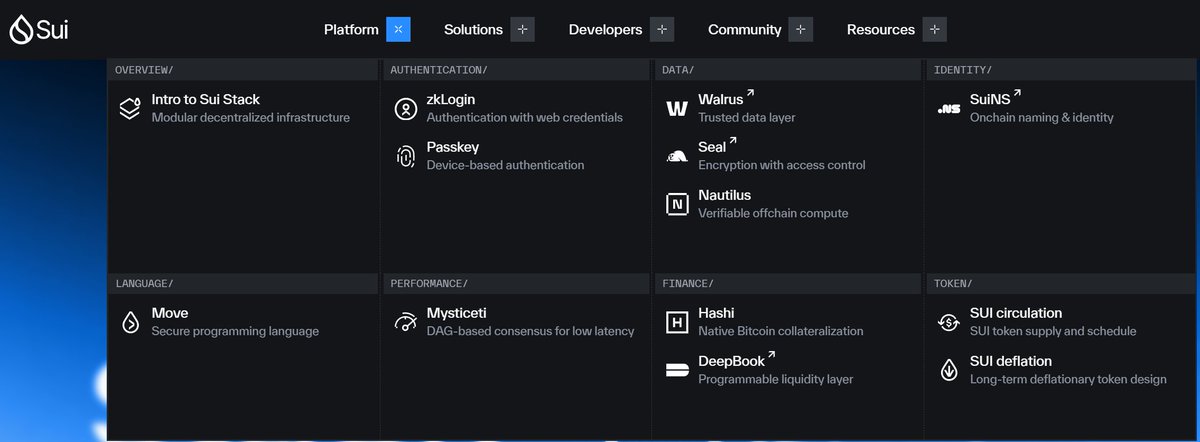
The Hashi protocol on Sui solves this deadlock:
By not selling Bitcoin, capital efficiency can still be released.
Building institutional-level Bitcoin credit on Sui, Fenwick law firm has confirmed: Hashi transactions do not constitute taxable events.
5/ AI Agent economy: Sui naturally fits
AI agents are becoming real economic participants—they can place orders, make payments, manage assets, and execute trades.
What kind of financial infrastructure do they need?
→ Zero-cost payments (cannot deduct gas for every transaction)
→ Funds come with rules (automatically executed by logic, no approval pop-ups)
→ Instant settlement (machines don’t wait for people)
→ Can be directly called by code (no wallet pop-up confirmation needed)
Item by item, Sui natively meets these requirements without needing transformation.
The largest transaction volume on the chain in the future may come not from humans, but from machines.
Whoever first solves the financial infrastructure for machines will win the next decade.
In the end
In every cycle, a chain emerges to define the narrative of that era.
For the next round, I bet on Sui.
DYOR.
免责声明:本文章仅代表作者个人观点,不代表本平台的立场和观点。本文章仅供信息分享,不构成对任何人的任何投资建议。用户与作者之间的任何争议,与本平台无关。如网页中刊载的文章或图片涉及侵权,请提供相关的权利证明和身份证明发送邮件到support@aicoin.com,本平台相关工作人员将会进行核查。


