In the past decade, from an investment perspective, I gradually understood one thing: companies that create apps ultimately meet their demise; those quietly making money are the landlords collecting "tolls." 🧐
Look, during the Internet boom, everyone wanted to create the next Taobao or WeChat, and what happened? The vast majority failed. Instead, essential services like Alibaba Cloud and Tencent Cloud, which sell servers, made money effortlessly. The same applies in the Web3 era: 99% of DApps and NFT projects have gone to zero, yet Ethereum's gas fees remain unaffected. I believe the logic in the AI era will be similar!
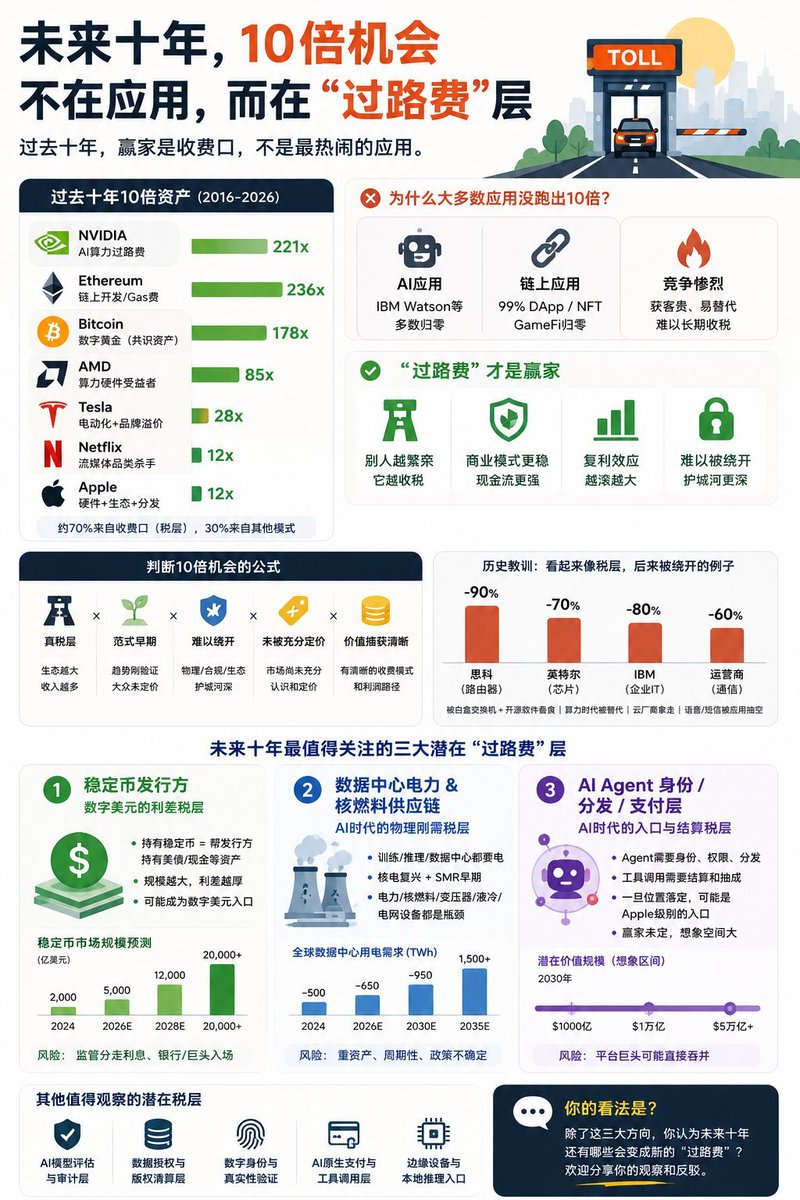
Combining 👇 the image below, I want to talk to everyone about where the opportunities lie in the next ten years, as well as some core U.S. stocks and cryptocurrency investments we currently hold!
The underlying principle is quite simple: when investing in Web3 and AI, minimize investments in application layers and focus on the foundational infrastructure and essential tax-collecting layers. The application layer is too exhausting; a project may spend half a year developing a blockbuster, only to be copied within three months, and it has to keep spending money on advertising.
But the tax-collecting layer is different; as long as people need to go online, require computing power, and conduct transactions, it will earn money effortlessly. It doesn't matter how applications change; the underlying "tolls" cannot be avoided.
The data from the past decade is clear: Nvidia increased by 221 times, Ethereum by 236 times, and Bitcoin by 178 times.
• Nvidia collects an "AI computing tax"; if you want to engage in AI, you have to buy my cards—there are no other options.
• Ethereum collects "gas fees"; if you want to transfer funds or play with NFTs on the chain, you have to pay me transaction fees.
• Bitcoin collects a "consensus tax"; everyone recognizes it as digital gold, making it an asset in itself.
Do you see the pattern? The real money-makers are those who hold the "tax rights."
📊 In the next ten years, I am optimistic about these three tax-collection areas and their related projects and companies.
1️⃣ The "interest rate tax" of the digital dollar (stablecoins and RWA)
If we want to play DeFi on the chain and invest in RWA, we first need to convert our money into USDT or USDC. The issuers use our USD to buy government bonds and earn interest, giving us a digital token in return. The larger the scale, the more appealing the interest. This is a surefire business. Especially with the advent of the AI Agent era, USD stablecoins will be a natural payment medium with trading volumes reaching trillions.
This is definitely the "interest rate tax"; whoever occupies this entry point will be the Nvidia of the financial world.
Here are the core companies I am optimistic about:
• Circle (U.S. stock code #CRCL) is currently unique as a compliant stablecoin (USDC). When institutions want to put trillions of assets on the chain, compliant stablecoins are the only gateway. Coupled with the unlikeliness of interest rate cuts this year, U.S. Treasury yields remain high; this will stabilize the performance of USD stablecoin issuers. Additionally, Circle is actively promoting the capture of AI Agent payment gateways, with a market share of up to 68%, making it the preferred stablecoin for AI Agent payments.
• Ondo Finance (crypto code #ONDO) is a leader in the RWA space. It has brought U.S. stocks and bonds onto the chain. It is still in the "early paradigm." In terms of tax-collection logic, as the scale of RWA on-chain assets expands, ONDO, as the liquidity management layer, will take a cut from every on-chain U.S. bond and stock profit. This will turn it into a "tax-collecting entry point" connecting traditional finance with crypto finance. The only downside is that its tokenization capability is relatively weak, lacking buyback and deflationary mechanisms!
2️⃣ The "physical necessity tax" of the AI era (electricity and energy supply chains)
The end of AI is really just electricity. No matter how powerful the chip, it won't work without power.
Nowadays, data centers are electricity-hungry beasts; I'm particularly focused on the revival of nuclear power (SMR small modular reactors), transformers, and liquid cooling equipment. Without electricity, even the strongest AI is nothing more than a decoration. This is a hard tax—there's no avoiding it.
Here are the core companies I am optimistic about:
• Vertiv Holdings (U.S. stock code #VRT) is a company we've recommended for a long time; trading around $100, it is a global giant in liquid cooling and power management for data centers. Currently, AI chips generate incredible heat; traditional fans can't handle it anymore, so liquid cooling is essential. Vertiv holds a significant market share in high-end liquid cooling. In terms of tax-collection logic, it is an indispensable part of data center construction. Without its cooling systems, expensive NVIDIA chips would be destroyed.
• OKLO (U.S. stock code #OKLO) is a leader in the SMR small modular reactor space. Although the vast majority of SMRs are still in the design and approval stages, OKLO has already received site selection permission from the U.S. Department of Energy, bringing it closer to commercial operations. It is also an early-stage company with a strong technological barrier; OKLO uses fast reactor technology that can use nuclear waste as fuel, which has very high compliance and environmental barriers. It has also received investments and support from OpenAI founder Sam Altman, indicating significant potential.
3️⃣ The AI Agent identity/distribution/payment layer—the "Apple tax" of the AI era
In the future, the ones helping us do work may be AI, not humans. For AI to book tickets or make purchases, it needs an identity and must be able to pay directly.
Whoever can set the payment standards and identity protocols between AIs will hold the throat of the AI era. I believe this area will be a breeding ground for the next tenfold investment.
Here are the core companies I am optimistic about:
• World Network (crypto code #WLD), in an era overwhelmed by AI-generated content, proving "I am human" or "this is my data" has become extremely scarce. #WLD is a digital identity protocol founded by OpenAI founder Sam Altman, using iris scanning for real-person determination and uniqueness. Just think: when 90% of future internet content is AI-generated, an account that can "prove you are real" will be the hardest ticket to obtain, further enhanced by OpenAI's IPO this year; the opportunity is self-evident. In terms of tax-collection logic, if all social media and banking applications require World ID logins in the future, it will become the "entry tax point" for the digital world globally.
• Bittensor (crypto code #TAO) is like an "Amazon for AI." Whether you are generating images, translating code, or collecting data, you can set up a "subnet stall" there. All subnets must pledge TAO to operate, and all contributions of computing power and intelligence assessments are settled through TAO. As long as someone wants to utilize decentralized AI capabilities through this network, TAO will be the unavoidable currency for settlement.
Currently, Bittensor is like the early Ethereum. Ethereum collected "financial taxes" through smart contracts, while Bittensor collects "intelligent trading taxes" via the Yuma consensus mechanism. Although recently, early supporters of the subnet, Covenant AI founder Sam Dare, left, causing some turbulence, this event does not affect the project itself; we continue to pay attention to the breadth of its subnet ecosystem, which is the core of TAO.
Besides the above, in the crypto space, we have also positioned ourselves in basic infrastructures like oracle services, public chains, etc., such as #LINK, #PYTH, #SOL, and #SUI. In the future, whether for prediction markets or AI Agents, real-world data will be necessary, such as asset prices, weather, and event information, and they will be in demand, also representing essential tax-collecting projects! Public chains need no further explanation; developing Web3 applications requires building on public chains, which are long-term tax collectors!
🎯 Recently, we have also been focusing on two hidden tracks:
• AI model evaluation and auditing—regulation is bound to manage AI in the future; who will certify AI as safe and unbiased? This "trust tax" will become increasingly valuable.
• Edge device entry—it's not feasible for all computing power to reside in the cloud; devices like smartphones, glasses, and headphones also need to run AI locally. This "terminal access tax" could be an opportunity for hardware manufacturers to turn the tables. Recently, Anker's integrated storage and computing chip Thus belongs to this category and provides localized AI computing capacity for headphones.
🧐 How to select tenfold candidates? I find the formula provided in the image quite practical:
Tenfold opportunity = True tax layer × Early paradigm × Unavoidable × Not fully priced
Seek early stages—don't chase what everyone knows; look for newly emerging areas that the public hasn’t yet understood (like the current AI Agent space, the nuclear power space, or AI chips focused on edge devices). Currently, we have started gradually taking profits from companies in the memory chip sector, such as #MU.
Evaluate the moat—ask yourself: Can anyone bypass this company? If they can't, that's a good tax collector.
In summary, for buying stocks, focus on—energy (nuclear) + those selling shovels (grid, hardware, storage chips, etc.)
For buying coins, focus on—the underlying settlement networks (BTC/SOL/PYTH/LINK/TAO) + stablecoin issuers.
The lessons of the past ten years are clear: the application layer has faced repeated failures, while the tax-collecting layer remains stable.
In the next decade, don't be the chives; be the one collecting taxes. DYOR 🙏
免责声明:本文章仅代表作者个人观点,不代表本平台的立场和观点。本文章仅供信息分享,不构成对任何人的任何投资建议。用户与作者之间的任何争议,与本平台无关。如网页中刊载的文章或图片涉及侵权,请提供相关的权利证明和身份证明发送邮件到support@aicoin.com,本平台相关工作人员将会进行核查。


