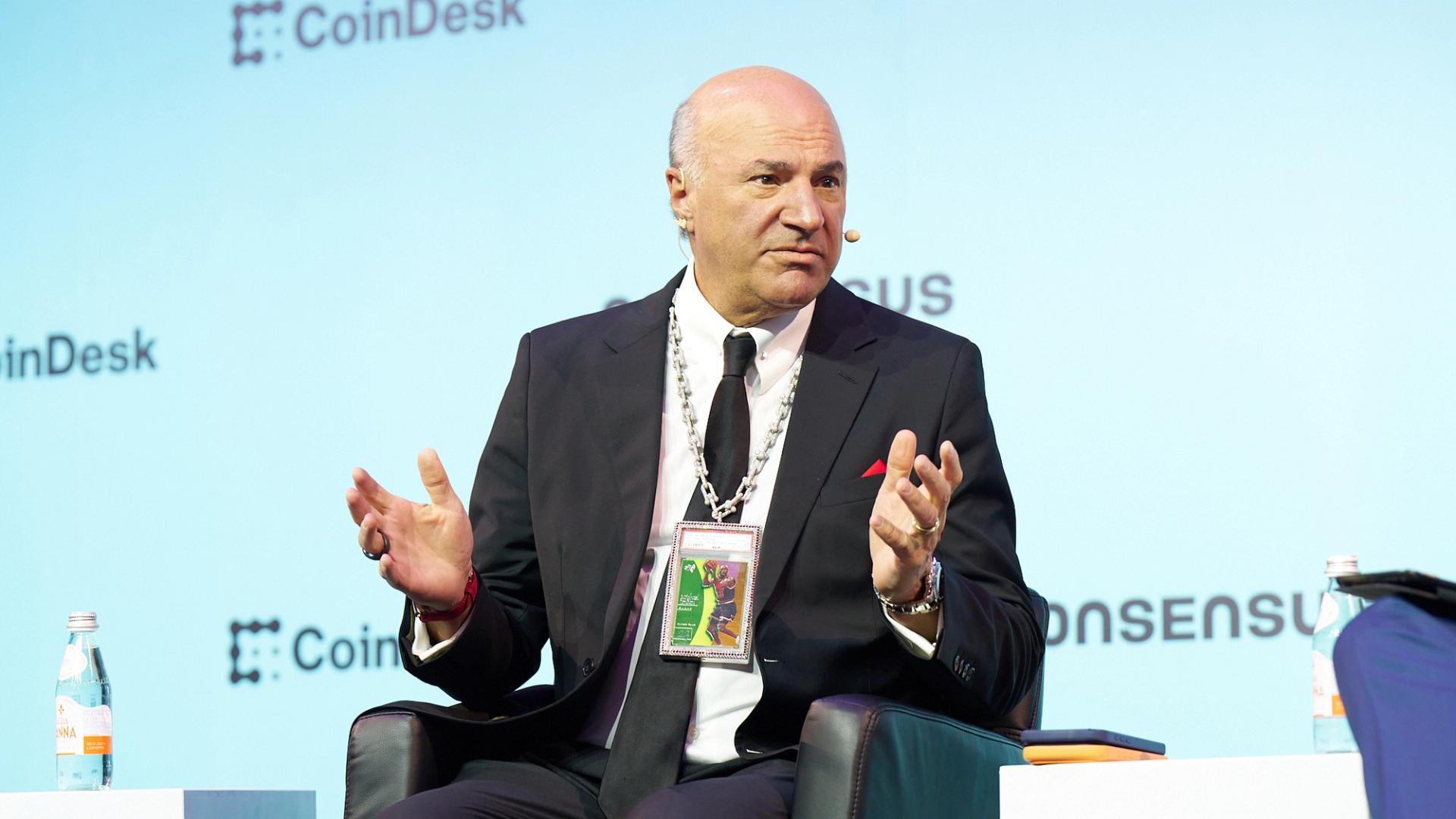
What to know : Kevin O’Leary told the Consensus conference in Miami that tokenization and bitcoin will remain largely off-limits to major institutional investors until Congress passes clear, comprehensive digital-asset regulation. He argued that Wall Street’s experiments with tokenization are mostly hype without legal certainty, pointing to the rapid uptake of stablecoins after the GENIUS Act as evidence that clear rules can unlock adoption. O’Leary said institutional interest has consolidated around bitcoin and ether while many smaller tokens have been “slaughtered,” and he contended that the real long-term value lies in blockchain infrastructure, corporate adoption and the energy and data centers that power digital assets.
Miami Beach, FL — Kevin O’Leary says Wall Street’s tokenization boom is mostly hype until Congress finally gives the crypto industry the rules it has been waiting for.
“Tokenization will never be adopted by institutional indexers, ever. Neither will bitcoin, which is still a fringe asset to the big guys,” O’Leary said at Consensus in Miami, arguing that large investors still see most digital assets as uninvestable without clear federal regulation.
Speaking at Consensus Miami 2026, the investor and “Shark Tank” personality argued that regulatory uncertainty is still preventing large financial firms from fully embracing blockchain-based assets.
He said the turning point will come only when the U.S. establishes a formal legal framework for digital assets. “It has to become compliant globally within the [Securities and Exchange Commission] with an actual passage of a bill,” he said. “When that occurs, it’s going to change everything.”
The comments come as Wall Street firms increasingly experiment with tokenization — the process of turning assets like stocks, bonds or funds into blockchain-based digital tokens that can trade continuously and settle instantly. Advocates argue the technology could modernize financial infrastructure by reducing settlement times and lowering costs.
But O’Leary said institutions still need legal certainty before committing significant capital.
He pointed to stablecoins as an example of how regulation can accelerate adoption. Referring to recent U.S. legislative efforts, O’Leary said stablecoins were adopted “almost immediately” once policymakers passed the GENIUS Act.
“Instead of wasting three days, we’re transacting in minutes at a fraction of the cost with full compliance and transparency,” he said, describing cross-border payments using stablecoins.
O’Leary also argued that institutional investors have sharply narrowed their focus within crypto markets. “97% of the entire value of the entire market is simply BTC and ether (ETH),” he said, adding that many smaller tokens have been “slaughtered.”
He described a growing divide between speculative crypto assets and blockchain infrastructure with real enterprise adoption.
The biggest long-term opportunity remains finding a blockchain platform that large corporations standardize around for applications such as logistics, contract management or inventory systems, according to O’Leary.
“You show me the adoption onto the platform that becomes a moat,” he said.
The investor also tied the future of blockchain and AI to infrastructure more broadly, arguing that energy and data centers may ultimately prove more valuable than the digital assets themselves.
“Power is more valuable than bitcoin,” O’Leary said.
免责声明:本文章仅代表作者个人观点,不代表本平台的立场和观点。本文章仅供信息分享,不构成对任何人的任何投资建议。用户与作者之间的任何争议,与本平台无关。如网页中刊载的文章或图片涉及侵权,请提供相关的权利证明和身份证明发送邮件到support@aicoin.com,本平台相关工作人员将会进行核查。


