Earnings Season—The “X-ray” to Insights on Corporate Value and Market Trends
Every year, the US stock market welcomes several "earnings seasons," which are key periods when publicly listed companies disclose their operating performance, financial condition, and future outlook to the public. For investors, the earnings season is not only an important node for testing investment logic and adjusting investment strategies but also a golden opportunity to capture market fluctuations and uncover potential "dark horses." However, faced with a vast amount of financial data and professional terminology, many investors often feel at a loss. How can one peel back the layers from complex earnings reports, gain insight into a company's true value, and turn that into investment opportunities? This article will provide you with a “nanny-level” earnings report interpretation guide.
Core Indicators: Understanding the “Language” of Earnings Reports
A complete earnings report usually includes the balance sheet, income statement, and cash flow statement. For ordinary investors, we should focus on several core indicators in the income statement:
1. Revenue: The Company’s “Blood Generation Capacity”
Revenue is the total income a company earns within a specific period through selling products or providing services. It is the most direct indicator of a company's scale and market share. Paying attention to the year-over-year and quarter-over-quarter growth rates of revenue can help determine the speed of the company's business expansion. If revenue continues to grow rapidly, it usually indicates that the company’s products or services are well-received in the market and possess strong competitiveness.
2. Earnings Per Share (EPS): The “Size of the Cake” for Shareholders
EPS refers to the company's net profit divided by the total share capital, representing the earnings attributable to each share. It is one of the most important indicators of a company’s profitability. The growth of EPS is directly related to shareholder returns. Investors should be aware of:
- Diluted EPS: Takes into account the impact of all potential dilutive securities (such as options and convertible bonds) on share capital, providing a more accurate reflection of the situation.
- Non-GAAP EPS: Companies typically provide adjusted EPS, excluding one-time or non-recurring gains and losses. While this helps in understanding core business performance, caution is necessary as companies may use it to “beautify” their performance.
3. Net Income: The Final “Earnings Result”
Net income is the final profit a company earns after deducting all costs, expenses, and taxes. It is the ultimate indicator of a company’s operational efficiency. Trends in net income growth and changes in profit margins (net income/revenue) can reflect a company’s profitability quality and cost control ability.
4. Guidance: The Management’s “Future Expectations”
In addition to past performance, company management typically provides performance guidance for the next quarter or year during earnings calls or reports (such as revenue expectations, EPS expectations). This is more forward-looking than historical data and is an important basis for the market to assess the company's future direction. Investors should pay attention to:
- Is the guidance better than expected? If the guidance provided by the company exceeds general market expectations, it usually boosts the stock price.
- Is the guidance conservative? Some companies deliberately provide conservative guidance to “easily surpass” it in the future, creating “surprises.”
5. Earnings Surprise: The Market’s “Emotional Catalyst”
Earnings surprise refers to the difference between the company's actual reported performance and the general expectations of market analysts. Whether it is a “beat” or a “miss,” it can have an immediate impact on the stock price. A beat usually leads to a stock price increase, while a miss may lead to a decline. Investors need to focus on:
- The magnitude of the surprise: The larger the magnitude of the surprise, the stronger the stock price reaction may be.
- “Whisper expectations”: Sometimes the market forms an “unofficial expectation” that is higher than the analyst consensus; if the company can exceed this “whisper expectation,” it can be more explosive.
Practical Analysis: Taking Technology Giant AMD as an Example
Using semiconductor giant AMD (Advanced Micro Devices) as an example, let's assume during the earnings season that we focus on the following aspects:
1. Revenue Growth: Focus on the revenue contribution and growth rate of its data center business (e.g., AI chip MI300 series), which represents its competitiveness in the AI computing market.
2. EPS Performance: Compare actual EPS with analyst expectations as well as the growth situation compared to the same period last year. If EPS continues to grow and profit margins increase, it indicates strong profitability of the company.
3. Performance Guidance: Management's guidance on revenue and gross margin for the next quarter or the entire year, especially expectations for AI chip shipment volumes and growth in data center business, will directly affect the market’s judgment on AMD's future growth potential.
4. Conference Call: Carefully listen to management's interpretations of market trends, product roadmaps, competitive landscape, and macroeconomic impacts during the earnings call to find clues for future growth.
By comprehensively analyzing these indicators, investors can more thoroughly assess AMD's operational status and investment value, leading to more informed investment decisions. 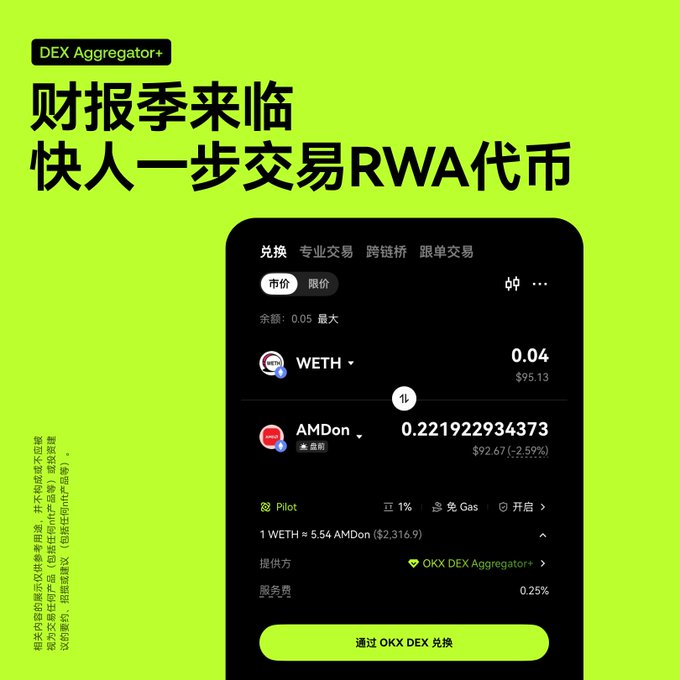
Investment Implementation: OKX Wallet—Your Quick Access to US Stock RWA Trading
After completing a deep analysis of US stock earnings reports and identifying potential investment targets, how can you conveniently and efficiently turn them into actual investments? The traditional US stock account opening process is cumbersome, trading hours are limited, and fund transfers are inconvenient, often deterring Web3 investors.
Now, OKX Web3 Wallet provides you with a new solution: Directly trade US stock RWA (real-world assets) tokens!
With OKX DEX Aggregator+, you can easily participate in trading US stock RWA tokens without leaving the blockchain, enjoying the following core advantages:
- 24/7 trading, breaking time limits: Say goodbye to traditional US stock trading time limitations; you can trade US stock RWA tokens anytime, anywhere, responding immediately to market changes after earnings releases, and even capturing **“pre-market”** trading opportunities.
- No complicated account opening, one-click access: Bypass the complicated account opening process of traditional brokers; you can directly trade through the OKX wallet, as simple as buying and selling cryptocurrencies.
- Multi-Solver bidding, locking in the best prices: OKX DEX Aggregator+ aggregates liquidity across the network and employs a multi-solver bidding mechanism to ensure that each of your trades is executed at the most competitive price, effectively reducing slippage.
- No Gas fees for transactions, lowering costs: Some transactions support zero gas fees, further reducing your trading costs and enhancing profit margins.
- Comprehensive asset management, seamless switching: Within one OKX wallet, you can simultaneously manage your crypto assets and US stock RWA assets, achieving a truly “one-stop” investment experience.
For example, when you analyze AMD's earnings report and are optimistic about its future performance, you can directly search and trade the corresponding RWA token (like AMDon) in OKX DEX Aggregator+, easily completing your layout.
Conclusion
The earnings season is a challenge but also an opportunity. Mastering the essence of earnings report analysis allows you to gain clearer insights into corporate value and capture market trends. Meanwhile, the OKX wallet provides you with a “fast track” to transform these insights into actual investments. Upgrade your investment tools now and participate in the global asset allocation in a smarter and more efficient way in the world of Web3, seizing the opportunity!
免责声明:本文章仅代表作者个人观点,不代表本平台的立场和观点。本文章仅供信息分享,不构成对任何人的任何投资建议。用户与作者之间的任何争议,与本平台无关。如网页中刊载的文章或图片涉及侵权,请提供相关的权利证明和身份证明发送邮件到support@aicoin.com,本平台相关工作人员将会进行核查。