Author: 798.eth, creator of the web3.devmeebits Chinese community
There is a Merge Lab at http://slonks.xyz. Opening https://slonks.xyz/merge-lab reveals a strange scene. On the left is Slonk #608, an ordinary male punk avatar, slop=15. On the right is Slonk #645, an ordinary female punk, slop=3. In the middle is the appearance after merging, with black hair, blue eyes, and yellow hair fragments mixed together, slop=161, +146 slop.
Viewing this image as an entry point to Slonks economics is 100 times more intuitive than reading the whitepaper.
Mechanism
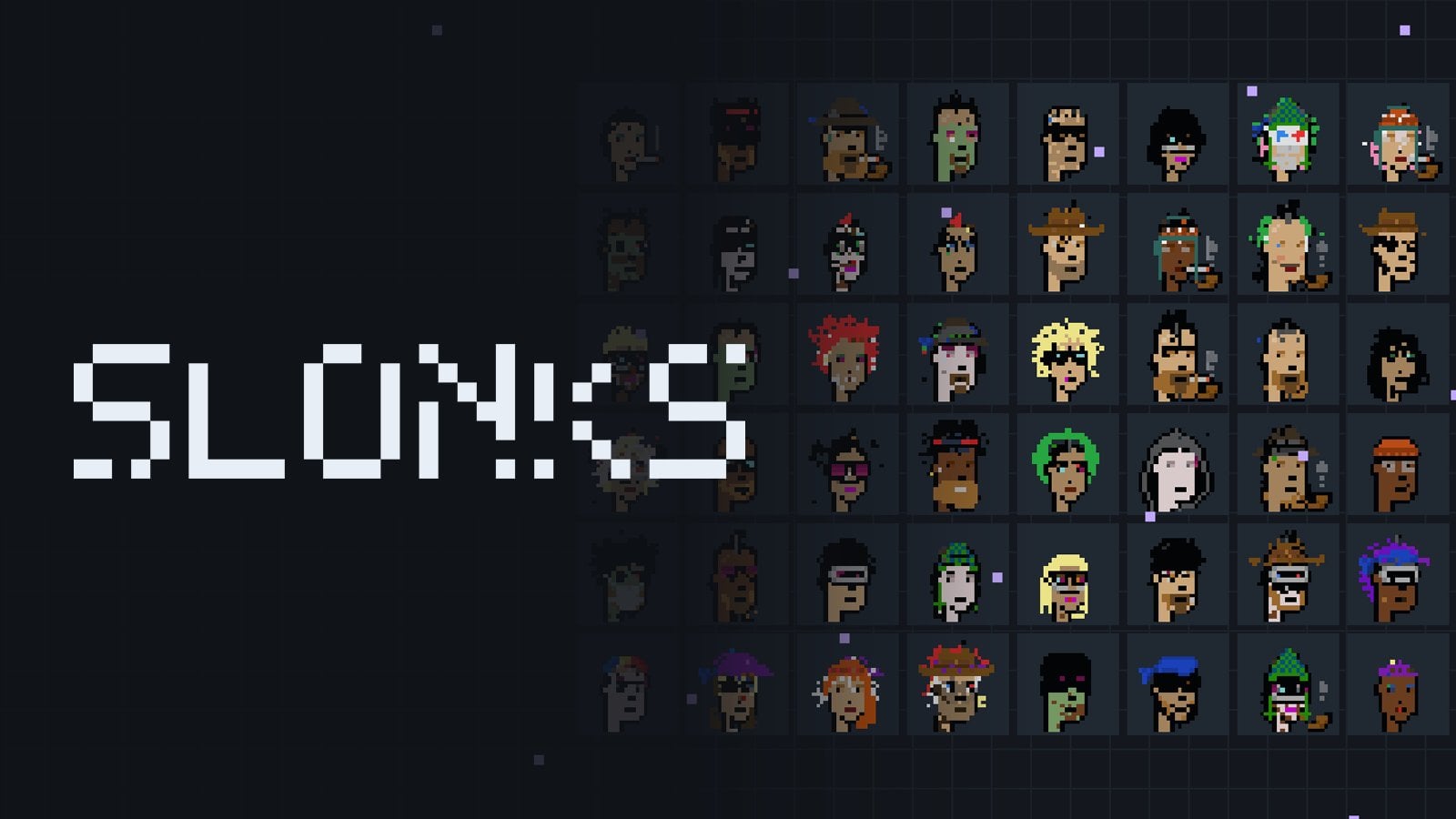
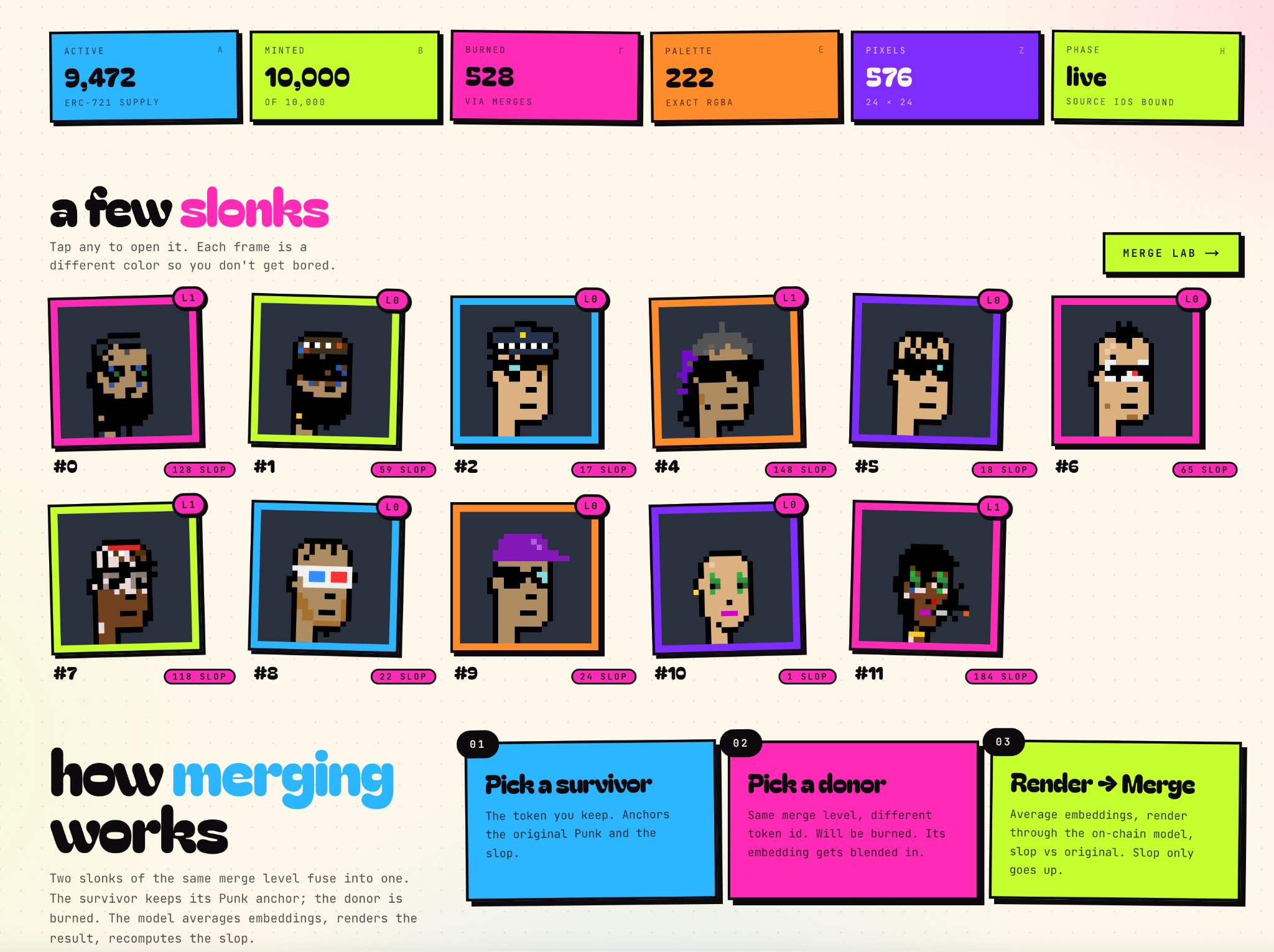
Slonks is an NFT collection that reconstructs CryptoPunks using an on-chain neural network model. Each Slonk corresponds to a CryptoPunk source, with the model rendering the reconstruction using a 24×24 pixel + 222 color palette. The model is not perfect, and the pixel difference between the rendered image and the original punk defines the slop value of that Slonk. The slop ranges from 0 to 576, since the canvas is a total of 576 pixels.
The core mechanism of the $SLOP token plan currently being written is called voiding. Holders send their Slonk into the void contract, and the contract mints a corresponding amount of $SLOP based on the current slop value. A Slonk with slop=15 voids 15 $SLOP. A slop=400 voids 400 $SLOP. The $SLOP cap is 5,760,000, equivalent to 10,000 × 576, which is the limit where each Slonk is completely wrong.
Merging is another avenue. One Slonk acts as the survivor, and the other as the donor; the donor is permanently destroyed, and the survivor upgrades to the next merge level, receiving a new embedding. The new embedding renders a new image, which is compared to the source of the survivor, and the slop value is recalculated.
Regarding the logic that slop increases after merging, there was a misunderstanding that needs to correct a detail at the mechanism level (thanks to jef's reply): the increase in slop is not random, nor is it simply due to the blended model's declining simulation ability, but rather determined by the morphological differences (DIFFERENCE) between the two source punks. For instance, combining a hoodie large head shape with a female small head shape shows the greatest morphological difference, resulting in the slop skyrocketing after merging. Therefore, to achieve max $SLOP yield, one must find pairings with the greatest morphological differences; friends can try this out at the Merge Lab.
Merging itself does not mint $SLOP, but after merging, voiding can mint more $SLOP. This pathway is not explicitly stated in the whitepaper, but is mathematically valid. In the example of #608 + #645, originally, the two together voiding could only mint 18 $SLOP, but after merging, #608 alone can mint 161 $SLOP. The cost is the permanent loss of #645 this Slonk.
Data and Deflation: Level as a Scar from Destruction
Slonks was deployed on May 1, and 5 days have passed. The current totalSupply is 9,505, total minted 10,012, total burned 507. 5.06% of Slonks have permanently disappeared from the blockchain.
Daily burn numbers: Day 1: 0, Day 2: 79, Day 3: 175, Day 4: 60, Day 5: 69, Day 6: 124. The 175 on Day 3 was an explosion from the community-centered testing of merging, and the surge to 124 on Day 6 was due to strategy warming caused by the $SLOP whitepaper. The merge rate is accelerating, not decelerating.
It is worth noting that voiding has not yet started. The $SLOP contract has not been deployed, and all current burns are purely merging actions; players have already begun strategic consumption based on slop values before the $SLOP launch.
Destruction allows Slonks to continue deflation, while the level of Slonks (mergeLevel) is the scar of destruction.
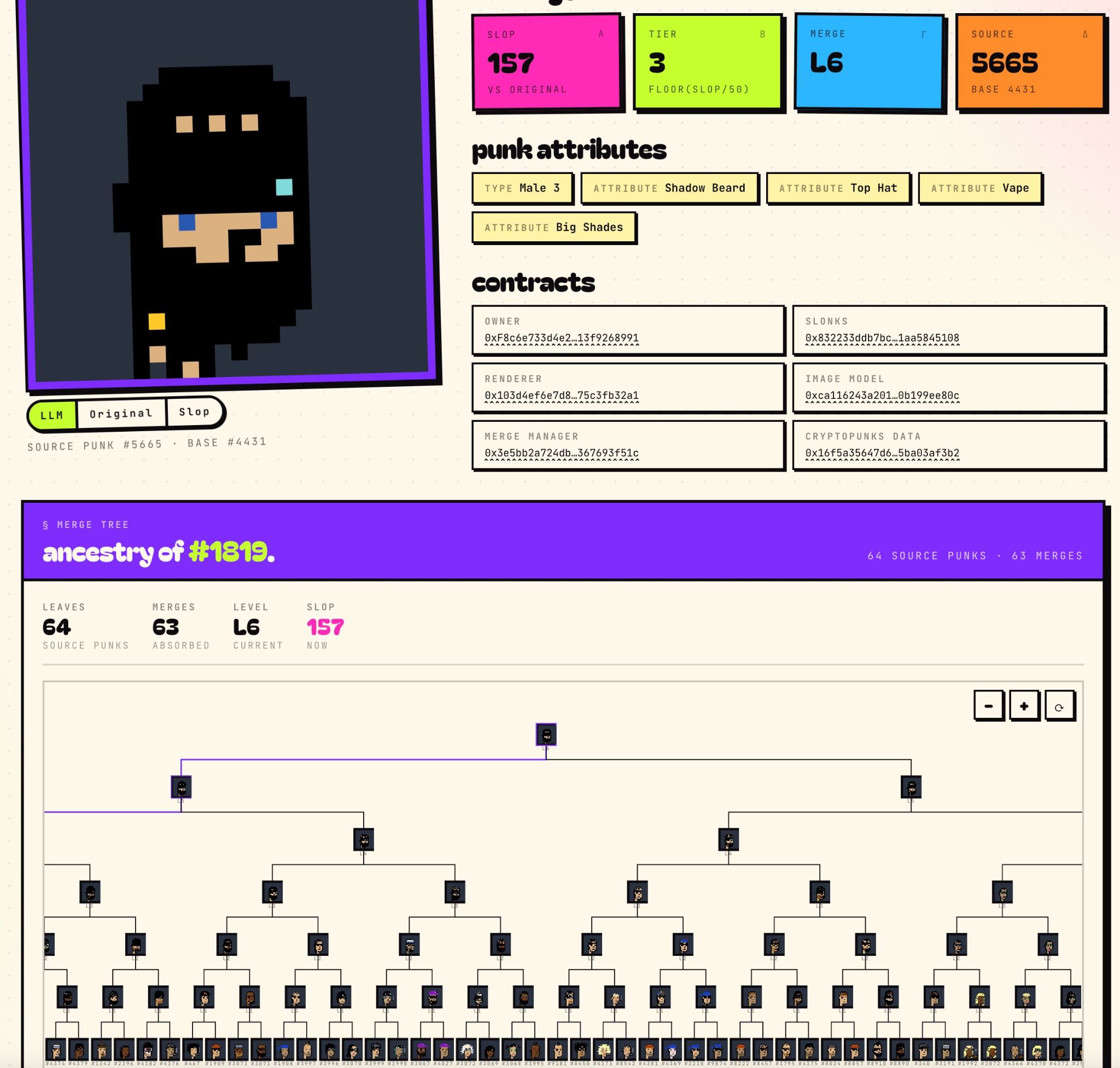
In the entire collection, those with mergeLevel greater than 0 should be less than 5%. MergeLevel is a strange field in the contract. The tokenURI shows it, it can be filtered on OpenSea, and each Slonk on-chain records the level number; however, there are no view functions exposing it in the contract, and no mechanisms rely on it for rewards.
The only hard constraint it has is same-level merges. L0 can only pair with L0, L1 can only pair with L1. This means that to level up, one must destroy double the same-level Slonks. L1 burns 2 L0s, L2 burns 4 L0s, L5 burns 32 L0s, and L10 burns 10% of the total collection of Slonks. The theoretical limit is L13, requiring the burning of 8192 L0s to exchange for one; the entire collection cannot reach this level.
Leveling up comes at a geometric cost, but with no geometric reward. It's completely the opposite of traditional games; in Slonks, leveling up involves throwing one similar token after another into the incinerator. The level number does not reflect how many wins one has, but how many tokens of the same generation have been burned. The mergeLevel is currently an empty trait. The team has retained its existing interface; whether it may be tied to $SLOP economic incentives in the future remains to be seen. But from the image after merging, one can see that the level reflects the traces of destroying similar items.
Dual Valuation
At this point, the factual layer is solidified. Slonks does not have a single valuation logic; rather, it has two conflicting valuation logics.
The first valuation looks at the rarity of the source punk. There are 9 Aliens, 24 Apes, and 88 Zombies in the CryptoPunks community that are acknowledged as rare. If a Slonk's source is Alien #2890 or Ape #5275, no matter how well the model renders, it cannot eliminate the scarcity premium of the source itself. The lower the slop and the higher the restoration of such a Slonk, the more it can maintain the visual recognition of that Alien's green face or Ape's ape face. Low slop is the core value of this type of Slonk.
The second valuation looks at the amount of $SLOP that can be minted through voiding. The higher the slop, the more $SLOP is voided. This valuation has nothing to do with whether the source punk is rare. An ordinary male punk with slop=400 voids 400 $SLOP. An Alien Slonk with slop=15 voids 15 $SLOP. In terms of $SLOP price, ordinary punk slop high is worth much more than Alien slop low.
The two valuations directly conflict in the merge decision-making.
If you hold a low slop Slonk with a source that is Alien, merging will do two things.
- First, it will give it a new embedding, and the rendered image will no longer faithfully replicate Alien's green face.
- Second, it will destroy one donor Slonk.
The result is that you obtain a Slonk with raised slop, but visually it can no longer be identified as Alien. It cannot be recognized as Ape, cannot be identified as Zombie, cannot be seen as any rare punk. The scarcity premium assigned by the CryptoPunks community returns to zero.
What you gain is just the future potential to void and mint 100 more $SLOP. The price of $SLOP is yet to be launched and remains unknown, but the secondary market value of Alien is verifiable. This transaction is negative in expected value for those holding rare source Slonks.
On the other hand, for holders of ordinary source low slop Slonks, merging is a positive expectation. Such Slonks lack both source rarity and $SLOP quantity value, placing them in an undervalued position. Throwing them into the merge to transform into high slop is the most valuable thing they can do.
Evolution
Projecting this logic at the entire collection level reveals a Darwinian picture.
Slonks with poor model restoration are the fittest. Their slop is high, they are a gold mine for voiding, and no one will merge them; thus, they survive.
Slonks with good model restoration are divided into two layers. Those with rare sources survive since no one dares to merge them because it would destroy their visual recognition. Ordinary source Slonks are recycled, concentrated as donors thrown into merges to upgrade other Slonks.
The final collection will evolve into two coexisting categories. One is high slop "perfect failures," where the model renders these punks completely unrecognizable, but the voiding value is high. The other is low slop "rare faithful reconstructions," where sources are Alien/Ape/Zombie; low slop retains visual recognition, carrying high secondary market value.
The middle ground Slonks continue to disappear. Ordinary source ordinary slop Slonks have no valuation advantages and are natural donors for merges. They contribute to the survival of two categories, while permanently exiting.
5 days, 5%. This rate will continue to rise as merge tools become more widespread and the $SLOP launch approaches. Slonks is an NFT project designed to actively disappear. Its scarcity is not a fixed number like the 10,000 at launch, but the result of each market merge decision collectively calculated.
Conclusion
Slonks and unipeg are both playing with scarcity, but in opposite directions. Unipeg uses dust accumulation to make integers hard to assemble, with the NFT count oscillating around 6,000. Slonks directly destroys; over 500 have disappeared in 5 days, with no signs of slowing, irreversible.
Merging is described as a neutral mechanism in the whitepaper. On-chain, it is not. Merging is Slonks' means of achieving collection valuation optimization through self-consumption. Each merge is a market vote, permanently removing a Slonk from the world in exchange for upgrading the slop of another.
5 days ago there were 10,012. Today there are 9,505. $SLOP has not yet launched, and the elimination has already begun.
免责声明:本文章仅代表作者个人观点,不代表本平台的立场和观点。本文章仅供信息分享,不构成对任何人的任何投资建议。用户与作者之间的任何争议,与本平台无关。如网页中刊载的文章或图片涉及侵权,请提供相关的权利证明和身份证明发送邮件到support@aicoin.com,本平台相关工作人员将会进行核查。


