On the afternoon of May 6, Nvidia announced an investment. The amount isn't particularly large, 500 million dollars. But the contract states that it can be increased to 3.2 billion in the future. Corning's stock price rose 14% that day.
What is more intriguing is the structure of this deal. In the 18 million shares of equity certificates given to Nvidia by Corning, 3 million shares have an exchange price of 0.0001 dollars. This means these 3 million shares are almost given to Corning. On the same afternoon, at an investor conference in New York, Corning raised its revenue growth target to 40 billion by 2030.
But none of this is the most unusual part of Corning in recent months. The "iPhone screen glass supplier" stated in its first-quarter financial report that, in the past few months, two unnamed companies had signed multi-year contracts worth 6 billion dollars with Corning. The use of "again" is because Corning recently just signed a contract of the same scale with Meta.
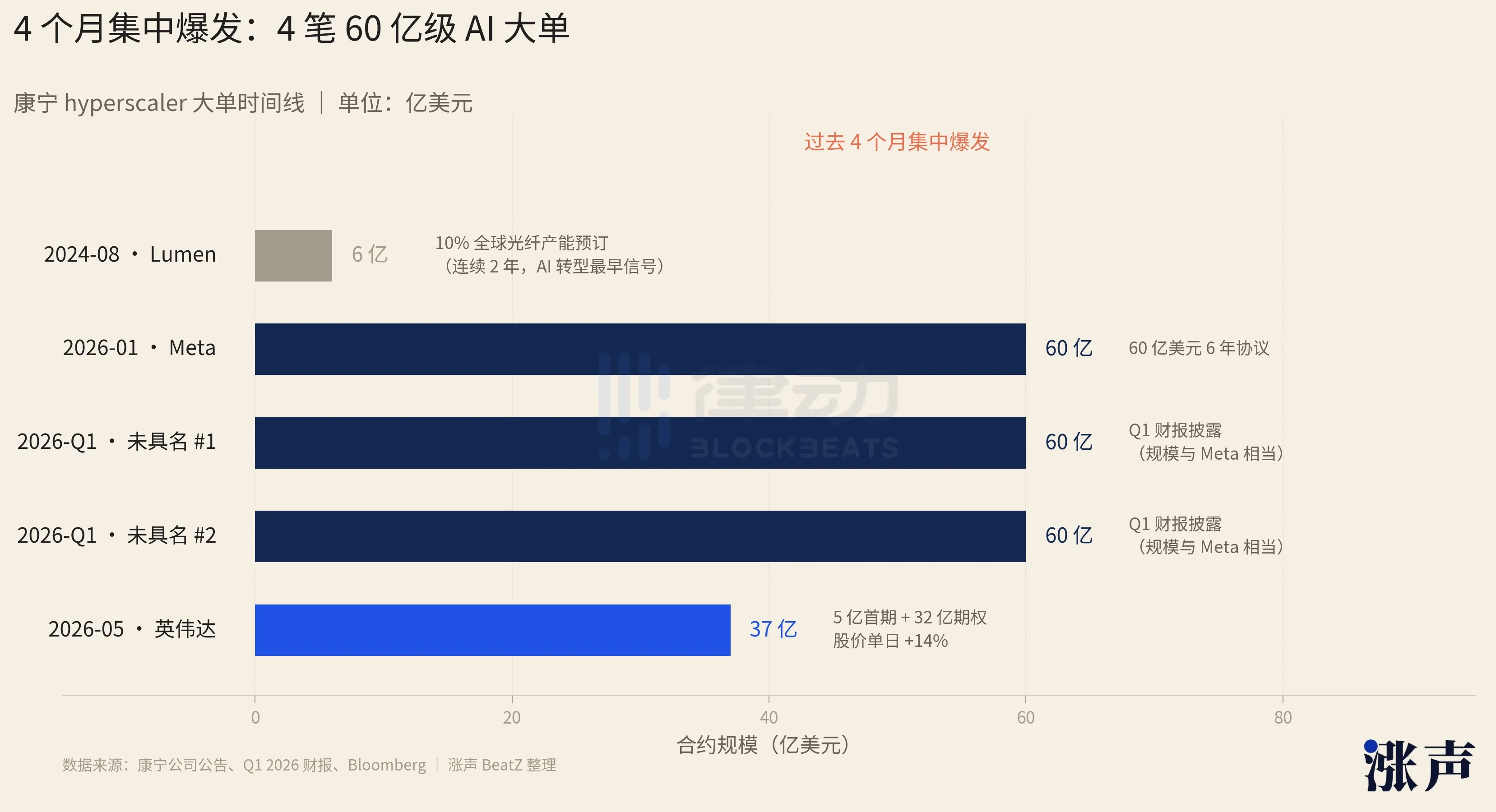
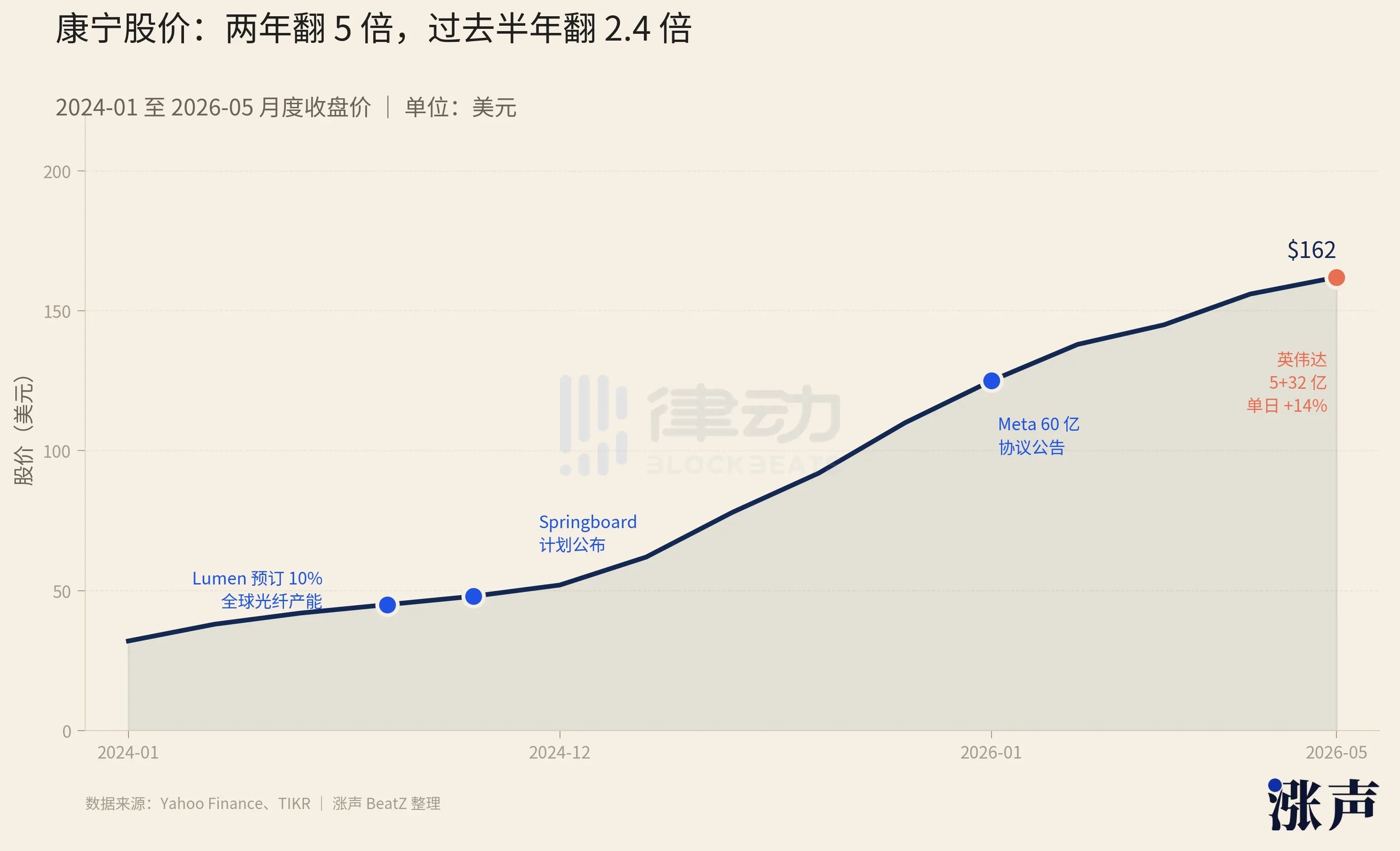
If you count, you will find that in the past 4 months, at least 4 large AI contracts, each worth billions, have concentrated on this 174-year-old glass company. In the past 6 months, Corning's stock price has risen by 140%, and compared to two years ago, it has increased fivefold.
From selling phone glass to being a hot commodity in AI factories
If you are reading this article on your phone, the glass covering your screen is most likely produced by Corning. Since the first generation of the iPhone by Apple in 2007, Corning's Gorilla Glass has almost become the default choice for high-end mobile phone screens globally. However, "mobile phone glass supplier" is just one side of Corning, and it is not the most profitable one.
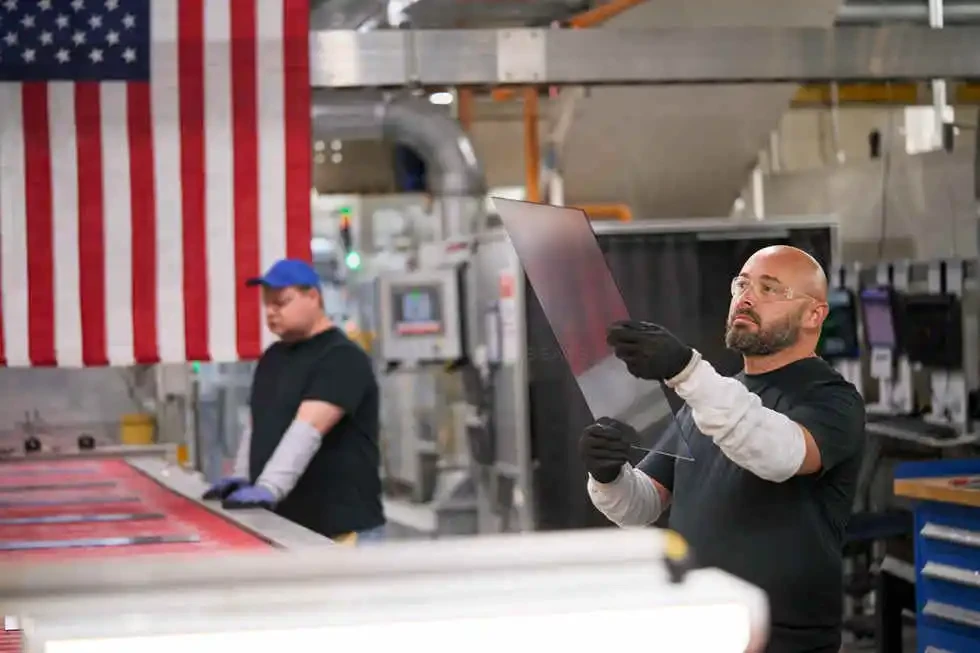
Corning's Gorilla Glass production line, source: Apple
This company was founded in 1851, creating the first glass shell for Thomas Edison’s incandescent light bulb, and in the 1970s, it invented low-loss optical fibers from scratch, pioneering the entire modern fiber optics industry. The glass for the 2007 iPhone represented its third major business transformation. Today, Corning is undergoing its fourth transformation, as optical communications become a real business driver.
Corning's optical communications business has over 50 years of history, but in the past two years, the client structure of this business has undergone a complete overhaul.
For a long time, Corning primarily sold fiber optics to telecommunications operators like AT&T and Verizon. These companies used them to lay fiber optics for homes and build 4G and 5G bases. In 2009, Corning launched a data center wiring solution called EDGE, officially adding data center operators to its client list. Over the past decade, as mobile internet surged, cloud services proliferated, and remote work exploded during the pandemic, Corning's optical communications business steadily rose, but it was never the primary revenue source.
In November 2022, OpenAI introduced ChatGPT to the public. From that moment on, data centers around the globe began redesigning their physical infrastructure to accommodate this new AI training computation demand. The density of optical fibers needed for AI training is something that has never been encountered in previous eras.
The first signs of this appeared in August 2024. An American telecommunications operator called Lumen pre-ordered 10% of Corning's global fiber optic capacity for two consecutive years. This was the earliest public signal of Corning's business transitioning into the AI domain.
By early 2026, the previously mentioned 4 contracts worth 6 billion dollars erupted simultaneously. Corning had been working with data center operators for 15 years, but the shift of "secondary clients" to "absolute main force" happened only in the past 24 months.
The direct effects of the customer flip were evident in Corning's financial reports. Corning's total revenue for 2023 dropped by 11% year-on-year, reflecting a low point in the industry. However, by 2025, the total revenue surged to 15.6 billion dollars, a 19% increase year-on-year. In the first quarter of this year, its revenue grew by an additional 18% year-on-year. The most remarkable growth came from the optical communications business, which expanded by 35% for the year. The proportion of optical communications in total revenue jumped from 30% in 2020 to 37% in 2025. The change in absolute value is even more intuitive, growing from 2 billion dollars five years ago to 6.3 billion dollars in 2025, more than tripling.
This rise from "secondary business" to "main engine" is not coincidental; it is backed by a growth plan led by CEO Wendell Weeks. This plan has an internal code name: Springboard.
Two years ago, Corning was still viewed as a "boring glass manufacturer" by Wall Street analysts, classified as a mature, low-growth dividend stock. But three years after the implementation of the Springboard plan, Corning's stock price rose from just over 30 dollars in early 2024 to 162 dollars, a fivefold increase within two years, with a direct 140% rise in the past 6 months. The glass factory has transformed into "the nervous system of the AI revolution."
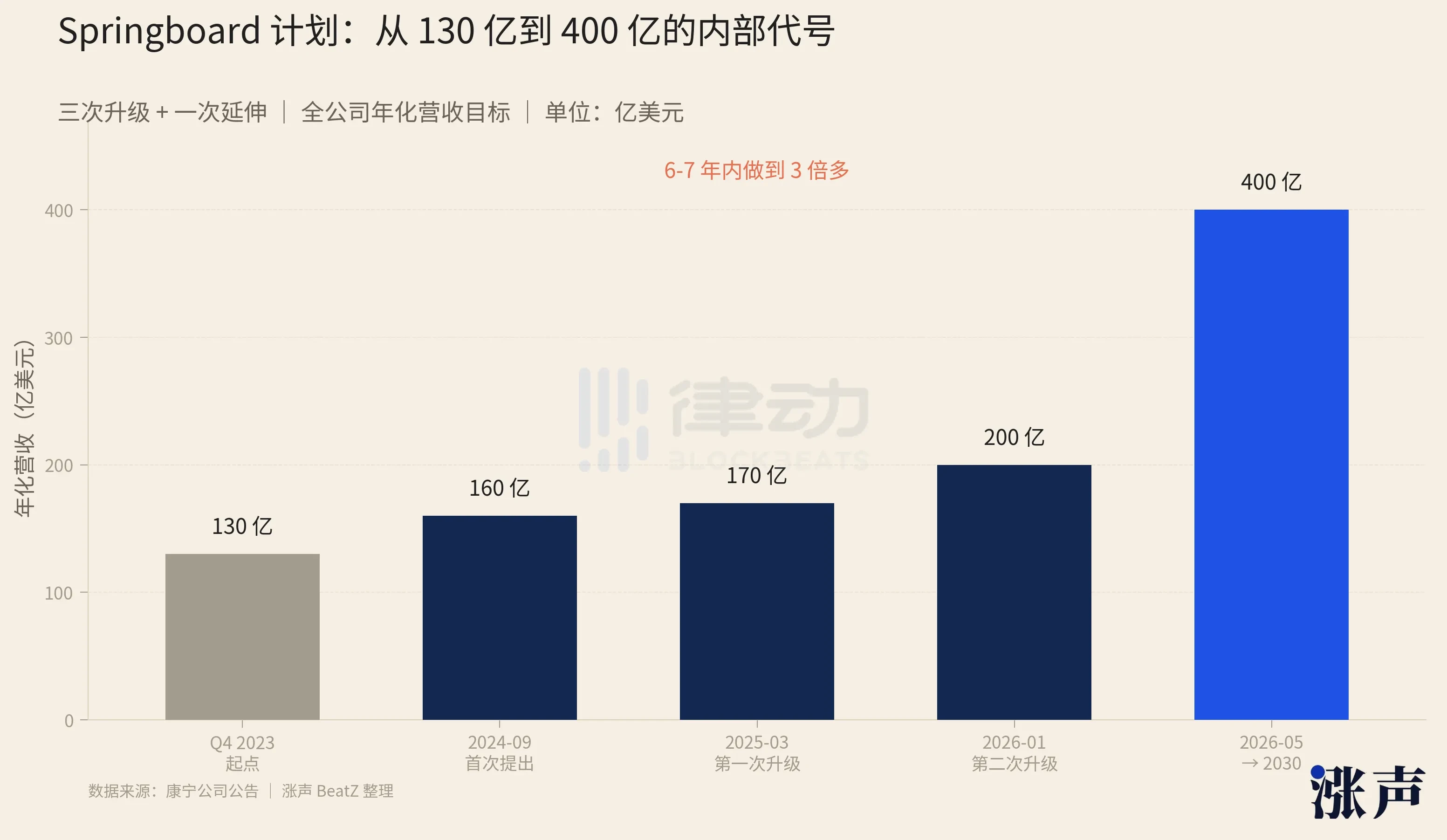
The Springboard plan was first unveiled in September 2024. The starting point was the annualized revenue level in the fourth quarter of 2023, about 13 billion dollars. The initial goal was to increase annualized revenue by over 3 billion dollars by the end of 2026, with an overall operating profit margin reaching 20%.
However, over the next year and a half, this target was raised three times, all the way to 6.5 billion dollars, pushing the annualized revenue target for the end of 2026 to the scale of 20 billion dollars. After Nvidia invested in Corning on May 6, the company immediately raised its internal revenue target to 40 billion dollars by 2030. Meanwhile, Corning achieved its 20% profit margin target a year ahead, in the fourth quarter of 2025.
The key to the Springboard plan is "premium." The company's sales grew by 18%, but earnings per share increased by 46%, a profit growth rate 2.5 times that of sales. On the business level, Corning primarily did three specific things:
The first was to raise prices significantly for existing businesses. Corning's display glass is already a mature business that hasn’t grown in years. However, at the end of 2024, Corning raised prices by over 10% on this line while locking in yen exchange rates until 2030. As a result, even in an environment of yen depreciation, this line consistently contributes between 900 million to 950 million dollars in net profit annually, with a net profit margin maintained at 25%.
The second was the upgrade of optical communication products. In 2025, optical communication sales increased by 35%, yet net profits grew by 71%. This indicates that not only did optical communications sell more, but each fiber also earned more.
The third action was to utilize idle capacity. Corning did not build new factories on a large scale but restarted idle capacity that had been unused during previous downturns, allowing the company's overall gross margin to rise from 33% in 2024 to 36% in 2025.
Of course, the ability to raise prices effectively comes from people being willing to pay. The increase in profit from product upgrades is because customers are willing to pay more for upgraded products. The reason Springboard allows Corning's profit growth rate to outpace revenue is fundamentally that its client structure has a group of customers willing to pay a premium.
Everyone is racing for optical fibers
The AGI race and order demands have made every data center operator incredibly anxious about time.
The core business of the cloud giants has always been "renting IT to enterprises." Most of the traffic from new companies like Netflix, Airbnb, and Uber that emerged alongside the mobile internet is "north-south" traffic. A user opens an app externally, the request is sent to a server in the cloud, and the server returns data. While servers occasionally communicate with one another, the volume and frequency are generally low. This network structure does not place high demands on the underlying physical infrastructure: Ethernet is sufficient, copper cables are sufficient, and regular optical fibers are sufficient. This architecture was used by cloud giants comfortably for over a decade, being stable, reliable, and profitable.
Until the advent of ChatGPT, when the rules began to change.
In the coming years, almost all cloud giants have started to handle training themselves. Microsoft is the largest computing power provider for OpenAI; AWS is deeply integrated with Anthropic; Alibaba is training Tongyi. The core business of cloud giants has started shifting from "renting IT to enterprises" to "training AI for the world."
However, this transition triggered a chain reaction at the physical infrastructure level that exceeded all accumulated common sense over the past 20 years.
The traffic pattern for AI training is "east-west." Training a large model may require tens of thousands of GPUs to communicate with each other simultaneously, syncing the gradients calculated by each GPU. If even one line is slow, the entire training phase has to wait for it, turning thousands of GPUs into "cars stuck at an intersection." Thus, east-west traffic demands latency and bandwidth that are dozens of times greater than previous north-south traffic.
Previously, most of the high-speed connections within data centers were copper cables. Copper is cheap, easy to install, and has stable performance, making it the default choice for data centers. However, the geometric structure of AI training clusters is precisely what copper cables dislike. Tens of thousands of GPUs are distributed across dozens of racks, typically several meters apart, making copper connection impossible. On the other hand, optical fibers have no distance limitations in this regard.
Suddenly, the sparse network that was previously sufficient was no longer enough. Cloud giants needed to lay optical fibers more densely than ever before.
This scale of relaying has already been reflected in their capital expenditures. In 2026, the combined capital expenditure of the six major cloud giants is expected to exceed 600 billion dollars, with the number of operational hyperscale data centers globally reaching 1,297, nearly three times the count from early 2018. In the year 2026 alone, the number of new data centers is expected to exceed 150, with corresponding spending on AI infrastructure construction exceeding 400 billion dollars.
Market research firms estimate that the total demand for optical fibers in AI clusters is 10 to 100 times that of traditional cloud services. This is the fundamental reason why Corning can secure 4 contracts worth 6 billion dollars each.
Between data centers, and between racks, all optical fibers must pass through something called cable conduits. These are typically plastic or metal tubes with an inner diameter of 2 to 4 inches, either buried underground or running along racks. These conduits have a characteristic that once laid, it is very difficult to add more. To bury an additional conduit between cities means re-applying for road rights and digging up the roads again, which takes years. To add a conduit in an already operational data center means downtime for renovations, taking months.
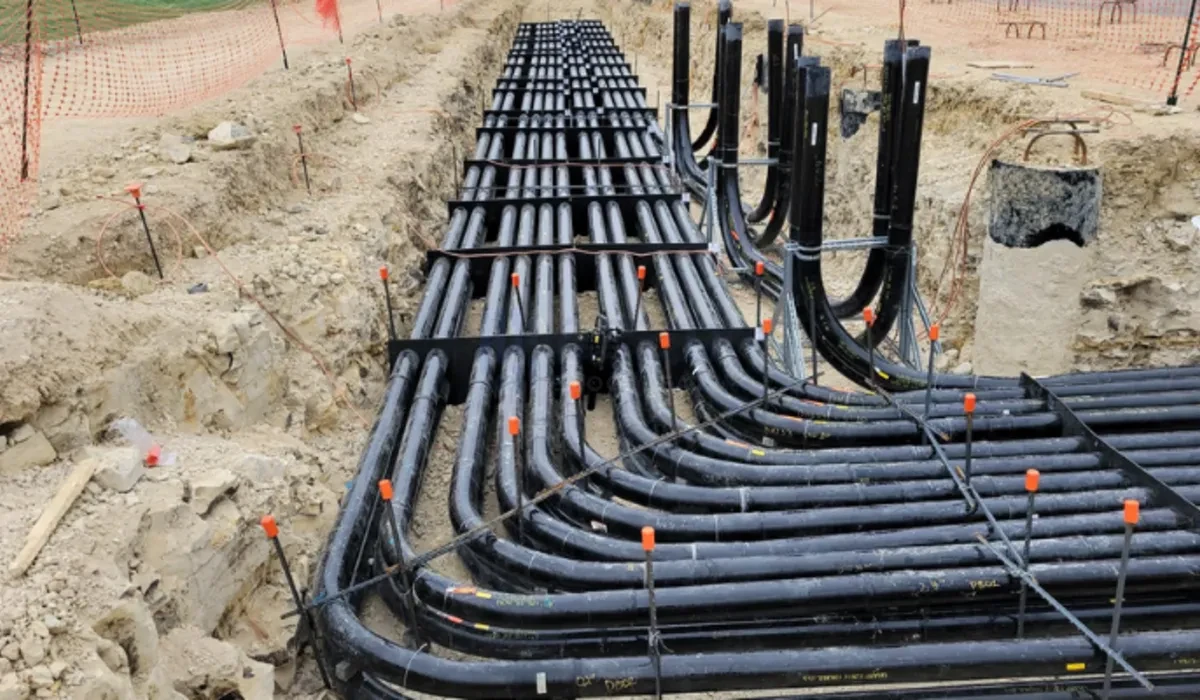
Cable conduits that will soon be buried underground, source: internet
What Corning has been doing for AI data centers over the past two years is enabling more optical fibers to fit into existing conduits without adding more conduits.
In addition to making the optical fibers themselves thinner, Corning has also modified the arrangement of these fibers from loose "spaghetti-style" to a flat ribbon design that can be rolled up and then flattened when needed. Originally, a 2-inch conduit could fit just over a thousand fibers, whereas Corning's new design can accommodate over three thousand, effectively doubling the quantity. If using a 4-inch conduit along with 6 of such cables side by side, it can hold over twenty thousand optical fibers, more than six times the traditional design.
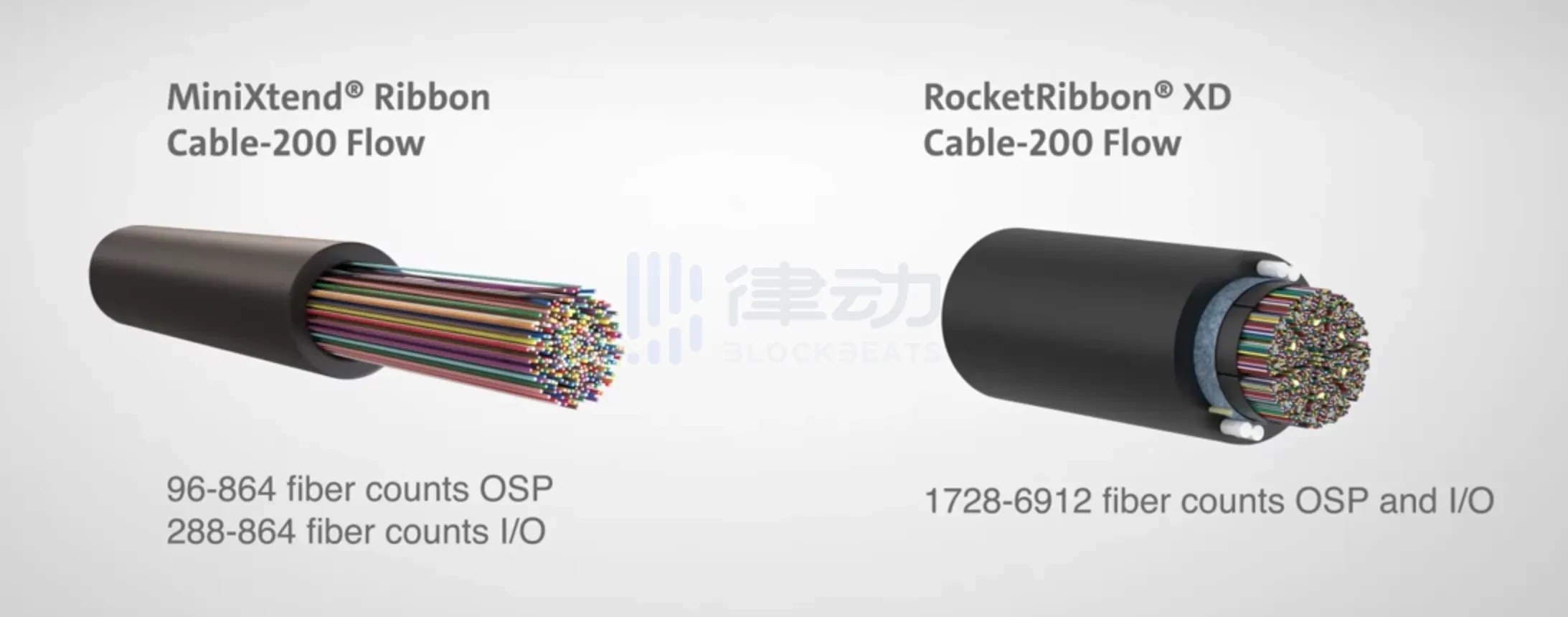
Corning's rollable optical fiber, source: Corning
Not only does it accommodate more, but the termination process is also less labor-intensive. A 3,456 fiber cable traditionally requires over 200 hours to terminate, while Corning’s ribbon design can cut that down to under 40 hours, reducing cable preparation time by 30%. It’s important to note that the U.S. already faces a shortage of optical communication engineers.
In the construction process of a large AI factory, every month of delay means massive GPU depreciation and postponed training tasks, amounting to millions on paper. Spending an additional 30% to 70% premium on a product that can cut several months of time and millions in engineering costs is almost unambiguously cost-effective.
Jensen Huang's "unprecedented scale"
On May 8, Nvidia CEO Jensen Huang reiterated in an interview that the next generation of AI infrastructure requires a massive amount of optical connections, as copper wire can no longer meet demand. He also stated that Nvidia aims to expand optical technology applications at an unprecedented scale.
The details of the recent investment transaction in Corning indeed reflect this notion of "unprecedented scale." Among the 18 million stock certificates, 3 million are "free gift." Such structure is rare in Nvidia's ecosystem investments over the past year, indicating that Nvidia instantly obtained significant equity exposure in Corning without needing to use cash, resembling more a signing fee for a long-term partnership agreement.
Furthermore, Corning is not the only piece on Nvidia's chessboard. Since September of last year, Nvidia has entered a new investment rhythm. One is greater in scale, and the other frequently utilizes financial instruments like "frameworks," "options," and "prepaid warrants," locking in commitments first and then fulfilling them in batches. In addition to a 100 billion dollar investment framework for OpenAI, Nvidia has also continually invested tens to hundreds of billions of dollars in AI infrastructure with Anthropic, Intel, CoreWeave, and others.
One easily overlooked aspect is its investment in optical communications. Besides Corning, Nvidia also invested 2 billion dollars each in Lumentum and Coherent, both of which are among the largest optical device companies in the world. Counting Corning's initial 500 million dollar investment plus the 3.2 billion option, Nvidia has invested around 7.7 billion dollars in the subfield of optical communications alone.
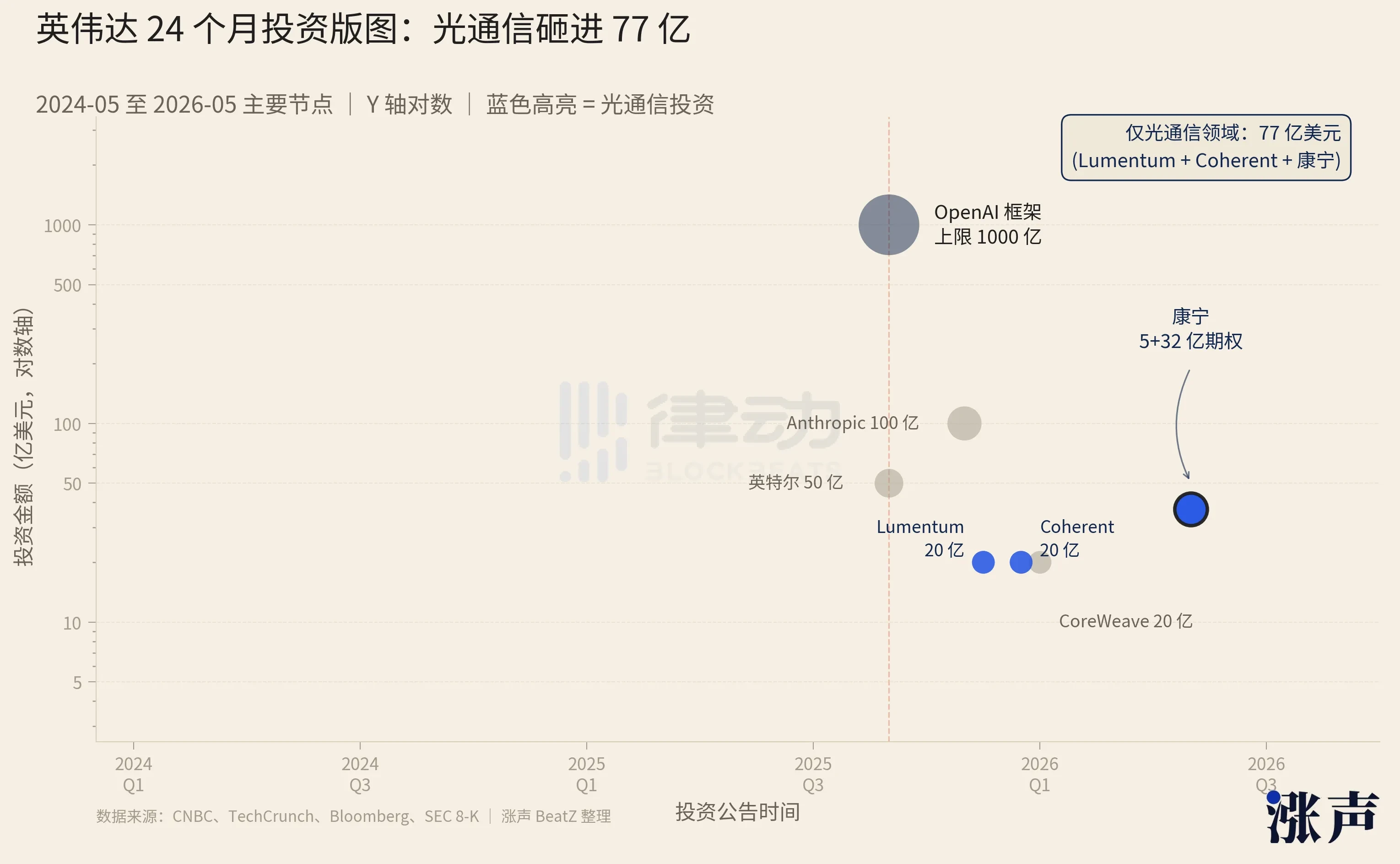
If you compile this investment data into a table, you will find it entirely represents a construction checklist for AI factories: computing power, networking, optics, power, cooling, software, customers, models, with at least one key supplier locked at each level by Nvidia. At this year's GTC conference, Nvidia integrated all these into a publicly disclosed design, releasing a hardware reference architecture called Vera Rubin DSX and a digital twin solution named Omniverse DSX Blueprint, essentially "the construction drawing of an AI factory."
A GW-level (power for 1 million households) AI factory requires 18 to 24 months from planning to commissioning, coordinating over 100 suppliers along the way. Previously, each data center operator had to redo the interface verification themselves. However, Nvidia’s Omniverse DSX has systematized this process, as all partner products have been verified in Nvidia’s digital twin, parameters aligned, and interfaces standardized, allowing cloud giants to directly purchase according to Nvidia’s blueprints.
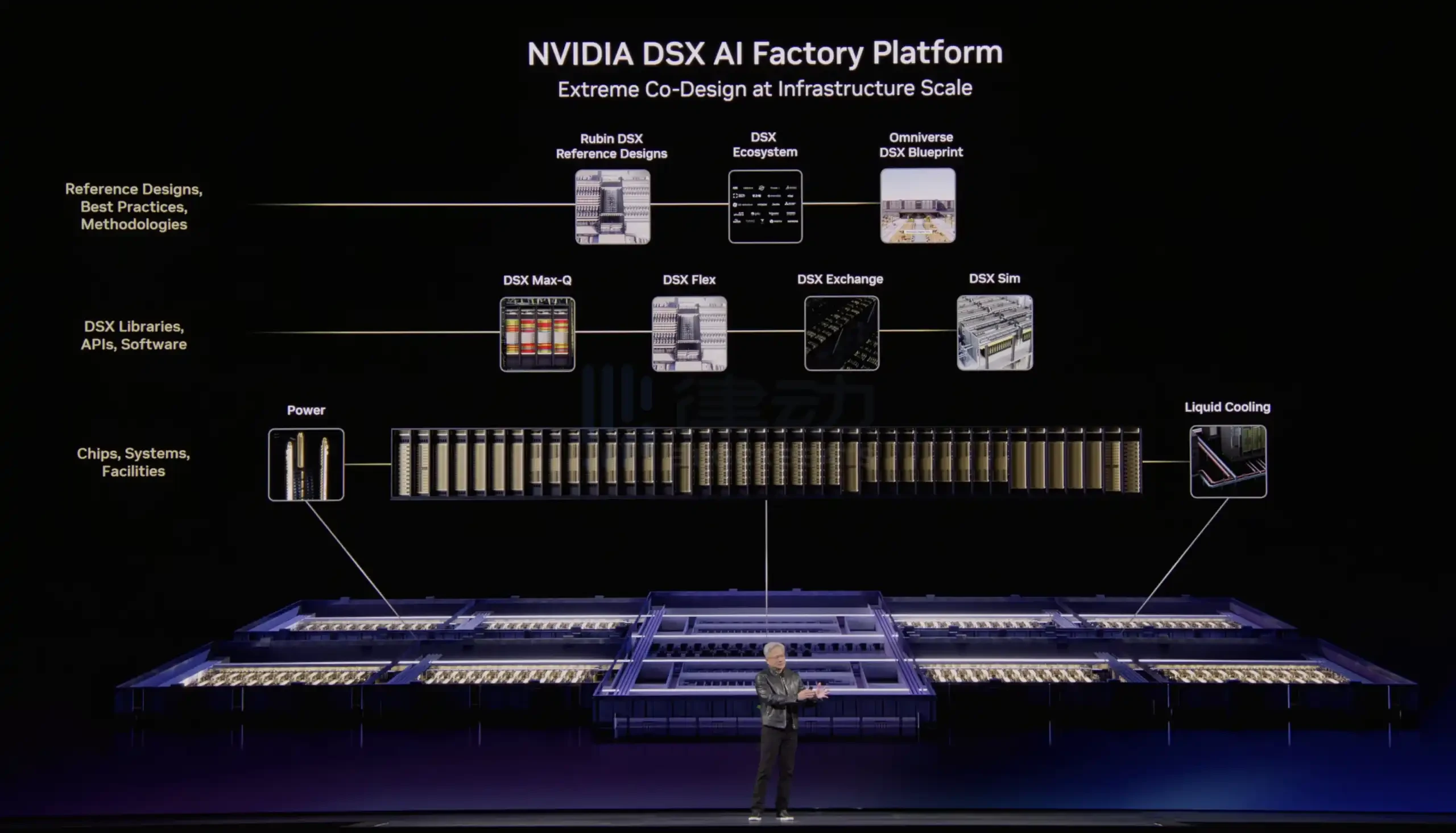
Jensen Huang releases the AI factory blueprint platform at the 2026 GTC conference, source: NVIDIA
This marks a critical step for Nvidia's transformation from a chip company to an "AI factory general contractor." With increased integration and expanded gross profit space, even if AMD or Broadcom were to produce GPUs of equivalent performance tomorrow, replicating this supply chain coordination ability from chips to optical fibers to power grids would take at least several more years.
Thus, the real significance of Nvidia's 3.2 billion options granted to Corning is locking a key player into the "local optical communications capacity" section of its AI factory construction blueprint. Of course, currently, only Nvidia has the capability to draw such a blueprint.
免责声明:本文章仅代表作者个人观点,不代表本平台的立场和观点。本文章仅供信息分享,不构成对任何人的任何投资建议。用户与作者之间的任何争议,与本平台无关。如网页中刊载的文章或图片涉及侵权,请提供相关的权利证明和身份证明发送邮件到support@aicoin.com,本平台相关工作人员将会进行核查。


