Author: DD Didi
Options for Unable to Open Overseas Accounts
If you are in China, platforms like Alipay, TianTian Fund, banks, and broker apps can buy QDII funds issued by domestic fund companies, such as tracking:
- S&P 500
- NASDAQ 100
- MSCI US 50
- US Tech Stock Index
- Global Allocation Funds
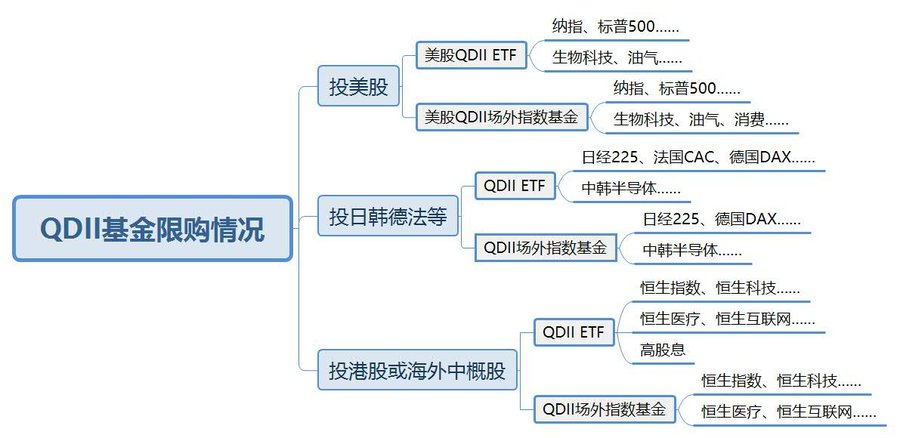
The essence of QDII is: Domestic fund companies take your RMB to invest in overseas markets through regulatory quotas. The Securities Regulatory Commission defines QDII as domestic fund companies, securities firms, and other institutions that are approved to raise funds domestically and then invest in overseas securities markets.
The advantage of this route is: There is no need to convert money into dollars, no need for overseas bank cards, no need for U.S. stock broker accounts, and no need to handle complex tax forms.
Options for Opening Overseas Accounts (Recommended)
For example, directly buying:
VOO: S&P 500 ETF
IVV: S&P 500 ETF
SPY: S&P 500 ETF
QQQ: NASDAQ 100 ETF
VTI: U.S. Total Market ETF
This route is closer to actually buying U.S. stock ETFs
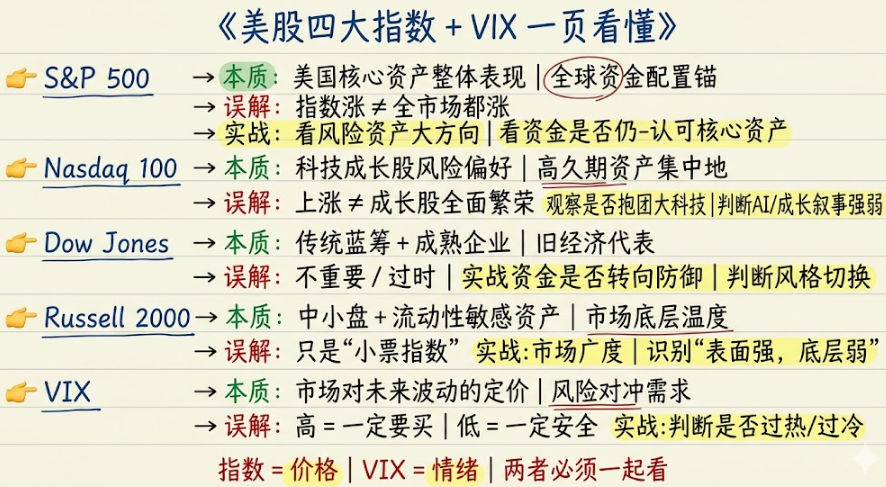
Here, let's review the four major indices + VIX again
But for newcomers, the difficulty lies in: You typically need overseas broker accounts, overseas bank cards, funding paths, tax forms, currency exchange costs, and also need to pay attention to foreign exchange compliance issues.
In the current environment, individuals directly using personal foreign exchange quotas for overseas securities investment is not a typical current account usage. The foreign exchange bureau's information also clearly distinguishes between current accounts and capital accounts, while personal facilitation quotas primarily apply to current accounts and certain convertible capital accounts, with QDII being one of the officially listed mechanisms for overseas securities investment.
Deciding on the Buying Method
Method 1: Dollar-Cost Averaging
Most suitable for beginners.
For example, buying a little bit every week, every two weeks, or every month.
The benefit is there is no need to predict highs and lows.
Suitable groups:
Stable income, looking to allocate to U.S. stocks long-term, not wanting to monitor the market.
Method 2: Incremental Buying
For example, if you plan to invest 10,000 RMB, instead of buying it all today, you can break it down into 5 parts:
Buy 2,000 today
Buy another 2,000 if it drops 5%
Buy another 2,000 if it drops 10%
Make a fixed contribution every month
Keep some cash
Suitable groups:
Have some spare money but fear buying at a high point.
Method 3: Core Position + Observation Position
For example:
70% buy S&P 500
20% buy NASDAQ 100
10% keep cash or money market funds
Beginners shouldn't start with a full position in NASDAQ because it rises sharply and falls sharply as well (however, in terms of the long-term trend of the U.S. as a tech powerhouse, the NASDAQ is likely to have long-term bullish advantages).
Special ETFs
Of course, not everyone wants to just dollar-cost average into indices when investing, so here are some ETFs that focus on specific sectors, but since this article is written for newcomers in the community, I won't elaborate too much.
DXYZ - Destiny Tech100 Inc. (Closed-End Fund, Non-Traditional ETF)
- Focus on 100 high-growth Pre-IPO tech unicorns, currently holding 32 stocks (targeting 100). SpaceX economic exposure is about 16.2% (largest holding), xAI 3.5%, OpenAI 2.1%, Databricks 4%, Shield AI 4.1%, etc., also includes Stripe, Revolut, Epic Games, etc. Management fee is 2.5%, holding private shares through SPV.
- Recently exploded: Rumors of SpaceX IPO (expected mid-2026) led to a surge in stock price (+21% on May 8 to approximately 54.6 USD), is the most direct tool for Pre-IPO SpaceX + AI in the public market, discussion and trading volume skyrocketed.
NASA - Tema Space Innovators ETF (Active)
- Pure space economy ETF, directly holds about 10-12% of SpaceX Pre-IPO shares (SPV), also includes Rocket Lab, AST SpaceMobile, etc.
- Currently popular: Ongoing news from SpaceX makes it the purest Pre-IPO positioning tool in space.
XOVR - ERShares Private-Public Crossover ETF
- First Pre-IPO crossover ETF, holding SpaceX (previously up to 10%+) and other private growth companies, combining public entrepreneurial stocks and private equity exposure.
- Currently popular: Innovative products for Pre-IPO investments are attracting large inflows of capital.
RONB - Baron First Principles ETF (Active)
- Actively managed growth type, directly holding about 9% of SpaceX Pre-IPO shares, focusing on companies with long-term competitive advantages.
- Currently popular: Baron team's stock selection + SpaceX exposure, suitable for enjoying growth dividends.
ARKX - ARK Space Exploration & Innovation ETF (Active)
- ARK series space innovation ETF, actively selecting stocks covering space exploration and related technologies, indirectly high Pre-IPO exposure.
- Currently popular: Cathie Wood's style + the space concept continues to ferment.
免责声明:本文章仅代表作者个人观点,不代表本平台的立场和观点。本文章仅供信息分享,不构成对任何人的任何投资建议。用户与作者之间的任何争议,与本平台无关。如网页中刊载的文章或图片涉及侵权,请提供相关的权利证明和身份证明发送邮件到support@aicoin.com,本平台相关工作人员将会进行核查。


