Source: Y Combinator
In Silicon Valley, Y Combinator (YC) is recognized as the "touchstone" for startups worldwide.
As the world's top startup incubator, YC has incubated more than 5,600 companies since its establishment in 2005, nurturing tech giants like Airbnb, Stripe, Dropbox, Reddit, and Coinbase. Today, OpenAI's CEO Sam Altman also once served as YC's president.
It can be said that YC's perspective represents the forefront of trends in tech entrepreneurship. Recently, YC partner Diana Hu made a striking judgment on the podcast "How To Build A Company With AI From The Ground Up": The operational speed of AI-native startups may be 1,000 times faster than that of existing industry giants.
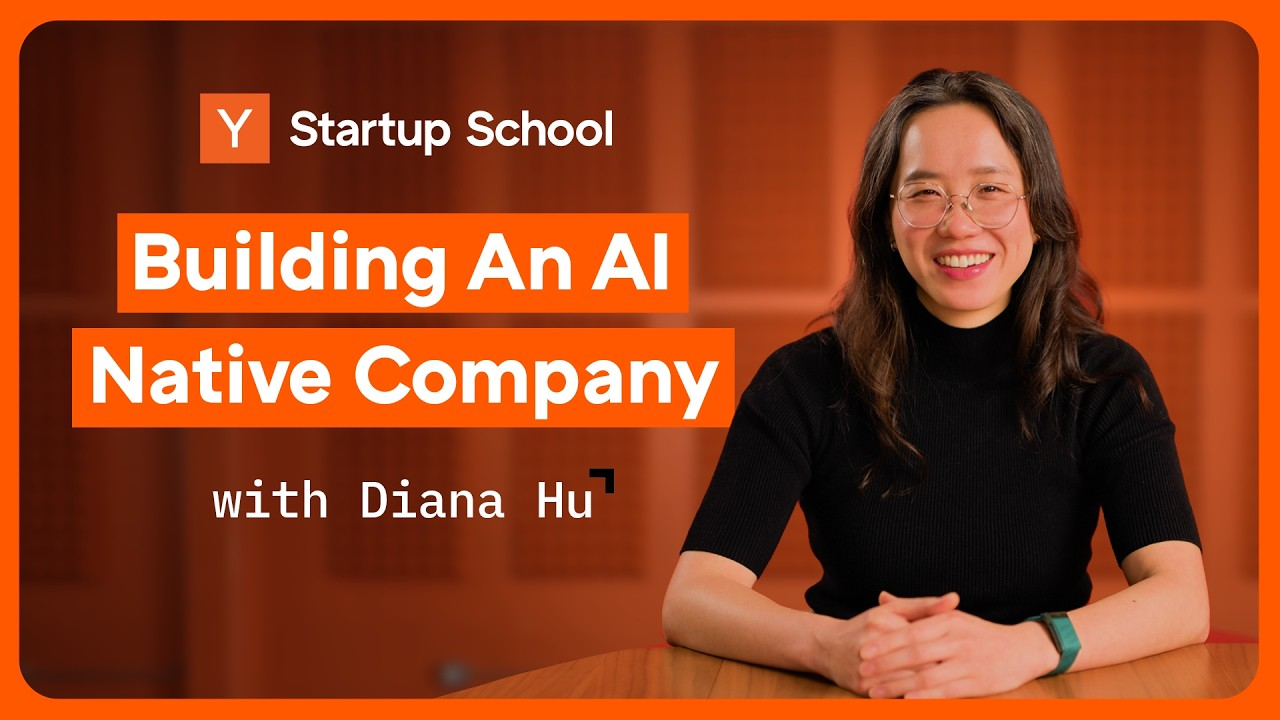
TinTinLand has organized the key insights from the original video. Let’s take a look at how a truly AI-native company should operate from YC's perspective.
Not "using AI", but "running on AI"
Currently, most discussions about AI are still at the "efficiency improvement" level, such as "AI can make engineers more efficient" or "we need to add a Copilot to existing processes." This line of thinking is fundamentally misguided.
The real transformation is not an enhancement of productivity, but the emergence of entirely new capabilities.
A true AI-native company should not merely view AI as a tool, but as the company's operating system (OS). In this model, every workflow, every decision, and every process should be processed through an intelligent layer that continuously learns and improves.
With the support of AI tools, an appropriate person can now build functions that previously required an entire team to accomplish, or even functions that were impossible to achieve before.
Making the entire company AI-queryable
Building a closed-loop system
Diana introduced the concept of "Closed Loop" from control systems to describe the ideal AI company.
Open Loop System: This is the operating method of traditional companies. Management makes decisions, employees execute, but the results often cannot be systematically measured and fed back, leading to significant information loss throughout the process.
Closed Loop System: The system continuously monitors output, captures information, and feeds it back to AI, thus optimizing processes over time.
The prerequisite for achieving a closed loop: Queryable
To achieve such a closed loop, it is necessary to make the company completely transparent and queryable to AI.
This means that all actions within the company must generate "digital products" that AI can learn from:
👉 Use AI assistants to record meetings throughout, reduce the use of personal messages and emails, embed AI agents in all communication channels, and build a real-time dashboard covering revenue, sales, engineering, recruitment, and operations.
Specific case: The revolution of engineering management
Diana provided a specific example in engineering management: Suppose you have an AI Agent that has access to Linear work orders, Slack channels, GitHub code repositories, Notion documents, customer feedback emails, and daily stand-up meeting recordings.
Then, this agent can genuinely analyze what was actually delivered during the last iteration cycle and how well it matched customer needs—rather than relying on distorted information from layered reports.
On this basis, the agent can take a step further: automatically propose the engineering plans for the next iteration cycle, making them more predictable and accurate. Diana stated that she has seen teams using this method reduce engineering time by half while completing nearly ten times the workload.
The core principle behind this is: To harness the full capabilities of AI, you need to provide the model with contextual information at the same level as the employees.
Software factory: Humans define specifications, AI writes code
In product development, a new paradigm is emerging—AI software factory. This is an evolved version of test-driven development (TDD):
Humans define success: Humans write requirement specifications (Specs) and define test cases for success criteria.
AI executes implementation: AI Agent generates code implementation and iterates until passing all tests.
Human role transformation: Humans define what to build and assess the output; writing code itself is the job of the agent.
Diana noted that some leading companies have achieved a complete absence of handwritten code in their codebases, only having Specs and testing toolkits.
This also realizes software engineer Steve Yegge's prediction of the "thousandfold engineer": surrounding a single engineer with a systematic cluster of agents that enables them to build things that were simply impossible to achieve alone in the past.
Flattening 2.0: A completely new organizational structure
When the company becomes queryable, the information flow becomes transparent and driven by the AI layer, traditional pyramid management structures become ineffective.
Traditionally, we needed middle management to communicate information up and down the organization. But in the new world, the AI intelligent layer takes on this responsibility. If your company is queryable and highly digitalized, then you should hardly need "human middleware."
Every layer of human routing eliminated is a direct speed boost.
Three types of employees in future companies
Diana quoted Block (formerly Square) founder Jack Dorsey's viewpoint: If you retain the existing organizational structure and management model, you completely miss this wave.
The future AI-native company will consist of three types of employees:
First type: Independent Contributors (IC). These are the individuals who directly create and operate things. In an AI-native company, this is not limited to engineers—operations, support, sales, everyone comes to meetings with runnable prototypes instead of PowerPoint presentations.
Second type: Directly Responsible Individuals (DRI), focusing on strategy and customer outcomes. This is not a traditional manager but a person with clear responsibility for a certain outcome.
Third type: AI Founders, at the forefront, leading by example to demonstrate the capacity gains brought by AI, rather than delegating the AI strategy to others.
Key transformation: Maximizing Token usage
👉 The most crucial transformation for AI-native companies is not to maximize the number of personnel, but to maximize Token usage.
More streamlined teams: An employee operating in conjunction with AI tools can produce as much as an entire large engineering team before.
Budget reconstruction: Founders should be willing to pay extremely high API bills. Because these bills replace very expensive and bloated human costs.
In this model, startups can create significant impact with a very small scale.
The "dimensionality reduction strike" advantage of startups
Why is now the best time for startups to surpass giants?
Diana pointed out that large existing companies face severe "path dependency." They must unwind years of accumulated standard operating procedures (SOPs) and core assumptions while maintaining existing operations. For them, changing core processes is highly risky.
In contrast, AI-native startups possess a significant advantage:
You can design the entire system, working methods, and corporate culture around AI from the very beginning. The result is that the operational speed of AI-native startups may be 1,000 times faster than that of existing industry giants.
Conclusion: An Unoutsourcable Belief
Finally, Diana offered a crucial warning: Do not outsource your belief in the power of AI tools; you must experience it yourself.
You must personally sit in front of a computer and work alongside programming agents until you witness firsthand how they break your cognitive boundaries of "what is possible."
For early founders, now is the best time: free from the constraints of legacy systems, without the need to retrain thousands of team members, and without deeply rooted organizational structures. You have the freedom to build the company right from scratch.
The future winners will belong to those who dare to instill AI into the soul of the company from day one.
免责声明:本文章仅代表作者个人观点,不代表本平台的立场和观点。本文章仅供信息分享,不构成对任何人的任何投资建议。用户与作者之间的任何争议,与本平台无关。如网页中刊载的文章或图片涉及侵权,请提供相关的权利证明和身份证明发送邮件到support@aicoin.com,本平台相关工作人员将会进行核查。


