Original source: Money-making Girl
Original整理: Deep Tide TechFlow
Key Takeaways
In this episode of "Money-making Girl," the host chats with He Yi, co-founder and co-CEO of BINANCE, about her childhood, growth, career choices, ambitions, cognition, execution, and how women can uplift themselves.
He Yi reminisced about how, as the second child in her family, she learned to actively fight for what she wanted. From insisting on going to school at the age of 4, to being inspired by martial arts and Yishu during her youth, to being unwilling to return home to teach after attending normal university, all these experiences shaped her strong subjectivity.
She also discussed why she went all in on Bitcoin during the rise of her hosting career: Bitcoin made her rethink "what money really is" and helped her envision a financial future based on global consensus and trusted networks. For ordinary people, her answer isn't complicated: first, understand the costs, then try bravely; iterate your understanding through execution; in life, you either gain or learn.
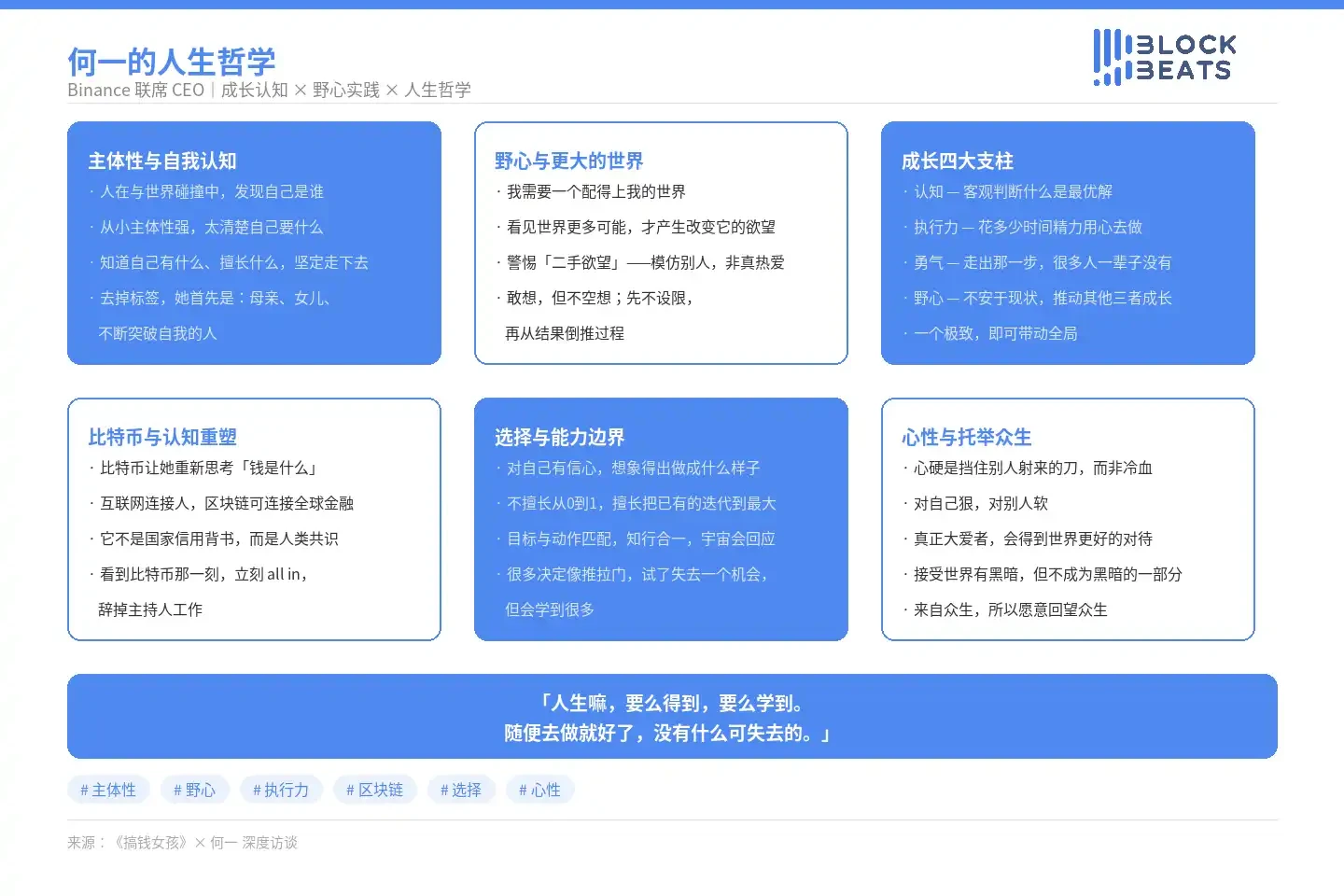
Highlights of Insightful Points
On Subjectivity and Self-awareness
· "People do not exist in isolation; one discovers who they are through every interaction and conflict with the world. You learn more about yourself through each interaction, how you face it, and how you handle it."
· "I believe that I have had a strong sense of subjectivity since childhood; I know very clearly what I want."
· "Why is it that only city kids can like beautiful things or flowers and grass? Why can't I?"
· "Do you really know what you have and what you don't, what you are good at and what you are not, and can you steadfastly walk down that path, even if you have to face challenges?"
On Ambition and a Larger World
· "I might have always been somewhat ambitious, always feeling that I need a world that matches my worth."
· "When you see parts of the world that you want to try to change, you'll hope for a bigger world and want to test it out."
· "Often, our desires are second-hand desires, merely imitating what others do."
· "You must dare to dream, but not fantasize. Do not set limits, then work backward from the results to the process."
On Cognition, Execution, Courage, and Ambition
· "The so-called four pillars are cognition, execution, courage, and ambition. If one part is extremely developed, it will promote the growth of the other parts. If two parts grow, they may further propel you forward."
· "Understanding yourself is whether you can objectively judge if this is your optimal solution and whether you truly enjoy it, even if it doesn’t make money, you would still want to keep doing it."
· "Execution isn’t just about doing it; it's about how much time and energy you spend working on it. Are you truly dedicated? Can you accept the long and arduous self-iteration before success?"
· "Many people think they understand a lot, only to blame their failures on bad luck, yet they may not even have the courage to take that first step."
· "If you truly love it, you'll find that doing what you love comes effortlessly."
On Bitcoin and Reshaping Financial Cognition
· "Bitcoin made me rethink what money really is, which moves me the most."
· "If the internet can connect people around the world, then there can also be a trusted network that connects global finance."
· "It's not money printed by a country or government based on credit, but rather a human consensus."
· "The moment I saw Bitcoin, I felt it was the right direction, and I wanted to enter this circle and do this thing."
On Choices, Missions, and Boundaries of Ability
· "I am confident in myself. If I join BINANCE, I can figure out what I can do, and it will become a world-class platform. It’s just a matter of time."
· "I might not be the best at creating something new from scratch, but I'm great at continuously optimizing and iterating something that already exists to its maximum potential."
· "Everyone's vision of who they want to be and where they want to go will eventually be answered by the universe; you just need to align your intentions with your actions."
· "Many decisions in this world are like sliding doors; once made, they can still be reversed. It's okay to try; you might lose an opportunity, but you will learn a lot."
On Success, Character, and Lifting Ordinary People
· "Being tough doesn't mean being cold-blooded towards others; it means you can stand firm against different opinions and the knives others throw your way."
· "I am quite tough on myself but soft towards others."
· "If there truly exists a hand of God in this world, it will treat those who genuinely care about this world better."
· "This world has both darkness and light; you must accept that it is part of the world, but that doesn’t mean you choose to be part of the darkness."
· "In life, you either gain or you learn; just do what you want without fear of losing anything."
Without all social labels, who are you?
It's Xiao Hui: Today, I am in Hong Kong interviewing a woman who can be described as legendary. She was born in a rural area of Yibin, Sichuan, and later found herself unexpectedly becoming an outdoor host for a tourism channel, and then she became known as "Customer Service Xiao He" in the blockchain industry. Now, her latest title is co-CEO of BINANCE, the world's largest blockchain trading platform and ecosystem.
Life can indeed take such an unexpected turn, which makes me curious about how she grew up. Today, we welcome He Yi, co-CEO of BINANCE. Welcome, Big Sister.
He Yi: Hello everyone, I am He Yi from BINANCE, and you can also call me Customer Service Xiao He.
It's Xiao Hui: Most people envision a CEO or female president to be very domineering and charismatic, but you have a gentle and approachable demeanor. So today, I'm curious to look back and see how "Xiao He" gradually became the current Big Sister.
Recently, there's been a popular self-introduction trend: If you strip away all social labels, how would you introduce yourself?
He Yi: I think first and foremost, I am a mother, a daughter, and a person who constantly breaks through himself.
It's Xiao Hui: That's a very simple expression. As for me, I feel like I need a lot of external judgments and dimensions. If I can't define myself, I wonder how others would define me. For instance, I've probably received a lot of feedback saying that I'm an approachable person because I do interviews, and people often say I can help them open up.
But that's also how others see me, and it seems I really need others' confirmations to determine who I am.
He Yi: That might indicate you're in the process of exploring life. People do not exist in isolation; one discovers who they are through every interaction and conflict with the world. You learn more about yourself through each interaction, how you face it, and how you handle it. It shows you're still young, still vibrant.
The "Second Child Law" taught He Yi to actively strive from a young age
It's Xiao Hui: Before I came here, I learned that you and I have a similar point: you have three siblings, you're the second child, and I'm the third. There's a phenomenon in psychology called the "Second Child Law," which reminds me of my second sister.
My second sister's personality is quite the opposite of yours; she is more domineering, flamboyant, and mischievous, which would trouble our parents; while I'm the more obedient type, making me feel more like a "daughter." I wonder if looking back, as the second child in your family, does this position leave a mark on your personality?
He Yi: I think it’s quite evident. Because I now have three children myself. Generally, when the first child is born, parents will pour a lot of attention and care into them; a little sneeze makes them nervous, so the first child receives all the love, the most love. By the time the second child arrives, people often say, "Raise the first child according to the book, and let the second child grow." The parents are less worried. They know how to handle a sick child, so they aren't as anxious.
The third child, usually the baby of the family, tends to be spoiled, and everyone dotes on them. So growing up, parents would definitely tell the elder sister, "You need to be considerate of your younger brother." Even if you don't compete, they will reflexively tell you to give in to your younger brother. The elder has assured love, the youngest also has assured love, while the second child has to fight for their own otherwise they will feel forgotten.
Additionally, sometimes what children call rebellion is actually a cry for help. As a result, they might also be more independent and self-driven.
The early awakening of subjectivity: Crying to go to primary school at age 4, ultimately admitted outside the norm
It's Xiao Hui: At what moment did you decide that you needed to fight for those things?
He Yi: My earliest memory is probably that I wanted to go to school at the age of 4. Because my sister is six years older, she was already in primary school when I was 4. I would think, "why can my sister go to school, but I can't?" So every day, I'd be at home shouting that I wanted to go to school, annoying the adults until they eventually took me to school.
My primary school homeroom teacher was a friend of my parents. He asked how old I was, and my parents lied, saying I was 6. At that time, they didn’t check IDs or bring any household registration, so they thought they’d just talk about it later, saying if my grades weren’t good, we could hold me back. So, I was tossed into school. I never repeated a grade and my grades were pretty good.
It's Xiao Hui: Because you wanted to do something, you were able to succeed at it. This may be your personality trait: you are very brave in expressing what you want. If the current environment is not what you desire, you feel the need to find an appropriate one.
He Yi: I also have a very vivid childhood memory. Since my family lived in the countryside, there were wildflowers and grasses everywhere. When I was in elementary school, I would go out every day to pick wildflowers, and my mom would laugh, saying how rural kids could love these flowers. To them, wildflowers and grasses were common and not worth attention; they thought this might be a privilege for city children.
But I have a very clear memory of thinking: Why can only city kids like beautiful things, like flowers and grasses? Why can't I?
I think this might reflect my active change or insistence on my own identity. With today’s popular terminology, it's called having a strong sense of subjectivity; my self-awareness awakened early, and perhaps I am inherently rebellious.
It's Xiao Hui: I have a similar experience. I was a left-hander and wrote with my left hand. At one point, my parents tried to switch me to being right-handed, but I was lucky because my kindergarten teacher was more open-minded, saying it was okay to let me continue since my writing was good. There was even a common belief that left-handed people are smarter, so the teacher protected my preference and my parents accepted it.
However, I was also quite stubborn about not changing. They asked me to switch, but I refused. They never approached me with harsher methods. For you, did your parents apply more freedom, or was there environmental pressure?
He Yi: My mom was very strict. But I think since childhood, I have had a strong sense of subjectivity; I was very clear about myself.
One outrageous thing I did before I turned 10 was gambling. Like, betting one dime with older kids. Later, when I lost and didn't have any pocket money, I lost 5 yuan. When my mom found out, I got a severe beating. In Sichuan, the bamboo branches hurt a lot. After beating me, she asked, "Do you want to keep playing?" I said no.
But then I thought, wait a minute, I still owe money. One must be trustworthy, so what do I do about the 5 yuan I owe? So, I found another group to continue playing and got caught by my mom again and got another beating. But by then, I was already in the process of paying off my debt, slowly starting to win back the money. After I paid off the debt, I never gambled again.
By the time I was under 10, I understood gambling: if you lose, you want to win it back, and if you win, you want to keep winning; it is endless. Therefore, I have absolutely no interest in gambling, perhaps I was
免责声明:本文章仅代表作者个人观点,不代表本平台的立场和观点。本文章仅供信息分享,不构成对任何人的任何投资建议。用户与作者之间的任何争议,与本平台无关。如网页中刊载的文章或图片涉及侵权,请提供相关的权利证明和身份证明发送邮件到support@aicoin.com,本平台相关工作人员将会进行核查。


