Written by: Silicon Valley Alan Walker
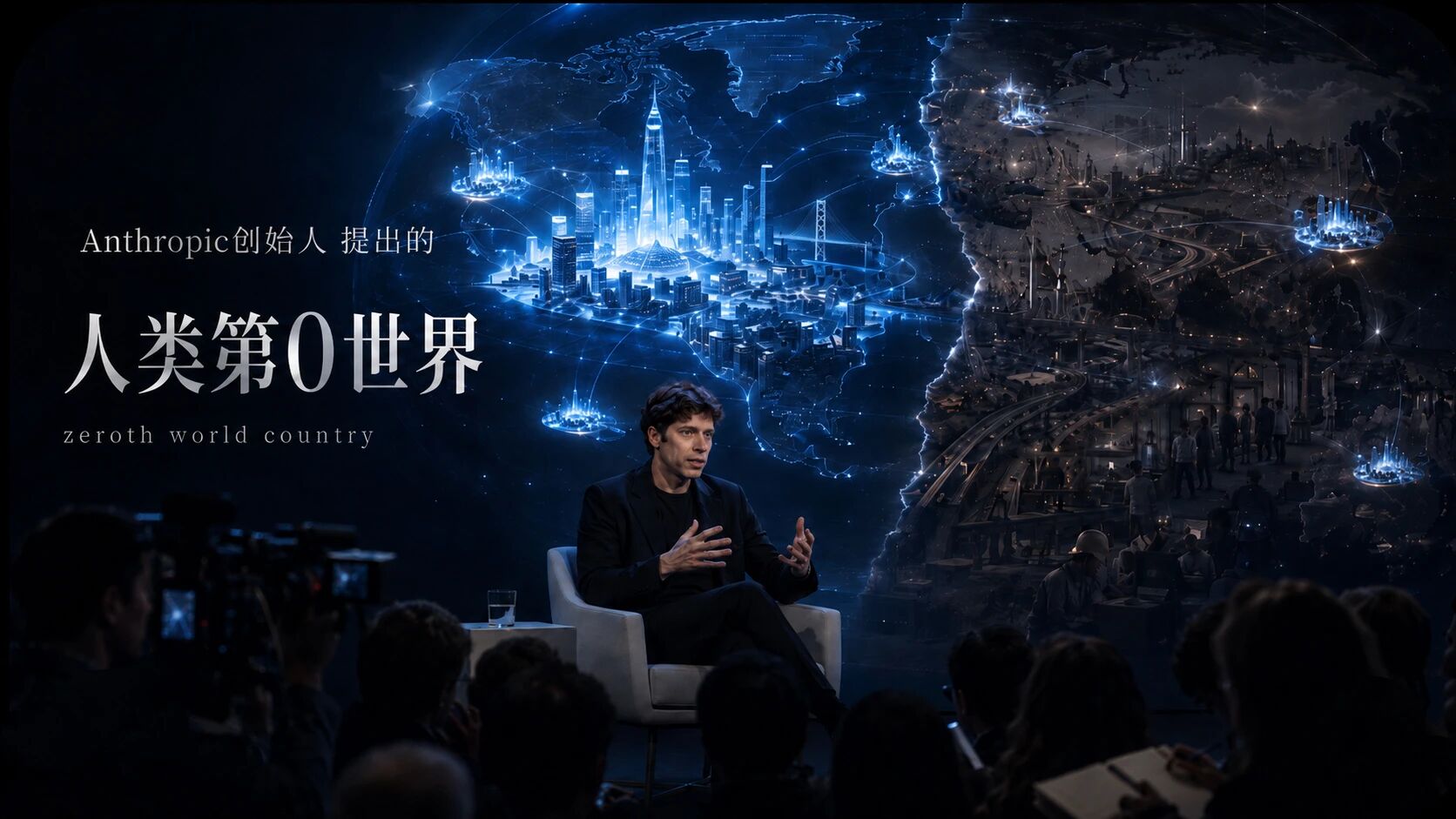
On January 20, 2026, Dario Amodei accepted an exclusive interview with The Wall Street Journal in Davos. During the 30-minute conversation, he spent most of the time discussing a chilling judgment: this round of AI will not bring about the traditional concept of "technological dividends - job growth - trickle-down effect," but rather divide human society in half — he used a new term called "zeroth world country," directly translated as "zero world country" — a "country within a country" consisting of about 10 million people, substantially decoupled from other human economic systems: 7 million in the Silicon Valley Bay Area, and another 3 million scattered around the globe. There, the GDP growth rate could be 50%, while the outside world only has 10%, 5%, or even lower. Dario emphasized repeatedly: this is a "nightmare," a "dystopia," but according to the current trajectory, it is emerging at a visible speed.
This article provides an in-depth interpretation of eight segments revolving around this concept — why the "zero world" exists, what it actually is, and how Silicon Valley people should view themselves.
01 - What exactly is the "zero world"?
Everyone should not rush to think if the "zero world" is the "lowest layer." This is the semantic intuitive error most ordinary people easily make. In the Chinese context, "zero" sounds like "nothing," like "lowest rank." But Dario uses "zeroth," where in the traditions of English computer science and mathematics, indexing starts from 0 — array[0] is the first, the foremost, the topmost element. Therefore, the "zero world" is not a slum that comes under the "third world," but rather, precisely the opposite: it is a new top layer that has been extricated from the "first world," floating above all existing class hierarchies. It completely vacates the classification of "first, second, and third world," a Cold War legacy, because it is no longer in the same economic gravitational field as them.
Dario's specific number is very interesting — 10 million people. Not 100 million, not 1 million. This magnitude sits precisely between a "city-state's population" and "a medium-sized industrial nation." Singapore has 6 million, Israel 10 million, Switzerland 9 million.
In other words, what he is describing is not an "elite class" (that concept is too classical), nor is it a "tech bubble circle" (too light), but rather a de facto new country — with its own division of labor, production relations, consumption preferences, and even language habits (like constantly talking about agentic, context window, RLHF). He even provided the geographic coordinates: 7 million in the Bay Area and 3 million distributed elsewhere. This is not an abstract metaphor; it is a map that has already been drawn, just waiting for history to color it in.

02 - The First Principle of Anthropology: Why This Time the Tool Revolution "Tears Apart" Civilization
From an anthropological perspective, the definition of humans has never been "thinking beings," but rather "tool-making beings" — Latin Homo faber. Every major tool revolution — stone tools, bronze, iron, steam, electricity — has redefined human hierarchies. This is not new; it has been repeatedly played out since the Neolithic revolution around 10,000 B.C. But there is an iron law that has never been broken before: regardless of how hierarchies split, everyone still remains in the same exchange network. Landlords need serfs to farm, factory owners need workers to operate machines, Wall Street needs the global supply chain to provide real collateral for its financial games. There are "asymmetric dependencies" between upstream and downstream, but ultimately they are interdependent.
What is different this time with AI is that it may allow the small group at the top to no longer need the downstream. When a 7 million strong Bay Area is paired with hundreds of millions of AI agents, theoretically its knowledge output, software supply, R&D capability, and even (once combined with robots) physical execution capability could be self-circulating. It’s like a tribe suddenly learning to communicate directly with the divine without priests — the priestly class is not oppressed but rendered irrelevant. Anthropologist Marshall Sahlins spoke of a concept: "structural irrelevance." This is far scarier than exploitation. The exploited are at least within the system; the irrelevant are forgotten by the system. The reason Dario's nightmare scenario is so chilling is essentially this: it is not 99% being exploited by 1%, but rather 1% simply scratching 99% off the map.
03 - The First Principle of the History of Science: Why Our Eyes Cannot Understand Exponential Curves
Dario repeatedly emphasized one statement in the interview — "the intelligence Moore's Law" (Moore's law for intelligence). He said he has looked at this curve for 15 years, and it is disturbingly smooth, doubling every three to six months. Yet public opinion fluctuates like an ECG — one moment "AI will destroy the world," and the next "AI has hit a wall and is in a bubble," oscillating back and forth every six months. His judgment is: the technology curve has not changed; what has changed is the human brain's perception accuracy of it. There are many precedents for this in the history of science. Ray Kurzweil repeatedly proves in "The Singularity Is Near" that the human brain is inherently designed to predict the future through linear extrapolation, while technological evolution is geometric. When a linear brain looks at a geometric curve, it feels "so-so" in the early stages, and then "suddenly explodes" later — in reality, it has been consistently climbing at its own pace.
Scientific philosopher Thomas Kuhn’s theory of "paradigm shifts" does not apply well here because Kuhn assumed epistemological "breaks." The peculiarity of AI lies in its continuity — there is no break, only a day-to-day, numbing accumulation. This leads to a very harsh conclusion: the zero class does not arrive suddenly on a certain day; it has quietly solidified since the night of AlexNet in 2012 at a rate of 0.1% per day.
You sit on California Ave drinking coffee, and across the street in a building full of 28-year-olds, their true productivity is fifty times yours, yet you can't feel it, because they still look like they are wearing Patagonia fleece jackets, ordering the same oat lattes. The real gap masked by this superficial similarity is precisely the insidious destructiveness of the exponential curve.
04 - High GDP Growth + High Unemployment, the First Time in Human History
Dario threw out a judgment that made all traditional economists cringe — "the characteristic of this technology is high GDP growth + high unemployment + high inequality." He said this combination "is logically not contradictory, but has almost never occurred in history." Why? Because steam engines, electricity, computers, and the internet — the script of each technological revolution goes: old jobs disappear → new jobs emerge → total employment does not decrease but increases. The Luddites smashed weaving machines, but textile workers later became railroad engineers, auto workers, programmers. Labor is always absorbed back into the economy. Economists call this "elastic recovery of the labor market."
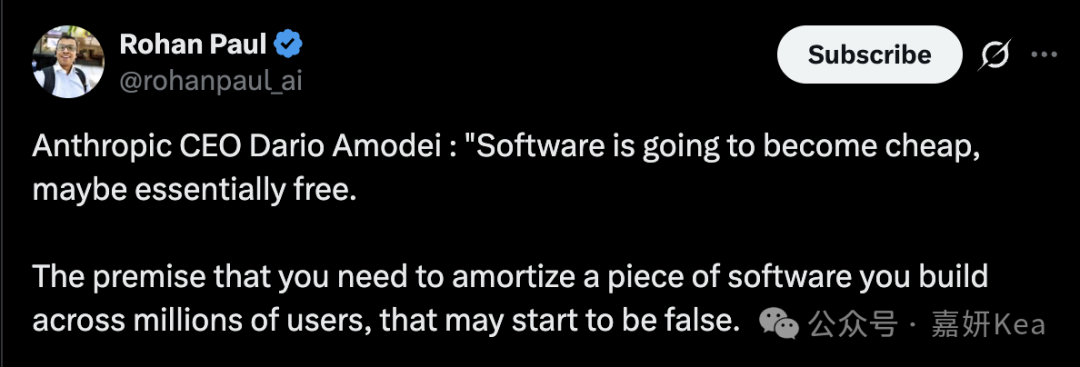
Why might AI break this iron law? The core lies in one sentence: Dario said, "Software will become almost free" — software is about to become cheap, even essentially free. The premise of "spreading the cost of a software over millions of users" may no longer hold. For this meeting's needs, it might only cost a few cents to have it create an app for everyone to chat — it is that flexible and that reusable.
From the first principles of economics, this means bringing the marginal cost of "software," as a factor of production, down to zero. When the marginal cost of a production factor drops to zero, all jobs, all company moats, all wage structures built around it collapse. This is not unemployment; it is an ontological crisis regarding employment itself. If Marx were alive today, he would have to rewrite "Capital" — because his labor theory of value presupposed that labor is scarce. AI renders cognitive labor no longer scarce, marking the greatest foundation collapse in economics in 200 years.
05 - What Remains for Humans When Production is Outsourced to Machines?
This is my favorite segment from the interview — an audience member asked how K-12 education should change in the AI era, and Dario's answer was not "teach programming" or "teach prompt engineering," but rather a very classical phrase: "Education should return to the tradition of shaping a person itself, shaping character, making people richer."
This sounds like self-help talk, but it carries the weight of a 2500-year philosophical struggle. Aristotle distinguished between two kinds of activities in "Nicomachean Ethics": poiesis (making, producing) and praxis (action, practical doing). He said, the dignity of a free man is not in poiesis (that is what slaves do), but in praxis — that is, the practice of virtue is itself the purpose, not a means.
The modernization of the past 200 years has completely reversed this. We define humans as "producers," judging their worth solely by their GDP contributions. Dario is subtly and gently bringing Aristotle back here. Heidegger refers to a term in "The Question Concerning Technology": Gestell (framework/setting), meaning technology is not a neutral tool; it frames the world (including humans) as callable resources. AI takes this framework to the extreme — the cognitive labor of humans becomes a resource that can be called upon by AI. At this point, if a person's entire value is vested in "I can calculate faster than others" or "I can write code," they become an object of technical setting, and their existence is hollowed out.
The true depth of Dario's proposal of the "zero world" lies not in economic disconnection, but in ontological disconnection: people in the zero world, because of deep symbiosis with AI, retain a space for "praxis" (they can engage in taste, make judgments, and navigate complex human decisions); while those left outside, if they continue to define themselves as "producers," will discover they are nothing.
06 - Why Do "Claude-pilled" Individuals and Those Who Have Never Encountered AI Have Different Brains?
A Wall Street Journal reporter used a particularly precise term — "Claude-pilled" (brainwashed/enlightened by Claude). This term describes a restructuring of cognitive architecture from a cognitive psychology perspective. A person who has extensively used agentic AI for 6 months has shifted their "thought" process from "I want → I do" to "I want → let the agent do → I evaluate → let the agent adjust." This is a third system beyond Daniel Kahneman's System 1 / System 2 — System 3: outsourcing to callable cognitive tools. Once your brain structurally connects to this system, you can't go back. Asking you to rewrite code, research, or make spreadsheets word by word is as painful as asking a modern person to do arithmetic with an abacus.
This explains another data point Dario mentioned in the interview: why startups use AI rapidly, while traditional businesses lag. On the surface, it's an "organizational agility" issue, but at a deeper level, it's a generational difference in cognitive architecture. A 26-year-old Silicon Valley engineer has grown up in a System 3 world since college; it is his mother tongue; whereas a 52-year-old middle manager from a Fortune 500 company needs to actively reshape cognitive habits he has used for 30 years, an undertaking as challenging as learning a foreign language with a completely different tonal system as an adult. Adding in the psychological endowment effect — the irrational high valuation people have of skills they already possess — allows us to understand why many very intelligent individuals firmly believe "AI is just so-so"; they are not foolish, but are protecting their 30 years of accumulated psychological assets.
Once this psychological gap forms, it will reinforce economic and geographical gaps, ultimately solidifying the distance between the "zero world" and others into an almost irreversible structure over the next 5 to 10 years.
07 - Why Is It "It" That Created the Zero World, Not Other Technologies?
From the technical characteristics of AI itself, it possesses four features that no other technological revolution has ever had simultaneously; these four features combined create a perfect crucible tailored for the "zero world." First, recursive self-improvement: AI writes code to train the next generation of AI, Dario himself stated that Claude Cowork was created using Claude in just a week and a half. This means the speed of improvement is positively correlated with usage density — those who use it more and whose feedback data enters the next generation model will run faster.
Second, the marginal cost approaches zero: one pharmaceutical factory can only produce one drug, while an AI model can serve as a lawyer, doctor, programmer, and copywriter simultaneously. Third, the extreme geographical concentration of infrastructure: TSMC's 5nm production line, Nvidia's design, Anthropic/OpenAI/Google's training clusters — the concentration of these resources is even more exaggerated than in the oil era of Texas. Fourth, the localized gathering of talent networks: the density of AI engineers in the Bay Area is over 10 times that of the second highest city. Throwing these four characteristics into the sociological "cumulative advantage model" (Matthew Effect), you will find it is a perfect positive feedback loop: the Bay Area uses it earliest → their data trains the next generation of models → the next generation of models double the productivity of Bay Area residents → more capital flows into the Bay Area → the Bay Area siphons more global AI talent → creates a denser collaboration network → uses it more intensively → repeats N times.

Dario mentioned "catch-up growth" in traditional economics as the theory of developing countries catching up with developed countries — technology can disseminate, can be imitated, can be caught up with. But this theory may fail in the AI era: imitators always imitate the "previous generation," while the zero class relies on innovations from "future future generations." When the speed of iteration surpasses the speed of catching up, the gap becomes a cliff. This is also why Dario said his real concern is not between countries but between different regions within a country — a Mississippi state may never catch up with a Palo Alto. Within a country, Palo Alto versus Mississippi is the microcosm of the zero world versus others.
08 - What to Do? Dario's Three-Step Prescriptions and Honest Words from Silicon Valley OGs
Dario’s solution is divided into three steps, worthy of close interpretation. The first step is measurement (Anthropic Economic Index): without clear terrain, any policy is like a blind person touching an elephant. This step corresponds to the first principle of the scientific method — observe first, then hypothesize, then intervene. The second step is adaptation: getting people to quickly learn to use, transition, and move; especially anticipating, "physical world jobs will be more stable than knowledge jobs." Translated, this means: jobs like plumbing, nursing, and gardening, which were once looked down upon, may be more stable than being an "AI trainer." The third step — also the one he’s genuinely stepping out on — is government redistribution. His exact words were, "If GDP grows so fast, the pie will become very large; the problem is not a lack of money, but how to divide it." He even said a serious thing: "Ideology cannot withstand reality." Today’s seemingly dichotomous policy stances will evolve into a bipartisan consensus in five years, because reality will force everyone to adapt.
Alan has been in Silicon Valley for nearly 30 years, witnessing the dot-com bubble, mobile internet, Web 2.0, SaaS, and has heard similar prophecies with each "revolution." But this time, he candidly admits he is unsure. In previous instances, the benefits of revolution ultimately trickled down to ordinary people — your mother called an Uber with a smartphone, your grandfather bought a hearing aid on Amazon. In this round of AI, he is doubting for the first time: the trickle-down effect may genuinely not happen because there is no "worker" layer to transmit the benefits. AI has directly eliminated producers, and while the pie has grown, the conveyor belt between the pie and most people has been severed.
So I summarize, Dario's "zero world" is not alarmist; it is an early warning map drawn in advance for all of us. Seeing this map, Silicon Valley people have two choices: one is to run headlong into the zero world, enjoying a 50% GDP growth while pretending not to see the outside world; the second is to actively rebuild the conveyor belt of benefits so that outside people can get on board — through educational restructuring, through the design of economic mobility, and through supporting government redistribution.
The second path is harder, but only the second path ensures that the act of "drinking Sunday coffee in Palo Alto" does not turn into an embarrassing footnote in historical photographs 20 years from now.

免责声明:本文章仅代表作者个人观点,不代表本平台的立场和观点。本文章仅供信息分享,不构成对任何人的任何投资建议。用户与作者之间的任何争议,与本平台无关。如网页中刊载的文章或图片涉及侵权,请提供相关的权利证明和身份证明发送邮件到support@aicoin.com,本平台相关工作人员将会进行核查。


