Author: Plain Language Blockchain
On May 18, 2010, in the early morning, in Jacksonville, Florida, a 28-year-old programmer posted a message on a forum with only 230 members.
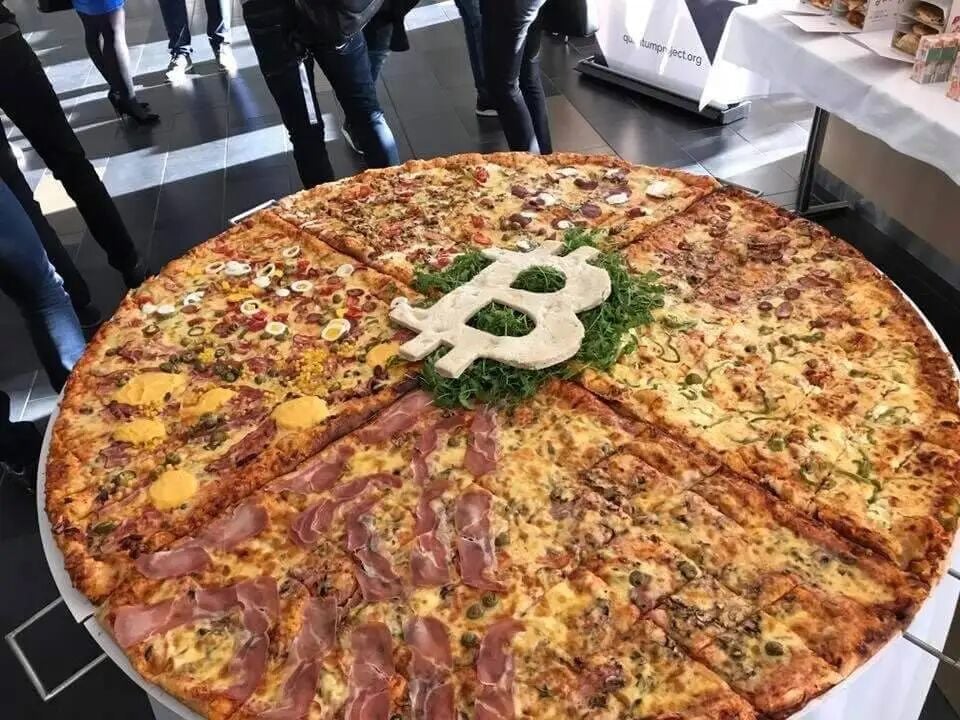
His name is Laszlo Hanyecz. The post stated, willing to offer ten thousand Bitcoins for someone to help order two large pizzas delivered to his house. The toppings should be onions, green peppers, and sausage, absolutely no anchovies.
This was not an impulsive purchase. This was the first complete price discovery in Bitcoin history.
Those two pizzas were a welding rod.
Sixteen years have passed, and the welding rod has moved in completely opposite directions. Back then, those ten thousand Bitcoins were worth 41 dollars, enough to buy two Papa John's. Today, they are worth 780 million dollars, enough to buy a fleet of medium-sized private jets.
And Papa John's is still that same Papa John's, with pizzas still costing tens of dollars each.
Those two pizzas marked the first time a piece of digital code was welded onto the physical world. From that moment on, Bitcoin was no longer just a toy exchanged between miners.
01, The Forum Post That Went Silent for 4 Days
The post went unanswered for 4 days.
With 230 members in the forum, most dispersed outside the United States, ordering pizza from afar had its barriers. Even Hanyecz couldn't help but reply, asking if the offer was too low.
On the fifth day, a 19-year-old student from California saw the post.
His name is Jeremy Sturdivant, and his forum ID is jercos. The two negotiated on IRC, and since Sturdivant did not have a way to settle using Bitcoin, he used his debit card instead to place an order at the Papa John's along Atlantic Avenue in Jacksonville, initially paying about 41 dollars. The pizzas themselves were only worth 25 to 30 dollars.
On May 22, the pizzas were delivered to Hanyecz's home. Hanyecz sent Sturdivant ten thousand Bitcoins, and even added an extra coin as a miner's fee. The 57043rd block of the Bitcoin blockchain forever recorded this transfer of 10001 BTC.
Sturdivant did not hold on to them. When Bitcoin rose to 400 dollars, he exchanged those coins for fiat currency, took a trip with his girlfriend, and upgraded his computer components. At today's prices, the opportunity cost of that trip is 780 million dollars.
Interestingly, Sturdivant never said he regretted it. He later mentioned in an interview that nobody really treated those ten thousand coins as money, but rather as a somewhat interesting experiment.
That was the first time decentralized assets stepped out of the code and landed in a box containing hot pizzas.
02, Hanyecz Was Not a Fool
The mainstream media likes to portray Hanyecz as the greedy fool who lost over a hundred million. This narrative does not hold.
Hanyecz is not a user; he is a developer. He was one of the early code contributors to Bitcoin and the first person in the industry to run a full node on Mac systems. More importantly, he was the first person in the entire network to write GPU mining code and to release it to the community for free.
Entering GPU mining directly paralleled the hashing power, kicking down the door to an entire arms race in mining rigs.
That summer of 2010, the block reward was still 50 BTC, with a very low overall network hash power. Hanyecz set up several GPU miners and mined almost with his eyes closed. His wallet peaked at 43,900 coins in June 2010.
For him, ten thousand Bitcoins were merely the output of 200 blocks.
Thus, the pizza transaction was not a loss for him, but a joyful dimensional arbitrage. Using the digital code he mined at almost zero cost to exchange for hot, substantial food that could fill his stomach. For a geek, this was more thrilling than making money.
He repeated this several times. Throughout that summer of 2010, he exchanged 80,000 to 100,000 Bitcoins for pizza. That wallet was completely emptied by June 2011, with most likely most being transferred to cold storage.
In August, he voluntarily closed the pizza offer. The reason was not regret, but because network hash power had increased, changing the marginal cost of mining Bitcoin.
Looking back at the transaction, he only stated: If no one was willing to take it, Bitcoin would not exist today.
03, Eight Years Later, He Bought Pizza Again
On February 25, 2018, Hanyecz made his move again.
This time he bought two pizzas, spending only 0.00649 Bitcoins, equivalent to about 60 dollars. The payment method had changed, as he used the Lightning Network. At that time, the Lightning Network had just launched its mainnet test, with very few people using it for day-to-day transactions. Once again, Hanyecz played the role of a first adopter.
The mainnet's 1MB blocks and 10-minute block intervals meant only 7 transactions could be processed per second. Such throughput could not support daily high-frequency consumption; when fees increased, buying a cup of coffee was unrealistic.
The Lightning Network moved transactions off-chain, allowing instant settlement with nearly zero fees, only settling with the mainnet when channels opened and closed.
The symbolic significance of this pizza transaction was as heavy as that of the one in 2010. It told the world that Bitcoin could actually handle small, high-frequency consumption scenarios.
However, one old problem remained unsolved: Papa John's itself did not accept Bitcoins. In both transactions, the merchants received fiat currency converted through intermediaries.
The last mile, from 2010 to 2018, was not crossed by anyone.
04, Sixteen Years Later, Pizza Can't Be Bought Anymore
Fast forward to May 2026, the 16th anniversary of Pizza Day.
Bitcoin's price fluctuated between 77,000 and 78,000 dollars. At the beginning of the year, a surge in CPI caused the price to drop from 82,000 dollars to around 76,800, but it was quickly supported by on-chain buying and Nvidia's earnings report.
This is no longer a game for a small forum of 230 people. The number of Bitcoin holders worldwide has surpassed a hundred million.
The most aggressive example is MicroStrategy. This company was transformed into a Bitcoin treasury by Michael Saylor, and as of May 17, it had accumulated 843,700 Bitcoins, accounting for over 4% of total supply, with a book value of 65.3 billion dollars.
Just in the week from May 11 to 17, they added 24,900 more at an average price of 81,000 dollars.
Wall Street's gateway has fully opened. The total scale of all U.S. crypto spot ETFs is nearing 120 billion dollars; just the Bitcoin ETF itself has net assets of 10.3785 billion, with historical net inflows of 5.8718 billion dollars.
Morgan Stanley's newly established MSBT in April has management fees directly hitting 14 basis points, challenging BlackRock's IBIT at 25 basis points. What once relied on forum connections to order a pizza in Jacksonville is now resting in the clearing accounts of traditional brokerages.
05 Summary
The other side of the story is in Africa.
For the ordinary people there, Pizza Day is not a financial joke; it is an awakening from the devaluation of local currencies and the exploitation of cross-border remittances.
Cold wallet manufacturers repeat the same phrase every year on Pizza Day: Not your private key, not your coin.
Hanyecz has never expressed regret. He has said that the meaning of that transaction was never about how much two pizzas were worth.
The Papa John's that was cut into eight pieces has long gone cold, and its box likely ended up in a landfill. But the record of Block 57043 on the blockchain remains.
That welding point still feels warm.
免责声明:本文章仅代表作者个人观点,不代表本平台的立场和观点。本文章仅供信息分享,不构成对任何人的任何投资建议。用户与作者之间的任何争议,与本平台无关。如网页中刊载的文章或图片涉及侵权,请提供相关的权利证明和身份证明发送邮件到support@aicoin.com,本平台相关工作人员将会进行核查。


