The logic of entrepreneurship is being completely restructured by AI.
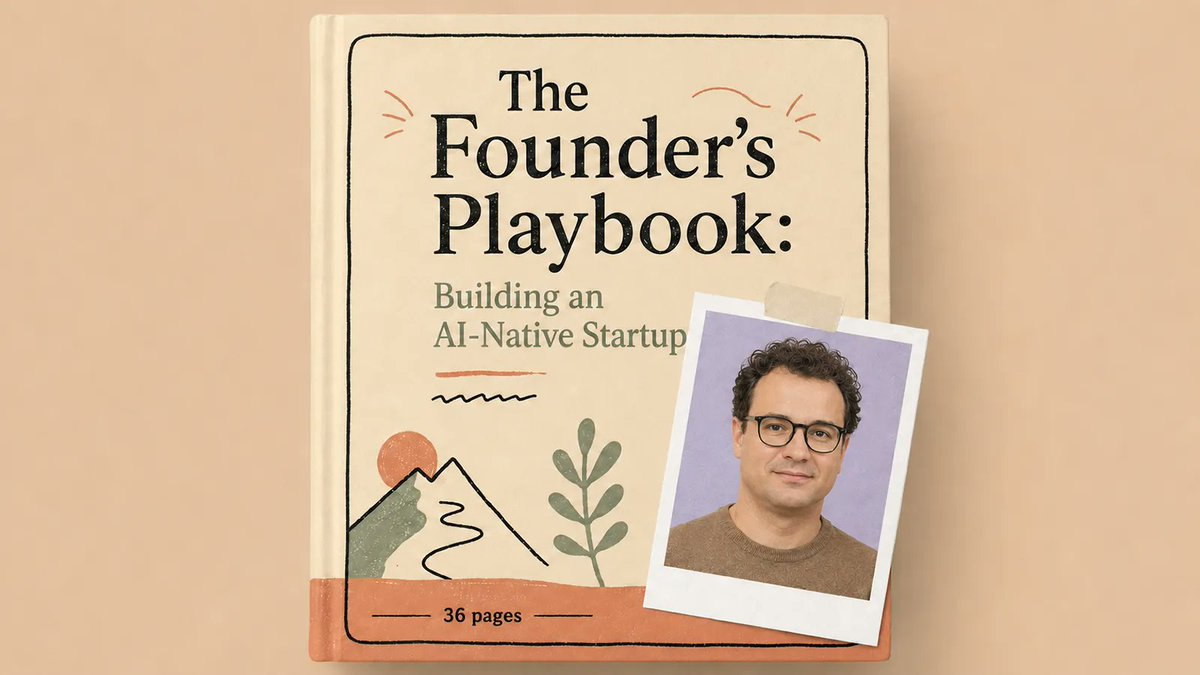
On May 14, Anthropic released a significant publication titled The Founder's Playbook: Building an AI-Native Startup, aimed at entrepreneurs who wish to use AI as the company's infrastructure.
The playbook defines AI-native startups as a brand new species: not traditional companies + a few AI tools, but businesses driven by AI operations from day one.
In Anthropic's description, AI is already able to write production-level code, conduct market research, draft funding materials, and automate operational processes. A lean team of 10 people can independently deliver production-level applications with the help of AI.
The role of the founder is also changing: more like a conductor, orchestrating AI agents to handle execution-level work while focusing on higher-level judgment and decision-making.
The playbook divides the entrepreneurial lifecycle into four stages: Idea → MVP → Launch → Scale, and details the application of AI at each stage, providing entrepreneurs with practical implementation guidance and best practices.
TinTinLand has compiled the essential content to help you grasp the core logic of AI-native entrepreneurship.
📖 Original playbook: https://claude.com/blog/the-founders-playbook
Transformation of the Founder’s Role
The handbook emphasizes that by 2026, AI large models and AI agents will have completely eliminated the high wall between "code builders" and "creative thinkers."
In the past, technical founders were responsible for coding, and business founders were responsible for operations; now even those without engineering backgrounds can use AI to turn ideas into products. Founders do not need to handle everything personally but rather design solutions, make product direction decisions, and delegate repetitive tasks to AI.
👉 This means that in the age of AI, experience and business judgment will be more valuable than pure technical ability, and founders will more often play the role of system architects and curators.
Three Major AI Tools from Claude
Anthropic presents a three-layer matrix of Claude productivity products:
Claude Chat: For interactive conversations and research queries, providing immediate responses to natural language questions, suitable for quick Q&A, brainstorming, and knowledge retrieval;
Claude Code: For automatically generating and iterating production-level code, supporting codebase access, Git integration, and plan modes, suitable for implementing and testing business functions;
Claude Cowork: Focused on automating knowledge-intensive workflows, such as document processing, cross-system integration, and team collaboration, useful for automating operational tasks, information organization, etc.
These tools operate based on the same underlying model, functioning through different workspaces and process designs.
Founders can choose appropriate tools based on the needs of different stages: for example, using Chat during the research stage, Code during the coding stage, and Cowork when building operational systems.
Four Stages of the Entrepreneurial Lifecycle
The handbook categorizes the entrepreneurial process into four stages (Idea, MVP, Launch, Scale), establishing core objectives, exit criteria, typical pitfalls, and AI practice recommendations for each stage.
1️⃣ Idea Stage
Core Question
Is it worth building this product? Before writing the first line of code, the problem must be validated to ensure it genuinely exists, rather than checking if one can develop it.
Stage Criteria
Problem-Solution Fit.
Founders need to address key questions: Is the problem specific and common? Who is experiencing this problem? How do existing solutions perform? Does your solution genuinely address the validated problem?
Typical Challenges
AI makes prototyping incredibly easy, but a working prototype does not equal actual market demand.
The handbook points out that even before AI emerged, 42% of startup failures were due to “building something no one wants”; AI will further amplify this risk. Another pitfall is confirmation bias: letting AI "prove" one's idea, as it will always find supporting evidence.
AI Practices
Use Claude as a “structured devil’s advocate”: have AI challenge your assumptions and help adjust your problem statement.
Utilize Claude Chat or Cowork for market and competitor research: map out the competitive landscape (including why competitors only solve half the problem), distill insights from industry reports and user interviews.
Use Claude Cowork to summarize user interview records and extract key insights, comparing supporting and opposing evidence to discover real needs or refine solutions.
2️⃣ MVP Stage
Core Question
What should be built? The core objective remains to gather evidence, but the focus shifts from problems to solutions: Are there clear users willing to use the product, retain it, pay for it, or recommend it?
Stage Criteria
Early signals of Product-Market Fit.
The “40% Rule” from Sean Ellis can be applied: If more than 40% of active users say they would be “very disappointed” without the product, PMF might be achieved.
Typical Challenges
Technical debt and scope creep. AI accelerates development, making founders prone to overlook architectural design and specifications: unstructured AI code may crash as user growth accelerates. The handbook stresses designing architecture before coding, rather than generating the entire codebase in one go.
Furthermore, due to “zero friction” in feature development, founders easily fall into scope creep, continuously adding features.
AI Practices
Create a persistent project “memory” document (like CLAUDE.md): use Claude to record architectural principles, design trade-offs, and to-do lists, providing context for all future development sessions.
Use Claude Code to complete coding tasks: have it generate the module framework first and then fill in functionalities to keep the code structure clear.
Utilize Claude Cowork to automate user interview processes: from research to feedback, recording and analyzing data throughout.
The emphasis in this stage is on using AI to replace repetitive tasks in the development process, while founders maintain control over product direction.
3️⃣ Launch Stage
Core Question
Can the business grow? This stage focuses on marketing, operations, and compliance.
Stage Criteria
All three elements are in place: growth channels are replicable and measurable (clear CAC, LTV, and payback period), the product supports production load (infrastructure and security compliance are in place), and system reliability has been tested in real scenarios.
Typical Challenges
Acceleration of technical debt accumulation, founders becoming bottlenecks, premature expansion.
As features become complete, latent defects and dependencies will manifest as traffic increases; at the same time, blindly exploring new markets before user feedback dilutes will disrupt existing metrics.
AI Practices
Build an “operating system” for the launch stage, replacing conventional operations with AI workflows:
For example, use Claude Cowork to automate scheduling, update CRMs, generate reports, and promotional content; use Claude Code to audit products and architecture: have it detect potential vulnerabilities and prioritize issues needing repair.
Allow founders to focus on important matters (product decisions, client negotiations, capital planning), delegating repetitive tasks to AI agents.
4️⃣ Scale Stage
Core Question
Is the company sustainable? Ensure that the business can operate stably even as the founders gradually step back.
Stage Criteria
The company reaches a state of sustainable operation: for example, continuous profitability, meeting IPO conditions, or having acquisition potential.
At this point, the organizational structure needs to be refined around different business units, with data-driven decision-making and operational automation becoming the norm.
Typical Challenges
Delegating operational control. Founders must overcome psychological barriers to “delegating,” allowing more daily operations to be handled by AI and teams.
AI eliminates traditional assumptions about team size: Previously, entering a new stage of entrepreneurship required larger teams and more funding, but with AI, a 10-person team can achieve outputs at the level of a large company.
AI Practices
Utilize AI technology to continuously enhance product competitiveness and business models: employ AI for differentiated marketing (tailoring strategies for different audience segments), optimizing operational efficiency, and building user engagement mechanisms (such as creating barriers through data network effects).
In this stage, Claude Chat is used to gain insights into new market opportunities, Claude Code supports system optimization for large-scale use, and Claude Cowork continues to assist in automating various processes.
Conclusion: New Rules for AI Entrepreneurship
At the end of this handbook, Anthropic succinctly summarizes:
“Whether it can be built” is no longer the boundary; “Whether it should be built” is the key.
As everyone can build quickly, the ability to build quickly itself is no longer an advantage. Advantages return to older sources — insights, judgment, and the ability to truly understand a problem and a group of people.
免责声明:本文章仅代表作者个人观点,不代表本平台的立场和观点。本文章仅供信息分享,不构成对任何人的任何投资建议。用户与作者之间的任何争议,与本平台无关。如网页中刊载的文章或图片涉及侵权,请提供相关的权利证明和身份证明发送邮件到support@aicoin.com,本平台相关工作人员将会进行核查。


