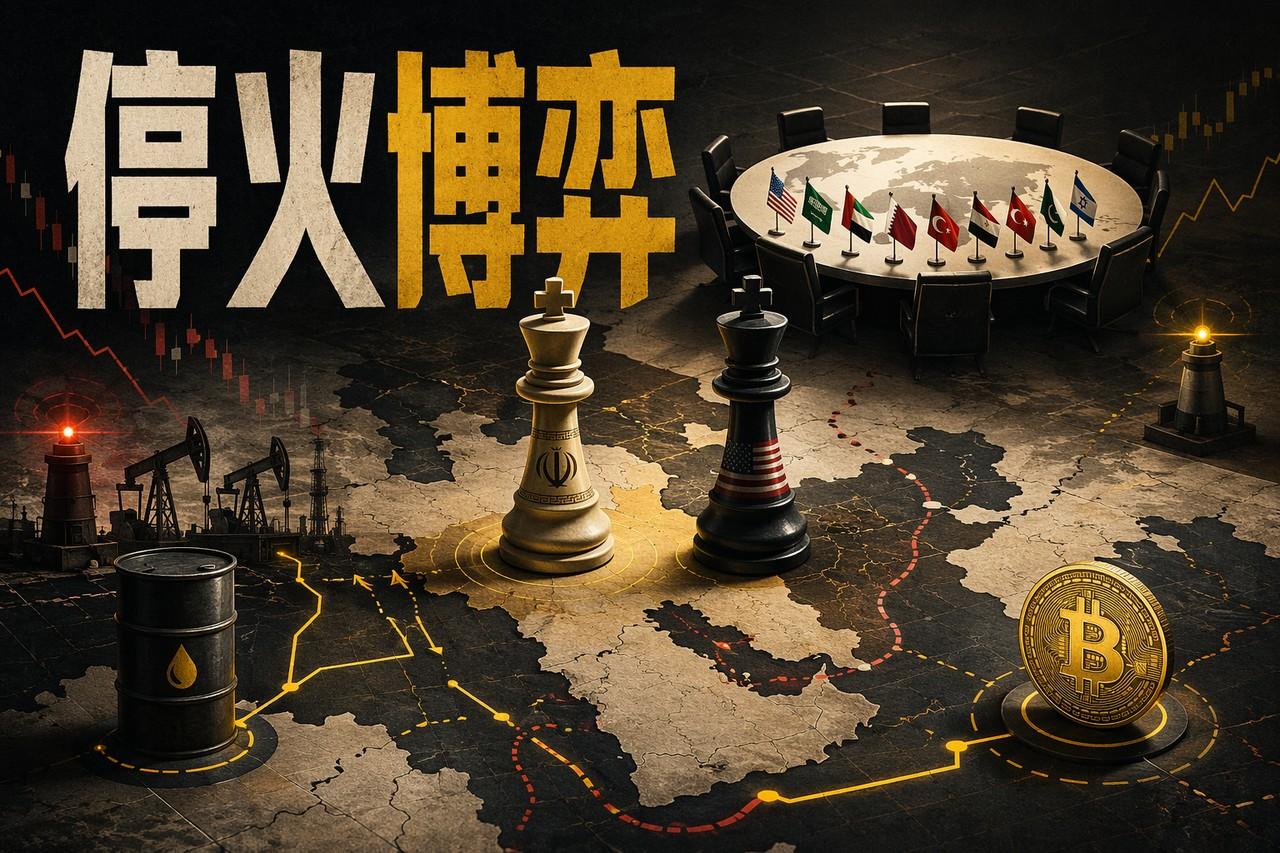
On May 23, 2026, Iranian Foreign Ministry spokesman Baghaei gave a rare optimistic signal in Tehran—after a period of dialogue, the views of the U.S. and Iran "tend to converge," and they are in the final stages of finalizing a memorandum of understanding with the United States. On the same day, in Washington, U.S. Secretary of State Rubio applied the brakes, acknowledging that negotiations "have made some progress" but emphasizing that the extent should not be overstated, as there is still much work to be done. He subtly added that an announcement regarding Iran may be made in the next few days, providing a time anchor for traders betting on macro and risk assets. Earlier, Pakistan's Chief of Army Staff Asim Munir was publicly named by Iran as a "messenger," with one of the core purposes of his visit to Iran being to convey and exchange specific information between the U.S. and Iran, which indicates that this long-standing high-temperature game in the Middle East is being reshaped through a third party. For the market, the issue has never been just "whether there is a memorandum of understanding," but rather: once this document, even partially, alleviates Iran's situation under financial and energy sanctions, how will it rewrite the trajectory of Middle Eastern geopolitical tensions and the risk premium in the Strait of Hormuz, impacting oil price expectations, inflation paths, and U.S. real yields, thereby forcing a repricing of global risk and U.S. dollar liquidity for crypto assets including BTC and ETH.
Pakistan’s Mediation: The Gold Content of U.S.-Iran De-escalation Signals
The technical path toward U.S.-Iran "de-escalation" this time is not about the two nations directly sitting at the same table but about slowly threading the needle through a third party like Pakistan. Iran has publicly named General Asim Munir of the Pakistani Army, whose recent visit to Iran aims to convey and exchange specific information between the U.S. and Iran; transforming the originally high-risk standoff into negotiable topic combinations. Coupled with Iran's long-term narrative of calling the current conflict a "war imposed upon us," this is actually sending a signal to the outside world: it has a subjective desire to end the stalemate but needs a dignified and controllable exit path, which Pakistan provides as a deniable and flexible communication channel.
However, from the comparison of their statements, the assessment of the "success rate" of this path is asymmetrical. Baghaei directly provided the statement "views tend to converge" and "the memorandum of understanding is in the final stages" on May 23, clearly raising the market's subjective valuation of de-escalation probabilities; on the same day, Rubio reminded the public not to overstate the progress and emphasized that "much work remains to be done," effectively pulling this probability back from "close to landing" to "still in the negotiation range." At the current stage, details of the MOU regarding whether it touches upon key issues like sanctions and energy exports have not been made public, so any impact assessment can only remain at the scenario simulation level. But for asset prices, it's enough to trigger a round of re-evaluation based on probability changes—the Middle Eastern geopolitical risk premium is no longer viewed as "constantly high" but instead enters a dynamic range that can be adjusted downward or potentially revert to the original point at any time. For traders, what they should truly pay attention to next is the slope of this "de-escalation probability curve," rather than the memorandum itself that may be reported in some news headline on a given day.
Once the Middle East Cools Down: Repricing of Oil Prices and Inflation Premiums
Once the market believes that this de-escalation will move from text to reality, the first thing to be rewritten will be the "worst-case scenario": the probability of large-scale conflicts in the Middle East and forced disruptions in the Strait of Hormuz will decrease, and the layer of war and shipping disruption premiums that has historically been piled onto oil prices will be gradually squeezed out. Iran itself is one of the important oil-producing countries and has long been at the center of sanctions and blockade narratives. If the geopolitical tension surrounding it decreases, when traders look at the upper space of oil prices, they will shift from "any unexpected event is bullish for the bulls" to "unless another black swan occurs, it is difficult to talk about a new super bull market story." Even if the current negotiations regarding sanctions and energy exports have yet to be publicly disclosed, merely strengthening expectations that "oil supply will not be further disrupted by geopolitics" is sufficient to compress the risk premium in the futures curve, making it harder for the bulls to justify high positions using Middle Eastern stories.
Once the oil price risk premium relaxes, the transmission pathway will directly impact inflation expectations. Energy holds a significant weight in the CPI basket of most economies, and every sharp fluctuation in oil prices will quickly reflect in short-term inflation data and market pricing. Currently, if the risks in the Middle East are re-evaluated, the market's expectations for the "right tail" of inflation paths over the next few years—that panic of re-inflation triggered by energy shocks—will be weakened. The retreat of inflation expectations means there is room to lower the "insurance premium for unpredictable inflation" embedded in nominal interest rates, which directly impacts the macro anchor of real yields within the global asset pricing framework: markets typically measure real yields as "nominal rates minus inflation expectations," and historical experience shows that periods when U.S. real yields decline and inflation risks are suppressed are more likely to be accompanied by repairs in the valuations of risk assets including BTC and ETH, as investors demand lower risk compensation for high-volatility assets and use lower discount rates to price future cash flows and long-term narratives. For on-chain capital, this macro repricing is not just an abstract concept but will manifest in actual position adjustments regarding how much volatility they are willing to bear and how much duration they are willing to stake on crypto assets.
Real Yields and the Direction of the Dollar: What BTC Is Attached To
Energy holds a considerable weight in the CPI basket of most economies, and any upward or downward fluctuations in oil prices will ultimately be translated by the market as adjustments to "inflation expectations." When inflation expectations are contrasted with nominal interest rates, they yield real yields—the key macro anchor for global asset pricing. When geopolitical tensions and energy shocks elevate short- and medium-term inflation expectations, central banks may choose to raise nominal rates to "suppress inflation," or passively accept a compression in real yields if inflation accelerates faster. Conversely, if the market interprets the U.S.-Iran de-escalation as a decrease in Middle Eastern risk premiums and a fallback on oil price tail risks, then future concerns about high inflation will ease, diminishing the impetus for nominal rates to rise, and the central expectation for real yields will also be adjusted downward. All of this will eventually be reflected in the relative attractiveness of dollar and non-dollar assets.
Historical experience shows that phases of rising U.S. real yields and a strengthening dollar often coincide with pressure on risk assets, including BTC and ETH: global funds, in order to secure a little bit of "risk-free real returns," are more willing to return to cash and U.S. Treasuries rather than bear high volatility exposure in the blockchain; when real yields decline and dollar momentum weakens, risk appetite warms, with funds seeking higher expected returns again, leading to an amplification in the valuation elasticity of BTC and ETH. In a scenario of "cooling geopolitical risks + easing inflation tail," if the market establishes a consensus that "real yields have peaked and are now declining," then BTC's narrative as a "geopolitical safe-haven asset" will recede to the background, appearing more like a high-beta risk asset highly sensitive to real rates and dollar direction, with its long and short structure around dollar and traditional assets more likely to be restructured around this macro anchor.
The Shadow of Sanctions and Oil Dollars: How Middle Eastern Funds View On-Chain Assets
Under long-term U.S. financial and energy sanctions, Iran has been locked out of the traditional dollar settlement and cross-border payment system, making any settlement tool that does not rely on interbank and SWIFT inherently attractive for its "constraint-avoiding" appeal. According to public information, various restricted entities have explored using on-chain assets or offshore structures to complete some cross-border payments; while their scale and pathways are opaque, the structural incentive for "de-jurisdiction" is real. If a U.S.-Iran understanding ultimately materializes and financial sanctions ease marginally, Iran's rigid demand for such gray channels may decrease, and some of the "forced on-chain" transaction volume may flow back into the traditional dollar system. However, at the same time, the recovery of oil and gas exports and current account surpluses may bring about entirely new cross-border allocation demands, some of which will navigate towards more compliant and transparent pathways into on-chain dollar assets and BTC and ETH, requiring the market to reprice the "Iran liquidity premium" between these two opposing forces.
Zooming out to the entire oil-producing region of the Middle East, oil prices and war risk premiums are not merely inflation expectations but are also upstream variables determining the scale of "petrodollar circulation": when oil prices are high and premiums thick, the current account surplus becomes more substantial, forcing sovereign and family funds to allocate them between U.S. Treasuries, dollar cash, global equities, and on-chain assets; when oil prices decline and geopolitical tensions ease, surpluses narrow, the amount of absolutely investable dollars decreases, but the "defensive allocation" towards Treasuries will also decline. For on-chain assets, this indicates two layers of adjustments: first, the weight of on-chain dollar assets within Middle Eastern funds' portfolios depends on whether they are perceived as "dollar alternative settlement layers" or "high-volatility risk assets," the former being driven by sanctions and compliance expectations, while the latter is more influenced by global real yields and dollar cycles; second, if more marginal increments within the petrodollar cycle start to be redistributed directly on-chain, the transaction structure and depth of BTC and ETH against dollar assets are likely to be rewritten depending on Middle Eastern funds' preferences for "dollar exposure vs. crypto beta," which will become a key window for observing how U.S.-Iran de-escalation truly alters the liquidity landscape of the cryptocurrency market.
From Memorandum of Understanding to K-Line Reaction: What Traders Should Focus On
The U.S. and Iran have stated they are at the "finalization stage of the memorandum of understanding," but the terms, timetable, and whether it touches on sanctions and energy exports are all in an information vacuum. Rubio, while admitting "some progress has been made," cautioned against overstating it, only providing ambiguous guidance of "news may come in the next few days," indicating that the market is currently pricing the "rising probability of de-escalation" rather than any confirmed outcomes. Traders should view this as a chain: Middle Eastern geopolitical risk premium → oil prices → inflation expectations → real yields → dollar index → BTC/ETH risk premium and on-chain flows. If, in the coming days, oil prices and inflation expectations curves decline simultaneously, while the U.S. yield curve implies a decline in real yields under relatively stable nominal rates, and the dollar index weakens, alongside a renewed correlation between BTC and traditional risk assets like U.S. stocks, and a net inflow of dollars into risk-seeking on-chain addresses or exchanges, then one can more confidently assert that "de-escalation" has been written into asset pricing; conversely, if oil prices and inflation expectations rise instead of fall, the yield curve rises again, and the dollar strengthens, while the crypto market only sees a short-term sentiment surge yet BTC/ETH correlations with traditional risk assets fall, pointing to a preference for risk-averse positions in on-chain dollars, it may resemble noise trading around news headlines rather than a substantial rewrite of the geopolitical landscape. In such a divergent environment, focusing on the resonance and divergence of the aforementioned macro and on-chain indicators will help you judge whether this memorandum of understanding genuinely alters the risk preference structure behind the next K-line more effectively than tracking any news push.
Join our community to discuss and strengthen together!
Official Telegram Community: https://t.me/aicoincn
AiCoin Chinese Twitter: https://x.com/AiCoinzh
OKX Welfare Group: https://aicoin.com/link/chat?cid=l61eM4owQ
Binance Welfare Group: https://aicoin.com/link/chat?cid=ynr7d1P6Z
免责声明:本文章仅代表作者个人观点,不代表本平台的立场和观点。本文章仅供信息分享,不构成对任何人的任何投资建议。用户与作者之间的任何争议,与本平台无关。如网页中刊载的文章或图片涉及侵权,请提供相关的权利证明和身份证明发送邮件到support@aicoin.com,本平台相关工作人员将会进行核查。