Original | Odaily Planet Daily (@OdailyChina)
Author | Wenser (@wenser2010)
The divide between old and new investment markets is accelerating: on one side, the U.S. stock market, Korean index, and Nikkei are all rising sharply, with many hot sectors and individual stocks hitting new highs; on the other side, mainstream cryptocurrencies are fluctuating downward, with BTC spot trading volume down more than 80% since last October.
Despair is spreading among crypto investors as funds flee; practitioners are continuously seeking new answers within construction—initially positioned as a Perp DEX, Hyperliquid has expanded its ecological map to the traditional financial asset domain, with RWA asset trading volume experiencing exponential growth; prediction markets like Polymarket and Kalshi are also starting to warm up to World Cup topics, with monthly trading volumes hitting historic highs—these are the "only two bright spots" in the crypto market and a narrative that has been tested.
What about the CEXs, the industry's liquidity centers? Top players are actively connecting with traditional financial markets and expanding the boundaries of the crypto market. This includes introducing RWA asset trading channels and adding entrances for prediction markets. The common goal of these initiatives is to address the shared issues of liquidity fragmentation in the crypto market, the separation of user experience, and low capital utilization rates.
New asset launches and increasing entrances are certainly necessary parts of industry development, but some hope to find new paths and construct a new way of industry building. Recently, OKX's launch of Exchange OS has revealed a new possibility: activating the industry ecosystem by redefining "market creation rights".
As the narrative of crypto assets runs dry, CEXs actively seek change
Let's detail the major structural problems facing the current crypto market:
First, the crypto market has no new stories. Previous cycles of public chains, NFTs, and DAOs have been continuously debunked, DeFi security incidents occur frequently, the BTC ecosystem is moving towards stagnation, meme coins and AI agent concept coins remain stagnant, and concepts like Desci and payment protocols like x402, as well as the recent Uniswap V4 Hook ecosystem, have failed to generate sustainable momentum.
Second, the liquidity in the crypto market is fragmented. Users are trapped in closed DApps and protocol islands, facing complex and costly frictional costs among different chains, platforms, applications, and protocols with no solutions in sight.
Third, the crypto market is "self-contained." Although ETFs and DAT for mainstream coins have opened up channels between crypto and traditional finance, both the capital capacity and the high risk and volatility of crypto assets further hinder efficient and convenient exchanges and circulation between the two. The crypto market is increasingly trapped in a situation of self-indulgence among practitioners.
Over the past decade or so, the crypto industry has achieved decentralized value transfer through Bitcoin, started decentralized asset issuance through Ethereum, and opened up decentralized financial liquidity through AMM protocols, but the old answers clearly cannot be adapted to the new stage.
Because of this, new industry samples are gradually emerging: on-chain Perp DEXs like Hyperliquid and Aster have opened up the ceiling of derivative assets; Polymarket and Kalshi have scaled the social behavior of "predictions" into the financial pricing system; RWA platforms like Ondo go further by packaging traditional on-chain assets into derivative assets.
In the face of the impact of emerging markets, many industry players have made different choices: Binance recently launched "Event Rush"; Bitget launched its self-developed RWA protocol product Reality, directly linking U.S. stock liquidity and supporting dividends; Bybit has continuously launched perpetual contracts for CSCO, RKLB, etc., and has introduced various airdrop activities. However, while most platforms remain focused on listing more RWAs (including U.S. pre-market assets) to maintain traffic, OKX has taken a series of completely opposite actions. From its product release rhythm in recent months, its market role has gradually upgraded from a single "product builder" to a "system explorer":
1. Agent Trade Kit: Aiming to solve the issue of "machine trading" in the AI era, facilitating users to execute on-chain actions through a native AI trading suite that allows AI agents to connect.
2. APP Payment Protocol (Agent Payments Protocol): Aims to define the on-chain payment standards for AI agents, so that the liquidity of crypto assets is no longer limited by complex wallet operations, allowing AI agent payments to be extended as part of business processes and supporting multiple payment models.
3. Exchange OS: An open trading protocol built on the X Layer, realizing a "protocolized" upgrade of capabilities such as matching, clearing, settlement, and unified accounts, supporting users to independently deploy spot, perpetual contracts, and prediction markets, covering CEX assets and Web3 on-chain markets.
If the Agent Trade Kit is an effort at the infrastructure and tools level, the launch of the APP Payment Protocol and Exchange OS showcases OKX's greater ambition. As a leading exchange, it has not chosen to "break through" on the asset level, but aims at a strategic approach that balances tactics and overarching goals. With the launch of Exchange OS, it represents CEX's attempt to bypass the old question of "which assets to list," instead pondering "who are the creators of the new market" as a key proposition.
OKX is dismantling the core "trading black box" of crypto exchanges and lowering it to the protocol level, pushing the crypto industry from a centralized pattern back into a dynamic state of decentralization.
With the protocol-level capabilities of Exchange OS, the vision of equitable access on-chain can be realized, and users' "market creation rights" will be further activated. At that time, quantitative teams can open perpetual markets based on arbitrage opportunities, RWA institutions can bundle assets such as stocks, private equity shares, and equity in unlisted companies into on-chain assets, and individual users can list a verifiable social event as a prediction market contract.
Meanwhile, cross-market unified accounts will integrate fragmented liquidity, enhancing capital utilization efficiency. Regarding the security of funds and the assurance of mechanisms, "code-level guarantees" ensure that funds are locked in protocol contracts, preventing market creators from opening back doors or engaging in theft. The design of OKX's self-operated markets and external markets adhering to the same protocol rules also creates a model for on-chain equity.
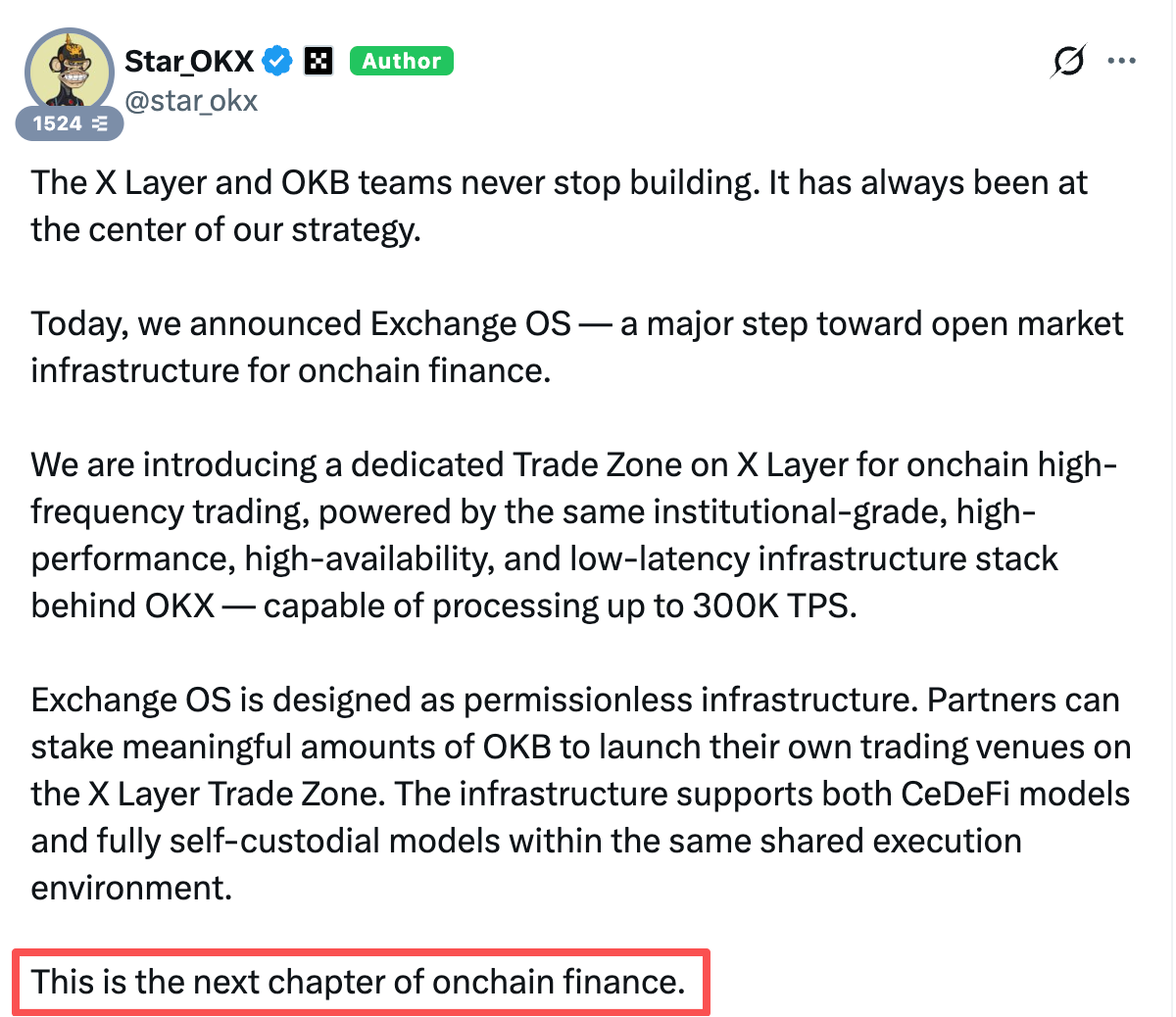
OKX CEO Star also expressed great expectations for the vision of Exchange OS, stating : "The next chapter of on-chain finance should not be written by any single platform; it should be co-authored by everyone who wants to build a market."
A New Industry Coordinate: The Emergence of a "Crypto Version of the App Store"
In the past, powers regarding asset types, asset categories, and asset pricing were all held by CEX platforms, while users and institutions could only abide by the platform's rules without the ability to express opinions on or urge changes to those rules; however, with the deep coupling of TradFi assets with CeFi and DeFi assets, asset types and asset issuance modes are no longer scarce resources. The true threshold is whether "market creation rights" can be allocated to various participating entities.
Now, as long as an event is verifiable, it can theoretically be transformed into an independent event market through the Exchange OS protocol, systematically reshaping the thresholds for financial participation and market pricing power.
Just like the iOS system activated the vibrant developer ecosystem of the App Store, the underlying trading operating system of Exchange OS is also expected to unleash the creativity of quantitative teams, RWA institutions, developers, and even ordinary individual users. It addresses not only the question of "who will create the market," but also further expands the boundaries of the crypto market, representing an important step in breaking the operational capacity ceiling of past CEX platforms.
Based on this transformation, the production relations of the crypto market will also be reconstructed.
From "Universal Investment" to "Comprehensive Production"
The main line of evolution in the crypto market is: a leap from productivity transformation to production relations transformation.
In the early stages of the industry, blockchain technology solved the productivity issue of "how to issue assets" (How to Launch a Token);
In the second stage, various crypto ETF assets emerged, transforming cryptocurrencies into intermediary currencies linking "traditional financial assets." The productivity was further released, and production relations regressed from the decentralized era to being controlled by centralized institutions;
In the third stage, the emergence of U.S. stock assets, commodities, and event contracts enriched the choices of asset types and investment targets, but the issues that the crypto industry needs to address shifted to "how to efficiently establish market organizational forms."
In this context, market participants, including retail traders, CEX platform users, and cryptocurrency investors, must inevitably undergo a "role upgrade"—they need to transition from passive acceptors and investors of platform assets to "producers" who define market rules and innovate market gameplay. Composite asset markets such as prediction markets, RWA assets, and U.S. pre-market assets will quickly emerge through various "marketization APIs".
However, opportunity corresponds to challenge. OKX's attempts to expand the boundaries of the crypto industry and explore the future of on-chain finance will inevitably face a series of trials. For the Exchange OS protocol and all of OKX’s products to become the "AppStore of the crypto world," it still depends on whether the following key points can be突破:
● First, the liquidity problem. In the early stages of the market ecosystem, can the activation of liquidity achieve ecological reflexivity, and build an economic closed loop based on spontaneous trading demands within the ecology?
● Second, performance capacity limits. Despite the support of technical foundations such as millisecond-level matching delays, unified settlement, and a processing capability of up to 300,000 TPS, how can the X Layer ecosystem support a staggering number of "financial applications" while maintaining stability in the long term?
● Third, the self-sustaining economic loop. Creating an internal economic closed loop similar to "Apple App Store-Apple applications-Apple tax" is quite challenging. Can the Exchange OS ecosystem form an effective feedback mechanism like "Hyperliquid - HLP treasury - HYPE buyback - HYPE price support"?
Certainly, the existence of various challenges only proves the necessity of industry development; many problems are often resolved by confronting challenges repeatedly. Even if short-term setbacks occur, the steadfast steps toward the right direction are commendable. Based on OKX's past brand heritage, market position, technical strength, and product capabilities, the long-term vision of "everything is a market" is undoubtedly promising for the future.
An Industry Experiment Requiring Courage, A Ticket to a New Era
As major industry players with a massive user base, the various attempts by platforms like OKX seem somewhat "a thankless task" in the current market environment—if successful, no one will praise them; it will be taken for granted as a business act; if they fail, they will inevitably face ridicule and won't escape the criticisms prevalent in the intensely competitive industry.
The narrative quickly fading always comes with a time, and someone must choose a different path, taking on the responsibility of "pushing the industry forward," exploring, experimenting, and taking risks without preconditions for return.
I believe that the future of the crypto field lies not merely in how many new tokens are launched, but in how many barriers to financial investment it smoothens and how many efficient, fair, and open trading markets it creates. The future direction that industry players should explore should not only aim at finding the next hot spot or seizing a momentary news headline but rather focus on establishing a fundamental trading operation system that accommodates asset flow and realizes financial autonomy.
Exchange OS and more industry attempts are forward-looking experiments in the realm of the transformation of production relations in the crypto world. In a certain sense, it serves as a ticket to the era of "everything is a market" and represents a high-profile return to the ideals of "decentralization, openness, and liberalism" inherent in crypto spirit.
Whoever can define the new trading coordinate system will win the future dominance of crypto and even global finance.
免责声明:本文章仅代表作者个人观点,不代表本平台的立场和观点。本文章仅供信息分享,不构成对任何人的任何投资建议。用户与作者之间的任何争议,与本平台无关。如网页中刊载的文章或图片涉及侵权,请提供相关的权利证明和身份证明发送邮件到support@aicoin.com,本平台相关工作人员将会进行核查。


