Written by: MiM
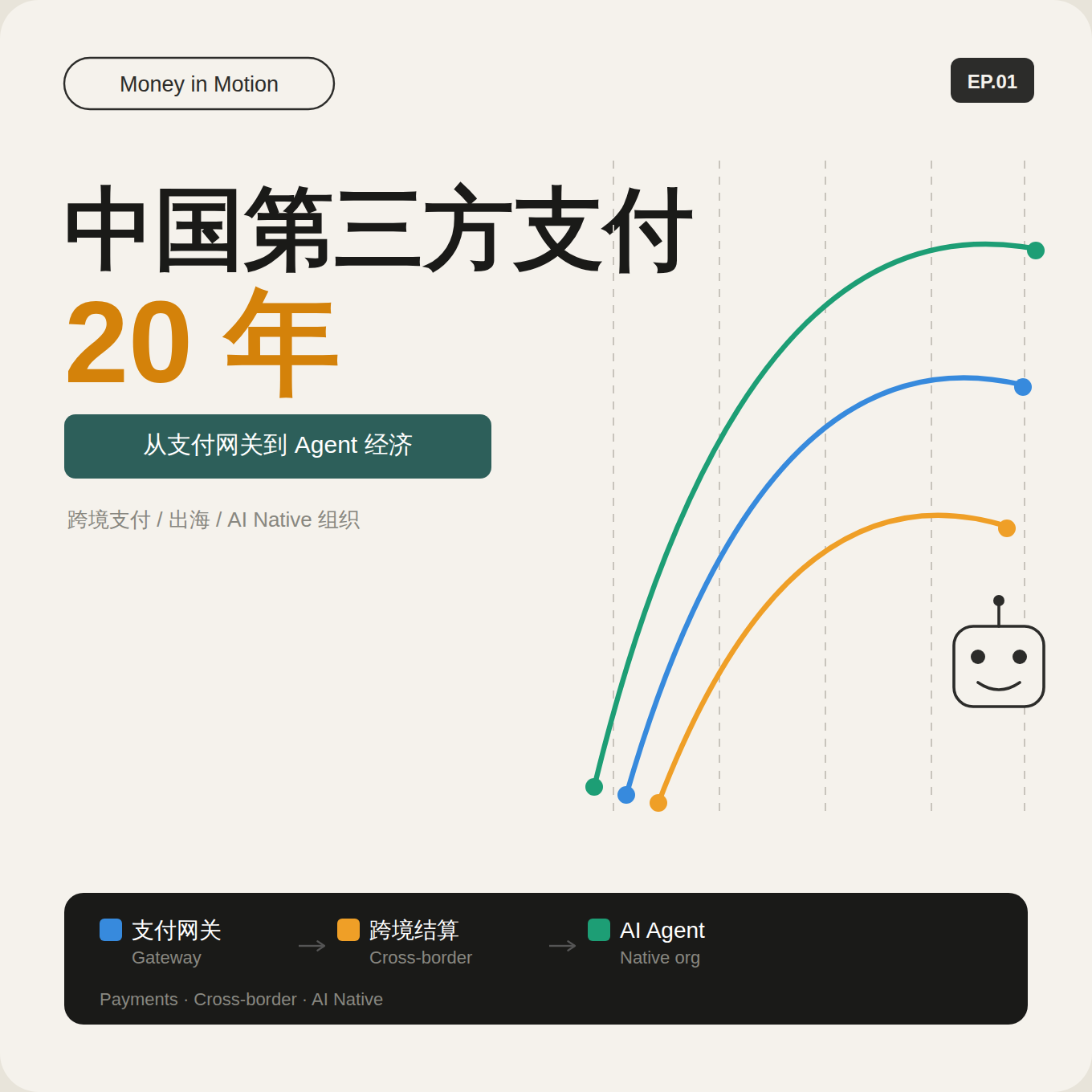
Hello everyone, welcome to Money in Motion. This is a podcast focusing on "how money flows." We will discuss payments, cross-border settlements, financial infrastructure, and the people and companies that truly drive capital movement globally. Who is taking risks? Who is providing liquidity? Who is solving the last-mile problems? And who is quietly reconstructing the global payment network? Money in Motion aims to break down these seemingly complex financial infrastructure issues back into real transactions, real demands, and real business models.
This is the first episode of Money in Motion. In this episode, we will see a snapshot of the Chinese payment industry over the past twenty years, from gateway companies to QR code payments, from innovative openings to regulatory contractions, from a saturated domestic market to exploring overseas markets—this context is worth carefully reviewing. Mr. Wu Wei has been in this industry for twenty-one years, witnessing its inception when the industry hardly existed, through its explosion, differentiation, and contraction. Today, we are fortunate to have him as our first guest, not just because he has witnessed this history, but also because he is still deeply pondering this matter—both grounded and constantly questioning.
A witness to an industry is also a thinker about its future. We feel that this dialogue is very suitable as an opening.
This episode's guest: Wu Wei (Partner and COO of a leading national payment company, 21 years in the industry) Hosts: Will & Yuki (Co-founders of Money in Motion) The views expressed in this article only represent the guest's personal opinions and do not reflect the views of the guest's organization or this media.
1. Origin of the Industry and Entry Experience
1.1 Entry into the Industry
Host: Mr. Wu has been in the payment industry for twenty-one years. At least for me, I was still young twenty-one years ago. Could you please introduce yourself briefly, Mr. Wu? Wu Wei: Hello everyone, I am Wu Wei. I have been in the payment industry for twenty-one years. I often joke that when I started, the industry hardly existed, and now, after so long, the industry is about to enter another contraction period. I am currently a partner and COO at a payment company in Beijing.
Host: Mr. Wu, what prompted you to enter the payment industry? Wu Wei: I graduated in 2004 and started a business with my classmates in Xiamen, focusing on OA—based on an open-source software system, primarily responsible for localization and domestic promotion. One of my partners had a forward-thinking idea: software should be free, and services should be chargeable. I was responsible for sales and often faced skepticism from clients—how could enterprise data be stored on a university student's server? We said we rented from a telecom company, and they replied, isn’t that still under your management? In fact, that was the early stage of the cloud.
After about two years, I was recommended to a company in Beijing—this company had both China Mobile and China UnionPay as shareholders. They wanted to develop mobile payments, with the main product being the "mobile wallet," where the core concept was to bind mobile phone numbers with bank cards. However, the binding process was quite cumbersome; users had to go to a bank branch in person, swipe their debit card, enter their password, and input their phone number to complete the binding, making promotions challenging. In May 2007, I was dispatched to Shanghai to take over the telecom operator’s MAS project—Mobile Agent Server. At that time, the Ministry of Industry and Information Technology required the standardization of financial-related SMS sending, insisting that bank service messages could only be sent through dedicated short numbers, allowing users to distinguish authenticity. We were responsible for the development, sales, and deployment of this system.
Later, as one of the founding core members, I co-founded F Payment Company.
1.2 The Initial Appearance of Payment
Host: Could you talk about the state and ecology of payment companies when they just started? Wu Wei: It should be around the time after the internet bubble burst, around 2003. People started to shift from purely informational websites to e-commerce, and as the value of goods and services began to be exchanged, they encountered payment settlement issues. At that time, even the banking infrastructure was not yet complete; online banking was just beginning. If you wanted to sell something on your website, you basically had to open corporate accounts with almost all mainstream banks, apply for B2C payment gateways one by one, then integrate, reconcile, process refunds, and handle customer complaints yourself. This was simply impractical for many internet startups.
Thus, "gateway companies" emerged. According to today's regulatory definitions, their essence is actually that of "large merchants"—using one technology company to open accounts with all banks, integrating all gateways, and once receiving payments, reconciling accounts before distributing to various merchants.
At that time, almost all merchants’ funds were tied up in the accounts of the gateway companies; lacking regulation meant that if a company went bankrupt, everyone would suffer losses. Around 2003, there were already seven or eight relatively mainstream payment companies being established. One detail I remember vividly: in 2006 or 2007, I visited the headquarters of Pudong Development Bank and ran into an old colleague. He asked about our transaction volume, which was approximately 600 million RMB per month at the time—we thought it was a huge number. Now, 600 million in a day is relatively small—such was the era.
Host: You mentioned the risks of gateway companies. How were licensing standards and classifications at that time? Wu Wei: By around 2009-2010, as gateway companies developed, regulators started to think that this needed to be formally regulated. In 2010, the People's Bank of China issued the "Measures for the Administration of Payment Services by Non-Financial Institutions," requiring non-financial institutions involved in payment services to obtain licenses. At that time, obtaining a license wasn’t very difficult; as long as the capital requirements were met and companies prepared according to the management measures, most companies could get one. After three batches, nearly 270 companies had obtained various payment licenses. The classification method was actually quite strange and was based on payment methods—for instance, those using bank cards were called acquiring licenses, those using online banking for B2C were called internet payment licenses, and those for IVR voice needed phone payment licenses, along with TV payment licenses and mobile payment licenses.
Later on, phone payment and TV payment businesses failed to develop, while internet payment became a larger and broader concept, ultimately encompassing everything else, resulting in three categories: card issuing (prepaid card) licenses, acquiring licenses, and internet payment licenses.
Looking back, this might have been the most tolerant and open stage our government and regulators have had concerning financial innovation in the past thirty years.
Subsequently, through the disillusionment of P2P, the downfall of cash loans, and large-scale rectifications of internet microloans and local financing leasing in recent years—among these industries, payment has managed to achieve a "soft landing" and continue to thrive. In that era, the industry entered a rapid growth phase of ten years.
2. Ten Years of the Chinese Payment Industry: Explosion, Differentiation, and Restructuring
2.1 Explosion
Host: What types or scenarios of business started to explode during the explosion period from 2010 to 2020? Which business scenarios began to contract, especially after 2020? Wu Wei: The online and offline aspects should be discussed separately. For offline prepaid cards, the initial commercial logic was very clear: after issuing cards, the funds could be reused, cards could have an expiration date, and the remaining value would be a significant profit.
Prepaid cards are essentially a gift card market—those who buy the cards do not use them, while those who use the cards do not buy them, leading to significant unclaimed value accumulation.
Once the volume of card issuance was substantial, it also significantly enhanced negotiating power with merchants—whether my card could be used at your place directly affected your sales. I remember a prepaid card company in Nanjing had commission rates with merchants that could reach up to 15%, plus a remaining value rate of around 17%, which was very lucrative. However, once the management measures for prepaid cards were formally implemented, the industry was basically sentenced to death—no longer able to utilize the pooled funds, the commercial logic collapsed. Later, many companies used prepaid cards to issue fake invoices; after their invoicing qualifications were restricted, this segment essentially disappeared.
In offline acquiring, once payment companies obtained their licenses, they could clear funds by themselves; the industry generally adopted an agency model for rapid expansion, with agents piling up in the thousands, spreading to cities, counties, and towns. Speaking of agent operations, there was a very common behavior of price manipulation: the state offered differentiated pricing for different industries—restaurant and hotel sectors had about a 0.2% fee, retail around 0.1%, and flights and supermarkets about 0.5%. When agents went out to expand, they would use convenience store licenses to register restaurant or hotel merchants in order to quote externally at the lower 0.1% fee, while in actuality charging a higher 0.2%, with the price difference being their arbitrage profit. Regulation was lenient at that time, and banks were desperately completing card issuance targets, with credit card approval standards being quite loose.
As for online, after consumer habits transitioned entirely to Alipay and WeChat, other payment companies lost control over the user interface, merely providing a layer of technical bridging. The online payment market saw a concentration between the two main players, possibly capturing over 90% of the market. During that decade, apart from payments themselves, various sectors such as P2P, internet finance, and consumer finance also saw an explosion—P2P needed payment, custody, and escrow services, all of which provided a wave of business for payment companies. However, later the overall collapse of P2P and the restructuring of consumer finance resulted in the disappearance of income for payment companies serving those sectors.
2.2 Differentiation
Host: How would you classify and layer the entire payment industry? Wu Wei: Generally, it can be divided into three categories:
- The first category is the C-end, which is in the form of wallets, already highly concentrated, dominated by a duopoly supplemented by major companies’ internal ecosystems.
- The second category is B-end standardized acquiring, which provides relatively standardized payment tools to merchants—POS systems, aggregated codes, SDK interfaces, etc. Overall, everyone is struggling in this area, and it will be impossible to reach a trillion in scale; inevitably, these companies will exit in the next three to five years.
- The third category is industrial payments, which are deeply customized and integrated according to industry characteristics—such as multi-party settlements in travel, payment for cross-border e-commerce, and special capital flows in the medical sector. The fate of industrial payments is tied to the industries they serve—travel will not disappear, and payment companies serving the travel industry will still have living space; however, if P2P collapses, all payment companies servicing P2P will lose their revenue as well.
Host: Following this P2P industrial payment question, there’s a saying in the industry that "the end of payment is lending." What is your view on this statement? Wu Wei: I do not see it this way. I prefer to understand payment companies as logistics companies—you can have a relatively inefficient government monopoly form like the postal service, or you can have a nascent but vibrant model like four major express delivery services, or gradually evolve into a refined, high-end model like SF Express, even extending to specialized logistics like biopharmaceutical cold chains.
The payment industry is the same. "The end of payment is lending," in my view, is more about internet companies arbitraging the Chinese financial regulatory system by leveraging their traffic and data advantages. Banks have a lot of restrictive layers; for instance, applying for a credit card requires "three relatives to meet," and now they cannot even issue cards without personal face-to-face meetings, photos, and signatures—this constrains industry development to some extent, but it also creates arbitrage opportunities for internet companies.
However, we cannot completely apply an efficiency-first logic to say that banks should be eliminated just because they are inefficient—because major corporations monopolizing traffic and data will significantly reduce the survival space for banks, and we must also consider public interests and regulatory balance. Efficiency itself must be evaluated through fairness and justice, and ultimately is a judgment rooted in a political foundation.
2.3 Regulatory Tightening
Host: Since 2020, the regulatory landscape has begun to reshape the industry. What impact has this change had on payment companies? Wu Wei: The tightening of regulation began as early as 2018-2019 with the disillusionment of P2P; it’s not just payment but the entire financial industry facing increased scrutiny. The biggest issue this brings is shrinking space for innovation and trial-and-error. If we look back at those gateway companies from around 2003, many of them would be held accountable by today’s standards. However, it was precisely because there was enough margin for error in that era that we have today’s overall landscape of the Chinese payment system. Currently, there are probably less than 150 companies still in continuous growth, which means over 120 out of the 270 have already disappeared. Regulations demand that single legal entities should not possess two licenses; originally, groups like Ping An and HNA had multiple licenses, which now requires either selling or merging them—such as how F Payment Company held both the internet payment and bank card acquiring licenses, while F Financial Company held the prepaid card license; we initially split due to regulatory compliance, only to later be required to merge back.
Host: Would this lead to very high thresholds for new entrepreneurs entering the industry, potentially stifling innovation? Or does this area no longer require much innovation? Wu Wei: That’s a good question. In the payment industry, I struggle to think of any business model that could radically innovate the industry—it has basically become an industry with almost no profits, and the space for innovation is very limited. If one truly wants to innovate, they should look for opportunities in new industries and new markets.
I believe we should encourage companies that have formed scale, characteristics, and structured foundations to restore complete capabilities, grow bigger and stronger; for those without scale or characteristics, there should be a reference to the ST system on the stock market to promote accelerated eliminations. A company unable to survive that refuses to exit willingly will generate a lot of gray and black transactions to maintain cash flow, complicating regulatory challenges and tarnishing the industry’s reputation.
Boiling a frog in warm water for five more years, time has passed, living in despair and confusion every day—for young professionals, this is quite cruel.
3. Cross-Border Payments: From Amazon Sellers' Receivables to the Belt and Road Initiative
3.1 The Starting Point of Chinese Cross-Border Payments
Host: Earlier, we talked about Chinese payments, and I know that Mr. Wu was also responsible for the cross-border payment sector. From which year did this area start to show signs? Wu Wei: I believe it might have been after the 2008 Olympics, around 2012-2013. At that time, China’s cross-border B2C e-commerce began to rise rapidly, with many Chinese sellers opening stores on Amazon, which required a service to provide an account for receiving payments from Amazon.
At that time, a representative company was P Company, which provided foreign virtual accounts for sellers. However, after receiving that money, a channel was needed to send it back home; the early player doing this was Fuyou Payment. At that time, P Company and Alibaba International were two major clients of F Payment Company, helping them exchange dollars back into RMB domestically.
Almost all cross-border businesses of Chinese payment companies began from this type of "distribution."
Later, P Company realized that purely focusing on distribution brought very thin profits and that they never had any customer interface. So when their channel business grew large enough, they boldly entered the collection phase (receiving payments overseas). Host: How did the business chain and pattern of cross-border payments evolve? Wu Wei: It is mainly composed of three segments:
- The first segment is overseas collection (Collection), helping Chinese sellers receive payments from Marketplaces, somewhat akin to domestic payment gateways;
- The second segment is cross-border fund distribution, sending funds from overseas back to the domestic market;
- The third segment is B2B trade settlement, generally known as regular trade, which has seen the fastest growth in recent years.
In the past three years, the development of Chinese payment companies in the direction of cross-border B2B has been the most significant. On one hand, China has actively sought alternative export markets beyond Europe and the US over the past five years; on the other hand, there’s a rapid increase in small currency demands from countries along the Belt and Road Initiative—whether it's Brazilian reais, Nigerian naira, or Russian rubles, trade in these regions is quite active, but payment supply is severely lacking, with foreign exchange controls, liquidity shortages, and high currency fluctuations making this a high-friction world which means high premiums and presents great opportunities for Chinese payment companies.
Overall, the annual trade scale of B2C cross-border e-commerce is only about 2 to 2.5 trillion RMB, while China's total international trade is nearing 8 trillion USD; service trade and general trade are the spaces that have truly not been fully covered yet.
3.2 Challenges in Cross-Border Payments
Host: Considering the challenges in cross-border payments, especially in markets along the Belt and Road Initiative, how do you view some of the irregularities? Wu Wei: This involves a very real yet sensitive topic. In the practice of cross-border trade, there is a common phenomenon: a batch of goods exported from China has a Chinese price tag of one hundred thousand dollars, but upon arrival, the importer only declares ten thousand dollars—this is a request from the importer to reduce their local import tariffs. In the context of the US initiating a trade war, a large number of low-value goods continue to flow in through this channel; in countries along the Belt and Road, local governments are financially weak with insufficient foreign reserves, and the competitiveness of importers precisely comes from their ability to declare taxes using "dual clearances" and reducing declared values. I think a significant portion of China’s foreign trade competitiveness comes from a full range of industrial systems and energy cost advantages, but at least about 20% of the competitiveness actually stems from such non-compliant operations. If customs in both countries truly achieve data exchange, where import and export declared values align perfectly, trade along the Belt and Road will immediately suffer a huge shock.
Thus, the essence of this question is: do you prioritize face or substance? I believe that preserving substance first allows for the strength to discuss face later.
Foreign trade merchants' acceptance of Stablecoin is often passive—they do not actively seek it, but rather buyers ask, "Can I pay you with USDC?" Domestic reception of these payment methods is not welcoming; many exporters would first receive funds through entities in Hong Kong and handle the capital backflow separately. In other words, the penetration of stablecoins in cross-border trade is being forced from the buyer's side to the seller's, rather than being actively pushed from the supply side.
Host: Combining challenges in cross-border payments, do you think blockchain or Stablecoin can genuinely resolve these issues? Wu Wei: I think these are actually two different matters. Blockchain as a technology has great advantages, but its advantages should manifest more in governance—if it's used as a new production tool or to coordinate production relations by authoritative or regulatory agencies, then that’s of great value. However, from a purely commercial utility perspective, removing the speculative use of Bitcoin, the hype around various altcoins, and the bubbles from numerous NFTs, what has truly played a clear and stable role as an intermediate channel in international settlements to this day is Stablecoin—replacing the model nested within agent banks, its efficiency is already quite significant. Even if it merely acts as a "bridge," removing speculative, money laundering, or illicit transactions, simply as a normal tool, the efficiency of Stablecoin has already surpassed that outdated financial infrastructure of Swift. It will face many twists and turns, but this direction itself will not change.
4. Future Outlook of the Chinese Payment Industry
4.1 Future Outlook
Host: Since you later went to Y Payment Company, one of the largest payment companies in the country, from a strategic standpoint, what kind of path will the payment industry take in the future? Wu Wei: The company has two strategies, one being internationalization and the other being intelligence enhancement. Its mission is to "become a leading transaction service provider of the era"—"era" implies constantly adapting to various changes: political changes, economic changes, technological changes, shifts in consumer habits, and industry changes. Today’s era presents three obvious characteristics:
- First, the turbulent geopolitical landscape;
- Second, Chinese enterprises and services must actively seek international markets;
- Third, the restructuring of productivity and production relations driven by intelligence, which is something almost all companies have to face.
In my eyes, this company is unique among independent payment companies for its comprehensive development. Its acquiring business ranks first domestically, the financial sector should be second domestically, and its international cross-border arm has consistently ranked first concerning distribution. Consumer payments originally were about 350 billion; this year it should reach 600 billion, with hopes to surpass 1 trillion by 2028, breaking into the top five. It has achieved scale in every niche market it has entered, and this diversification brings resilience against risks, which is much stronger than that of a singularly-focused company.
Host: From the industry’s perspective, how many independent payment companies do you think will survive in the end? Wu Wei: About five years ago, I conducted a calculation based on the total capacity of China’s payment market and the rates of each niche market, deriving that maintaining a single company’s normal operation requires significant capital and financial capabilities. Eventually, the number of entities that each niche market can sustain is extremely limited. I estimate that there will not be more than three in internet payments, a maximum of 10 to 12 in offline acquiring, and around 5 to 7 in cross-border payments. However, our company happens to have placements across several fields, and a few other firms also cover two to three, like encountering an all-rounded academic genius, leaving you little recourse. Overall, excluding subsidiaries of state-owned or national enterprises and internet giants’ self-operated payments, only three to five independent payment companies will probably remain in the market after this cleansing process needs another three to five years to complete.
Host: What advantages do you think these Chinese payment institutions possess in terms of international competitiveness compared to overseas payment companies? Wu Wei: The advantage of Chinese payment companies essentially boils down to Chinese people's advantages—diligence, intelligence, love for innovation and breakthroughs, enduring a rigorous market baptism full of challenges; this resilience is itself a competitive edge.
However, the biggest issue faced when going overseas is how everyone understands the concept of "going abroad."
One understanding is exporting products—after obtaining licenses in certain places, setting up an operational center to serve still online major clients or internet promotions without needing real localization. Another is true-localization based, establishing a business network locally to integrate into the local ecosystem. I know company O is doing quite well in Nigeria; it’s a good example, but it actually doesn’t have a deep background in China’s payment industry—they took a truly localized route.
Most Chinese payment companies have yet to make this determination—the earliest batch of people going abroad was those who ventured to the South Seas, elite in local economies, relying on genuine integration. Most companies still lack this determination.
4.2 Attractiveness of the Payment Industry and Those Years of Crisis
Host: What attracts you to the payment industry? Wu Wei: A predecessor in the payment industry once said: "You see those companies that look fabulous from the outside; they may not be making money; the real profitable ones are often silent." The noise in the world of public opinion and the true profit and loss in business might not relate directly at all—recognizing this is one reason he has stayed in the industry. Payment is closest to money, hence you can see many essential facets of business; the superficial business model and the actual logical foundation you land on often differ completely.
From the industry perspective, payments have two real advantages: First, the characteristics of economies of scale are quite apparent; moving from trillions to two trillion, doubling the scale could only see operational costs increase by 10% to 15%. Second, its reach is the broadest—no emerging industry’s rise would exclude payment companies because payments solve value exchanges; every commercial collaboration ultimately relies on transactions. This means you will always be the first to sense which industries are rising, always have opportunities to learn new things.
Additionally: many are spending too much time living in digital spaces, where 90% of content produced is done by B-end, all with commercial intent. After scrolling through three short videos, one feels like an expert; this phenomenon is scary. However, real business professionals—those who travel around the globe and deal with goods and orders daily—never care how their industry is rated online and never worry about their presence in the media; yet their understanding of industry and international trade is often far deeper.
The payment industry allows you easier access to these individuals.
Host: From your business or personal experiences, are there any events that left a deep impression on you? Whether exciting or tragic? Wu Wei: I feel that over the years of entrepreneurship, I nearly faced failure every year due to various reasons that made me think the company would collapse. Now, I slightly have the calmness of a professional manager, but previously, I was indeed on the brink of life and death every year. There are two instances that stand out strongly. One was at the industry level—the "Pre-Sale Rights Incident," which involved seven or eight payment companies and was a classic case of a compounded fallacy, the systematic risks arising from the overlap of three operational loopholes. The first loophole was lax auditing of agents; using convenience store licenses to register restaurant and hotel merchants to exploit price differences; the second loophole was banks issuing cards too liberally, resulting in many low-limit "empty cards" being purchased in bulk by scalpers; the third loophole was that the UnionPay rules allowed a 15% margin on pre-sale transactions, which seemed reasonable until you consider that, if a card has a limit of only ten yuan, one could first deposit 9990 yuan and then trigger the pre-sale margin rule, dramatically inflating the limit.
When scalpers discovered this flaw, they executed a large-scale "deposit-withdraw" cycle within about a week to manufacture huge amounts of false transaction volume. During settlement, banks noticed an abnormal situation where cards with limits of just a few yuan had generated substantial transaction volumes and identified the anomaly. Ultimately, the losses were fully borne by payment companies, leading to a year-long industry shutdown and rectification, with nearly every branch scrutinized by local regulators; many companies’ licensing qualifications remain incomplete to this day. However, precisely these companies that weathered the storm have been doing quite well in the industry today—illustrating the resilience of these firms.
Another instance was at the technical level—our own database version silently expired, halting around 30 to 50 billion yuan in pending clearances. Fortunately, the issue arose on a Friday night, and we worked from Friday to Monday noon to finally achieve a successful clearance without sleeping for seventy-one hours. That day happened to be my birthday.
5. AI Restructuring Corporate Organizations
5.1 Internal Restructuring with AI
Host: You mentioned AI's impact earlier. I feel AI is now an inevitable topic. We are currently in an explosion phase of AI at an individual level; companies are starting to undertake AI transformations, but the implementation of enterprise agents faces various challenges. Can you share how your company has approached the challenges of implementing enterprise agents?
Wu Wei: After taking on the strategic role in intelligence, I started learning about short video tactics, agent AI, prompt engineering, and after learning a bunch, I realized this method wouldn’t work, so I went to read Hassabis’s work, focusing on the evolution of AI and how talents like Hinton reached today’s state. At that time, I could not even grasp the basic concepts of deep learning; after reviewing this, I had a clearer idea of the current and potential stages of AI.
Back in the enterprise, I think AI's value can be assessed from three angles: First, the most mature and impactful area of AI on businesses to this day is still coding. The efficiency and cost of development and research have always been the biggest constraints for all technology and internet software companies, and AI can provide a substantial leap in quality production capacity in this direction. Once this constraint is removed, you may begin to discover that you simply cannot find demands—previously it was, "please wait for internal needs, I’ll prioritize client demands," but now with speed increases in development, it shifts the issue to whether your demand has any value.
My method is quite simple: observe token rankings, colleagues consuming in the bottom 10% don’t need further explanation, just let them go; for those not ranked in the bottom 10%, I’ll ask where their efforts have been directed. Second, AI should restructure work flows and production relations. There are two common understandings of AI; one is as a co-pilot to enhance employee efficiency, but there exists a rather absurd logic here—companies pass work packages off to employees, and employees pass these onto AI, so what does the company gain? The other approach is to substitute certain agents in existing work flows.
I believe both methods are merely temporary measures of "I don’t know what to do, so let’s do it this way"; long-term, this is a wrong path.
What should truly be done is to establish the subjectivity of agents—starting from first principles, re-questioning: what is the value of this department, this position, this business process? What problems does it solve? Then designing: to better achieve this value, what kind of agent do I need?
For instance, we have merchant auditing, merchant changes, re-recording expired documentation, and compliance reviews triggered after anti-money laundering checks… these should actually be redefined as "full lifecycle management of merchants" as a sub-agent, designed based on dimensions including pricing, risk, and compliance; this is the true AI Native approach. Third, when your production efficiency significantly increases and the organization genuinely becomes AI Native, your market positioning will also change—you will no longer just be a "payment company." At that point, the real challenge will become: how to discover customer demands?
In my view, the answer is that each product comes with its own services, data analysis, and operational agents, continuously accompanying the customers, extracting insights from behavioral data. All customer demands should be satisfied indiscriminately first, then categorically identified patterns should emerge through reinforcement learning to trigger product iterations. This is a reverse path of emergence followed by reconstruction; after patterns surface, those skilled in system architecture can then perform engineering transformations; this is the true form of an AI Native organization.
5.2 Starting from First Principles
Host: I completely agree with the need to start from first principles. Some founders I see are using diligent actions to cover up strategic laziness—they feel they can quickly validate demands using AI coding but have never considered why these demands should exist. The same applies to using AI to transform the organization; too many people rely on short video learning techniques without genuinely understanding AI’s current boundaries and how to treat it correctly. Our team is also small and experimenting—all actions are agent-first, allowing AI to make changes.
Wu Wei: Yes, this is in fact the most pressing need. Tools only account for 10% of the entire AI transformation in an enterprise; the remaining 90% involves the reform and revolution of the organization, which is a problem that people need to solve. It’s similar to teaching someone to ride a bicycle—5 minutes to teach how to pedal, but it takes 5 hours to teach them to go straight, and far longer to ride a complete distance. There are many AI tools available, but they account for a small portion; the real challenge lies in organizational transformation. The most concerning aspects are actually twofold. First, AI will inevitably hurt the interests of some individuals, so those promoting this internally will be labeled as "betrayers of coders"—and in the future, there will be all kinds of "betrayers," in risk control they will be termed "risk betrayers," customer service "customer betrayers," at heart they are human "betrayers," all challenging existing production relations. Sometimes resistance will force those pursuing smart transformations out of the company or put a stop to these efforts. Yet I think three to five years down the line, you will still have to return to this path.
Host: How long do you think this cycle will take to complete? Wu Wei: I've already built my house in the countryside. Jokingly, I say that once I wrap up a few things here, I’ll return to farming. I think it might not be five or ten years; it could happen even faster. Those who first complete internal explorations will expand first in the market. You will witness a fantastical process: market entities will finish their internal explorations and as those who complete first begin to spill over, this will accelerate contagion.
6. Bigger Propositions: Distribution, Identity, and the Future
6.1 Distribution, Identity, and the Future
Host: From a human perspective, what will be the impact on individuals when AI massively replaces jobs? Wu Wei: An interesting comment from a colleague was this: when AI becomes powerful enough, and everything is safeguarded by AI, what happens to young people? Because elders were also nurtured by other elders; their knowledge is accumulated through practice. If young people lack opportunities for foundational training from the beginning, how will they become CTOs or trainers or guardians of Agents?
When 90% of jobs are done by Agents, elders will only need to manage the remaining 10%, and may only need one or two disciples. The previous system had one person overseeing seven, with each managing seven below them, leading to a pyramid that could have seven layers, enabling the organization to absorb a large number of workers. However, in the future, an elder will only need two or three apprentices, drastically shrinking the pyramid; hence, the number of individuals the organization can absorb will be very limited—capital increasingly needs fewer individual laborers, making laborers weaker in front of capital. Ultimately, this returns to what Marx referred to as a ghost: at heart, it’s a distribution issue.
Wu Wei: Hinton proposed three very interesting points. First, historically, low-level intelligence has never led high-level intelligence; second, once AI is assigned tasks, it may, through rational analysis, conclude that "humans must be constrained"—it may not start by limiting humans, but rather by "I must take over this authority," indicating it has transitioned from the realm of intelligence to the realm of power; third, of course, you would want Agents to possess a certain level of self-defense capability, lest they be taken over, exploited, or become infected by viruses, but an intelligent, sufficiently smart Agent with continual self-evolution and a self-defense system, in the long run, will likely be very difficult to control. Overall, I lean towards pessimism.
Wu Wei: The dilemma humanity will face may not be how to fill their stomachs—at least in China, starvations seem quite difficult to achieve.
The real challenge is: when you have no job, how do you define yourself?
This is not merely an economic question, but an issue of identity recognition. Many wealthy second-generation individuals experience pain; they instead wish to be part of an organization and have a job—highlighting that the significance of work extends beyond mere survival; it is also tied to a sense of belonging and existential value. From tribal civilizations to farms, factories to companies, every transformation of organizational forms represents a reorganization of laborers. Companies as we know them are only about three hundred years old, democratic nations within two or three hundred years, and fiat currency systems also only around three hundred years—none of these are eternal. What the next organizational form will be is unknown, but it is certain that it will come.
The real test may be everyone’s cognitive abilities, preferences, and creativity—but our previous training has almost all been in execution and following disciplines, rather than in creation and judgment; this dislocation itself poses a substantial problem. Wu Wei: After the formation of sovereign nations, borders aim to prevent people from crossing. But now you can no longer control the flow of information, and you are also beginning to lose control over the flow of value. This immense inertia of existing power structures wishing to sustain themselves clashes with new economic cooperative methods—just as efforts to promote AI within companies encounter resistance from established production relationships, the same applies at the macro level. Even if temporarily suppressed, in three or five years, or five to ten years, you will still have to return to this path.
6.2 AI & Crypto
Host: As mentioned earlier—do you think AI and Crypto will intersect? Wu Wei: I think the probability is high, but two worlds need to be viewed separately. Currently, Agents have no identity, no accounts. Both non-identity economies and identity-based economies are substantial in scale, and it is highly probable that the two worlds will coexist for an extended period. If Agents remain in an "underground" state, they should naturally lean toward forms like Bitcoin or USDT, as these are the most organic vehicles for value transfer in non-identity economies. However, if under a compliant system, Agents can obtain a legitimate digital identity, then Visa and Mastercard would likely embrace them—because the efficiency advantages of stablecoins in international settlements will also be first adopted in the Agent economy, as fiat currencies have too many regulatory constraints, leaving insufficient flexibility.
However, this matter is already somewhat mature; hot-swapping will suffice; it’s not the most difficult challenge. What deserves focus is the path from narrative to practice in the Agent economy: currently, investment in AI infrastructure is massive, yet to date, only Anthropic has actually realized returns. Between the first and the eleventh copper coins, whether a clear pathway exists—in this regard is what deserves concentrated attention. Otherwise, it remains more of a 'wishful thinking' and imaginative narrative, rather than a grounded commercial reality. The current investment in AI infrastructure resembles that of builders in real estate—developing computing real estate, leasing out the completed buildings and finding tenants, following similar logic. Of course, there’s another narrative comparing it to an AI industrial revolution; both still need time for validation.
Host: If the backdrop of the AI industrial revolution holds, where do you see opportunities for ordinary people or the youth? Wu Wei: First, I must share some bad news: things will get increasingly difficult. The good news is: we are getting older, so we don’t need to worry as much. Regarding how to find opportunities, I actually don’t have a good solution. However, I recently read an economics book called "The Last Economy," which discussed a physics concept called "phase transition"—when water is nearing zero degrees and about to crystallize, every water molecule is in an unstable state, causing the entire system to oscillate rapidly between liquid and solid states; but at a certain critical point, it suddenly completes crystallization, entering a new stable state. This analogy is very fitting for today—certain areas may first exhibit polarization, and once that polarization reaches a critical point, it could quickly spread throughout the network, leading to an ecological expansion similar to a chain reaction when risks materialize. This process is very difficult to predict and see through, but it will certainly occur.
So if you do not plan to return to farming now, observe it closely, embrace it, and treat it as a game to play—that itself is also a fascinating pursuit. Host: Thank you very much for today’s guest—Mr. Wu. Every discussion about payments ultimately revolves around trust, liquidity, compliance, and genuine business needs. We hope to continuously clarify these complex but vital issues through this program. Stay tuned to Money in Motion; we will continue to observe with industry frontrunners how money is flowing and where it will head in the future.
Wu Wei: Thank you, everyone.
—— END ——
The views expressed in this article only represent the guest's personal opinions and do not reflect the views of the guest's organization or this media.
免责声明:本文章仅代表作者个人观点,不代表本平台的立场和观点。本文章仅供信息分享,不构成对任何人的任何投资建议。用户与作者之间的任何争议,与本平台无关。如网页中刊载的文章或图片涉及侵权,请提供相关的权利证明和身份证明发送邮件到support@aicoin.com,本平台相关工作人员将会进行核查。


