Key Takeaways:
- Bitcoin difficulty rose 1.72% on May 29 as hashrate topped 1.02 ZH/s.
- Hashrate Index data shows hashprice fell 13.56% from the month’s high, squeezing miner margins in May.
- Renewablox Co-CEO sees bitcoin mining evolving beyond hashpower as the June 12 difficulty epoch nears.
Bitcoin’s price spent the past seven days pacing between $72,800 and $77,700, according to market data. Those price levels have tightened the screws on mining profitability, weighing on bitcoin mining revenue, or the value generated by 1 petahash per second (PH/s) of computing power per day, a metric better known throughout the industry as hashprice.
As of this weekend, hashprice sits at $33.71 per PH/s per day, meaning miners are earning 4.99% less than they were 30 days ago, according to hashrateindex.com data. What makes the decline more notable is that hashprice briefly touched the $39 per PH/s mark twice over the past month. At its current level, the metric sits 13.56% below those recent highs.
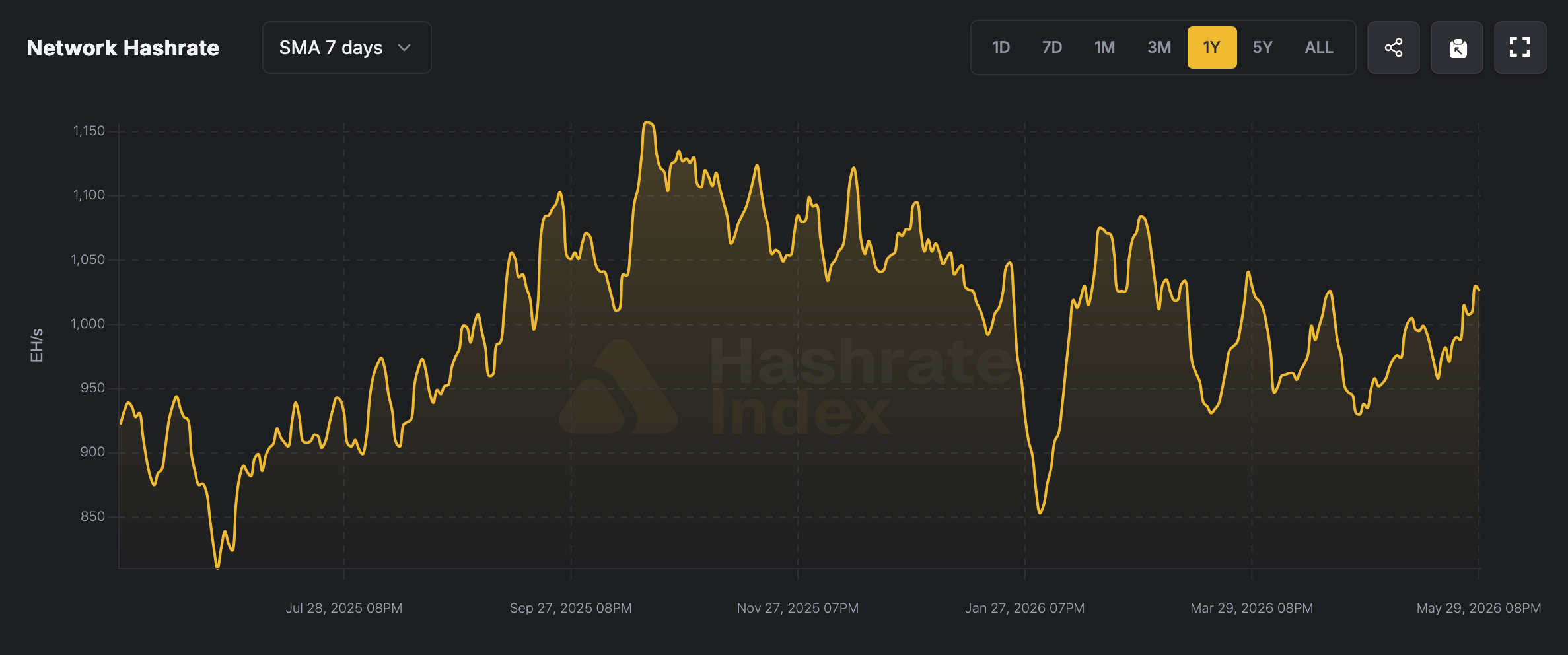
On the other hand, bitcoin miners have continued adding computational muscle despite the hit to revenue. Even with thinner margins, the network’s processing power has kept moving higher. This week, Bitcoin’s hashrate once again pushed beyond the 1 ZH/s threshold, and as of Saturday, May 30, 2026, it stands at 1,018.59 EH/s or around 1.02 ZH/s.Since touching 958 EH/s on May 18, the total hashrate has increased by 6.32%.
Co-CEO of Renewablox Jason Deane remarked this week that Bitcoin’s latest difficulty increase to 139 trillion brings the network back to a level first seen around September 2025, while noting that difficulty has largely remained between 126 trillion and 156 trillion over the past eight months. He added that hashrate has “barely changed overall,” as large miners continue shifting resources toward artificial intelligence (AI) infrastructure while natural network growth is offset by less profitable miners exiting due to price pressure.
Deane believes the industry is evolving beyond pure mining, with greater emphasis on grid balancing, heat generation, decarbonization, and reducing wasted energy. “The bitcoin mining industry is changing and, in my view, is likely to become less centralized over time,” he wrote on X.
That growth accelerated block production and ultimately triggered a difficulty adjustment at block height 951,552 on May 29. Data from Cloverpool.com shows the network difficulty climbed 1.72%, rising from 136.61 trillion to 138.96 trillion. On the other hand, bitcoin miners have continued adding computational muscle despite the hit to revenue. Even with thinner margins, the network’s processing power has kept climbing.
With the hashrate holding above 1 ZH/s, blocks have been arriving a touch faster, averaging 9 minutes and 53 seconds, and the next difficulty adjustment is projected to occur on June 12. For now, the network continues to present a familiar contradiction: mining revenue has cooled, yet competition among miners remains intense.
If hashrate stays above the 1 ZH/s mark and block times continue running ahead of schedule, Bitcoin could be headed for another difficulty increase in mid-June, adding yet another layer of pressure to an industry already navigating tighter economics.
Should that trend continue, the outcome may align with Deane’s view that Bitcoin mining is gradually broadening beyond raw hashpower into a more distributed industry focused on energy efficiency, grid services, and infrastructure innovation.
免责声明:本文章仅代表作者个人观点,不代表本平台的立场和观点。本文章仅供信息分享,不构成对任何人的任何投资建议。用户与作者之间的任何争议,与本平台无关。如网页中刊载的文章或图片涉及侵权,请提供相关的权利证明和身份证明发送邮件到support@aicoin.com,本平台相关工作人员将会进行核查。


