
Author: Rhythm
Perhaps everyone doesn't know that while the whole world is talking about Nvidia, Micron, and SK Hynix reaching new all-time highs every day, Bitcoin has already halved from its peak. The peak was over 120,000 USD, now it's over 60,000.
You can imagine that the crypto space is in disarray during this time of AI's surge.
It has become so chaotic that even trading platforms can't take it anymore; without trades, they can't make money. Some platforms, including the number one platform Binance, announced a few days ago that they connected with brokers, allowing all users to trade U.S. stocks on their platform.
As a result, some people discovered new opportunities.
“Recently, trading arbitrage on Hyperliquid has been so enjoyable that I don’t even want to study individual stocks anymore.”
A few years ago, this was about arbitrage opportunities with Bitcoin and Ethereum, but now that U.S. stocks are on blockchain, their targets have shifted to stocks like Samsung, Nvidia, and GameStop.
Although trading U.S. stocks is now described as nearly an effort-free task. In hot sectors like chips, energy, and optics, if you throw your money in with your eyes closed, your account will likely be up. There are always people around who have doubled their investment by betting on one or two stocks. But these savvy crypto practitioners, the way they make money has nothing to do with whether “the stocks go up or down.”
A group of people from the crypto circle is quietly using crypto market strategies to create a new profitable business in U.S. stocks.
A Contract That Never Expires
This logic begins with something called perpetual contracts. Perpetual contracts are a type of "alternative futures" in the crypto market with the highest trading volume, requiring no expiration or manual rollovers, specifically used for betting on price movements and leveraging, allowing you to open a position worth fifty dollars for just five bucks, all trading available 24 hours a day, and no one stops you if you suddenly want to place an order at three in the morning.
However, the perpetual contract had a problem from the start: Why would a contract that never expires follow real stock prices closely and not diverge?
The crypto industry’s solution for perpetual contracts is to introduce a mechanism called funding rates.
Put simply, funding rates are a kind of head tax; whoever has more people pays the fees.
For example, if you are bullish on Nvidia and don’t want to wait for U.S. stocks to open, you open a long position on the contract with five times leverage.
But the problem is, too many people want to do this; the long side is crowded, with few on the short side. To balance the two sides, the system stipulates that the side with fewer participants pays, while the side with many participants receives funds. Thus, every few hours, those who are going long have to automatically transfer money to the short side. The more people join you in going long, the more you pay, making it truly feel like you're paying a fine.
So how expensive can this fine get? Just look at a few real numbers to find out.
Binance is the largest cryptocurrency trading platform in terms of trading volume globally; on it, the long funding rate for Samsung Electronics' perpetual contract, annualized, is 364%, meaning if you are fully long on Samsung for an entire year, just this head tax will consume more than three times your principal. Nokia is at 403%, and BBX is at 591%.
Another platform worth mentioning is Hyperliquid, currently the largest decentralized perpetual contract trading platform on-chain, requiring no account registration or KYC, allowing anyone to trade directly after connecting a wallet. It's a product in the crypto space that comes closest to the experience of centralized trading platforms.
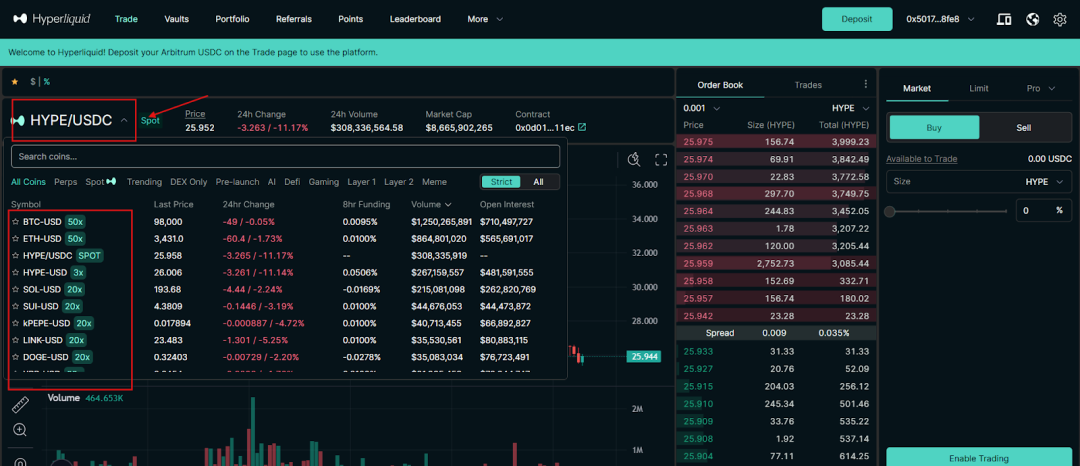
Hyperliquid Trading Interface
On it, Dell has a 281% funding rate, GameStop GME has 227%, even Zoom has 287%, showing that even a video conferencing company has so many people rushing to leverage and bet on its rise.
Another interesting aspect of this funding rate is that it signals the level of excitement on the long and short positions.
The more frenzy there is in the market, the higher the rates for those stocks that have recently been chased aggressively with many long positions. Conversely, Eli Lilly, one of the largest drug companies in America, has a negative funding rate on both Binance and Hyperliquid. Going long on Eli Lilly on Binance not only incurs no cost but also earns you a 65% annualized rate, while on Hyperliquid you can earn 103%. This indicates that there are too many people shorting Eli Lilly, causing the system to pay money to attract buyers to balance the market. Different platforms can have different funding rates for the same stock; Apple shows a rate of 0 on Binance, while on Hyperliquid, it is an annualized -14%, representing an arbitrage opportunity in the difference itself. This number doesn’t lie; the more people rush in, the more satisfying the collection is for those standing on the opposite side.
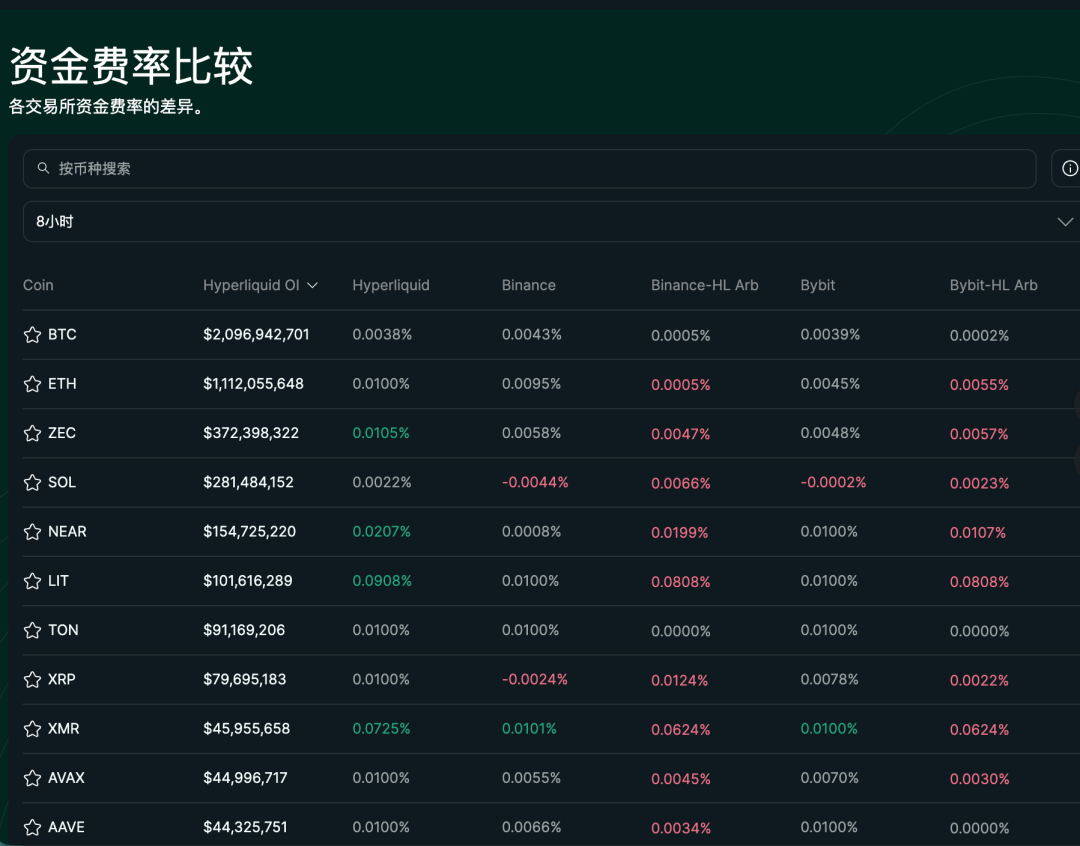
These extreme funding rates are visible in real-time on platforms like Hyperliquid, fostering cross-platform arbitrage opportunities (such as the funding rate difference between Binance and Hyperliquid).
A New Business After U.S. Stocks Go On-Chain
Cbb is a well-known big player in the crypto space, having made his initial money in the crypto market. Over the years, he has engaged in arbitraging perpetual contracts on tokens, and he publicly shared how he earned 5 million dollars by running an arbitrage bot on Hyperliquid.
He is also one of the earliest to transplant this strategy to U.S. stocks.
Cbb's operational logic is simple: on one hand, he buys real stocks in the formal market, and on the other hand, he takes equivalent short positions on the contract. When the stock price rises, the profit from the spot market covers the loss from the contract; when the stock price falls, the profit from the contract covers the loss from the spot market.
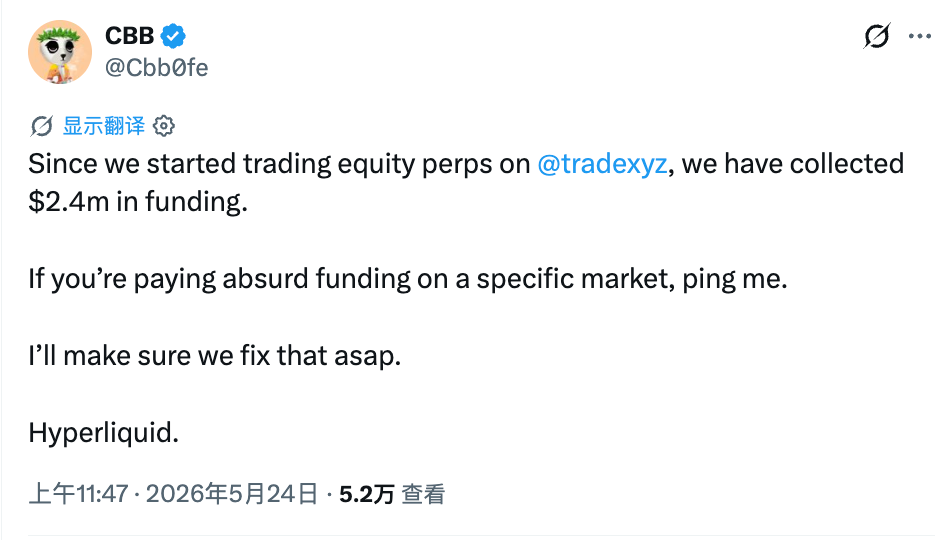
By hedging both sides, he is indifferent to price fluctuations; the only thing he cares about is the head tax in-between. He stated that recently, just by collecting funding fees, he has already made 2.4 million dollars. While a bunch of people outside are feverishly speculating on U.S. stocks to strike gold, he's selling shovels to those gold diggers. Now that perpetual contracts for U.S. stocks have emerged, he has directly applied the strategies honed in the crypto space to targets like Apple and Samsung.
Some might wonder why such opportunities are only available in the crypto space and not in traditional finance. In fact, traditional markets have similar mechanisms, known as borrowing fees and overnight interests; financing for long positions or borrowing stocks for short positions both incur costs. But that money goes into brokers' pockets, and the entire mechanism is opaque; you cannot see the overall long-short ratio in the market and have no way to act as a counterparty to receive that fee. Brokers keep this business to themselves, and ordinary people can only pay without the chance to earn. Perpetual contracts expose this mechanism, allowing anyone to see real-time rates and take on the role of the fee collector. This system is created in the crypto space and now applies to U.S. stocks.
Not just individuals like Cbb are involved; institutions are also beginning to eye this lucrative opportunity.
A stablecoin project is considering moving some of its reserves over to hedge. They calculated that this could generate an additional income of 40 million to 80 million dollars annually.
For institutions, this isn’t gambling, but a stable cash flow that can be incorporated into asset allocation, more akin to collecting rent, with the “tenants” being those who are eager to leverage and trade U.S. stocks.
So the question arises: Will astronomical annualized yields like 364% for Samsung and 591% for BBX continue to exist, or will they eventually converge?
Let's take Bitcoin as a reference. In its early days, the funding rate for Bitcoin perpetual contracts was around 18% annually. Later, with the launch of spot ETFs, arbitrage funds from Wall Street entered, quickly pushing the rate down to 9%, effectively halving it.
U.S. stock perpetual contracts will likely follow a similar path; the high rates now are because the number of arbitrageurs coming in is still small, and the order book is thin.
However, Binance has already launched spot trading for over 7,000 stocks, the New York Stock Exchange is promoting all-weather trading, and the U.S. futures regulatory body CFTC is starting to hint at compliance pathways for perpetual contracts, both sides are moving toward each other. Currently, the CFTC has opened a compliance path for Bitcoin perpetuities, and platforms like Coinbase have introduced simulated perpetual products, while Hyperliquid's open interest (OI) in stock perpetuals continues to grow. Once arbitrage funds flood in, the path for rate compression, similar to how Bitcoin's dropped from 18% to 9%, is likely to replay in the U.S. stock perpetual market.
Therefore, at this stage, it is essentially an early dividend window where those who enter first can enjoy the richest rewards.
免责声明:本文章仅代表作者个人观点,不代表本平台的立场和观点。本文章仅供信息分享,不构成对任何人的任何投资建议。用户与作者之间的任何争议,与本平台无关。如网页中刊载的文章或图片涉及侵权,请提供相关的权利证明和身份证明发送邮件到support@aicoin.com,本平台相关工作人员将会进行核查。


