Why has no player dominated the DeFi execution layer to date?
Written by: Tiger Research
Translated by: AididiaoJP, Foresight News
The DeFi ecosystem already has all the core financial primitives—from trading and lending to yield and derivatives. But what is truly missing is the "execution layer" that brings these products to mainstream users. This article analyzes why past attempts to eliminate wallet complexity and on-chain friction have failed and the structural differences brought by defi.app in this blank space.
Note: defi.app is a DeFi application that supports cross-chain aggregated trading, on-chain yield, and perpetual contracts, employing a fully abstracted Gas design, allowing users to manage Gas without switching networks, facilitating one-click operations for EVM and Solana, achieving self-custody. defi.app officially launched on Binance in June 2025, and its token HOME currently has a circulating market value of approximately $170 million.
Key Points
- The DeFi infrastructure has matured, but consumer-grade applications that can retain mainstream users are still absent. Traditional fintech like Robinhood is constrained by regulations and cannot enter the self-custody and high-leverage product fields.
- Since launching in February 2025, defi.app has accumulated a trading volume of $44 billion, with 1.06 million registered users, validating its appeal through Gas abstraction and chain-agnostic interfaces.
- Rocket Perps has transaction fees far exceeding standard DEXs, but 80% of the platform's total revenue will be directed toward governance-approved HOME buybacks through the DIP-004 proposal.
- For defi.app to achieve long-term growth, it must go beyond short-term user acquisition and create habitual, trustworthy daily use scenarios.
Why Has No One Captured the DeFi Execution Layer So Far?
Ethereum has been online since 2015 for ten years, and DeFi products continue to diversify, but mainstream adoption remains stagnant. The core barrier is not the products themselves, but user experience friction.
A 2023 Consensys/YouGov survey showed that 93% of people worldwide have heard of cryptocurrencies, but only 8% claim to be familiar with Web3 or DeFi. By 2025, the situation had not significantly improved.
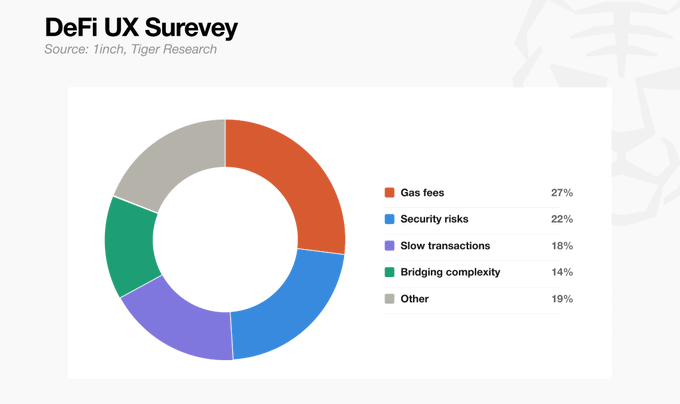
A 2025 1inch survey identified the main pain points in DeFi as: Gas fees (27%), security risks (22%), slow transactions (18%), and cross-chain complexity (14%). These are all experience issues, not product defects.
Robinhood's success in traditional finance lies in making stock trading "one-click trading fully free on the phone," breaking the barriers of high fees and complicated account openings at the time. It simplified the low-threshold investment experience, allowing anyone to easily try it out.
However, the native demand of DeFi is completely different: high-leverage derivatives, on-chain yields, and self-custody. These areas cannot be legally provided by regulated fintech companies. Robinhood has begun to venture into some crypto spot trading, but self-custody and unregulated high-leverage products remain beyond its regulatory red lines.
The goal of the DeFi execution layer is not to replicate Robinhood's business model, but to provide Robinhood-level user experiences in areas where Robinhood cannot reach.
Why Past Attempts Failed
Zerion, Zapper, and Instadapp (Avocado) have all attempted to lower the entry barrier to DeFi through aggregation dashboards and smart accounts (Account Abstraction). The direction was correct, but the retention rates were poor.
The structural failure lies in the lack of a sustainable retention loop. Once token or point incentives end, users flow to the next reward cycle. These platforms solved the technical barriers but failed to retain users without incentives, far below the 9.2% 30-day retention benchmark of traditional fintech companies.
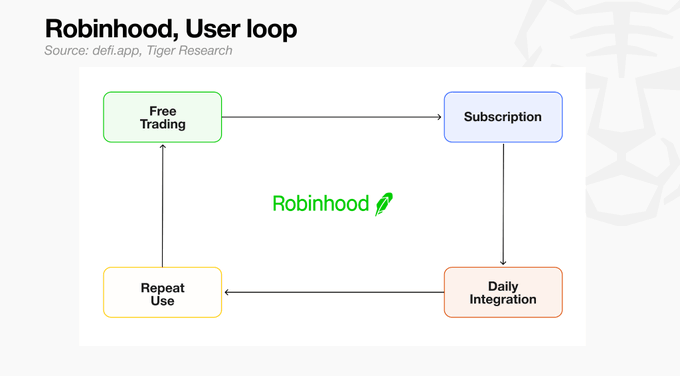
Reducing friction and cultivating daily usage habits are two completely different design problems. Robinhood retains users not just because of free trading, but because mechanisms such as push notifications, consumption analysis, and daily rewards create a self-returning cycle. However, past DeFi applications lacked the product design ability to build such a cycle without incentives.
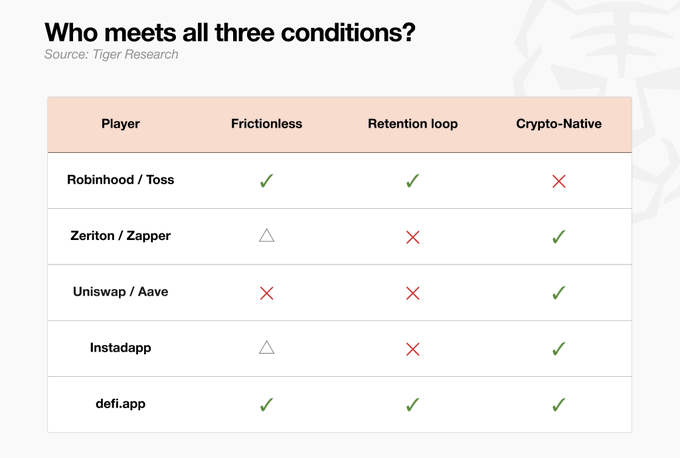
Looking back at the failure modes, to capture this market, three conditions must be met simultaneously:
- Effortless access: users do not feel chain separation, Gas fees, or cross-chain complexity;
- Retention loop: users can still voluntarily return after incentives end;
- Crypto-native coverage: fully support self-custody and high-leverage products, which are areas unapproachable for regulated fintech.
Only a platform that truly integrates all three can become the industry standard.
defi.app's Strategy: Let Data Speak
defi.app integrates Swap, Earn, and Perps into one interface, achieving Gas abstraction through EIP-4337 smart accounts, allowing users to manage Gas without any separate management. Transactions within the EVM and Solana ecosystems automatically select the optimal path through aggregators like 1inch and Jupiter. The design's core is to make financial products accessible while completely hiding the underlying complexities of Web3.
Key data since launch:
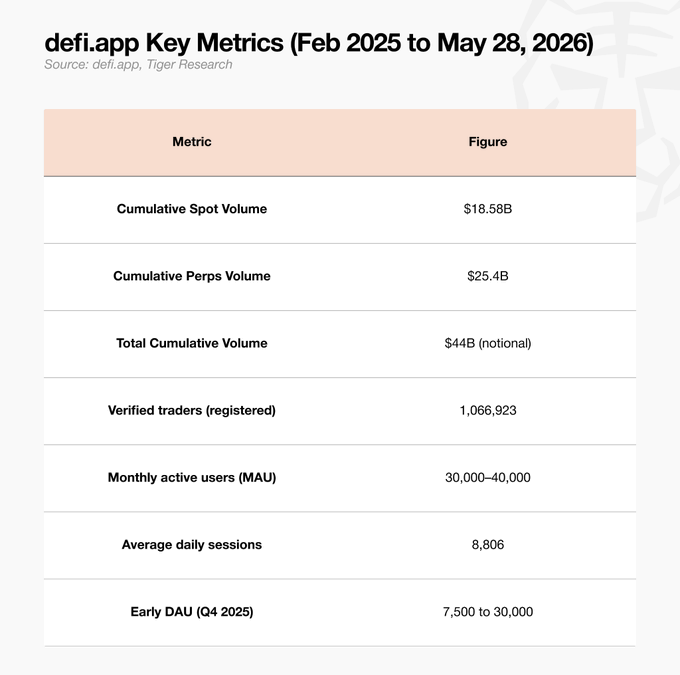
- 1.06 million registered users, demonstrating strong user acquisition capabilities;
- MAU stabilized at 30,000-40,000, with DAU increasing approximately 3000% compared to the early stages, indicating that a meaningful retention foundation was established before the public testing of Rocket Perps.
The public testing of Rocket Perps on June 4 will be a true test of this foundation.
Rocket Perps: Binding Usage Habits, Revenue, and Token Value Together
Previously, defi.app focused on eliminating friction and building retention loops, but it still remains in direct comparison with traditional fintech companies. It integrated multiple services but has yet to meet the third condition—crypto-native coverage.
Rocket Perps is precisely the response to this gap.
Rocket Perps is a 1000x leveraged perpetual product, with an interface styled like pixelated arcade games, based on Aark Digital’s oracle infrastructure, enabling instant openings and non-counterparty matching. Users can accumulate XP by clicking on falling meteors, redeeming HOME token rewards, forming a gamified loop that drives repeated usage.
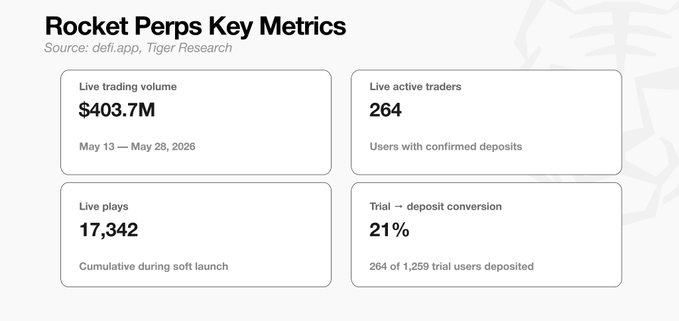
Soft launch data (May 13-28, 2026):
- 264 users contributed over $400 million in trading volume within two weeks, reflecting the capital efficiency and intensity unique to high-leverage products.
These are early high-risk-seeking traders, and the scalability post-public testing still needs verification.
1000x leverage seems exaggerated at first glance, but it completely aligns with the psychology of crypto traders—many are willing to take on high risks for high returns. Rocket Perps transforms this demand into products that regulated fintech companies cannot enter.
It is worth noting the fee design: a 4% margin fee is charged at entry, and a tiered highest of 50% on profits for withdrawal. This is far higher than the standard perpetual DEX rates of 0.02%-0.07%. However, 80% of the total revenue from the platform’s spot, perpetual, and Rocket Perps trading will be used for HOME buybacks based on the DIP-004 proposal, which is a deliberate eco-design. High-premium trading products rather than hedging tools, target users are more likely to accept such a fee structure.
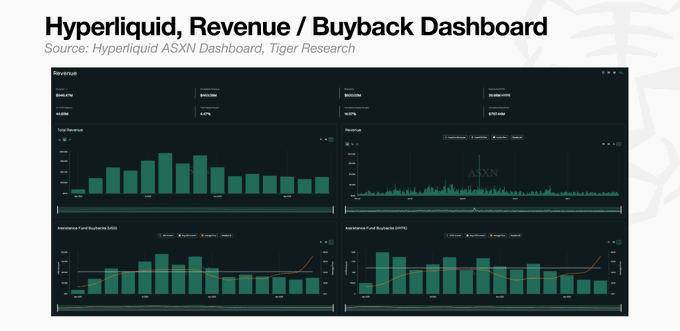
Hyperliquid provides the clearest precedent: the protocol uses 97% of transaction fees directly for HYPE buybacks, and each transaction is publicly verifiable on-chain. If defi.app can achieve the same positive flywheel with on-chain transparency, the premium paid by users will be offset by powerful holding incentives.
Milestones That defi.app Must Cross
Retention Verification and Trust Building
The 264 traders from the soft launch are a self-selected high-risk group. The public testing of Rocket Perps on June 4 is the first real test of retention for ordinary users—can the existing 30,000-40,000 MAU achieve meaningful expansion?
Robinhood faced the same challenge. After the meme stock frenzy of 2021 faded, MAUs plummeted. It later added credit cards, banking services, and social features, giving users reasons to open the app daily even without trading. This demonstrated the need for an independent daily loop to retain users regardless of market performance.
defi.app faces the same design challenge. Continuously launching features that align with crypto-native trader instincts can attract new users, but to retain them, they must feel it is a reliable "asset labor platform." Both must be advanced in sync. Only when users view defi.app as part of their daily asset management habit can it truly become an "everything is possible" app.
On-chain Transparent Buyback Execution
For investors evaluating HOME today, the strongest argument is that 80% of total platform revenue is directed to governance-approved buyback plans. However, crypto investors have been burned too many times by similar promises, and the scrutiny is high. Even the slightest gap between the promise and on-chain execution can lead to trust collapsing faster than expected.
Hyperliquid resolves this most thoroughly: buybacks are automatically executed at the moment fees are generated, each transaction is publicly verifiable on-chain, without any announcement, letting the data speak for itself.
defi.app’s 80% commitment is appealing in itself. If it can announce the buyback execution wallet address during the same period as the Rocket Perps public testing and launch a real-time revenue dashboard, it would establish a foundation for creating a trust flywheel equivalent to Hyperliquid.
Conclusion
Robinhood reshaped the financial experience but has always operated within regulatory boundaries. Self-custody, high leverage, and permissionless yields remain forbidden zones. DeFi has built finance outside these boundaries but has been unable to retain users. Infrastructure is already in place, yet daily returning cycles have yet to form.
defi.app’s goal is to fill this gap: to create a user experience in areas where Robinhood cannot enter, achieving what DeFi has not yet accomplished.
Its strategy revolves around three main lines:
- Completely eliminating friction through Gas and cross-chain abstraction;
- Providing reasons for users to return repeatedly with features like Rocket Perps;
- Returning real revenue through governance-approved $HOME buyback plans to the ecosystem.
The team behind defi.app understands what can genuinely draw users into the crypto market. For those embracing the volatility of crypto, Rocket Perps offers an attractive entry and reason to return. But beyond short-term user acquisition, the deeper question is: Can the platform create truly daily usage scenarios—users generating returns through Earn, accumulating XP through gaming, not for incentives, but because the app has become their daily method of managing assets?
When this condition is met, defi.app will no longer be just another DeFi application, but the first true industry standard in areas where Robinhood cannot reach.
免责声明:本文章仅代表作者个人观点,不代表本平台的立场和观点。本文章仅供信息分享,不构成对任何人的任何投资建议。用户与作者之间的任何争议,与本平台无关。如网页中刊载的文章或图片涉及侵权,请提供相关的权利证明和身份证明发送邮件到support@aicoin.com,本平台相关工作人员将会进行核查。


