The profit growth rate of A-shares in 2026 is expected to rise from 3.9% to 11%, and the "slow bull" market of the technology sector may not yet be over.
Written by: Xu Chao
Source: Wall Street Journal
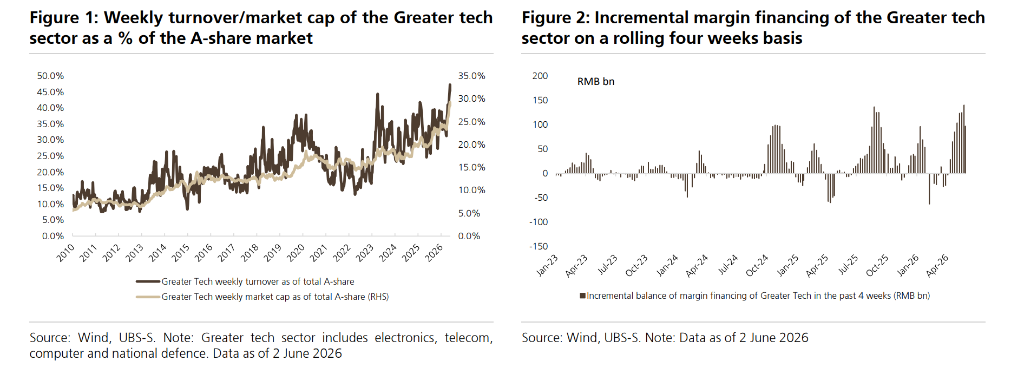
The technology sector of A-shares has rebounded strongly, with trading volume reaching new highs, raising concerns about market congestion. However, UBS Securities' latest research report offers a more comforting assessment: despite the trading volume and market capitalization of the large technology sector having surpassed historical highs, key indicators measuring institutional positioning concentration show that current congestion levels are still far below historical peaks, and the duration of this round of technology growth style is also not yet two years.
According to UBS's latest report, as of the first quarter of 2026, the overweight ratio of public funds in the large technology sector (including electronics, communications, computers, and defense) is 9.9%, down from 11.6% in Q3 2025, and significantly below the historical peak of 14.1% in Q4 2015; compared to the highest overweight ratio of the consumer sector at 18.7%, it is even further away.
UBS pointed out that the overweight ratio of public funds typically takes about three years to rise from a cyclical low to a peak; since the policy shift in September 2024, the excess performance of this round of technology growth style has been less than two years so far.
Meanwhile, the profit recovery of A-shares is accelerating, providing a more solid fundamental support for the market's upward movement.
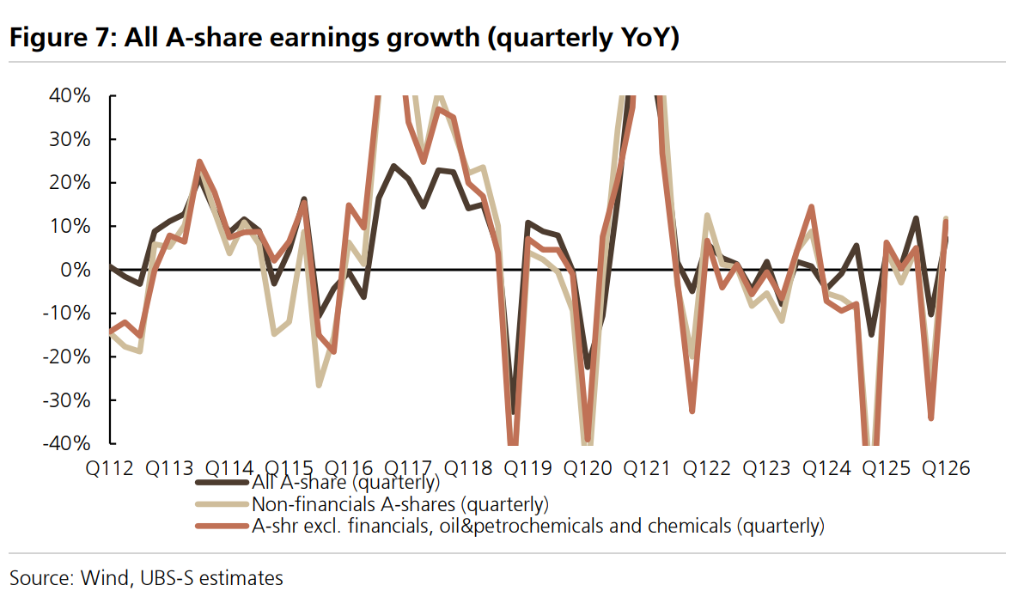
UBS expects the profit growth rate of all A-shares in 2026 to increase from 3.9% in 2025 to 11%. In the first quarter of 2026, profits in the non-financial sector have already grown by 11.8% year-on-year, with both gross and net profit margins reaching their highest levels since 2023. Continuous inflow of multi-channel funds, ongoing expansion of industry-themed ETFs, and the recovery of private fund issuance collectively form a significant support for the current market's micro liquidity.
In terms of tactical allocation, UBS prefers growth and cyclical styles under the benchmark "slow bull" scenario, with a focus on electronics, communications, electrical equipment, machinery, nonferrous metals, and chemicals at the sector level, maintaining buy ratings on several related targets.
Technology overweight ratio still has room, and this round's duration is still short
The trading heat and fund concentration in the technology sector have significantly intensified recently.
According to UBS data, as of June 2, 2026, the weekly trading volume of the large technology sector accounted for 45.5% of all A-shares, and its market capitalization accounted for 28.6% of the entire market, with both indicators at historical highs. Since the ceasefire between the U.S. and Iran on April 8 and the recovery of risk appetite, the composite index of innovative technologies (科创50) and the ChiNext index have gained 35.5% and 30.4% cumulatively, respectively, significantly outperforming the 11.0% and 9.8% gains of the total A-share index and the CSI 300 index during the same period.
However, UBS believes that using trading heat and short-term gains to judge congestion has limitations, and the overweight ratio of public funds is a more core indicator of institutional positioning concentration. From this perspective, the current overweight ratio of the large technology sector is not only below its own historical peak but also significantly behind levels seen in the consumer sector at historical peaks like 22.8% in Q3 2010 and 21.0% in Q3 2012.
UBS has summarized the historical patterns of five major style switches in A-shares since 2014:
- From 2014 to 2015, leveraged funds drove large fluctuations in the market;
- From 2017 to 2019, foreign capital inflows boosted the "blue chip stock" market;
- From 2019 to 2021, public funds favored companies with compounding profits, creating positive feedback;
- Before the policy shift from 2022 to 2024, insurance funds and the "national team" drove defensive sectors to outperform;
- After the policy shift in 2024, financing, ETFs, and private funds led to the superiority of small-cap and growth styles.
Research has found that each style typically takes about three years to form and switch—high prosperity fundamentals for a single sector are difficult to sustain beyond three years, and there is a natural ceiling on fund positioning concentration. The redemption pressure that follows the narrowing of excess returns will be transmitted to stock prices and trigger a trend reversal.
However, the allocation signals of some sub-industries are already noteworthy. The overweight ratio in the electronics sector has reached 6.6%, surpassing the previous high of 5.4% in Q3 2020; the overweight ratio in the communications sector has refreshed new highs for three consecutive quarters since 2010, reaching 4.0%. UBS stated that it will continue to monitor changes in related indicators.
Profit recovery accelerates, solidifying the foundation for market rise
UBS expects the profit growth rate of all A-shares in 2026 to rise to 11%, noting that multiple top-down and bottom-up indicators confirm that the trend of profit improvement is accelerating.
From the financial report data of the first quarter of 2026, the year-on-year profit growth rate of non-financial A-shares surged from 0.8% in 2025 to 11.8%; excluding oil, petrochemicals, and basic chemicals, the growth rate reached 12.3%. The profit growth rate of the Sci-Tech Innovation Board in the first quarter reached as high as 204.7%, and the ChiNext also reached 22.7%, both significantly outperforming the main board's 5.5%. Gross profit margin and net profit margin have increased by 0.6 percentage points and 0.3 percentage points year-on-year, both reaching their highest levels since 2023, indicating that under the backdrop of high oil prices, the profit margin pressure on downstream enterprises remains controllable.
On a macro level, the PPI in April rose by 2.8% year-on-year, and the CPI rose by 1.2%. UBS expects inflation to rise further in the coming months. Since the revenue growth rate of non-financial A-shares is highly correlated with nominal GDP and PPI trends, the rise in inflation will directly drive the revenue side to accelerate expansion.
Bottom-up data also confirms the upward profit trend.
In the first four months of this year, the profits of industrial enterprises above designated size grew by 18.2% year-on-year, with profits in computer, communication, and electronic equipment manufacturing soaring by 107.7% year-on-year; profits in the nonferrous metal mining, mining, and coal washing industries increased by 94.9%, 26.0%, and 21.0% year-on-year, respectively. Regarding profit expectations, the anticipated profit growth rates for the IT, materials, real estate, and energy industries have been raised by more than 20 percentage points over the past six months, with the upward trajectory highly similar to historical years of profit upcycles such as 2017, 2019, and 2021.
From a mid-term perspective, the increase in overseas business share is another important support for profit margin expansion. The share of overseas revenue of non-financial A-shares has steadily risen from 9.5% in 2010 to 18.7% in 2025, and the gross profit margin of overseas business has always been higher than that of domestic business, with the gap further widening in 2025. UBS believes that the continuous advancement of "anti-involution" policies and the implementation of supportive policies will also drive further restoration of industry profit margins in the mid-term.
Tactical allocation: balancing growth and cyclical, six major sectors favored
In terms of style allocation, UBS prefers the growth style under the benchmark "slow bull" scenario; the rebound of PPI and industrial profits supports the cyclical style; and the abundant liquidity and high turnover in the market favor the small-cap style.
However, the continuous expansion of industry-themed ETFs is forming extra funding support for leading companies. UBS expects a relatively balanced performance of large and small-cap styles in the second half of the year compared to 2025.
At the sector level, UBS favors six major directions: electronics (benefiting from the recovery in semiconductor inventory cycles and AI innovation), communications (profit growth of leading sub-industries driven by demand for AI computing power and the widespread implementation of the industrial internet), machinery (automation equipment and industrial robots benefiting from the recovery of domestic capital spending and domestic substitution), nonferrous metals (rebounds in copper and aluminum prices, and recovery in lithium industry demand), chemicals (anti-involution progress and accelerated exit of overseas capacity forming a bottom), and electrical equipment (policy support and the power demand for AI data centers driving the development of energy storage).
免责声明:本文章仅代表作者个人观点,不代表本平台的立场和观点。本文章仅供信息分享,不构成对任何人的任何投资建议。用户与作者之间的任何争议,与本平台无关。如网页中刊载的文章或图片涉及侵权,请提供相关的权利证明和身份证明发送邮件到support@aicoin.com,本平台相关工作人员将会进行核查。


