Written by: Distill AI
One tweet caused a UK stock to rise 90% in two days: what game is the mysterious Serenity playing? On February 16, 2026, an anonymous account with a cartoon female avatar posted a message on X. "Interesting trade idea: go long on $RPI." Raspberry Pi is a mini computer the size of a credit card designed to help children learn to code. Their reasoning sounded almost humorous, claiming that AI developers were recently scrambling to buy Raspberry Pis as hardware foundations for AI agents, while the Raspberry Pi's market value stood at only 500 million pounds; such a buying spree would be a disruptive boost for it. However, if the same people rushed to buy Apple's Mac Mini, it would barely make a splash for Apple's 3.7 trillion market cap.
Two days later, Raspberry Pi rose about 90%. Subsequently, Bloomberg, Reuters, and Yahoo Finance all reported on this matter, directly naming the account - an X user called aleabitoreddit. An anonymous retail trader without a real name, company, or Bloomberg terminal made a FTSE 250 stock headline in mainstream financial media. This person is named Serenity. If you've been following the AI market in U.S. stocks recently, it's hard to completely avoid this name.
From being kicked off forums to being copied by hedge funds
Serenity's starting point was anything but high-level.
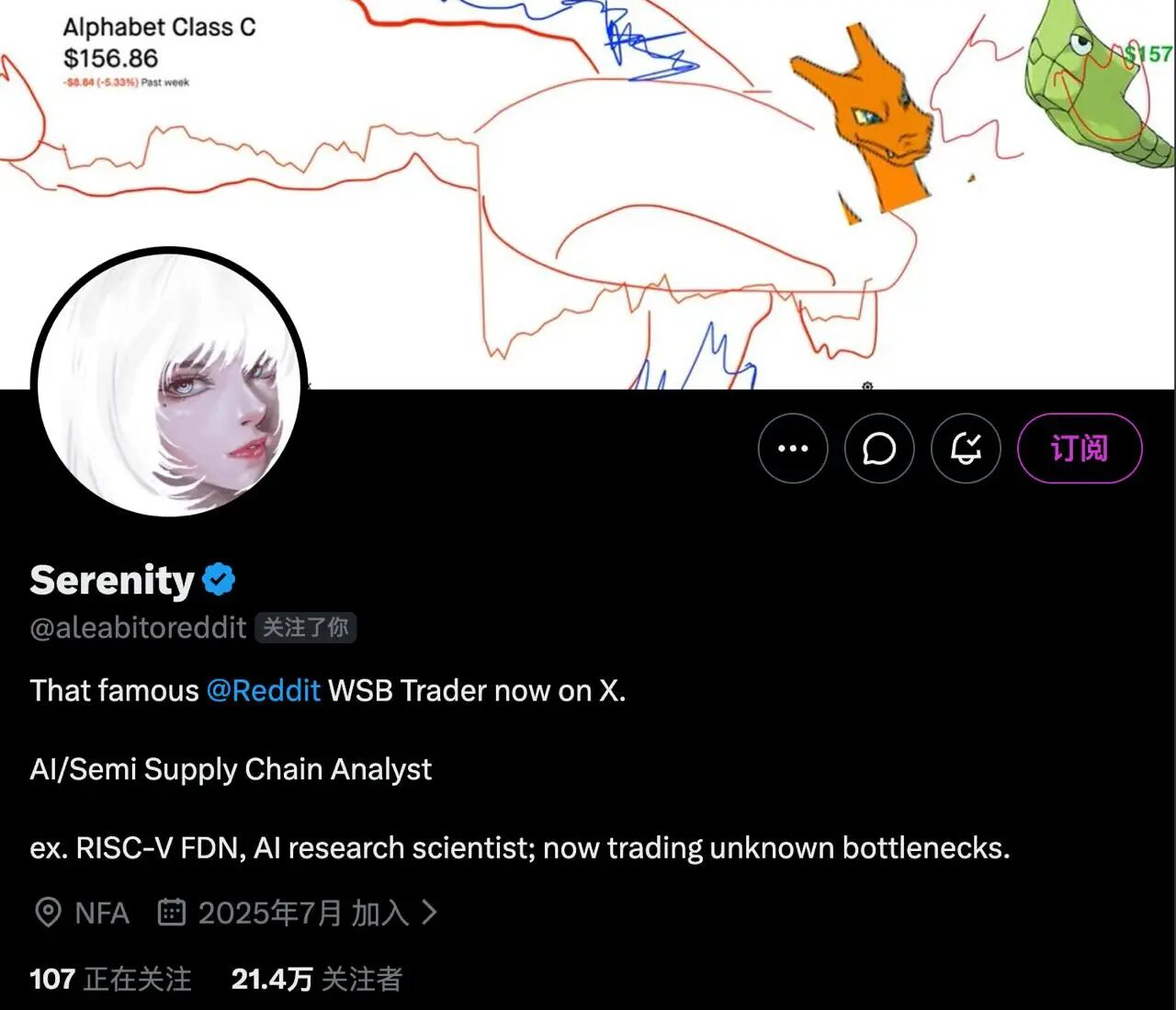
They first mingled in Reddit's wallstreetbets, known for high leverage, casino culture, and meme images. At that time, their account was named AleaBito, and their style resembled all other WSB gamblers: heavy on options, playing new stocks, and inventing various memes for visual storytelling. According to their own account, they once bet tens of thousands of dollars because a stock's technical chart looked like the belly of a bluefin tuna.
The turning point came in early 2022. They posted a deep dive research on a compound semiconductor company called AXT (AXTI) on the forum, not a meme image but a serious fundamental breakdown. At that time, the company's stock price was about $12, and no one cared. As a result, the moderator permanently banned them for allegedly raising the price and selling off. What happened to AXTI later? After a surge in demand for special semiconductor materials due to AI, its stock price skyrocketed to over $140; that research, which got them banned, became the most legendary battle they speak of to this day.
After being kicked out of WSB, they moved to X, changed to a cartoon avatar, renamed themselves Serenity, and completely changed their strategy. They no longer bet on charts or play memes but instead dove into something that sounded extremely boring, yet very few retail investors were willing to do: dissecting the entire hardware supply chain of AI from top to bottom.
Finding the Hormuz Strait of the AI era
Serenity's entire methodology can be condensed into a metaphor. About one-fifth of the world's oil must pass through a narrow waterway called the Hormuz Strait. This strait produces not a drop of oil and typically goes unnoticed. But if it is blocked, global oil prices immediately go out of control. Its significance does not come from its size but from its irreplaceability; all oil tankers must pass through here with no alternative routes. Serenity believes that the AI industry also hides countless such bottlenecks. Most Wall Street analysts view AI from top to bottom: focusing on Nvidia, Microsoft, and Google, calculating how much capital expenditure these giants will invest next year, and developing mathematical models for the upcoming quarterly reports. This is not wrong, but everyone is doing the same thing, and the information has long been priced in.
Serenity, on the other hand, looks from the bottom up. They start with Nvidia's top-tier GPU clusters and peel back layers like an onion: how do GPUs transfer data? Through optical modules. What makes optical modules emit light? Lasers. What materials are lasers made from? A compound semiconductor called indium phosphide. What substrate do indium phosphide wafers grow on? What equipment and raw material purity are needed for production? They break it down to the lowest level until they find those components that "only one or two companies in the world can manufacture, and no one can replace them in the short term." Once this component is in short supply, even the most powerful AI factories must halt operations, which is where the pricing power and profit surge come from.
For example, the previously mentioned AXTI produces "indium phosphide substrates." Serenity publicly warned by the end of 2025 that the entire AI industry would be choked by two companies that control over 60% to 70% of the indium phosphide substrate capacity. At that time, it sounded like a fairy tale. A few months later, the CEO of a Taiwanese epitaxial factory, IntelliEPI, stated almost verbatim at a conference: "The shortage of indium phosphide substrates is the bottleneck of the entire AI infrastructure."
They confirmed this nearly a year earlier than the industry.
How did they find it?
This raises an interesting question: these companies are not secrets, and their financial reports are public. Why was it an anonymous retail investor who discovered this, rather than a large investment bank with hundreds of analysts? The answer lies in three "institutional blind spots," and Serenity's entire strategy essentially arbitrages these gaps. The first blind spot is market capitalization. Analysts at large investment banks typically do not cover companies with less than $1 billion market capitalization because they are too small to earn underwriting fees for the bank, and no one reads them anyway. Yet, the most critical bottlenecks in the AI supply chain often lie with these overlooked small companies. The second blind spot is borders. Wall Street analysts focusing on U.S. stocks wouldn't study a laser company listed in Stockholm, Sweden, nor would they look at a fiber optic component manufacturer in Taiwan's OTC market. Research has defined territories, while supply chains are global. There are vacancies in between that no one fills.
The third blind spot is language and technical barriers. To understand the value chain of CPO, one might need to read papers by Korean scholars, check patents from Japanese manufacturers, and translate HS codes for export declarations. These tasks are tedious and uninteresting, leaving large funds unmotivated to do them, while Serenity is willing to dive in alone. One of their most representative targets perfectly intersects these three blind spots: a small Swedish company called Sivers. It produces something that is upstream and scarce in the CPO architecture—high-power laser light sources. Small market cap, listed in Sweden, with obscure technology; it was entirely off Wall Street's radar. Serenity targeted such companies. Later, this company announced partnerships with major manufacturers like Jabil, received grants from the U.S. "CHIPS Act," and got included in the MSCI Sweden index. With these announcements, the stock price increased nearly twentyfold within a year.
There is also a habit they claim to practice, but others cannot observe: before publicly publishing any research, they give the draft to several AI models, ordering them to act as devil's advocates, specifically pointing out logical holes, technical gaps, and potential replacement scenarios in their logic. This effectively simulates an internal research debate in an institution, but they do it all alone.
What stocks have they called?
Discussing methodology is too abstract; looking directly at the stocks they’ve recommended feels more tangible. Below are some representative stocks compiled from their public posts. First, let's clarify three things: most of these are the prices at which they first made their recommendations, with some entry prices calculated by outsiders, which do not equate to their actual costs. What they achieved prominence in is the AI optical communication theme:
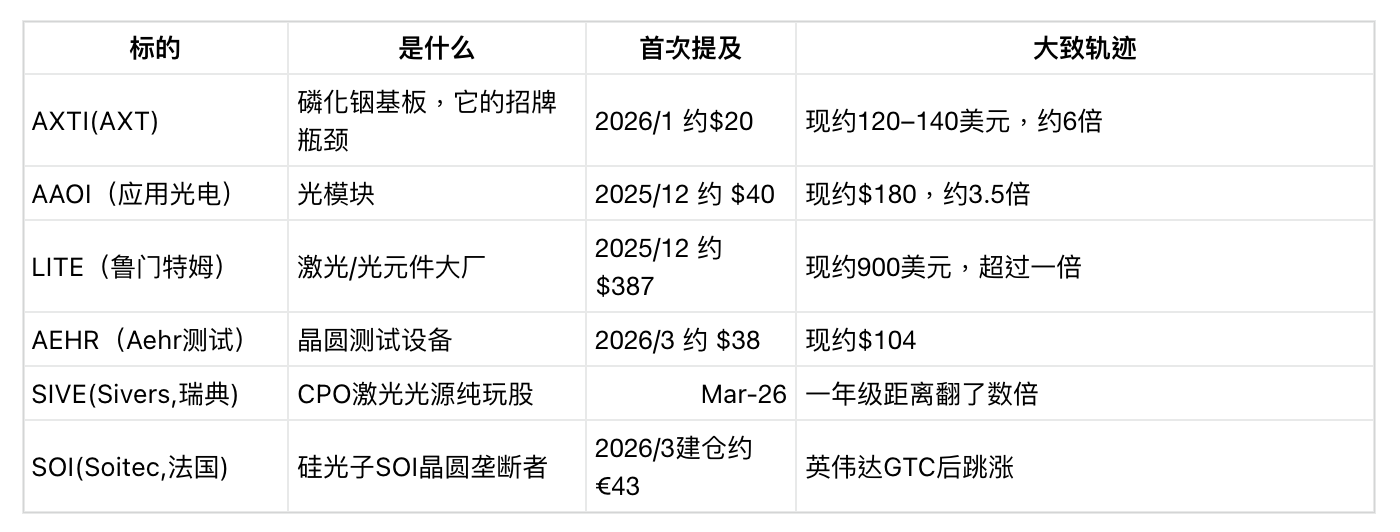
Besides optical communication, they also recommended several stocks in memory and other AI hardware that later surged: SanDisk (SNDK) rose from about $460 to over $1500; Micron (MU) rose from about $389 to over $900; Marvell (MRVL) rose from about $77 to approximately $199; even earlier, in July 2025, they recommended Astera Labs (ALAB), which rose from about $89 to around $325.
If you lay these out, you'll find a common theme: almost all the stocks they called were either yet to be focused on by the mainstream, have a smaller market cap, or are listed outside the U.S. By the time Bloomberg started reporting or ETFs started buying passively, they had already captured much of the price increase. But here’s the back end of the story, as the table above is filtered.
The Other Half You Should Know
At this point, Serenity sounds like a genius. Not so fast. If this article ended here, it would resemble hagiography. The part about Serenity that should be remembered by the average reader is exactly the following half. First, they’ve also stepped on landmines—quite a few, actually. The beautiful report card above has been selectively picked. They also publicly called stocks like Upwork (UPWK), which fell from around $13 to $9, losing 35%; the first call on Hims & Hers (HIMS) was around $45, later halving to $25; Circle (CRCL) plummeted from its IPO price of approximately $185 to $102. Human memory can be biased; stocks that surged are repeatedly shared, screen captured, and regarded as legends, while losing ones quietly sink to the bottom of the timeline. If someone only shows you a list of winners, you should raise a question mark; this isn't targeting Serenity, but applies to anyone showcasing their results.
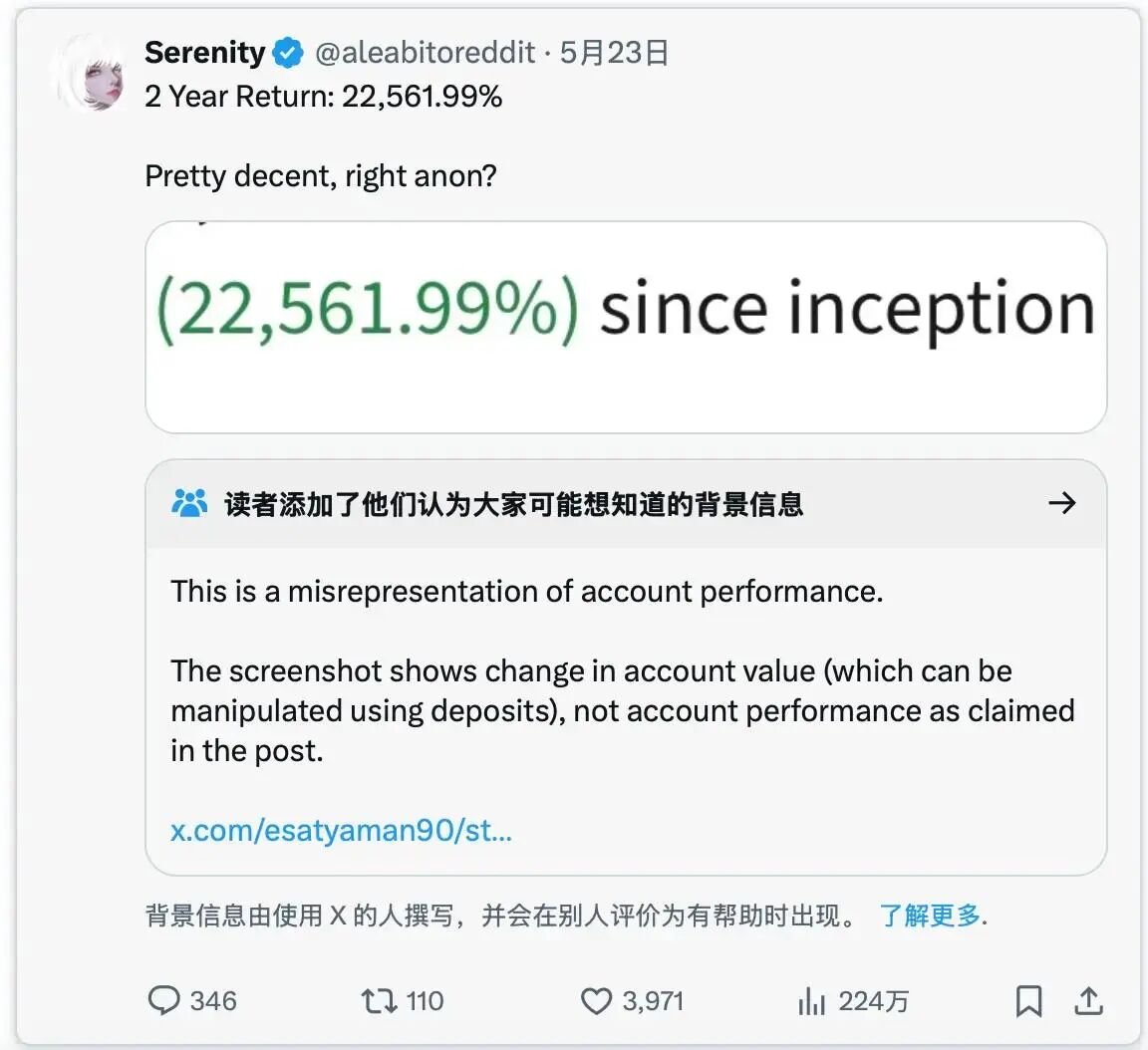
Second, all their performance claims are self-reported. Returns of 22,561% over two years, annualized over 600%, and thirtyfold in half a year—these astounding figures all come from screenshots shared on X. There are no broker statements, no fund audits, and no third-party verification whatsoever. In the financial world, self-reported return rates carry nearly the same credibility as no reported rates at all.
Third, their identity is entirely untraceable. They claim to be a former AI research scientist who has published papers in the journal Nature, a member of the RISC-V Foundation, and even stated they turned down a job offer from Nvidia's AI team back when Nvidia's stock price was still low in 2018. These stories are compelling, but since they are anonymous, none can be verified. Anonymity grants them the freedom to speak without constraints and a shield from accountability. These two aspects are two sides of the same coin.
Fourth, and most practically: their approach objectively resembles a sophisticated version of pumping and dumping. Note that, as of now, no named short-selling institutions or regulatory bodies have accused them of illegality. It must be clarified that fact. However, the reality is: they specifically target illiquid micro-cap stocks, publicly call for long positions, attracting a surge of retail investors, yet never disclose when they sell. This is not speculation; they have admitted it themselves, saying this is exactly why they do not create follow-along apps or inform others of their exit times.
The problem is that the liquidity of micro-cap stocks is akin to a narrow footbridge. When a crowd rushes in simultaneously, stock prices can soar instantly; however, once the tide turns and everyone tries to exit at once, that narrow bridge can lead to a stampede. Those calling for entries are loud, but exits are often silent; under this structure, the last retail investors left holding the bag bear the brunt of the risk. Serenity warns: do not blindly emulate my trades. This advice is sincere but indicates they are acutely aware of the dangers of this game.
Fifth, they are gambling on a one-way street. Almost all of their core holdings are based on two bold assumptions: CPO is the only physical route for the evolution of AI hardware, and humanoid robots will reach a scale of one billion units in the future. If one day Nvidia finds that copper cables can last a few more years or if CPO runs into some engineering bottleneck, their entire supply chain empire built on silicon photonics, indium phosphide, and lasers would be instantly revalued on a physical level. This is a high-stakes gamble, albeit one based on informed reasoning.
What You Should Really Take Away from Them
Having said all this, the conclusion is neither to rush to copy their stocks nor to dismiss them as a scam. Both attitudes are too lazy. The real value of Serenity lies not in any specific stock ticker. What’s truly valuable is their order of interpretation regarding the world. In an era of information overload, one of the most common mistakes retail investors make is trying to compete with institutions that have conducted decades of research on traditional financial analysis. That’s not your home turf; their advantage is too great for you to catch up. However, there’s one thing where everyone is nearly on the same starting line: who can more rapidly use a new framework to reanalyze a world being rewritten by AI. Serenity's exhibited framework can be distilled into one question: the next time you see any company claiming to be an "AI concept," instead of rushing to ask "will it go up," first ask yourself: within the entire system, is it the silent, irreplaceable physical switch? Who are its upstream and downstream partners? Does it address a genuine shortage issue?
If you can answer this question, your perspective on the AI market will already have one layer more than the vast majority in the market.
免责声明:本文章仅代表作者个人观点,不代表本平台的立场和观点。本文章仅供信息分享,不构成对任何人的任何投资建议。用户与作者之间的任何争议,与本平台无关。如网页中刊载的文章或图片涉及侵权,请提供相关的权利证明和身份证明发送邮件到support@aicoin.com,本平台相关工作人员将会进行核查。


