Written by: Ada, Deep潮 TechFlow
With only seven days until the start of the FIFA World Cup in the US, Canada, and Mexico, Polymarket's "World Cup Champion" single market transaction has surpassed $1.6 billion. The Q1 2026 report jointly disclosed by Bitget Wallet and Polymarket shows that the number of active wallets on the platform has risen to 1.29 million, with a monthly transaction volume of $25.7 billion in March, which is 13.5 times that of the same period last year. However, corresponding to the institutional narrative of being a "money printer," another set of data released by The Wall Street Journal, on-chain analysts, and academic teams show that 70% to 84.1% of accounts are losing money, with 0.04% of wallets taking home 70% of the platform's profits, and fewer than 2,000 accounts dividing nearly $500 million, with the average ordinary user losing between $1 to $100, and the worst-performing 10% losing an average of $4,000.
When the World Cup brings overseas retail investors back to the betting interfaces of Polymarket and Kalshi, another side of this expansion deserves to be clearly understood.
The True Picture of 1.29 Million Wallets: Behavioral Changes Are More Worth Attention Than Transaction Volume
The report jointly released by Bitget Wallet and Polymarket on April 30 is the most complete portrait of the retail demographic in prediction markets to date. The report is based on on-chain data from Dune Analytics, covering 1.29 million active wallets in Q1 2026.
In terms of transaction volume, Polymarket had a nominal transaction volume of $25.7 billion in March, growing nearly 13.5 times from $1.9 billion in March 2025. However, Elden Mirzoian, head of Polymarket's growth department, emphasized in the report, "The real change is not in transaction volume, but in behavior."
Specifically, 82.3% of users had a total trading volume of less than $10,000 for the entire quarter, with only 2.5% of wallets accumulating trades exceeding $100,000. "Micro users" had an average quarterly trading volume of only $35, and "light users" only $392. The median single transaction amount is between $2 and $3, almost equivalent to buying a cup of coffee.
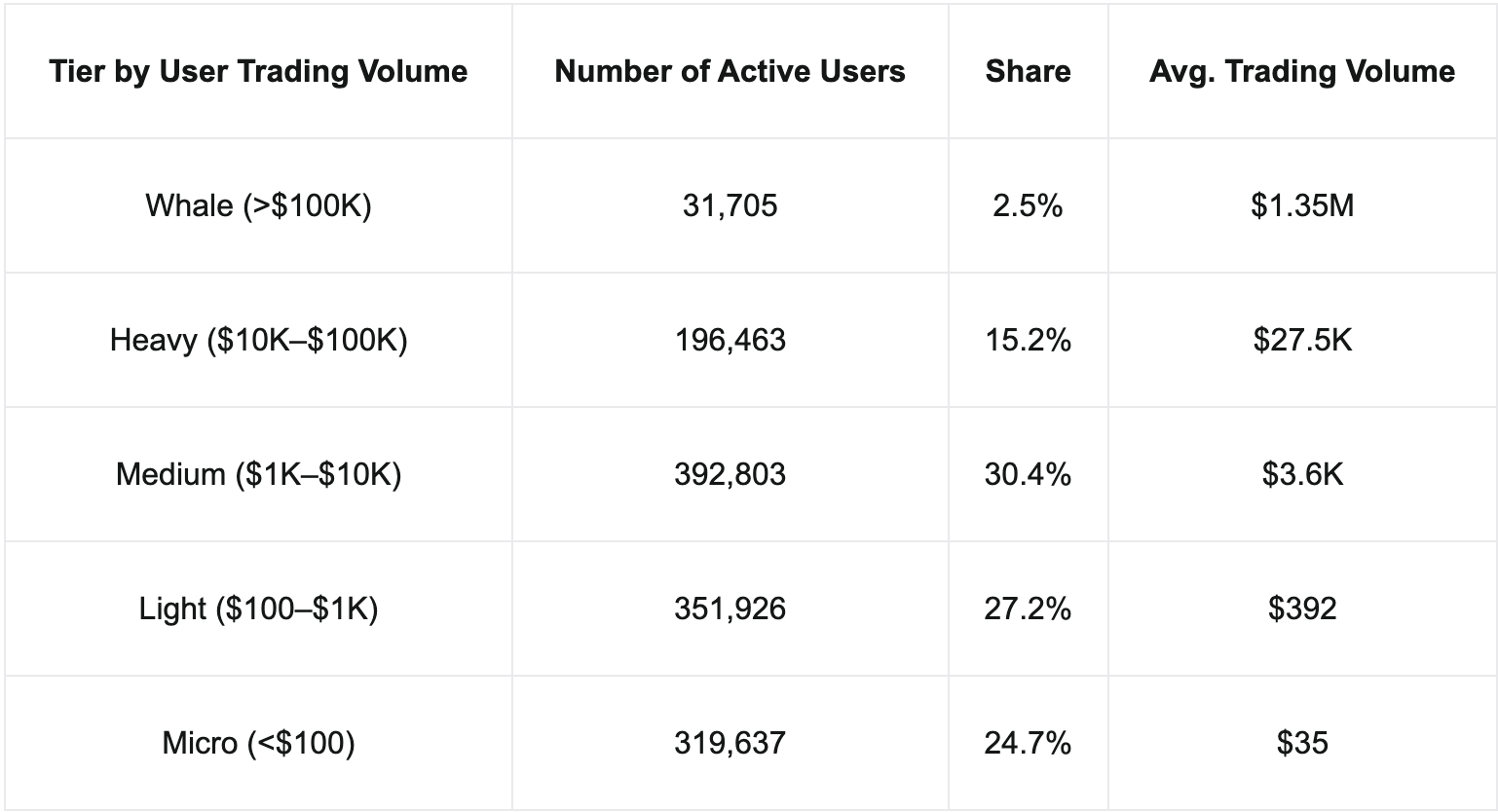
Behavioral stickiness data presents a different growth structure. The number of active days per quarter for users rose from 2.5 days to 9.9 days, and the number of categories participated in rose from 1.45 to 2.34. Polymarket COO Alvin Kan summarized this by saying, "Prediction markets are no longer about capital, but about sustained, repeated behavior. What we see is a shift in behavior, and the market is not growing through larger single bets, but through more clicks every day."
In simple terms, this is a group of "frequent, small, cross-category" retail users. Sports has become the top category in Q1, with a total transaction volume of $10.1 billion; BTC-related event contracts attracted 593,000 users and generated $5.42 billion in transactions, becoming the largest entry point in the crypto segment.
70% to 84% of Wallets Are Losing Money, Three Independent Studies Point to the Same Conclusion
But the bustling scene has another side: an extreme skew in loss distribution.
In the past six months, at least three independent studies have pointed to the same conclusion: the prediction market is a pyramid with a highly concentrated group of winners.
In December 2025, on-chain analyst DeFi Oasis analyzed 124 million transactions from 1.7 million wallet addresses on Polymarket, concluding that 70% of addresses have realized losses, with less than 0.04% of wallets taking home 70% of the total profits, amounting to approximately $370 million.
In April 2026, on-chain researcher Andrey Sergeenkov published a larger sample size report through The Defiant, covering 2.5 million Polymarket wallets and improving the handling of token splits and mergers. Under the new criteria, the proportion of losses rose from 70% to 84.1%. This means that fewer than 1 in 6 Polymarket wallets are able to achieve positive returns.
In May 2026, Wall Street Journal reporter Caitlin Ostroff and others published another analysis based on platform data, corroborating the conclusions of the previous two studies. 0.1% of accounts took home 67% of the total profits, with fewer than 2,000 accounts netting nearly $500 million; the least successful 10% of users averaged a loss of $4,000; and ordinary users typically lost between $1 to $100. Kalshi has also disclosed similar data, stating that for every 1 winner on the platform, there are 2.9 losers.
Ironically, details around Kalshi's "mention markets" (betting on whether a public figure will say a specific word in a specific situation) reveal interesting patterns. Barclays and third-party analysts conducted pricing efficiency tests on over 35,000 settled mention markets on Kalshi, concluding that a "YES" priced at 50% ultimately paid out only 40% of the time. In other words, retail investors systematically overestimated the probability of such events occurring. In typical retail behavior of "buying YES at the first price level," the average loss reached 11%. In February 2026 alone, Kalshi users bet $181 million on mention markets, with a single bet on whether Trump would say the words "cartel", "Somalia", or "hockey" taking in $28 million.
The Pyramid's Apex: Théo, Domer, and Those Automated Wallets
The few faces at the top of the pyramid form an interesting contrast with institutional players.
The most well-known is Théo, a former banking trader from France. A subsequent review by Bloomberg showed that the number of accounts he controlled expanded from the originally identified 4 to 11, with cumulative profits of about $80 to $85 million in the 2024 elections, not the $48 million single figure initially reported. His methodology involves manually commissioning private polling firms to conduct "neighbor effect" polls, bypassing the biases of mainstream polling. Polymarket CEO Shayne Coplan confirmed in a CBS "60 Minutes" interview in December 2025: "Everyone says he's a fool, but he actually commissioned a large number of private polls."
The account with the largest historical transaction volume on Polymarket is Domer (on-chain ID @ImJustKen), who has traded in nearly 10,000 markets on platforms like PredictIt and Augur since 2007, with an on-platform nominal transaction volume of about $300 million and net profits exceeding $2.5 million, netting $100,000 in the week of December 22-28, 2025. In an interview with On Chain Times, Domer bluntly advised retail investors: "You can start with $20, and the worst-case scenario is losing $20; it's not a big deal." Implicitly, the difference in odds between professional players and retail investors comes from fund management rather than single win rates.
The account at the top of Polymarket's historical profit leaderboard is ID "kch123," with a PnL of $11.78 million; the "GamblingIsAllYouNeed" account's on-chain records show total winnings of $40.2 million and total payouts of $35.3 million, netting approximately $4.9 million, with an account net worth of about $14.1 million (including principal), and a win rate of 53.3%. These figures indicate that a win rate just exceeding 50% combined with relatively restrained position management can still yield seven-figure net profits over the long term on Polymarket. In April of this year, there was a more dramatic case, where the account "Beachboy4" made a profit of $6.12 million in a single day, mainly from sports contracts related to matches involving Tottenham Hotspur and Sunderland, although prior to this, the same account had accumulated losses of about $688,000, so the single-day turnaround completely eliminated the historical drawdown.
However, these stories are not mainstream. According to empirical research from the IMDEA Software Institute in Spain, wallets concentrated with profits on Polymarket are mostly operated by arbitrage bots, market-making algorithms, or high-frequency trading systems. The fully public on-chain order book provides a systematic advantage to machine traders; quantitative wallets equipped with low-latency APIs and probabilistic models are simply not on the same playing field as an ordinary user who opens a webpage temporarily.
170+ Tools and Copy Trading Bots: Retail Investors Trying to Arm Themselves
Realizing this structural gap, retail investors have begun to arm themselves in reverse.
According to statistics from Tencent News in January 2026, over 170 types of tools, bots, and products have formed around Polymarket. Among these, Telegram copy trading bots have become the most active tool entry in the Chinese community.
OkBet is the first product to fully integrate Polymarket’s ordering and copy trading functions into Telegram, charging a 1% transparent fee for each transaction, with keys managed through Google Cloud KMS encryption. Polygun acquired the independent data tool Polymarket Analytics in early 2026, combining "smart money identification" and "automated copy trading" into one-stop products. Kreo added daily loss limits and stop-loss rules on top of copy trading, also covering Polymarket and Kalshi. PolyHub (under Hubble) focuses on identifying smart money addresses. Additionally, there are more tools like Polycule (multi-person collaborative betting), Predictify Bot (AI alerts and order management), and Bankr (AI agent integration).
However, copy trading bots are not as万能 as they seem. A guide released by CryptoRank and BlockTempo in March pointed out three typical traps.
First, PNL data can create a false sense of prosperity. Polymarket involves multiple on-chain operations including buying, splitting, merging, and redeeming, and selecting incorrect dimensions for tool calculations can lead to exponential discrepancies. Second, arbitrage bots hedge one-sided interferences. Common automated AI trading bot addresses on the leaderboard profit by cross-market arbitrage, with each transaction having a hedged position; if a follower only copies one leg of the trade, the risks they bear become completely asymmetrical. Third, a high win rate does not equate to high expected returns. Some addresses specifically choose markets with win rates above 98% that are about to settle to grab the last $0.02 profit margin, leading to potential losses for followers after deducting fees.
A more fundamental physical barrier is that Polymarket’s minimum transaction amount is $1. If the funds of the copy trading wallet are $100,000, and the single bet proportion is 0.5% (i.e., $500), the copy trader would be unable to transact at a proportional bet of $0.5 due to being below the minimum unit.
The Chinese community has also formed a relatively mature traffic ecosystem around Polymarket, with polymarketcn.com providing a full process tutorial for registration, top-ups (directly through Binance/OKX), withdrawals, and arbitrage strategies, mainly targeting Chinese users who cannot directly deposit through USD bank transactions.
The Next Stress Test of the World Cup
With seven days until the World Cup kicks off, prediction markets are about to welcome the largest event-level traffic since the 2024 US elections. As of the time of writing, Polymarket's "World Cup Champion" single market has accumulated a transaction volume of $1.6 billion, with a 24-hour transaction volume of $7 million and liquidity of $46 million, with odds showing Spain and France tied at around 16-17%, England around 11-13%, and Argentina and Brazil in the 9-12% range. Polymarket has opened over 100 segmented markets for this World Cup, including contracts for 12 group champions, the top scorer, and Messi/Yamal's participation.
It is noteworthy that two recent independent analyses assessing the win rates for prediction market retail investors match closely with statistical results of traditional sports betting released by the UK Gambling Authority for 2024. In other words, the rate at which prediction market retail investors are losing money is roughly the same as that of traditional casino patrons. Polymarket's own product page emphasizes that "the platform accurately predicts the final outcome 94% of the time a month in advance," which is promotion from the angle of the market as an aggregative signal; however, from the perspective of individual returns for retail investors, the accuracy of market predictions and the profitability of individual trades are two completely different propositions.
Prediction markets are highly accurate signaling machines, a point Polymarket and Kalshi repeatedly emphasize; they are also financial markets where 84% of users are losing money, this too has data backing it. As the World Cup attracts global retail investors back to the game, institutions, market makers, and arbitrage bots are also waiting for them to join.
Bernstein estimates the long-term TAM of this sector to be $1 trillion. If this figure holds, the corresponding scale of net capital outflow will come from that 84% of wallets.
免责声明:本文章仅代表作者个人观点,不代表本平台的立场和观点。本文章仅供信息分享,不构成对任何人的任何投资建议。用户与作者之间的任何争议,与本平台无关。如网页中刊载的文章或图片涉及侵权,请提供相关的权利证明和身份证明发送邮件到support@aicoin.com,本平台相关工作人员将会进行核查。


