“Your profit is my opportunity.”
Written by: Jason Rosenthal, a16z crypto operating partner
Translated by: Chopper, Foresight News
Throughout business history, many evergreen companies rely on the flow of funds as a key factor for success: engaging in value creation and transfer within the ecosystem, and extracting profits from it. The larger the value flowing through the ecosystem, the more likely the company will grow in scale.
Cryptographic technology is the first modern technology to be inherently adapted to this business logic. If a startup does not base its product design and business model on this logic during its initial stages, it will miss out on huge opportunities. The widespread use of stablecoins has enabled funds and value to flow at internet-scale speeds, allowing for around-the-clock global settlement with end-to-end programmability. Today, the underlying channels for fund flow are fully open, and unit economic models are public and transparent; every circulating dollar in the world becomes potential traffic in this field.
Underlying Business Logic
Blockchain is essentially a network-based business model. All transactions are uniformly recorded in a shared ledger, and every new participant reinforces this underlying system for subsequent developers. The more users and developers leverage the ecosystem and build applications, the greater the value of the entire network for all users.
Most traditional enterprises require years to build network effects on outdated infrastructure; in contrast, entrepreneurs in the crypto space can start with inherent network effects.
Network tokens further amplify this advantage. A well-designed token economy can bind users, developers, service providers, node validators, and protocol ecosystems to a common goal—promoting network development while distributing profits according to each party's contribution. The profits generated by the protocol ultimately belong to all participants in the ecosystem. There are no private rebates, nor any special transactions; only a positive cycle forms: value circulates within the system, and profits flow back to everyone who contributes to building the ecosystem.
This business logic is not a new phenomenon; it is just that the crypto industry has enabled startups to land and scale more easily for the first time.
The core of profitability for railway companies has never been selling locomotives, but rather charging toll fees for every freight train that transports grain, coal, and steel. Standard Oil, U.S. Steel, and AT&T all rooted in the value transfer process. Google and metaverse platforms replaced traditional print and television media not simply because their advertising formats are superior, but because they occupy crucial touchpoints where attention transforms into commercial transactions, carving out a share of multi-trillion-dollar commercial traffic. Amazon Web Services occupies a core position in computing resources.
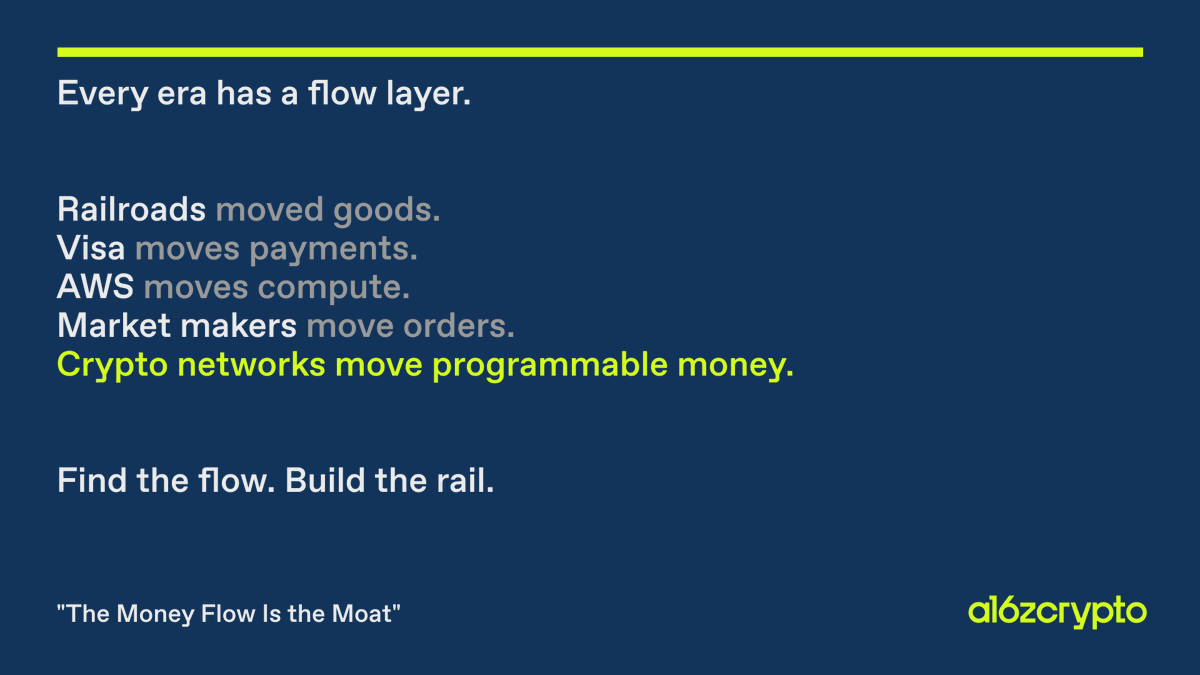
The rule remains consistent: find the core path of value flow and occupy a key position within it.
This logic is vividly reflected in financial markets. In the fiscal year 2024, Visa processed a total payment amount of $15.7 trillion, achieving a net income of $35.9 billion. The well-known market maker Jane Street had a net trading income of $20.5 billion last year, surpassing Citibank and Bank of America. The top five market makers in the U.S. handled 87% of order flow payments: they do not predict market fluctuations but merely stay stationed along the flow of every order, resulting in higher trading volumes and thus more substantial profits.
These companies also share a common point: powerful network effects. The more merchants that accept Visa cards, the more valuable the card is to cardholders; conversely, the more cardholders there are, the more merchants are attracted to open services. The order flow market follows the same logic: the more brokers that are connected, the narrower the bid-ask spread becomes, attracting more brokers, thus generating larger order flow traffic.
Combining fund flow with network effects is one of the most robust business models in the commercial world.
Your Profit is My Opportunity
Bezos proposed a classic point: "Your profit is my opportunity." Originally aimed at the retail industry, this statement is even more relevant in the traditional financial services sector—where the financial industry holds the largest scale of global profit capture. Payment, asset custody, lending, foreign exchange, asset securitization, transaction settlement, market making, and other subdivided tracks are all included.
Visa and Mastercard built their networks based on the 1960s, charging transaction fees of 2% to 3%; cross-border remittance channels charge as much as 6% to 9%; lead brokers and asset custody institutions take a commission from each securities transaction. Even if the U.S. shortens the securities settlement cycle to T+1 in 2024, capital will still be idled overnight, meaning that all market participants need to bear a structural cost.
The existing profit margins in these industries are all potential points for transformation. Reducing transaction costs, improving capital flow efficiency, and potentially expanding the overall market size. Stripe and Square have already proven that this model is effective in the payment field.
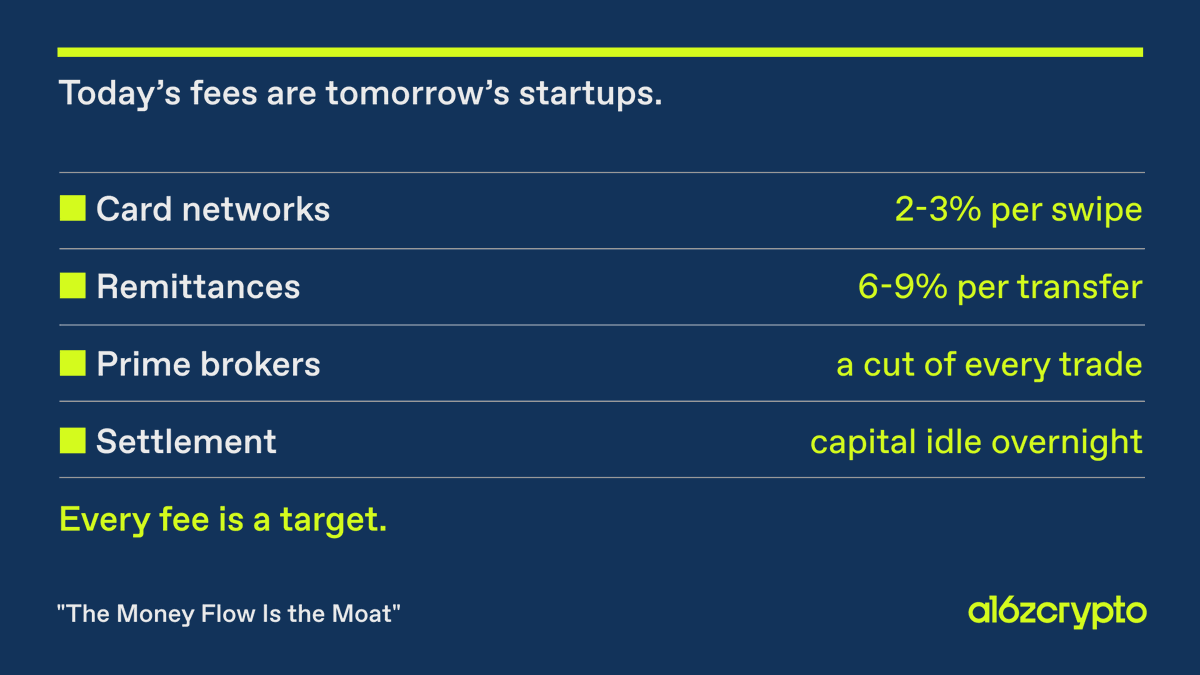
Meanwhile, entrepreneurs in the crypto industry have the opportunity to build the next generation of infrastructure: featuring programmability, instant transaction settlement, global coverage, and rooted in the capital flow chain from inception.
Opportunities have also extended beyond the boundaries of financial services. The markets for computing power, GPU transactions, storage chips, AI training data, energy, robotics, aerospace, rare earth metals, etc., are all about to witness massive global value flows, and existing traditional channels cannot support such a volume of business.
The aforementioned tracks represent new blue ocean markets relying on programmable infrastructure and focusing on capital flow models. There are no entrenched old platforms, convoluted intermediary providers, or outdated patterns that need to be preserved.
As an entrepreneur, it may be worthwhile to ask yourself a few questions: Is your current business positioned at the core of value flow? When the transaction scale and value volume of the product ecosystem grows tenfold, can your revenue grow in tandem? If you are developing a new product, which link in your target market has the highest profit capture relative to the value it creates?
The answers lie where the opportunities are. Reduce costs in existing links, enter new value flow tracks, and leverage network effects to achieve sustained growth.
免责声明:本文章仅代表作者个人观点,不代表本平台的立场和观点。本文章仅供信息分享,不构成对任何人的任何投资建议。用户与作者之间的任何争议,与本平台无关。如网页中刊载的文章或图片涉及侵权,请提供相关的权利证明和身份证明发送邮件到support@aicoin.com,本平台相关工作人员将会进行核查。


