The cross-market asset panel, PM betting monitoring, investment map, and personal operation platform are all quite basic, but very useful.
Written by: Tyler
In the past half month, I've become somewhat addicted to Vibe Coding.
It’s not the kind of obsession where I think, "I want to create an amazing product," but rather a sudden realization that many small ideas that had been stuck in my mind could actually be realized little by little by myself.
As everyone knows, Vibe Coding is about using natural language to command AI to write code for you, bringing the product to life.
I usually work with Codex and Claude Code client, describing the requirements and functional modules, and they help me write code. When the quota runs out, I switch to CLI and connect to DeepSeek API to keep going.
1. Those "Ideas I Wanted to Do but Never Did"
In the past, a lot of ideas often popped up in my mind.
For example, could there be a panel that aggregates assets like US stocks, Crypto, Hong Kong stocks, and A shares in one view, instead of switching back and forth in several apps every day?
For example, could there be a monitoring tool for unusual market movements that alerts me when an asset suddenly rises or falls, along with its related targets and sectors?
For example, could there be an investment map that, when researching a sector, doesn’t just focus on one project but lays out the entire network, including upstream, downstream, benefiting targets, potential risks, and related assets?
Additionally, there are many bets in the prediction market (PM) regarding the valuations of unlisted companies, market cap surpasses, and macro events. Could these data be compared against news events and changes in the secondary market?
There were plenty of ideas, but getting started was just too troublesome.
You need to understand code, be able to design pages, connect to data, and refine repeatedly; if you hire someone, the costs are high and the requirements might not be communicated clearly. After going back and forth a few times, most ideas ended up being summarized in that phrase—"Forget it, let’s just make do with Excel for now."
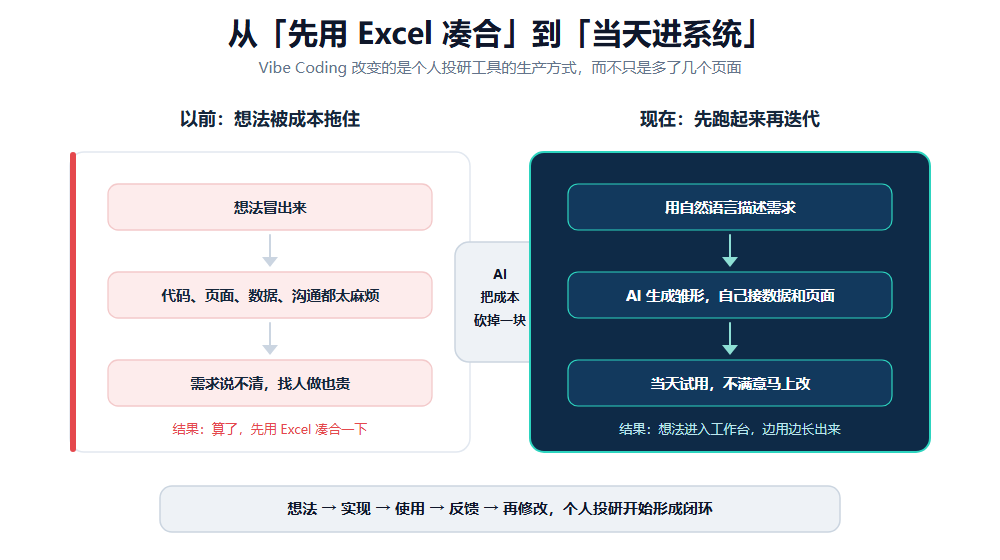
However, after messing around with Vibe Coding for the past half month, I found that this was indeed different.
I began creating some rough but functional tools for myself. When an idea pops up, I can bring it into the system on the same day instead of letting it scatter across chat logs, bookmarks, and my own mind.
2. In Half a Month, I Created Four Little Tools
In the last half month, I mainly created four things (not counting other miscellaneous tools).
The first, a cross-market asset panel
The reason is quite simple. My assets are scattered in several places: Hong Kong stocks and US stocks in brokerage apps, Crypto on trading platforms, and A shares in another software.
Every day, to take a look at my overall situation, I have to open each app and switch back and forth, and after going through all of them, I still can’t piece together a complete picture. So, the first thing I did was to put all my holdings in one page:
At the top are total assets and today’s profits and losses, and below are divided by market—one column for US stocks, one for Crypto, and one for Hong Kong and A shares. It’s clear at a glance what the status of my entire portfolio is, who is rising or falling today.
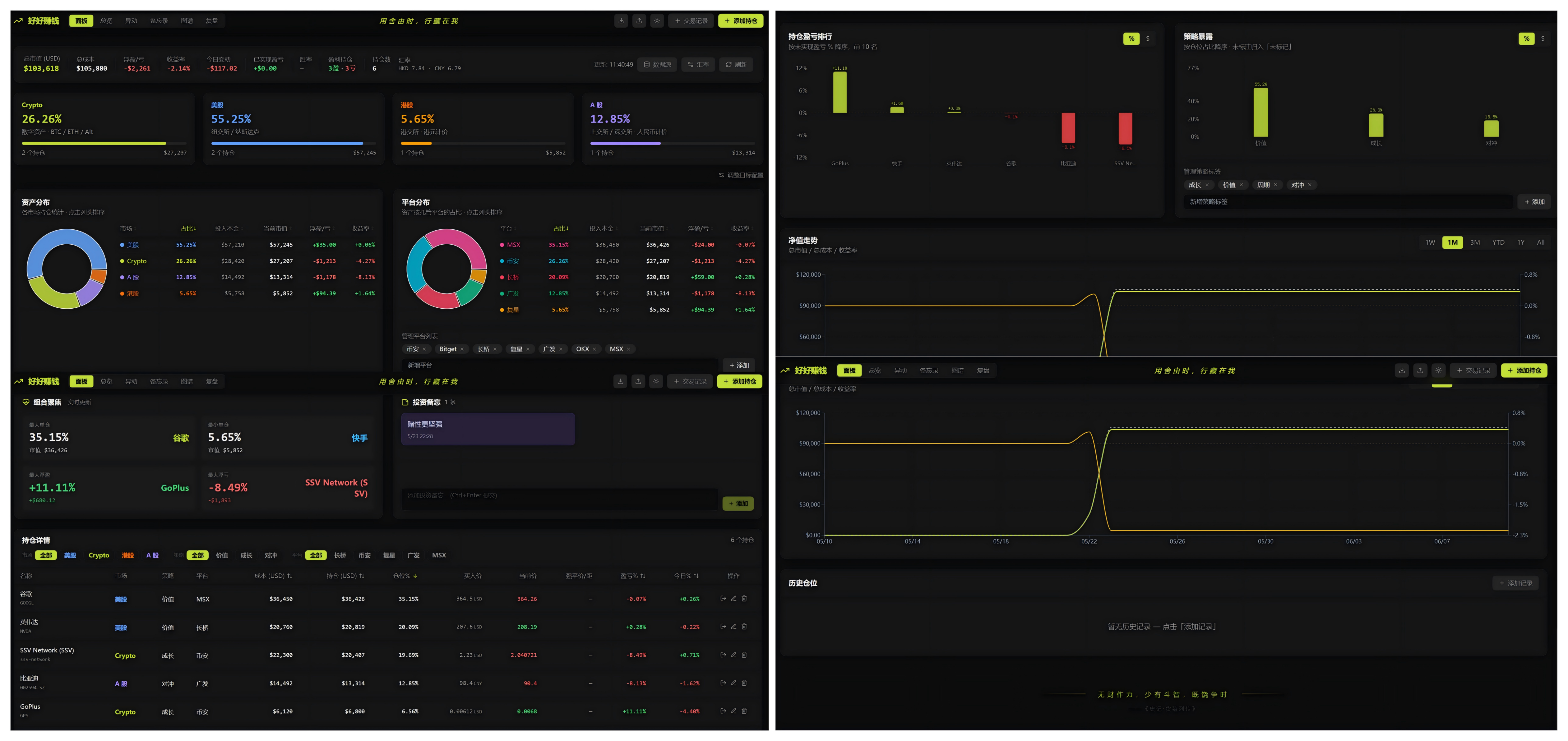
After creating it, I found it quite useful, so I couldn't resist adding more tabs one by one, as new requirements kept emerging:
Monitoring unusual market movements: I can set up alerts for specific targets and thresholds in advance, highlighting any sudden significant drops or rises, saving me from constantly watching the market.
Investment map: When researching a sector, I can visualize the upstream, downstream, benefiting targets, risk points, and related assets in one network, which makes tracing the flow of funds and relationships easier.
Memo + Review: Noting down why I was optimistic at the time, what happened afterward, and where my judgments were right or wrong, so I can revisit them later.
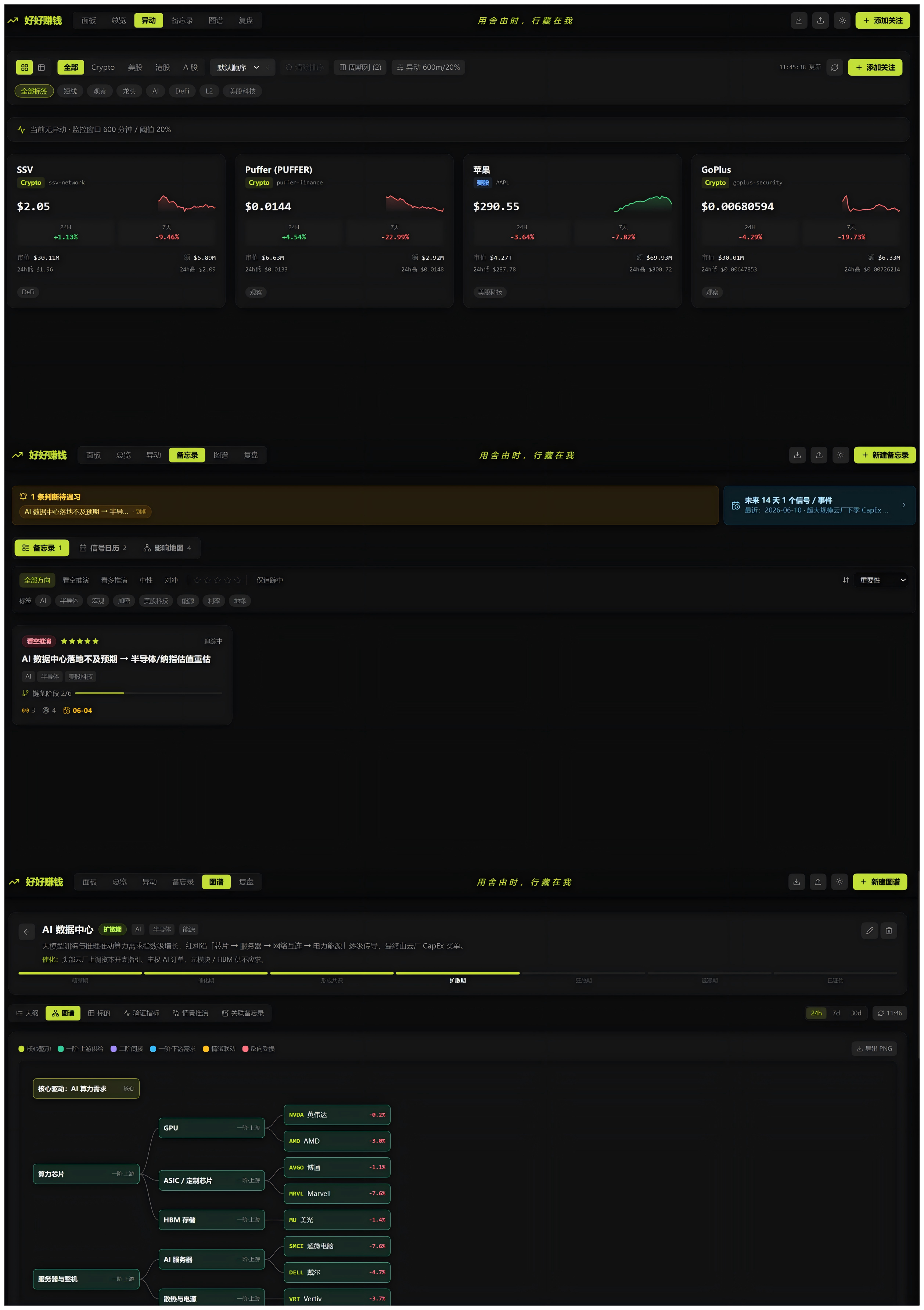
This panel contains all my genuine holdings, which is relatively private, so I deployed it locally.
The second: Polymarket betting monitoring
This is specifically for monitoring prediction markets.
To explain simply, the prediction market (like PM) is where people bet real money on whether a future event will happen, and the price itself represents the market's perceived probability— for example, a "yes" bet on "SpaceX will reach a valuation of $2 trillion by the end of June" priced at 0.8 means the market thinks there’s an 80% chance it will happen.
For the bets I care about, like "Will OpenAI/Anthropic’s valuation increase by the end of the year?" or "Will a certain event in the Seven Sisters happen?", I used to have to check them one by one. Now, I’ve consolidated them all onto one dashboard and can view the changing probabilities alongside news events and fluctuations in the secondary market, making it clear who moves first and who influences whom.
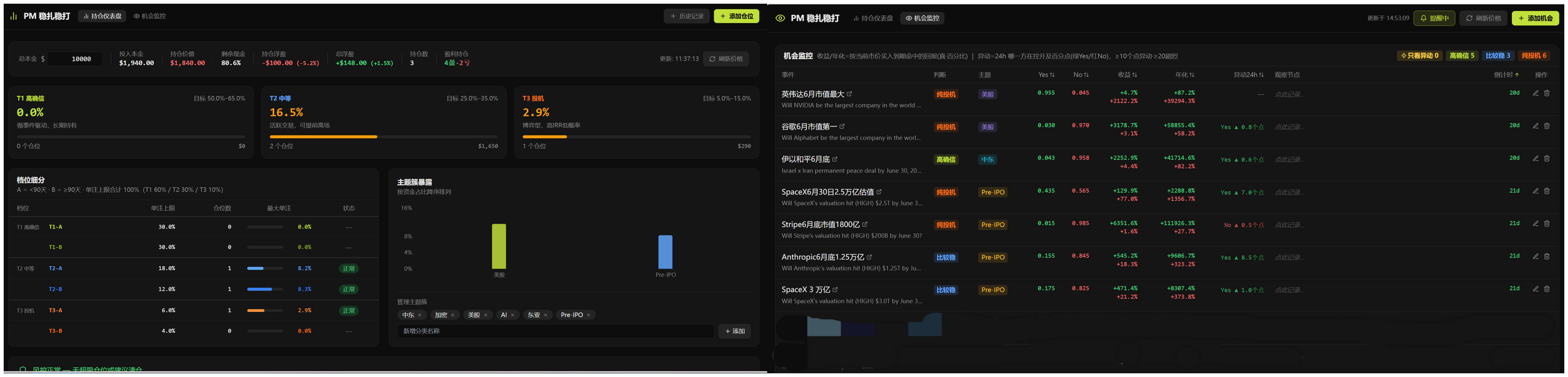
I also categorized these bets according to my own criteria (I internally label them as T1 (high confidence)/ T2 (relatively stable)/ T3 (pure speculation)) and sorted them by expected return, so at a glance, I can distinguish which ones are just noise.
To be honest, my slight advantage in this market is having access to Chinese information and the political and economic dynamics in East Asia—many are led by Western players, and the pricing often lags behind, with opportunities hidden in that time difference.
The third: Small operational backend
This one is unrelated to investment and is for my writing purposes.
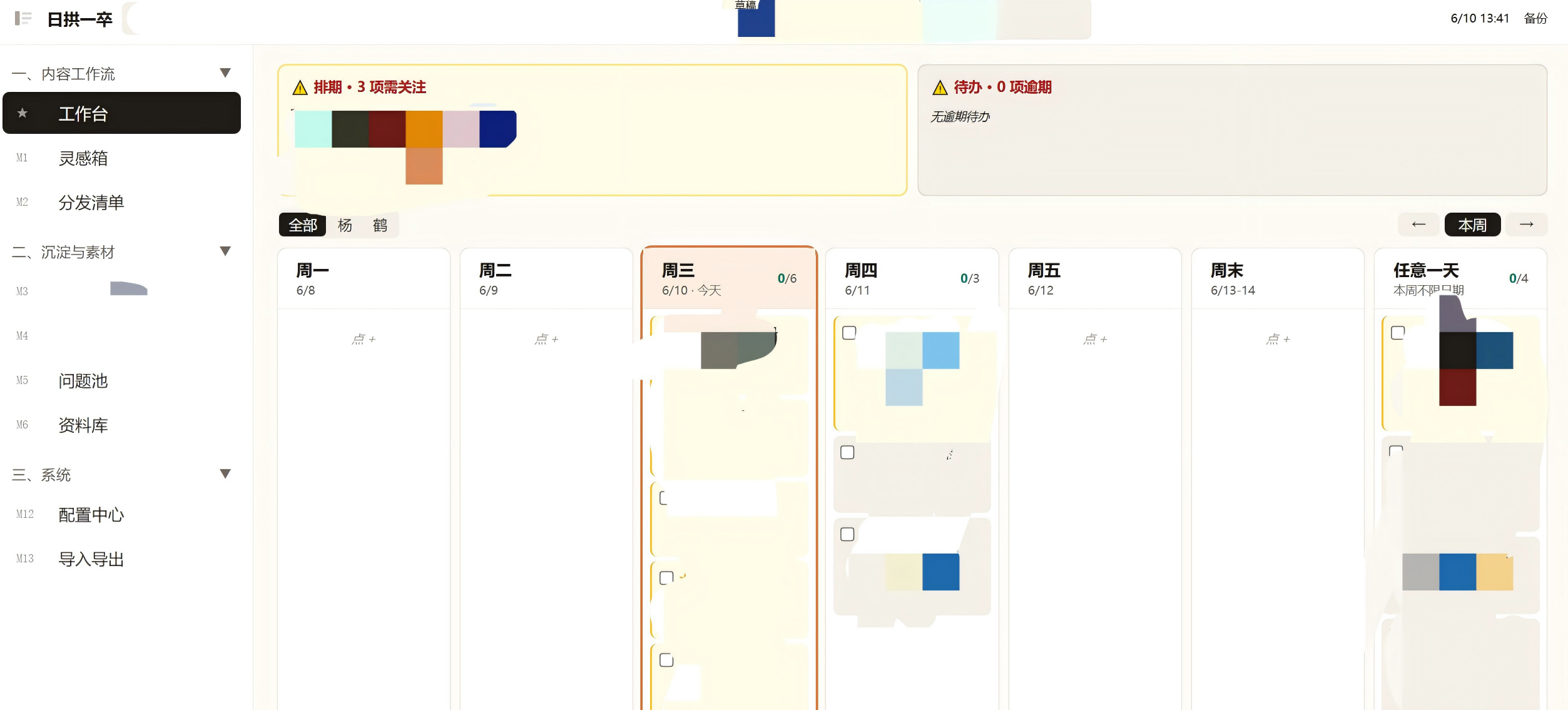
I usually have to choose topics, write articles, and post across several platforms. Progress is all remembered in my head or dug up from chat records, which often gets messy, so I created a small backend to manage it, including a list of topics, article progress, publishing platforms, and an idea box.
Since I might need this when I go out, I didn’t make it local but deployed it on the cloud—using GitHub + Vercel, so I can access and modify it easily on my phone, which is quite convenient.
The fourth: One-click formatting tool
This was mainly to meet my personal needs. After finishing an article, I have to publish it on many platforms, especially since every Web3 media has a different formatting rule, which takes a lot of time to adjust manually.
So I made a small tool, along with a browser userscript set up for Coding. I can drop in a Markdown or Word original document, and it will automatically convert it into the corresponding formats for various platforms and insert images directly. It may not be very advanced, but it saves a bit of mechanical work every day.
In fact, these four tools are still quite basic, and one might even say they are a bit ugly—not exactly mature products—but they are really useful to me because once an idea emerges, I can immediately bring it into the system instead of letting it scatter and be forgotten.
This is the most important change I feel.
3. How Everyday People Conduct Investment Research Has Really Changed
Because of this, I increasingly feel that ordinary people do not have to start with very complex models when investing, but at least they should have a few basic systems of their own.
Now, AI is not changing ordinary people suddenly into experts, but rather allowing many things that were once "I want to do but can't" to take shape.
This is especially evident for someone like me who looks at the market every day; as long as there are ideas, every ordinary investor can actually gradually build a few of their own basic systems:
Asset observation system: What assets are you actually monitoring, which market they belong to, and what changes have occurred recently;
Signal monitoring system: Which events, when they occur, might indicate changing market expectations;
Map organization system: A sector is not just a point but a network—who is upstream, who is downstream, who benefits from sentiment, who benefits from performance, and who benefits from funds. Especially over the past year, stocks in the AI sector have essentially rewarded those who can thoroughly understand a specific track (from HPC to optical modules to storage chains);
Review system: Why did you feel optimistic at that time, what happened afterward, and where were your judgments right or wrong;
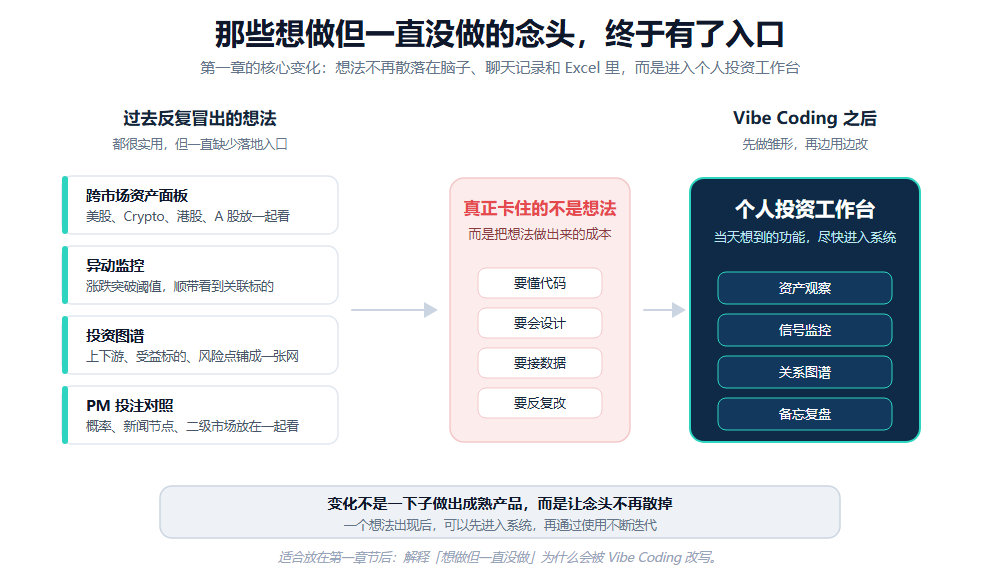
These things were not impossible before; they were just too troublesome and hard to maintain. The greatest significance of AI is cutting out a large portion of that trouble.
You may not necessarily know how to code, but you can describe requirements, and then gradually build your product designs without needing to finish everything at once. You can release the first version, use it, and make changes along the way.
This is also what attracts me the most about Vibe Coding—the feedback is incredibly fast. Previously, there would often be a long gap between when an idea emerged and when it was implemented, often long enough for you to forget why you wanted to pursue it in the first place.
Now, if you think of a feature today, you can try it out the same day; if you’re not satisfied, you can make changes immediately; if new requirements pop up after two days, you can continue to iterate.
This cycle of "idea—implementation—usage—feedback—revision" can truly become addictive once it gets going.
In Conclusion
This article serves as the first record of "Tyler in a New Phase."
In the future, I will try to provide updates, documenting my investment thoughts, tested tools, on-chain practices, arbitrage studies, as well as some educational/introduction content on Web3 practices and investment knowledge points.
Feel free to follow and communicate anytime.
免责声明:本文章仅代表作者个人观点,不代表本平台的立场和观点。本文章仅供信息分享,不构成对任何人的任何投资建议。用户与作者之间的任何争议,与本平台无关。如网页中刊载的文章或图片涉及侵权,请提供相关的权利证明和身份证明发送邮件到support@aicoin.com,本平台相关工作人员将会进行核查。