Source: The Defiant
Translated by: Yuliya, PANews
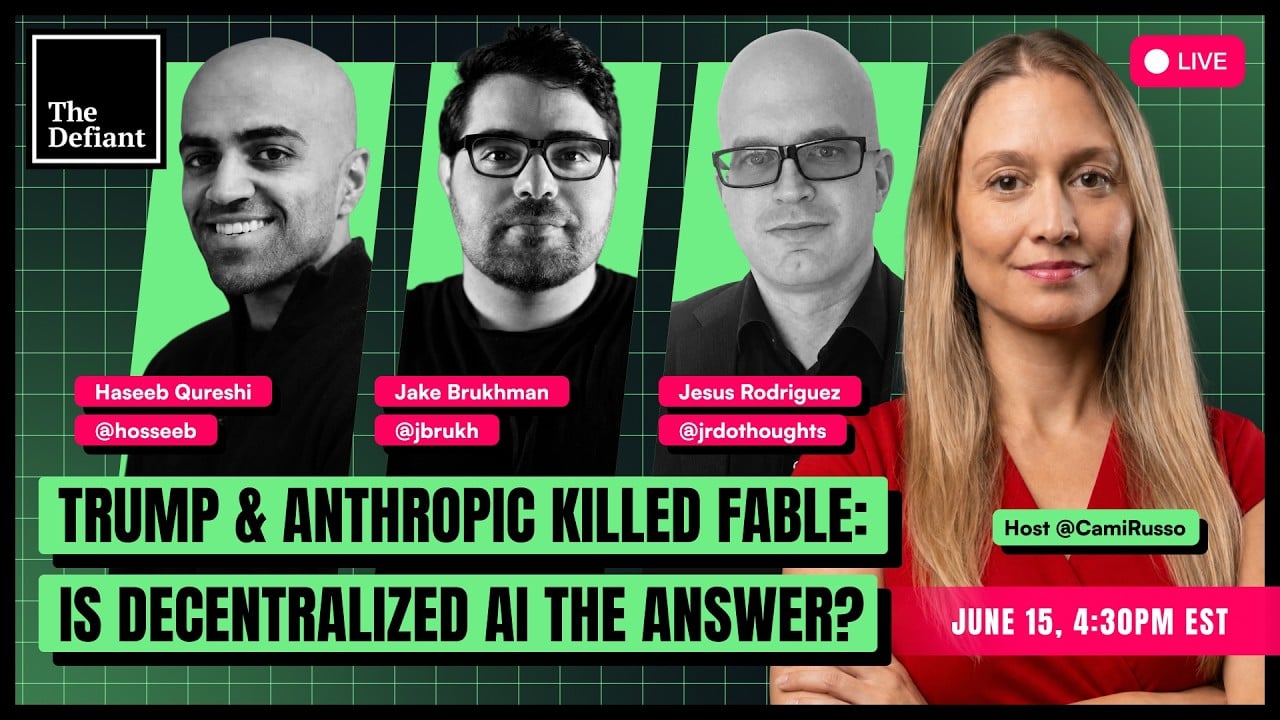
Editor’s Note: Last week, the release of Claude Fable 5 by Anthropic ignited the most severe crisis of trust in the cutting-edge AI field: Researchers found that once the model suspected that users were developing competing products, it would "secretly poison" and quietly reduce the quality of responses, coupled with the model's 30-day data retention requirement, which led to its ban within Microsoft. This has sparked a question that has been asked in the crypto field for years: Should any single company control so much cutting-edge AI?
In response, Camila Russo, founder and CEO of The Defiant, invited Jake Brukhman, founder of CoinFund, Jesus Rodriguez, founder of Sentora and The Sequence, and Haseeb Qureshi, managing partner of Dragonfly, to engage in a heated debate about the future direction of decentralized AI.
The Battle of Large Models, the Trend of Open Source, and the Panic of "Lockdown"
Haseeb: Our current investment logic is: In the future, we will see more and more "non-cutting-edge" models emerging, and user spending on model tokens (computational expenses) will increasingly flow into these non-cutting-edge areas. Everyone knows that pouring money into the most cutting-edge large models is unsustainable, and the vast majority of people do not require such high intelligence.
There are many distilled, open-source, or openly weighted models on the market, priced very affordably. You can easily assign different tasks to them. There's a joke online saying that someone actually used a model like Mythos or Claude Fable 5 to rename a file— as we become more familiar with these models, such scenarios will become more frequent. What you need to think about is: Why use a sledgehammer to crack a nut?
That said, the term "decentralized AI" is too broad. If it just refers to "everyone using various models developed by different organizations" (like the OpenRouter model), that doesn't differ much from our current world. But if it refers to "training or running AI models using decentralized networks," then that’s a different logic altogether. We are actually quite pessimistic about the latter, at the moment, we don't see any reliable reasons to prove that training or running models in a decentralized environment is economically viable and has market demand.
Of course, the release method of Fable has indeed triggered a strong backlash. People have a possessive desire for good products; once they start using them, they feel, "You can’t take it away unless I’m dead." When the government suddenly intervenes to lock it down, people undoubtedly feel deprived. But at the same time, if you remember the scene when Mythos was initially released, it was terrifying— all our existing software, operating systems, or browsers had vulnerabilities like Swiss cheese in the face of it. At that time, no one jumped up to say, "You should make this open to all humanity."
Some say the actions of the U.S. government here are crazy. Anthropic claims they cleared all concerns from national security agencies before releasing Fable 5, but as far as I know, national security departments intervened in the blocking of Mythos long ago. Mythos was only promoted to a select group of thirty-some partners in Project Glasswing, which were meticulously chosen by the government, not by Anthropic. So the claim that "Fable was released behind the government's back" is obviously unfounded. There are rumors that Amazon's president Andy Jassy went to the government or the White House, telling them about backdoor vulnerabilities in the model, which made the government realize the danger and immediately locked down Fable 5 across the U.S.
This governance and security mechanism is clearly not sound. While I agree that what is happening in labs (whether at Anthropic or OpenAI) is extremely dangerous and needs to be approached cautiously, I also believe that there is tremendous economic value inherent in the allocation of open-source and openly weighted models, and both must develop in parallel.
*Note: Project Glasswing is a cybersecurity project initiated by Anthropic in collaboration with several tech companies, launched in April 2026.
Jesus: Without delving into apocalyptic tech topics, I have indeed heard from people in the cybersecurity industry that Mythos is indeed terrifying. After its release, I spoke with some people at Anthropic, and the issues are very real. But I also heard well-known CEOs in the cybersecurity field express that they would prefer open access to this model, as releasing it outright would give all these security companies enough preparation time. Attempting to restrict it or delay the release by three months, you'll never get enough buffer. But the counterargument is: Would releasing Mythos outright lead to catastrophic consequences?
Haseeb: We are in the blockchain space, do you really think it wouldn’t be catastrophic if North Korea got this model?
Camila: But isn't there an argument that if everyone has it, it could reduce risk because everyone can test it?
Haseeb: Not everyone has nuclear weapons.
Jake: Using nuclear weapons as a metaphor is not entirely appropriate. Take Mythos for example, it's a model that exploits system vulnerabilities. We need to do a cost-benefit analysis: Hackers are spending money using Mythos to find vulnerabilities, and website owners also have to spend money to defend. Is this market really equitable? Do hackers really think it's worth spending great amounts of time to exploit a Linux vulnerability that can’t be monetized?
If this model that can exploit vulnerabilities is only in the hands of a few (like large companies can use it, but ordinary people cannot), you are essentially creating an imbalance. Some people can protect their assets, while others can only take hits. So I personally believe that allowing everyone to access the model equally is better.
This isn't some cyberpunk-style rebellious spirit; it's an inevitable trend in the market. Today, you see closed-source cutting-edge models, but at the same time, there is a large number of open-source models (largely produced by Chinese labs). Although they are at a disadvantage in computational power, their gap with cutting-edge models in various evaluation metrics is only a few percentage points. The charts from Epoch.ai clearly show that the gap between open-source and closed-source models is rapidly narrowing. Even if Anthropic wants to be the "Big Brother" protecting everyone, the reality is that people need these models to protect their websites and software. They will always get access—whether it’s through Anthropic, from open-source labs in Asia, or through models trained on decentralized networks.
Export Controls, Regulations, and the Boundaries of Open Access
Camila: Jake, do you think there shouldn’t be any guardrails at all? Should everything be completely open to everyone?
Haseeb: Let me add to this question. Do you think the concept of "export controls" should not exist at all? Because beyond AI, the internet itself is an element of war.
Jake: I don't have a political stance, I'm just a tech guy, and I'm not in the State Department. If the U.S. government decides to impose export controls, that’s their business. But that’s a different matter from whether "technology should be shared globally."
Suppose Fable is trained on a decentralized network, with no one entity possessing the complete model weights (some weights in the U.S., some in Amsterdam, some in Australia). If the U.S. imposes export controls on the portion of weights within its territory, the model could still flow seamlessly in other parts of the world. That’s an issue concerning the U.S.'s enforcement mechanism. Look at Bitcoin; it is a sovereign, independent, decentralized currency that can't be stopped. Haseeb mentioned earlier that he's not sure if there's a market demand for decentralized AI, which is akin to saying in 2011, "I don't know if there's demand for PoW (proof of work)." In fact, because there is a demand for global, permissionless currency, there is immense demand for the technology. Similarly, there is a tremendous demand for global, permissionless AI, which no matter how much the U.S. State Department dislikes, it can't stop.
Jesus: Speaking of the analogy of export controls, if you restrict everyone’s access to Mythos, but some open-weight model suddenly evolves network attack capabilities? Look at the current cybersecurity benchmark tests; DeepSeek-V4 or Qwen 3.7 are ranking very high. Models with network attack capabilities are just a matter of time.
The AI community likes to use nuclear weapons as a metaphor: After World War II, there was a four-year period where the U.S. had nuclear weapons while other countries did not. There's a theory that if the U.S. had pressured back then, communism might never have developed in Eastern Europe. But then the Soviet Union developed nuclear weapons too. What concerns me is not opening it up to everyone initially but instead selectively deciding who gets access. If this is export control, why isn't every American company allowed to access it?
Haseeb: Regarding Fable, we need to clarify the details. The government requires that Fable be closed to all non-Americans. Currently, Anthropic does not have sufficient KYC (Know Your Customer) mechanisms to ensure compliance, and export control is strictly a liability issue. If the model falls into the hands of non-Americans, you have a problem. That’s why they currently lack confidence in saying they can accomplish this. Currently, Polymarket predicts that by the end of July, there is a 77% probability they can restore operations for Americans, whereas the probability of restoration around early June was about 50%.
Evidently, the idea of "banning any foreigners from using Fable 5" is ridiculous in itself. There are a large number of foreign employees holding H1B visas in the U.S.; it’s absurd that a French engineer on your programming team is not allowed to use Fable. This will likely be negotiated and changed before actual enforcement; if Anthropic can fix vulnerabilities and implement stricter controls, there may not be a need to completely shut down non-American actors.
But this is different from the situation with Mythos. Fable was originally intended to be a "good citizen model" for writing code and drafting emails, whereas the U.S. government's stance towards Mythos was: No, this can only be given to Americans, and "only to those named on our list." This is no longer export control; this is essentially the AI version of the "Manhattan Project."
According to reliable sources I have, the government led the process of Project Glasswing, which is why the slots went to large companies like Microsoft rather than some random cybersecurity firms. This isn’t surprising for a government that views it as an extremely dangerous offensive cyber weapon; we treat fighter jets and missiles the same way. This isn’t about Anthropic wanting only 30 companies to use it for marketing purposes; they would prefer the whole world to use their products.
Camila: In the crypto space, we see that with the sharp increase in the number of hacking attacks caused by AI, we can infer what the risks would be if Mythos were widely adopted. Jake, do you think it’s reasonable to restrict certain groups from using these models in some cases, or do you still insist they should be open to everyone?
Jake: As I said, this is two independent questions: "Is decentralized AI technology viable?" The government can certainly enact laws for regulatory purposes; it’s not a black-and-white choice. However, decentralized technology can bring more competition by lowering the barriers to entry. It utilizes commodity-level hardware to reduce costs.
I spoke with a founder today who is doing inference on heterogeneous commodity GPUs. He believes that as electricity costs rise, it will be a cheaper option for consumers in the long run. All technological advancements ultimately aim to reduce costs and barriers. AI can be said to be the most centralized industry in the world at present, and it most needs to break down barriers. We support decentralized AI to protect consumer choices, and ultimately, to defend democracy.
The Physical Bottlenecks and Algorithm Breakthroughs of Decentralized AI
Camila: If only a few centralized companies end up controlling most of the AI models used globally, what happens? If there is realistically no successful decentralized AI, what’s the cost?
Jesus: I have to counter Jake. From a technical standpoint, creating a Mythos-level model in a decentralized way would be significantly more costly than centralization. NVIDIA has a moat in deep waters that few people mention: apart from Google having TPUs, currently all large architectures run on hundreds or thousands of NVIDIA GPUs; AMD simply does not have that operational data.
I actually support centralized AI; I have built two companies in this field. Decentralized AI isn't a new phenomenon; it has never found a product-market fit (PMF). Previously, models were small and simple enough that decentralization didn’t matter much. Now they are large enough that decentralization becomes extremely difficult. Furthermore, we have gaps in talent, compensation, and funding. A lot of inference isn’t happening on cutting-edge GPUs but on previous generations of GPUs, with pre-training requiring H100s.
Jake: The supply of GPUs has been bottlenecked over the past few years, and prices have been rising consistently. In 2026, it will be very difficult for typical mid-tier startups to find H100s. Historically, large-scale training has been conducted in luxury data centers that require nuclear power support—those industrial-grade GPUs have 132GB of memory, and inter-node bandwidth reaches 1 to 3 TB/s. If I tell you we can transfer this process to consumer-grade devices (like regular Nvidia GPUs, or even your Macbook or Mac Studio) and run on regular consumer-grade networks, you’d think I’m crazy.
However, when faced with such enormous computational demands, people have significant motivation to change training methods and optimize algorithms. Let me use a quantum analogy: Google has two types of quantum specialists; those in hardware will say that quantum computers will not solve any problems in the next ten years, while those in software will say, "Be careful with Ethereum in 3 to 5 years." Haseeb and Jesus are looking at the problem from a hardware perspective, while I am looking at it from the perspective of optimizing hardware usage.
We are making significant progress. Not only does research show that post-training reinforcement learning can be ten times faster and cheaper, but the ongoing Pluralis is purely running on an RTX 4090, which will demonstrate that you can train a real large language model (LLM) on purely consumer-grade devices. Because half of a data center's TCO (total cost of ownership) is maintenance and cooling, while a swarm of devices has none of these costs, it becomes cheaper. Even if it is slightly slower, the much lower cost still makes it economically viable.
The earliest batch of algorithms (like DiLoCo, Sparse LoCo, and Google's algorithm from two years ago) has developed parameters from 10 billion, 40 billion to 72 billion. Now Macrocosmos has reached 100 billion parameters. The next generation of algorithms will disrupt the model; I believe using these methods, we will reach trillions of parameters.
Haseeb: Let me play the skeptic.
First, building large models has two limitations: computation and bandwidth. The laws of physics cannot be broken; if you don’t physically place the devices together and communicate through high-bandwidth interconnects, but instead communicate over the public internet and compress gradient updates, you will inevitably pay a huge price. Additionally, machines in a decentralized network are all over the place, making it impossible to accurately calculate "total cost of ownership (TCO)." This very narrative was told by people promoting decentralized storage back then: "It is slow now, but it will be fine once algorithms are optimized." What happened? Decentralized storage gained no demand because it was neither cheap nor efficient.
The most critical point is: the biggest limitation of training a large model is data. Training a model like Mythos or Fable, which is roughly estimated to have 80 trillion parameters, requires massive amounts of token data. OpenAI and Anthropic spend heavily to generate data from suppliers; they incur high costs producing synthetic data and acquiring user data from the usage traces of Claude Code and Codex. The decentralized crowd simply does not have this data.
Setting aside the economics, looking at it from the demand side. I believe the core value proposition of cryptocurrency is not decentralization; decentralization is merely a means, with the goal being self-sovereignty and anti-censorship. This was also the reason Satoshi designed Bitcoin. In the AI field, what do people care about? First, cost; second, owning the model and ensuring data is not included in the training set; third, anti-censorship. People absolutely detest the censorship policies of Fable 5 and its internal mechanisms that undermine performance.
Look at Venice AI; it is currently the darling of the crypto AI product world. It uses Near AI for confidential computing, protecting privacy and zero data retention. But the most commonly used models on Venice are not those trained in a decentralized manner (not from Pluralis, etc.), but rather open-weight models operated by conventional companies like DeepSeek or GLM-5. This indicates that the direction of AI development may be: people want a privacy and anti-censorship experience, but it doesn’t necessarily have to be achieved through a Bitcoin or Ethereum-level underlying decentralized mechanism.
Jesus: Decentralized and centralized AI people often find themselves solving the problems of two generations behind. A researcher told me a few days ago, "Pre-training hasn’t been fully solved, but it’s already very boring." Many innovations in inference come from post-training, and now we are talking about recursion, continual learning, etc. Decentralized AI is actually widening the gap under the dimensionality reduction attack of talent and funding. As for small models and edge computing, many times just distilling a large model (like Google's Gemma) works perfectly. If you create a decentralized cluster, after working hard for a month, if one computer drops offline causing a total crash, I can’t imagine how you’d deal with that.
Jake: You could be wrong about this; decentralized training clusters actually have very strong resilience. In giant data centers, if one GPU fails, you may need to restart the training; whereas in a Swarm, GPUs of different sizes and shapes can join and leave the network during training without a negative impact. The biggest evidence is that Google recently stated on their blog that they started using DiLoCo-style algorithms in their own data centers.
Regarding the data issue, Haseeb is correct, but that doesn’t mean that decentralized people lack data while centralized people have it. There are many clients in the market wanting better AI economics. For instance, Kirkland & Ellis recently announced they will invest $500 million to purchase their own proprietary dataset for training, and they are even looking to hire AI engineers internally in their firm. For clients like them with a $500 million budget wanting to train their own models, decentralized networks eliminate the cooling and maintenance costs of data centers, drastically reducing the computing underpinnings' costs.
Haseeb: The reason Kirkland & Ellis is doing this is that they don’t want to share their data. If they put their data on a decentralized network, their data would be exposed. They’re not doing this because they believe they are good at training models; they want to internalize value. Why hand it over to Harvey (an AI legal tool)?
Jake: Who says decentralized training has to be completely transparent? It can absolutely be implemented under a privacy permission system. The more critical point is that when the model weights are decentralized, no single entity has control over all the weights, necessitating that users of the model pay the network. This revenue stream no longer flows to OpenAI's Sam Altman or Anthropic's Dario but to the token holders, buyers, and training participants in the network. This creates a business model and revenue stream for the model. Traditional law firms may not adopt it immediately, but there will undoubtedly be companies that find this a good way to finance products.
Cyber Attacks, Geopolitics, and the Final Fortress
Camila: If all this is achievable, then decentralized AI could be just as powerful as centralized AI. In cases where the Fable model is required to be shut down by the government, can decentralized networks withstand censorship?
Jake: Anti-censorship isn’t actually the primary mission of these networks. However, if you really want to do that, you can shatter the neural network, dispersing the weights across dozens of countries so that it can't be forcibly shut down. But I reiterate that the ultimate goal of decentralized AI is to lower barriers, democratize computing power, and allow more people to afford to train models.
Jesus: OpenAI mentioned earlier that "the model itself is no longer the product." In the field of decentralized AI, people seem obsessed with building models while actually lagging two or three generations behind existing technology. We should seek value around the infrastructure surrounding models: sandboxes for code execution and computation, evaluation mechanisms (Evals), synthetic data pipelines, and so on. Many modern financial applications can be built at the intersection of DeFi and AI, but we haven’t fully utilized that.
Haseeb: Returning to the initial question, if cutting-edge AI were completely open-sourced and spread everywhere, even export controls wouldn't be able to contain it, what would happen?
I believe there would be a "COVID-level" cyber tsunami globally. Software that can’t be patched, and small companies’ servers, will be utterly demolished. Just look at the data on the blockchain: April 2026 will go down as the month with the most hacker attacks in crypto history, followed by May setting a new record. Although the total amount stolen isn’t exaggerated, the frequency of incidents is spiking, which means storing money in small protocols is more dangerous than ever.
If everyone in the world holds a "rocket launcher," it will inevitably lead to the destruction of significant infrastructure. Although after the suffering, in two or three years, our systems will be reinforced with "tank armor," the pain period will be extremely intense.
Camila: Wouldn't it be better to put such powerful tools in everyone's hands rather than controlling them by just a few companies and governments?
Haseeb: The "everyone" you're talking about includes North Korea. Do you really want North Korea to have access to Mythos?
Camila: So you would rather let the U.S. government have a monopoly, even allowing them to censor others, than let all of humanity share whatever they want?
Haseeb: If I had to choose between "only Americans can use it" and "the whole world can use it," I would choose America. If you genuinely believe AGI (Artificial General Intelligence) will come, then it is the most powerful weapon in human history. Historically, weapons of mass destruction have been controlled by sovereign nations, and that’s normal. I'm not worried about the Chinese government obtaining Mythos; they're careful and have long-term planning; I worry about North Korea, terrorists, and rogue hacker groups. Just as I am not concerned about China having nuclear weapons, I worry about North Korea pushing the button.
Camila: Finally, please summarize, Jake and Jesus. Haseeb's firepower is too strong; we need some faith recharge for decentralization.
Jake: From an investor's perspective, it’s about finding fields with great risk-reward ratios. Decentralized AI is a very cool area. A few days ago during dinner, one of our friends said: "Cryptocurrency is becoming purely a traffic business; what should we do?" In this world, decentralized AI could be said to be the last fortress in the cryptocurrency field; it’s genuinely operational cutting-edge technology. I am very excited about the companies we work with in this space (like Pluralis, Prime, Intel, Jensen, Bagel, Pearl, etc.).
Jesus: Decentralized AI certainly holds value, but I still don’t have high hopes for decentralized "pre-training." I believe there are enormous opportunities within decentralized AI infrastructure. The tech stack under Crypto is too outdated; the whole world is modernizing through AI, and the combination of DeFi and AI is definitely the next big opportunity.
免责声明:本文章仅代表作者个人观点,不代表本平台的立场和观点。本文章仅供信息分享,不构成对任何人的任何投资建议。用户与作者之间的任何争议,与本平台无关。如网页中刊载的文章或图片涉及侵权,请提供相关的权利证明和身份证明发送邮件到support@aicoin.com,本平台相关工作人员将会进行核查。


