
Author: Frank, PANews
The World Cup has never lacked predictions. Professional institutions, odds companies, fan communities, and data models all provide their answers before the matches begin. However, in the prediction market, judgment is not just an opinion; it requires real money to place a bet.
When a strong team’s winning price rises due to continuous buying, when the share of a draw suddenly gets swept up before kickoff, when a single wallet places dozens of orders on the same match, what the prediction market presents is no longer just the question of "who will win," but a real-time experiment involving funds, information, and biases.
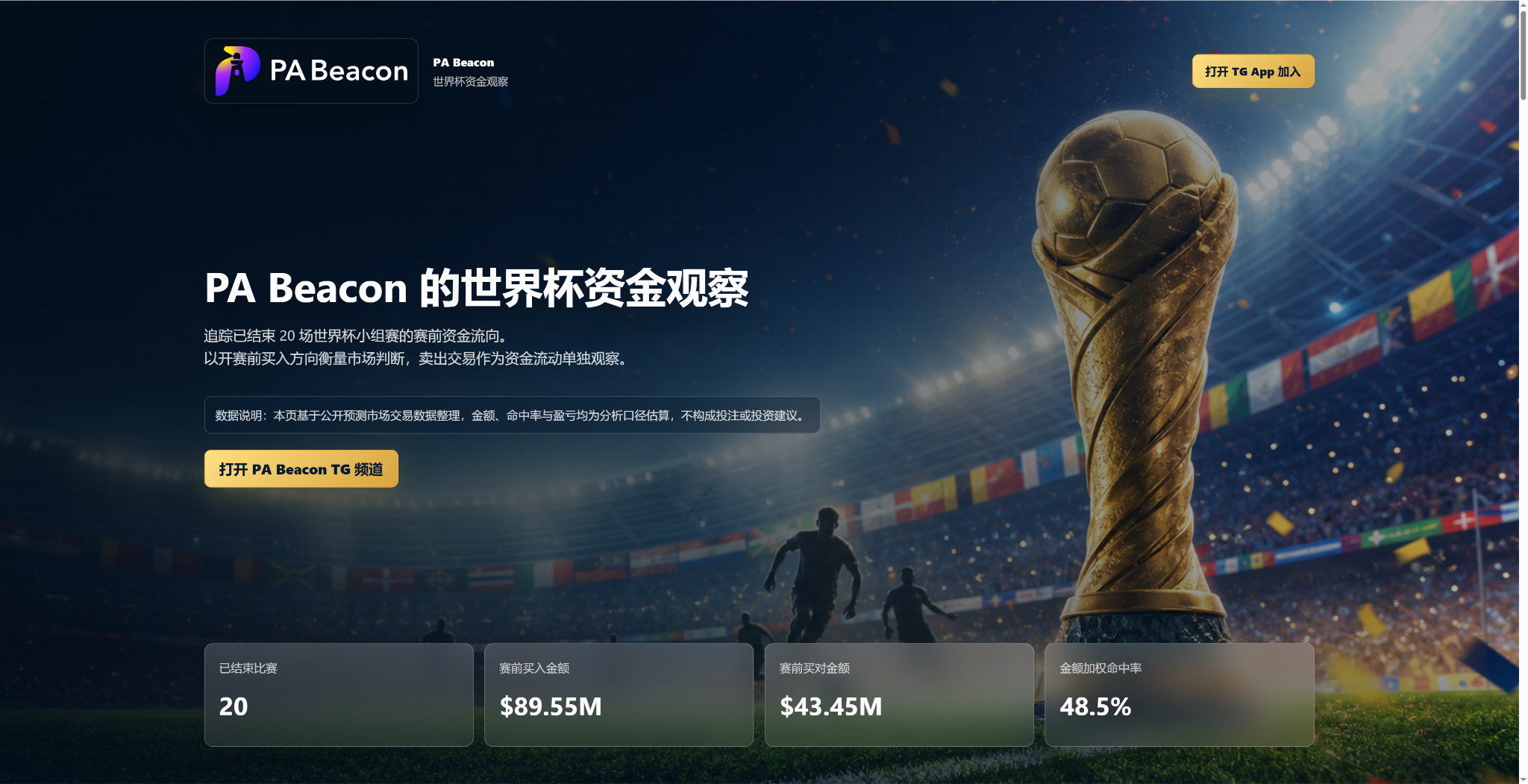
PA Beacon has compiled the trading data of Polymarket's completed World Cup contracts. As of June 17, 2026, covering 20 completed group matches, all single transactions were over $5,000. The total buying amount before the matches was $89.5457 million, and the amount corresponding to correct predictions was $43.4504 million, resulting in a weighted hitting rate of 48.5%.
This result does not align with many people's intuitive notions of "smart money." At least in this set of World Cup samples, substantial funds did not predict all outcomes correctly as if looking into a crystal ball. Interestingly, if we estimate based on holding the accumulated buying positions until settlement, the total cost of 1,278 combined trading positions was $89.5457 million, while the total payout was $87.7863 million, leading to an overall loss of about $1.7594 million, resulting in an ROI of -2.0%.
In other words, the true value of the prediction market may not lie in telling us "who will surely win" but in revealing a more complex issue: when funds are at stake based on their judgments, which consensuses will be validated, which biases will be punished, and which so-called smart money will also fail in the face of uncertainty on the field.
Draws remain the greatest risk, but strong team narratives are beginning to recover
In the 20 completed matches, there were 12 with a winner and 8 with a draw; there were 10 matches with over 2.5 total goals, and both teams scored in 14 matches.
On June 17, the latest four matches finally did not result in upsets. France defeated Senegal 3-1, Norway defeated Iraq 4-1, Argentina defeated Algeria 3-0, and Austria defeated Jordan 3-1. The popular teams and strong narratives were realized in these matches, pushing the weighted hitting rate of pre-match buying amounts from 45.8% to 48.5%.
However, overall, draws still remain the most significant risk factor in this round of the prediction market. There were 8 draws out of 20 matches, accounting for 40.0%. For large funds betting on strong teams to win, the most dangerous outcome is often not an upset win by a weak team, but rather the inability of popular teams to convert advantages into victories, ultimately losing profits to a draw.
The Belgium vs. Egypt match is the most typical case. This match attracted the highest pre-match buying amount in the sample, reaching $12.3855 million, with a total of 145 pre-match buy-ins involving 53 wallets. However, the match ended in a 1-1 draw, resulting in a hitting rate of only 5.4% for the pre-match buying funds. From the trading results, a large amount of money clearly saw a Belgian victory as the main narrative, but the answer given by the football pitch was a draw. Moreover, the unusually high buying amount in a match that did not attract much attention is also quite puzzling. An overseas analyst @ORamosBets suggested that this match might involve an $8.6 million "money laundering" transaction.
The Netherlands vs. Japan displayed a similar structure. The pre-match buying amount was $6.0814 million, while the final score was 2-2, with a hitting rate of only 18.9%. The Spain vs. Cape Verde match was more extreme, with 210 pre-match buy-ins totaling $4.3117 million, ultimately resulting in a 0-0 draw, and a hitting rate of 23.0%. These three matches absorbed a total of $22.7715 million in pre-match buying but led to significant deviations from the mainstream funding direction due to the draw results.
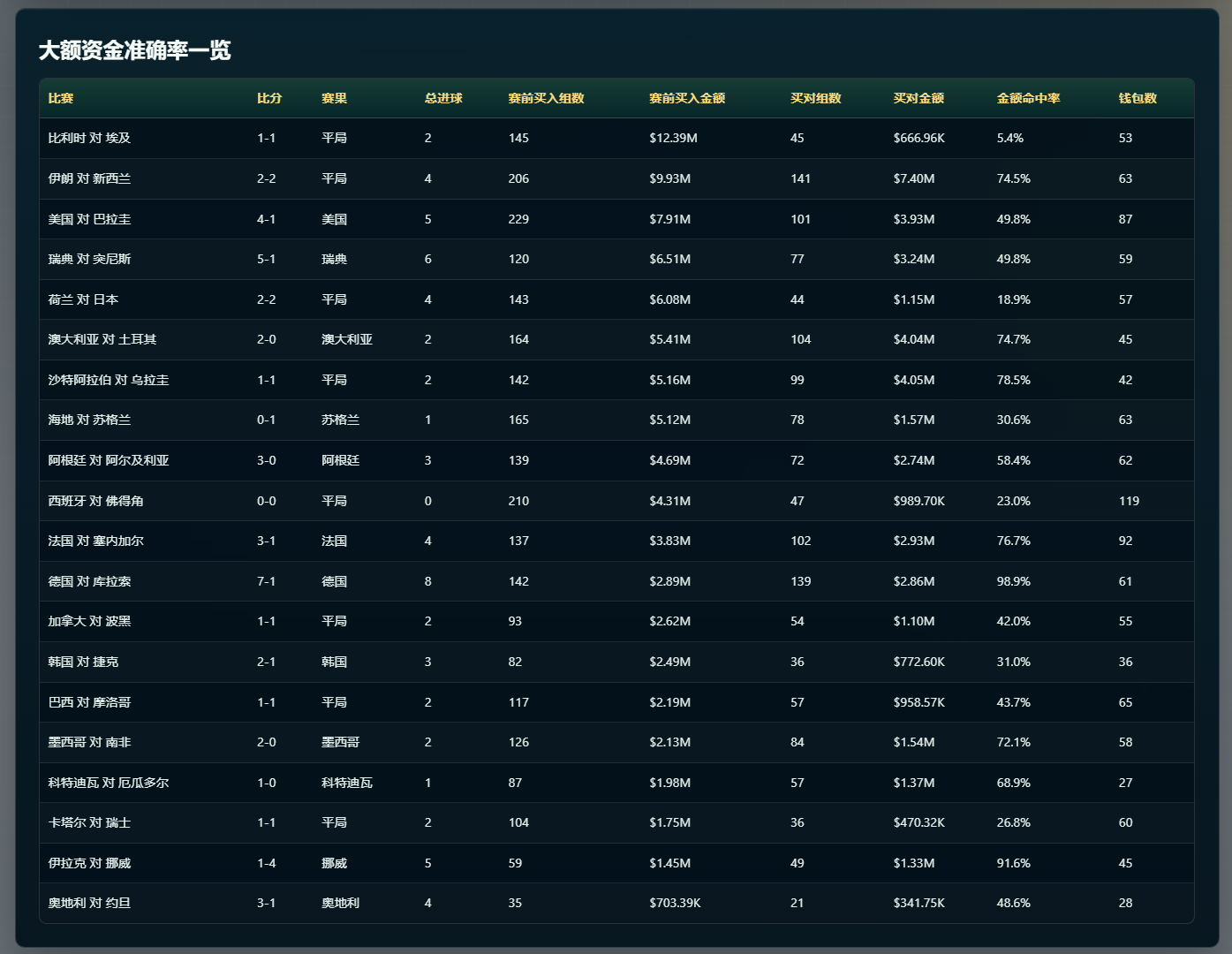
However, the market is not entirely ineffective. Germany's match against Curacao is a sample of "correct consensus," as Germany ultimately won 7-1, with a pre-match buying amount of $2.8883 million and a hitting rate of 98.9%. In the Iraq vs. Norway match, Norway won 4-1, with a pre-match buying amount of $1.4464 million and a hitting rate of 91.6%. The hitting rate for France vs. Senegal also reached 76.7%. These cases illustrate that when the strength gap is clear and the outcome paths are relatively straightforward, large funds can still reflect higher information efficiency in advance.
What truly deserves consideration is when the market is more effective and when it is more easily swayed by emotions. The greater the strength gap, the easier it is for prices to become containers for information; when the strength gap is not large enough to cover the risk of a draw, prices can become amplifiers for popular narratives.
"Buy No" continues to outperform, but the advantage is narrowing
From the result shares perspective, in the latest sample of 20 matches, "Buy No" still clearly outperforms "Buy Yes."
In 2,645 pre-match buy-ins, the amount for buying "Yes" was $49.9188 million, with a hit amount of $18.7170 million and a hitting rate of 37.5%; the amount for buying "No" was $39.6270 million, with a hit amount of $24.7334 million and a hitting rate of 62.4%.
This gap remains very significant. It does not mean that "always buy No" is a stable strategy, but rather indicates that in this set of samples, the market's pricing of popular outcomes may still be overvalued. Once a match trends toward a draw, and the popular team cannot win, or the market prices one team’s victory probability too high, buying "No" shares will have a greater margin of error.
Iran vs. New Zealand is one of the best examples. The match ultimately ended in a 2-2 draw, with a pre-match buying amount of $992.82 thousand, achieving a hitting rate of 74.5%. Among them, mintblade concentrated its buying on "Iran not winning," with an aggregated cost of $647.05 thousand at an average price of about 0.49. If estimated to hold until settlement, this position could generate approximately $1,324.43 thousand, yielding about $677.38 thousand in profit with an ROI of 104.7%.
This is not about hitting an upset win or loss but about betting on "the favorite failing to deliver." In the prediction market, these types of trades are more intriguing than simply buying a draw. It does not require traders to accurately determine that the match will definitely end in a draw; it only needs to evaluate that a particular popular result is overvalued. In low-scoring and highly random match environments like the World Cup, this line of thinking is often closer to the inherent risks than betting on a single win or loss.
However, the matches on June 17 also showed that the advantage of "Buy No" is not unrepairable. After the strong directions of France, Norway, and Argentina played out successfully, the hitting rate for buying "Yes" has risen from 28.8% in the previous sample to 37.5%. This indicates that the prediction market does not always punish the popular but punishes them when their prices are overly inflated.
Some made $6.77 million overnight, while others lost $8 million in a match
If the sample is expanded from the match level to the position level, the high volatility characteristics of the prediction market become even more apparent.
In this statistical analysis, there were 1,278 pre-match aggregated positions, of which 694 were correct, and 584 were incorrect. The number of correct positions already exceeds that of incorrect ones, but due to the enormous differences in amounts across positions, the final result still relies on the success or failure of a few large positions.
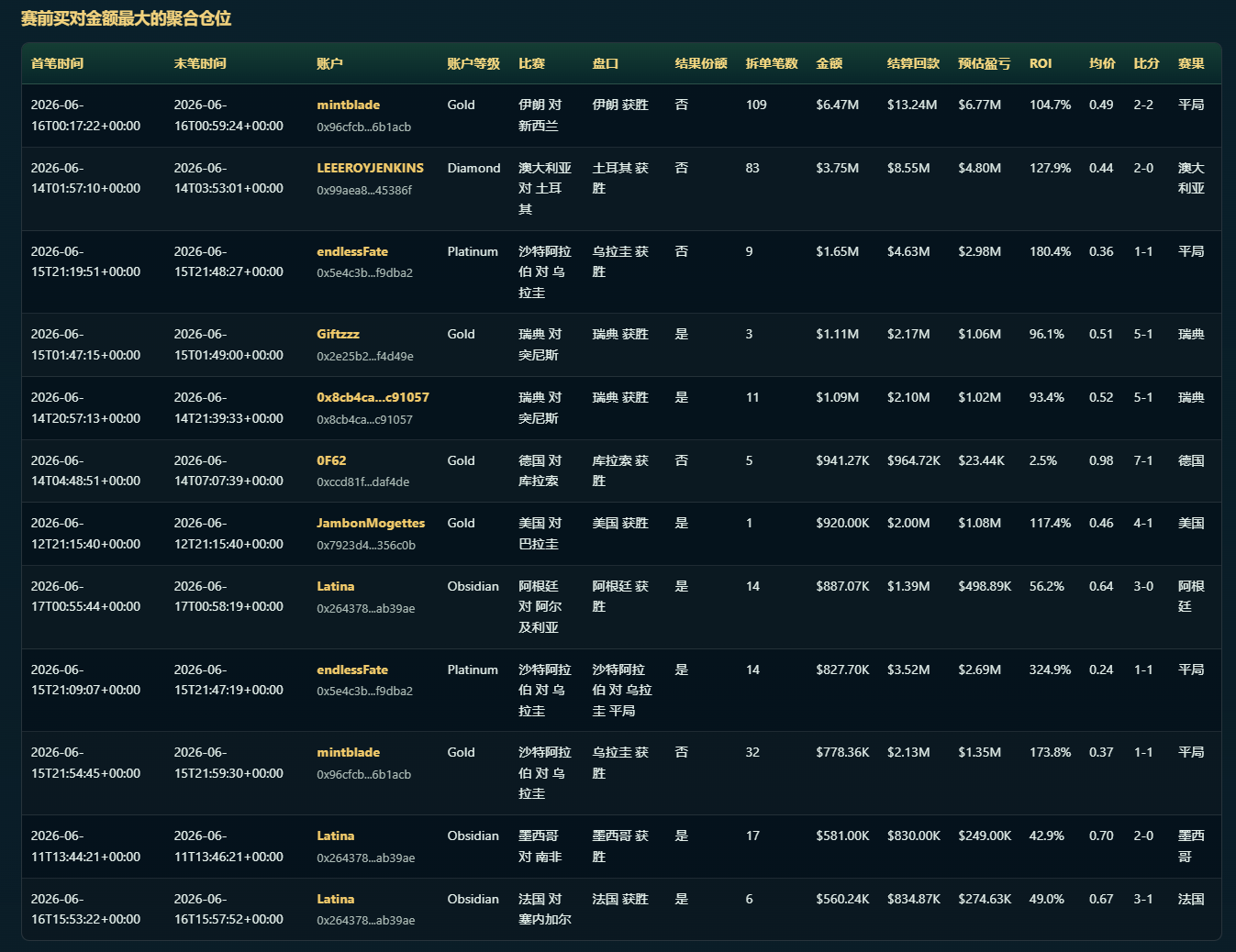
The largest winning case comes from mintblade. This wallet bought "Iran not winning" in the Iran vs. New Zealand match, with its mentioned cost of about $647.05 thousand, and estimated profits of $677.38 thousand.
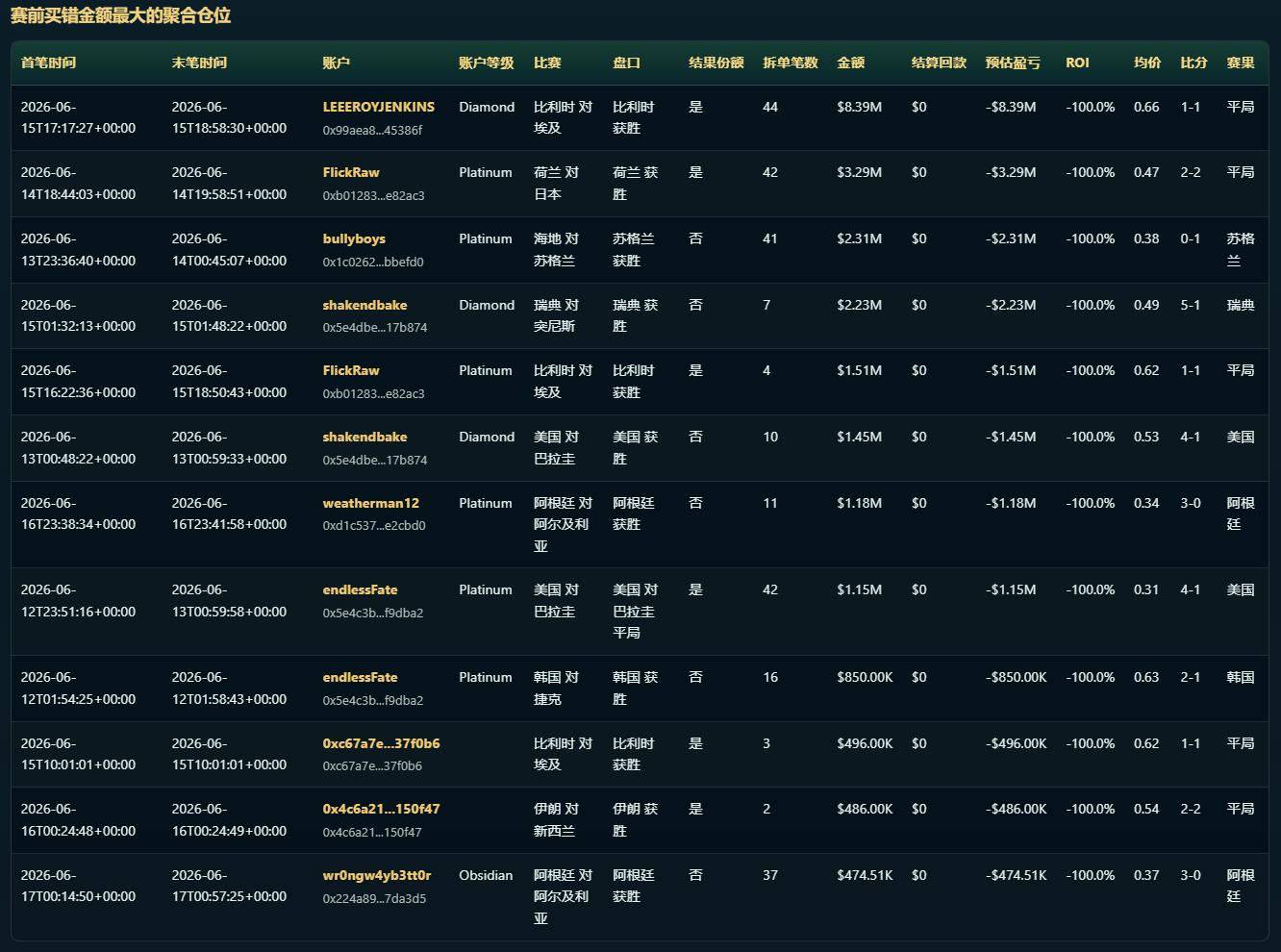
The second-largest winning case comes from LEEEROYJENKINS, who bought "Turkey not winning" in the Australia vs. Turkey match, with a cost of approximately $375.11 thousand and an average price of about 0.44. Australia ultimately won 2-0, and if held to settlement, this position is estimated to yield $479.76 thousand, with an ROI of 127.9%. However, LEEEROYJENKINS also bought "Belgium winning" in the Belgium vs. Egypt match with a cost of about $839.43 thousand and an average price of about 0.66. Ultimately, this position went to zero, leading to an estimated loss of $839.43 thousand. This resulted in the account's profit amount shifting from $5 million to -$2.57 million, essentially wiping out in one night.
The 0-0 draw between Spain and Cape Verde also created a low-cost, high-return case. fishalive bought "Spain not winning," with a cost of approximately $306.5 thousand, at an average price of only 0.09. Since the match ended in a draw, this position could yield an estimated profit of about $3,157.2 thousand, with an ROI exceeding 1000%. The appeal of such transactions is evident: when the market firmly believes that the popular team will win, the reverse share price can be sufficiently low, and once the result deviates from the mainstream narrative, the profit elasticity becomes significant.
Latina purchased "Argentina winning" for the Argentina vs. Algeria match, with a cost of approximately $888.3 thousand. Argentina ultimately won 3-0, yielding an estimated profit of about $499.3 thousand, with an ROI of 56.2%.
FlickRaw bought "Netherlands winning" in the Netherlands vs. Japan match at a cost of $3.29 million; ultimately, the match ended 2-2, and the position also went to zero. In the new sample, weatherman12 and wr0ngw4yb3tt0r both bought "Argentina not winning" in the Argentina vs. Algeria match, but Argentina ultimately won 3-0, with estimated losses of $1.1759 million and $471.6 thousand, respectively.
These cases point to a fact: large funds in the prediction market resemble high-volatility information trading rather than low-volatility arbitrage. When bets are correct, low-price shares can yield near double or even multiple returns; when bets are wrong, the binary settlement mechanism can cause the principal to go to zero directly.
Many times, we see one wallet "spotting a match and making a few million dollars," but we do not see that other similarly large funds also went to zero in another match within the same market structure.
Continuous wallets are more worthy of tracking than individual match whales
From a wallet dimension, those worth tracking long-term are often those that cover multiple matches and have consistent success.
Ranked by pre-match buying amount, mintblade is another extreme. This wallet’s buying amount is $7.2889 million, covering only 2 matches, achieving a hitting rate of 100.0%. But due to the limited coverage of only 2 matches, the sample size is still small.
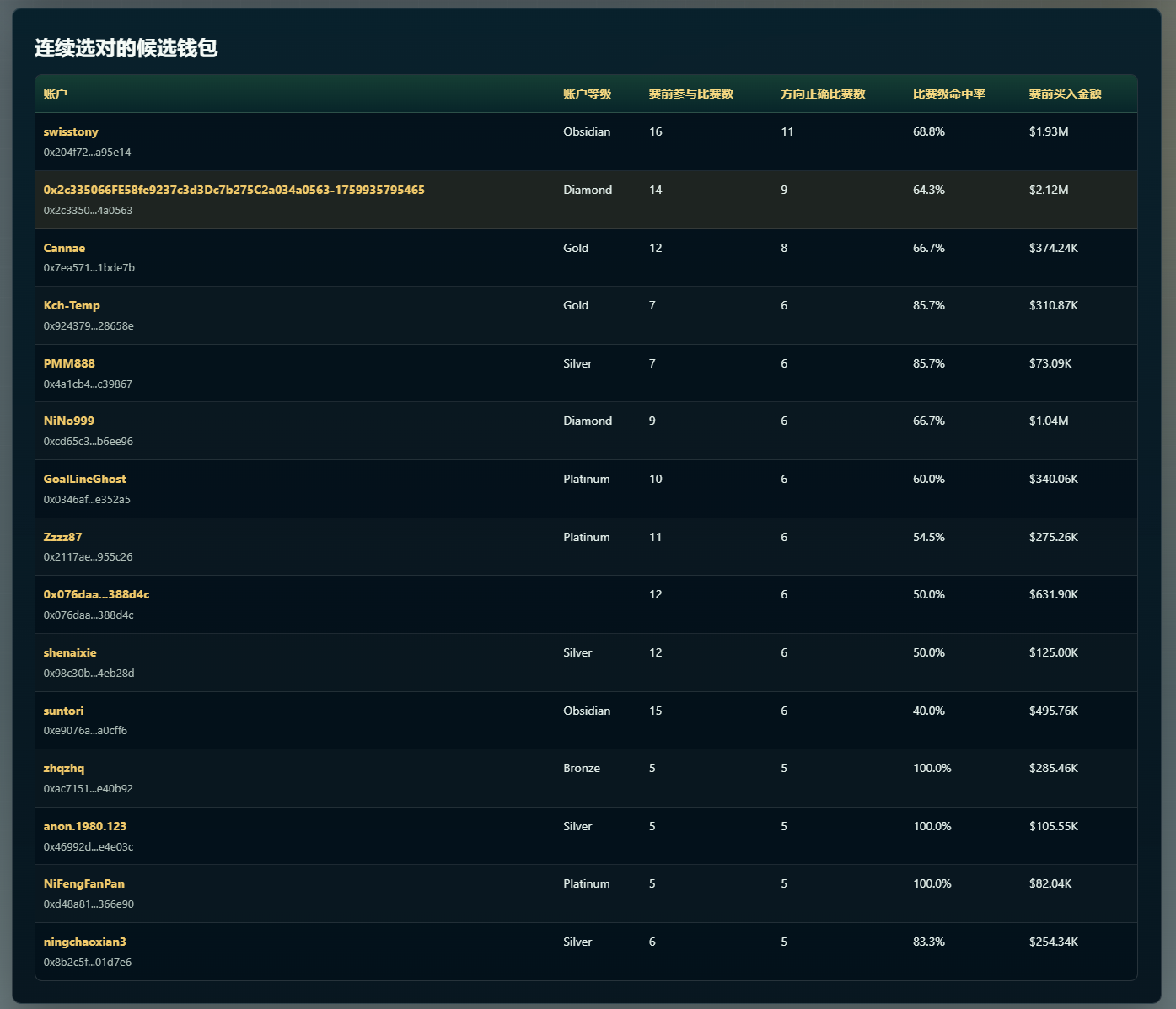
In contrast, swisstony has more continuous observational value. This wallet covers 16 matches, hits 11 matches, with a pre-match buying amount of $1.9284 million and a hitting rate of 73.3%. NiNo999 covers 9 matches with a hitting rate of 76.2%; Cannae covers 12 matches with a hitting rate of 66.7%. These wallets may not have the most astonishing individual amounts, but due to covering more matches, their behavior approaches a more observable trading pattern.
The latest sample has also shown some low-amount, high-continuity accounts. For example, zhqzhq, anon.1980.123, and NiFengFanPan covered 5 matches each and achieved hitting in all, with buying amounts of approximately $290 thousand, $110 thousand, and $80 thousand, respectively. Whether these accounts have lasting value needs further match validation.
The allure of the World Cup lies precisely in its unpredictability. In this multi-million dollar financial experiment, Polymarket has not become a crystal ball for predicting the future, but rather functions more like a mirror, clearly reflecting the fervor, biases, and blind faith in popular narratives of the collective.
The failures and wild gains of large funds further validate a simple truth: in the face of absolute uncertainty, no one can forever rise above rules and probabilities. The so-called "smart money" is not truly intelligent because it has superpowers to see the future; rather, it is wise in knowing how to find pricing discrepancies amidst uncertainty and always maintaining a respect for risks.
PA Beacon has recently launched a World Cup fund observation, updated daily based on the latest large fund trading situations. Interested readers can click to read the original text. Once again, it is reminded that the above content is compiled according to Polymarket trading data, with amounts, hitting rates, and profits/losses being estimated for analytical purposes, and does not constitute betting or investment advice.
免责声明:本文章仅代表作者个人观点,不代表本平台的立场和观点。本文章仅供信息分享,不构成对任何人的任何投资建议。用户与作者之间的任何争议,与本平台无关。如网页中刊载的文章或图片涉及侵权,请提供相关的权利证明和身份证明发送邮件到support@aicoin.com,本平台相关工作人员将会进行核查。


