Written by: Joseph Chalom
How this milestone highlights the true core competitive advantage of the Ethereum ecosystem
I have just concluded a trip to Asia. During this journey, I had in-depth discussions with Ethereum developers and ecosystem leaders from various locations. Notably, the teams from Nonce Classic, Four Pillars, and DSRV in the Seoul area, as well as partners from SNZ, stood out. Additionally, the recently launched Ethereum Community Center in Hong Kong is also worth mentioning. This center, as the first permanent physical space for the Ethereum community in Asia, is now supported by the Ethereum Foundation.
What impressed me was not only the vibrant energy of the local ecosystem but also the serious attitude and ambitious goals of the frontline builders. The quality, experimental spirit, and long-term thinking of these projects from the global Ethereum ecosystem were both impressive and inspiring.
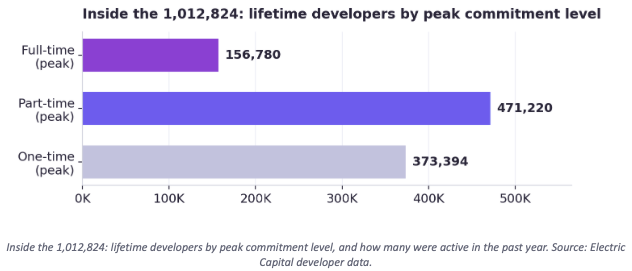
This experience made a cold statistic feel tangible. According to the latest data from Electric Capital, the Ethereum ecosystem currently has over one million lifetime developers, specifically 1,012,824 independent contributors. This figure is unmatched in the entire cryptocurrency space; no other ecosystem comes close.
The deeper significance of this milestone: An industry node worth examining
One million is a whole number, often lacking in substance. However, this set of data for Ethereum carries significant weight. Behind the numbers is the world's largest pool of technical talent gathered around an open, permissionless blockchain network. More importantly, this talent reservoir is not only deepening but also steadily broadening.
Among these one million builders, about 232,000 developers were active over the past twelve months.
Why is it Ethereum: The core question that the industry truly needs to focus on
For many years, discussions in the cryptocurrency industry have revolved around TPS, gas fees, and transaction speeds. Every emerging public chain claims to be "faster than Ethereum." Yet, the truly important question for the industry has never been who is fastest. The real focus is on:
What is the long-term strategic location logic of top builders?
On this issue, Ethereum's uniqueness remains irreplaceable. This moat is not only reflected in technical dimensions but also extends to institutional, cultural, economic, and composability aspects. It is the result of ten years of accumulation in the developer community, infrastructure systems, standards, toolkits, liquidity accumulation, cutting-edge research, application ecology, and social coordination mechanisms. No other ecosystem can achieve comprehensive replication in these dimensions.
Ethereum has now established its position as the default operating system for programmable finance and internet-native capital formation.
The current focus and deep reinforcement of the moat configuration by million-level developers
The core value of the million-level developer ecosystem lies in its current focused areas. The industry is currently concentrating on the most technically challenging and highest-risk topics: the scalability of core protocols, privacy protection, quantum resistance, and the upcoming autonomous agent (Agent) ecosystem that will be built on top of it.
Glamsterdam: Advancing innovation without compromising fundamentals. The Glamsterdam upgrade planned for implementation in 2026 reflects how Ethereum is advancing development while safeguarding its core values. Its core changes include formally introducing a proposer-builder separation mechanism (ePBS) and block-level access lists (BALs). These BALs unlock the potential for parallel execution and higher throughput while also opening the door for gas limit increases. These improvements will genuinely enhance the capacity of Layer 1. The expansion path aimed at future needs continues to extend while maintaining trusted neutrality, security, and MEV fairness. This is the real-time operational state of the moat configuration.
Synchronous composability: A single-chain experience of multi-Rollup patterns. Composability has always been Ethereum's core competitive advantage. The next leap is to extend this capability to the Layer 2 track. The integration of native Rollups with "Based" Rollups for synchronous composability is breaking the issue of multi-chain fragmentation. Contracts on a single Rollup can call contracts on the mainnet or other Rollups within a single atomic transaction. Cross-chain bridging becomes redundant, and confirmation waits are completely eliminated. The various projects being advanced by Linea, the Ethereum economic zone, Gnosis, Zisk, and the Ethereum Foundation are deeply integrating this design with real-time proof mechanisms. The result is that dozens of Rollups no longer present themselves as isolated networks but begin to display single-chain synergy. This is a direct response to fragmentation skepticism.
Quantum resistance: Ethereum's most significant leading position. No mainstream ecosystem has a more substantial reserve in the post-quantum security field. The "Streamlined Ethereum" roadmap, the post-quantum security task force that the Ethereum Foundation plans to establish in early 2026, the pq.ethereum.org hub, and more than a dozen client teams continuously operating a post-quantum interoperability development network weekly, together form a cohesive wave of coordinated open-source migration, aiming for completion around 2029. Once the quantum threat becomes a reality, those managing trillions in assets will only have one core concern: which chain has the most comprehensive advance preparations.
The multi-dimensional architecture of the moat: Beyond developer composability, standards, and trust
The ongoing gathering of developer resources stems from Ethereum's underlying architectural logic. Its most profound network effect is not reflected in liquidity accumulation but is deeply rooted in the dimension of composability: the application layer presents inter-operable financial Lego characteristics. Components such as lending protocols, stablecoins, exchanges, wallets, tokenized assets, oracles, and Layer 2 Rollups interact seamlessly thanks to shared standards. This allows developers to avoid reinventing the wheel. The EVM has become the de facto layer of application standards in the crypto world, while Solidity skills possess cross-platform universality and can be seamlessly transferred to Base, Arbitrum, Optimism, Polygon, zkSync, Scroll, Linea, and hundreds of other networks.
Mastering the Ethereum tech stack maximizes choice. This expansion of choice will drive the flywheel to accelerate: more developers will flood in, generating richer tools and greater liquidity, which will, in turn, attract more institutions to enter the space, ultimately benefiting the developer community. These developers will build composable protocols and assets. Liquidity reinforces itself, and composability creates its own ecosystem.
Ethereum's dominance is reflected in the core area of value accumulation, not just in superficially busy scenes:
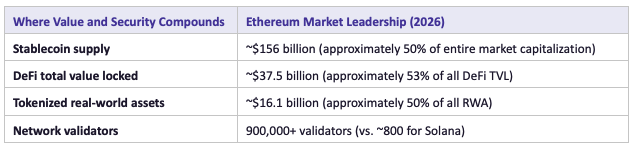
Three major forces are continuously consolidating this leading advantage:
Trusted neutrality. The Ethereum network is jointly protected by over 900,000 validators, while Solana has only about 800 validators. Major institutions place high value on this level of decentralization and platform neutrality.
Modular pattern. Rollups such as Base, Arbitrum, and Optimism have not fragmented the Ethereum ecosystem but rather expanded it into an increasingly interconnected modular internet economic system. This system fully inherits the security properties of the mainnet.
Cultural ecosystem. Ethereum brings together a disproportionately high number of top researchers, cryptographers, and EIP standard setters. This group leads the technological direction of the entire industry. Among all competitive advantages, cultural barriers are the hardest to replicate by forks.
Ethereum is unique.
Creating on-chain activity and becoming a long-term coordination hub for internet-native finance are fundamentally different. The latter is the core level truly trusted by the world's top financial institutions. Ethereum occupies a dominant position in the mindset of large asset owners. This group values trust mechanisms, security attributes, and liquidity the most. During my time at BlackRock, I witnessed Ethereum’s dominance firsthand.
In the evolution of the technology market, ecosystems will continue to consolidate around standard-setting power, liquidity aggregation, and developer mindset share. This trend constitutes Ethereum’s moat.
After in-depth discussions with developers, builders, and ecosystem leaders in Seoul and Hong Kong, I am more convinced of Ethereum's competitive advantages than ever. I have seen the top talent building the next generation of financial infrastructure. They are not only the founders of the industry's future but also the architects of an autonomous financial system. These individuals and teams will change the world.
The future landscape of Ethereum is gradually unfolding.
免责声明:本文章仅代表作者个人观点,不代表本平台的立场和观点。本文章仅供信息分享,不构成对任何人的任何投资建议。用户与作者之间的任何争议,与本平台无关。如网页中刊载的文章或图片涉及侵权,请提供相关的权利证明和身份证明发送邮件到support@aicoin.com,本平台相关工作人员将会进行核查。


