Original|Odaily Planet Daily(@OdailyChina)
Author|Wenser(@wenser2010)
Speaking of SemiAnalysis, the recent upheaval in the US stock market's storage and chip industry caused by the agency's research report is still fresh in mind.
As an independent investment research agency with annual revenues expected to exceed $100 million, SemiAnalysis now plays multiple roles including a comprehensive consulting firm, modeling service platform, and technology laboratory. However, the person steering this rapidly growing agency, highly praised by Nvidia founder Jensen Huang and AMD CEO Lisa Su, is not a technologist or an engineer deeply entrenched in chip manufacturing, but rather a "beekeeper and forum veteran" who once kept bees in Minnesota and anonymously discussed technical issues on various enthusiast forums in the United States.
In this edition of Character Decoding, Odaily Planet Daily shares the story of——Dylan Patel, the founder of SemiAnalysis.
SemiAnalysis Founder: The “Forum Tech Guy” Who Self-Taught to Master Skills
Compared to Citrini, which pays more attention to macro trends and long-term themes, SemiAnalysis chooses to focus more specifically on delving into the semiconductor industry, and its founder Dylan Patel (hereinafter referred to as Dylan) is indeed a "legend in the industry."

Early Experiences: A Beekeeper in Rural Georgia, the American Version of “Forum Veteran”
According to Dylan sharing during a food interview program at Latent Space, he grew up in rural Georgia and attended the University of Georgia. After graduating college, he even worked as a beekeeper in Minnesota for about a year and a half.
At that time, he was somewhat in a "lost state." Now, summarizing his past in his own words, he said: “I feel like I have just gone through many phases of life... it seems there's no clear, direct path to follow.” (Odaily Planet Daily Note: This refers to his transition from a chip enthusiast, semiconductor forum moderator, anonymous chip blogger, to founder of an investment research agency, founder of a hedge fund, and more.)
Speaking of his entry into the industry, it can be described as “full of twists and turns.”
From the age of 8 to 12, he was highly active in semiconductor forums as a "forum warrior," engaging deeply with hardware devices like Xbox by repairing them, studying chip documents, and self-learning semiconductor knowledge through discussions with community enthusiasts.
As such, he began sharing chip knowledge and discussing hard topics like chip manufacturing technology and the chip industry supply chain as an anonymous chip blogger on platforms such as Reddit, WordPress, and Silicon Twitter.
In May 2020, Dylan officially launched his personal blog channel SemiAnalysis, aiming to provide accurate and independent technical analysis of the semiconductor industry. At that time, the "AI explosion moment driven by GPT" had not yet arrived, and the semiconductor industry was still a niche technical field with very few deep content available in the market.
Initially, SemiAnalysis was just a very niche personal content channel built on WordPress. After repeated suggestions from his good friend Doug, Dylan subsequently moved it to the Substack platform and shifted from a free model to a paid subscription model. (Odaily Planet Daily Note: According to Dylan himself, this friend later joined Substack in the following years.)
From then on, Dylan began to build his "personal business system" around the paid content channel, which included technical content analysis, commercial consulting, and research report production on semiconductor supply chains, AI infrastructure products, cloud ecosystems, machine learning models, and more high-tech industries.
SemiAnalysis: From a One-Person Company to a Global Team of Over 60 People
By 2025, SemiAnalysis has gradually transformed from Dylan's original "one-person company model" (OPC) into a global company with approximately 60 professional research team members. They have also established a professional chip and semiconductor product teardown laboratory called STEEL (SemiAnalysis Teardown Engineering & Evaluation Lab) in Oregon, USA.
Last year, the agency's revenue reached $20 million; this year, according to The Information report, SemiAnalysis's revenue is expected to exceed $100 million, primarily from hyperscalers, semiconductor giants, startups, and institutional subscriptions/models/consultations. According to Dylan himself, there are plans to establish a VC investment firm in the future. Previously, he had personally invested in about 20 startups through individual/SPV structures and had raised $50 million for Fluidstack to finance SPV structures.
External Impact: Highly Recognized by Jensen Huang, AMD CEO, and Others
After nearly 6 years of development, Dylan and SemiAnalysis have become the "industry textbook" and "must-read guide" in the current AI track and semiconductor industry.
Previously, Nvidia founder Jensen Huang had frequently mentioned SemiAnalysis in his speeches at the GTC Developer Conference and publicly endorsed the details of their research reports, especially benchmark evaluations like Nvidia InferenceX, which can be seen as “public endorsement.”
Earlier, in December 2024, after conducting about 5 months of in-depth testing and benchmark evaluations of AMD's MI300X GPU, the SemiAnalysis team published a critical report titled “MI300X vs H100 vs H200 Benchmark Part 1: Training - CUDA Moat Still Alive,” which pointed out that although the AMD MI300X GPU had decent theoretical competitiveness, its ROCm software stack had numerous gaps (such as many bugs, poor usability, and immature ecosystem), leading to a significantly inferior actual user experience compared to Nvidia's CUDA software stack and rendering it ineffective as a strong product for training work.
A few hours after the report was released, AMD CEO Lisa Su personally contacted Dylan and had a conversation with him the next day. It is worth noting that the communication was originally planned to last only 30 minutes, but due to the large volume of information, numerous feedback issues, and the involvement of technical details between engineers, it ultimately extended to 90 minutes. This is one of the rare deep dialogues between the CEO of a multibillion-dollar publicly traded company and an independent third-party research agency. In the end, Su publicly thanked him for the “constructive feedback” (even if it was criticism) (Odaily Planet Daily Note: The original words were Feedback is a gift even when it's critical).
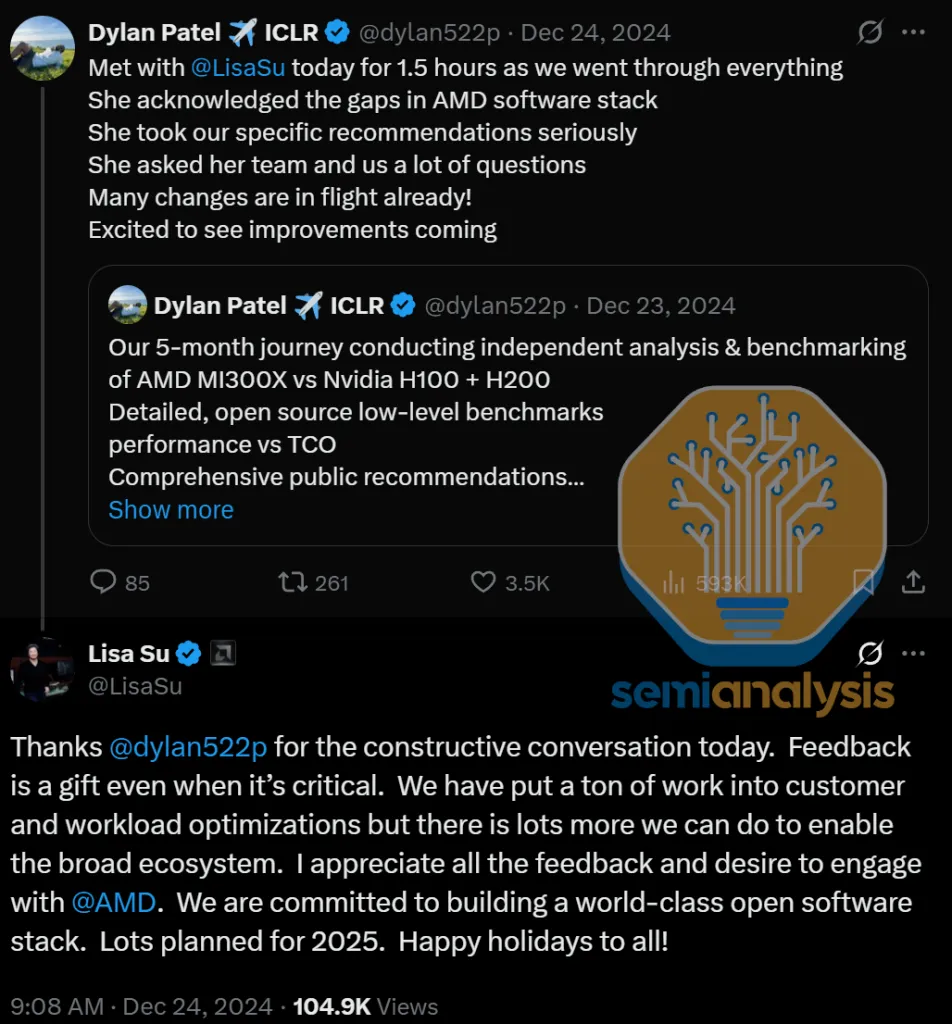
AMD CEO Lisa Su’s high praise and positive response
In April 2025, SemiAnalysis againreleased a follow-up report stating that “more than 4 months have passed, AMD has accelerated in ROCm, developer relations, CI/CD, etc., and AMD MI450X is expected to outperform Nvidia,” also acknowledging AMD's subsequent improvements, becoming a landmark case of “independent research directly influencing major companies' decisions.”
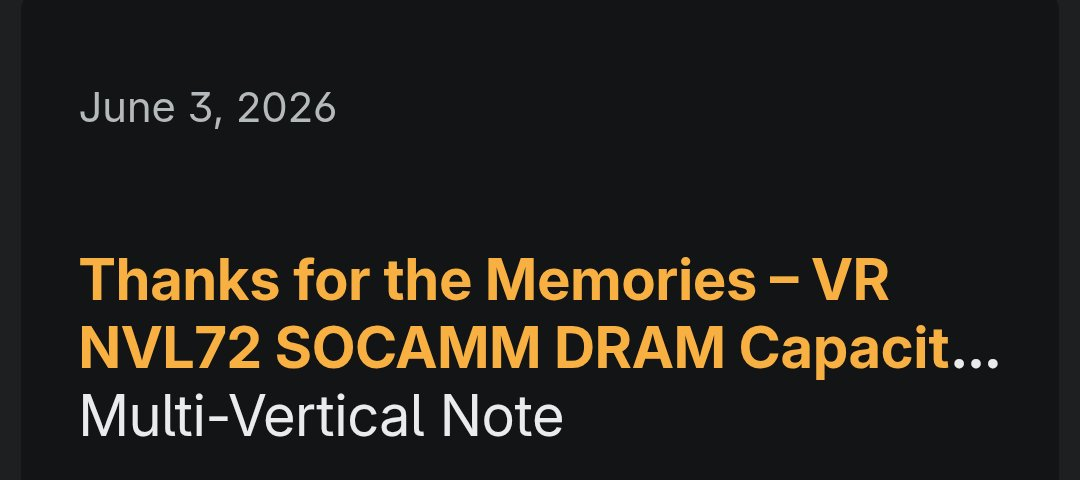
At the beginning of June, Citrini analyst Jukan shared parts of the SemiAnalysis research report, which pointed out that “Nvidia's next-generation AI server cluster Rubin NVL72 has made significant adjustments to memory configurations. To cope with supply chain pressures and ensure timely delivery of Rubin cabinets, the single cabinet capacity has plummeted from the originally planned 55TB to 28TB, a reduction of about 50%, using a downsized 96GB SOCAMM memory module instead of the previous high-end 192GB module.” As a result of this news, many memory-related stocks, including Micron and SK Hynix, experienced downward pressure and declined on the same day.
In response, Dylan stated: “I like it when people quote us, but often they take it out of context. In reality, the original report did not use such clickbait titles.” The image he later posted showed that the original report title was “Thanks for the Memories...”.
In comparison, SemiAnalysis places greater emphasis on “technical implementation details,” focusing on the real bottlenecks in the AI construction process (power shortages, supply chain legacies, inference scaling, Nvidia ecosystem dynamics, etc.), and often embeds realistic constraint analyses in optimistic demand judgments, thus being more suitable for guiding specific investments and industry decisions. For more on SemiAnalysis, see “From Community 'Hardware Enthusiasts' to AI Circle 'Turbulence': How SemiAnalysis, Earning Nearly $100 Million a Year, Stirred the Semiconductor Market?”
Recommended Reading:
Latent Space First Issue: Scenario Cooking with SemiAnalysis Founder Dylan Patel
免责声明:本文章仅代表作者个人观点,不代表本平台的立场和观点。本文章仅供信息分享,不构成对任何人的任何投资建议。用户与作者之间的任何争议,与本平台无关。如网页中刊载的文章或图片涉及侵权,请提供相关的权利证明和身份证明发送邮件到support@aicoin.com,本平台相关工作人员将会进行核查。