Key Takeaways:
Ki Young Ju, chief executive of analytics firm Cryptoquant, has reframed the bear case in a way that cuts against the usual crash narrative, arguing that bitcoin’s biggest risk is not a crash but boredom.
He reasons that a sharp drawdown can be survived as long as the market still believes in the asset’s long-term thesis, but a market that simply drifts sideways for years slowly erodes conviction (and the financing structures built on top of it). Ki Young Ju has spent much of 2026 forecasting just boring sideways action, noting that capital inflows into bitcoin have dried up as investor attention rotates back to stocks and “shiny rocks.”
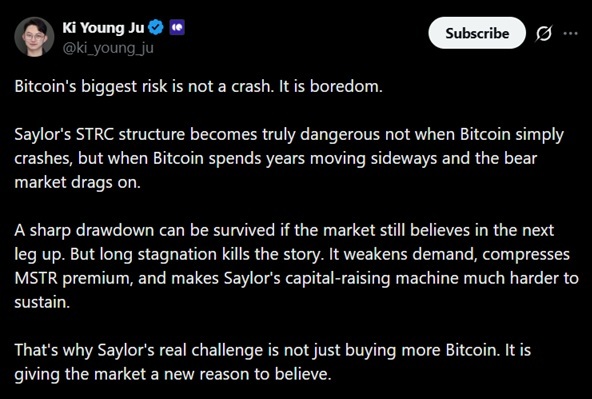
Image source: X
He has also credited Saylor’s Strategy and spot exchange-traded fund (ETF) buyers with absorbing heavy selling from older holders, estimating bitcoin could be trading closer to $22,000 without that demand.
The specific vulnerability Ki Young Ju flagged is STRC, the centerpiece of Strategy’s fundraising machine. Formally known as the Variable Rate Series A Perpetual Stretch Preferred Stock, STRC launched in July 2025 and was engineered to trade near a $100 par value, with a monthly-adjusting dividend (currently 11.5%) meant to keep its price stable.
Bitcoin.com News recently reported that STRC has grown into the world’s largest preferred stock by market value, topping $8.5 billion in under a year. That stability is the whole point as Strategy uses STRC to raise fresh capital from yield-hungry investors and funnels the proceeds into bitcoin, without diluting common shareholders or taking on conventional debt.
Moreover, it bears mentioning that STRC’s proceeds funded roughly 77,000 BTC of purchases in 2026, far outpacing net inflows into U.S. spot bitcoin ETFs over the same period.
But the instrument seems to have wobbled a bit, recently sliding toward $85, down about 15% from par, after touching record lows (a move that challenges the trade-near-$100 promise underpinning the design). Ki Young Ju’s warning is that a long, dull market is exactly the environment in which a yield product like STRC strains.
Saylor, executive chairman of Strategy (Nasdaq: MSTR), offered no concession, adding: “Markets are closed today. Volatility is never easy. Bitcoin keeps working. So do we.” The message landed as bitcoin traded around $62,500.
Moreover, Bitcoin.com News reported that Saylor recently broke his silence after Strategy sold bitcoin for the first time in four years to help cover preferred dividends, a move that split the community and briefly hammered MSTR shares. Critics have gone further, with some calling STRC’s 11.5% yield a bait-and-switch that markets bitcoin exposure while leaving buyers tied to a leveraged financing scheme.
Strategy, for its part, has put forth STRC as a lower-volatility on-ramp to the bitcoin ecosystem for institutions, a pitch Saylor has promoted aggressively even as the stock drifted below par. The disagreement is not really about whether bitcoin endures, but about whether the machinery built to accumulate it can survive a market that goes quiet.
As things stand, Strategy holds more than 800,000 BTC, making it the largest corporate holder, and its steady buying has helped set a floor under prices. If Ki Young Ju is right that boredom is the enemy, the test will be how long STRC investors keep collecting their dividend while prices go nowhere.
免责声明:本文章仅代表作者个人观点,不代表本平台的立场和观点。本文章仅供信息分享,不构成对任何人的任何投资建议。用户与作者之间的任何争议,与本平台无关。如网页中刊载的文章或图片涉及侵权,请提供相关的权利证明和身份证明发送邮件到support@aicoin.com,本平台相关工作人员将会进行核查。


