Author: Etherealize
Translation: Deep Tide TechFlow
Deep Tide Guide: Stripe wants everyone to use Tempo, JPMorgan wants to push its own chain, Circle wants to promote Arc—giants will never build on their rivals' turf. This is precisely where Ethereum has its chance: when everyone refuses to yield to a company's infrastructure, the only choice is a neutral layer that no one controls.
Ethereum is replaying the history of the Internet and Linux.
"Stripe wants everything to happen on Tempo, but JPMorgan wants everything to happen on JPMorgan Chain, Circle wants everything to happen on Arc, and so on. They will never reach an agreement. Big players will never agree to build on another big player's infrastructure. That is why Ethereum is the only option. It is the only way forward—as a neutral infrastructure that everyone can accept."
In 1995, most tech elites were convinced that the Internet would lose to proprietary corporate networks. They were wrong, and today's critics of Ethereum are likely to make the same mistake for similar reasons. The most famous example is Bill Gates, who predicted in his book "The Road Ahead" that the future of digital commerce would not run on the open Internet, but on proprietary networks owned by companies like Microsoft and Oracle. That was once the consensus. As a16z co-founder Ben Horowitz wrote: "Almost no one thought the Internet would have a significant impact outside of science — the most pessimistic were precisely those important tech industry leaders busy building proprietary alternatives." Linux experienced something similar. Throughout the late 1990s, Sun Microsystems dominated the high-end Unix server market, but by the early 2000s, it lost most of its business to open-source Linux running on cheap commodity hardware.
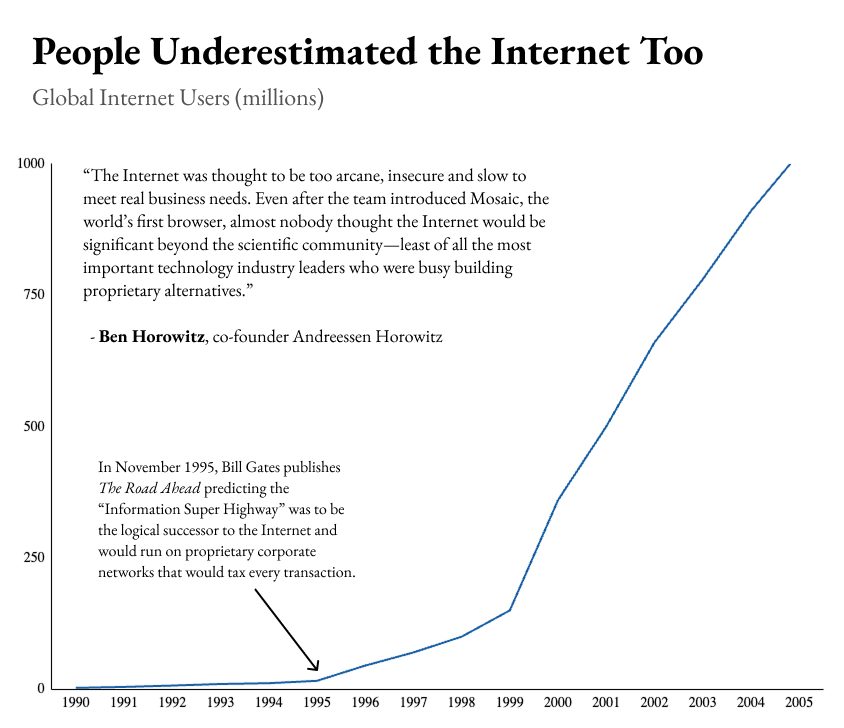
A similar pattern is unfolding today in the financial infrastructure sector. Corporations perceive opportunities and threats and are competing to build proprietary blockchains within their own controlled walls. For a while, proprietary versions seemed to be winning—they were faster, had better user experiences, and possessed large business development teams. Then they are gradually devoured by an open, trusted neutral alternative because no company can keep up with the pace of permissionless innovation forever, nor will serious participants build on the infrastructure controlled by competitors.
In his 1997 essay "The Cathedral and the Bazaar," Linux contributor Eric Raymond attempted to explain why open, permissionless infrastructure tends to win out in the long run. Since Fred Brooks' "Mythical Man-Month," the conventional wisdom has been that software must be built by small, tightly-knit teams under a single architect's leadership, as communication costs grow quadratically. However, Raymond observed thousands of contributors (most of whom had never met) simultaneously working on different parts of the Linux kernel, surpassing billion-dollar companies. If traditional software is carefully crafted like a "cathedral," then the "bazaar" is Raymond's description of the chaotic, open, distributed development model that Linus Torvalds stumbled upon—he made the kernel source code available for free and accepted patches from anyone willing to submit them. The guiding philosophy, in Raymond's words, is "release early, release often, let anyone who can contribute do so, open to the point of promiscuity," which produced an operating system running most of the web by the early 21st century.
Raymond's explanation is that the bazaar avoids the squared communication cost problem because contributors do not directly coordinate with each other. They coordinate with the codebase through patches and releases, and maintainers integrate their work into the medium through which everyone coordinates. As he stated, "The principle behind Brooks' Law has not been invalidated, but in a situation with many developers and inexpensive communication, its influence can be overwhelmed by other nonlinear factors."
Another mechanism identified by Raymond is that the bazaar eliminates the distinction between users and developers. In the cathedral, users are customers who report bugs to a help desk. In the bazaar, users are co-developers who report bugs by fixing them or providing enough technical detail to describe the bug for others to fix. Raymond explains that in open-source communities, "every problem is transparent to someone." Collective collaboration surpasses any centralized competitor:
"The Linux world behaves in many ways like a free market or ecosystem, a collection of self-interested agents trying to maximize utility, creating a spontaneously self-correcting order that is more subtle and efficient than any centralized planning."
You can see this situation in Ethereum. Fabian Vogelsteller wrote the ERC-20 standard, which is now used by every stablecoin because he found no clean way to support tokens while building wallets—each token had a different interface. The ERC-721 standard for NFTs comes from the creators of CryptoKitties. Uniswap is now the largest exchange of its kind in the world, originating from a blog post by Vitalik Buterin and built by Hayden Adams, a mechanical engineer without a financial background. They improved the network without needing permission. As Sun Microsystems co-founder Bill Joy said, "Whoever you are, most of the smartest people work for others," and in a permissionless system, innovation can come from anywhere.
The difference between the bazaar and the cathedral is that the bazaar's integration layer is thin, open, and based on credibility rather than authority. Coordinators like Linus Torvalds or Vitalik Buterin lead because contributors choose to follow, and contributors choose to follow because the coordinators' decisions can be checked, critiqued, and forked if necessary. The internet has a thin centralized integration in the form of the IETF and IANA. Wikipedia has its editing process. Any project that has gained sustained advantages from permissionless innovation combines truly open contributions with structured integration, preventing the chaos that critics worry about. And the integration layer must operate through credibility rather than coercion, or else it will fail.
The bazaar also requires a foundation that cannot be captured by anyone. If Torvalds tried to privatize the kernel, contributors would fork the project and continue elsewhere. Raymond developed this idea in "Homesteading the Noosphere," positing that open source has developed a property regime similar to Locke's theory of land ownership: developers establish ownership by pioneering projects (writing initial code), maintain that ownership through continued contribution, and can transfer ownership through legitimate inheritance. The credibility of open licenses is a formal mechanism, whereas the normative framework of the Internet wilderness is a social mechanism. Take away either one, and contributors will go work elsewhere, where their contributions will not be appropriated.
In the Ethereum community, Vitalik Buterin formalized this requirement into "trusted neutrality." When the rules are transparent, apply equally to all participants, are difficult to change, and participation is open to anyone willing to follow the rules, then the coordination mechanism is deemed trusted and neutral. These four attributes are drawn from systems capable of attracting contributions at scale. The Internet, Linux, and Wikipedia all have versions of these four attributes. Proprietary networks, walled gardens, and enterprise blockchains do not.
Over sufficiently long timeframes, trusted neutral systems tend to win out. Open networks replace proprietary networks; Linux replaced proprietary Unix; Wikipedia replaced Encarta and the Britannica. Every time, proprietary alternatives had real advantages—focused products, more capital, customer support teams, specialized marketing and business development teams—yet each time, as open ecosystems matured and network effects reversed, these advantages eroded. Once an open alternative crosses the threshold in accrued contributions, tools, and trustworthiness that does not change the rules, closed systems become nearly impossible to compete against.
A similar pattern is now playing out at every layer of financial infrastructure. SWIFT, Visa, and Mastercard, as well as consortium chains pitched to institutions today, are different products with different histories, but structurally the same bets: centrally controlled infrastructure with potential landlords. For forty years, SWIFT has been a neutral conduit owned by its member banks until the U.S. pressured it to cut off Iranian banks in 2012 and several Russian banks in 2022. Despite corporate governance and a registration in Belgium, SWIFT ultimately answers to the U.S., and the rest of the world has noticed. China accelerated CIPS, Russia built SPFS, India expanded UPI, and Brazil's Pix became a pillar of BRICS Pay. Visa and Mastercard started as bank cooperatives but later became toll booths charging merchants transaction fees of 1.5-3.5%. The consortium chains pitched today (such as Canton, Tempo, Arc) carry the same flaw: a landlord whose interests may diverge from those building on it.
"The initial vision of consortium blockchains—five banks or major companies coming together to create their own chain—has fundamentally failed," Vitalik Buterin explains. "It ultimately inherits most of the disadvantages of centralization and most of the disadvantages of decentralization at the same time." As he describes, the issue is that the first few banks feel like equal founders, but the twentieth bank is just joining something already controlled by competitors. You incur all the engineering costs of distributed systems without the benefits of openness, composability, and trusted neutrality—all of which are the reasons to pursue blockchain in the first place.
The wreckage confirms his point. Between 2017 and 2019, several major banking alliances set out to rebuild trade finance on the blockchain. We.trade, backed by a dozen banks including HSBC and Deutsche Bank, went bankrupt in 2022. Marco Polo signed on more than thirty banks and dissolved a year later. Contour closed months later. The Australian Securities Exchange spent six years and about AUD 250 million on a licensed ledger built by Digital Asset (the company behind Canton) before abandoning the project in 2022. Meanwhile, the uncontrolled Ethereum has never gone down in its more than ten years of history, only growing.
This is why developers choose Ethereum. According to statistics from Electric Capital, over a million developers have contributed to the Ethereum ecosystem over its lifespan, with approximately 232,000 active developers in the past year alone. No other chain comes close to this figure. Part of the reason is the ordinary flywheel effect: tools, standards, and job opportunities are all on Ethereum, so people learn to build there, which attracts more tools and jobs. But developers and institutions also specifically choose Ethereum for its exceptional decentralization and trusted neutrality. For example, last year Robinhood chose to build its L2 on Ethereum rather than its own L1; the company's crypto head Johann Kerbrat explained the reason:
"You see a lot of companies building their own L1 now. We're excited about the idea of controlling everything you want to build, but creating a truly, properly decentralized chain is extremely difficult, and Ethereum basically gives you that for free. When you look at some of the new L1s being created, they aren't really decentralized, and they're not really secure. Ultimately, it's pretty much just a fancier database that's a little slower than a real database, so we just don't see the value in it."
Erik Voorhees, founder of Venice AI (a privacy-first AI inference platform with over three million users and tens of millions of dollars ARR), outlined a similar reasoning just days ago. When asked why they chose to build Venice on Coinbase's Ethereum L2 Base, Erik replied: "This isn't even a question for us; the Ethereum ecosystem is the most real, resilient, and powerful ecosystem among all smart contract platforms."
The most important attribute of a blockchain is sovereignty. The revolutionary nature of Bitcoin is that it is the world's first sovereign computing platform. Before Bitcoin, all computing platforms belonged to individuals, companies, or governments that had to obey the will of their owners and the rules of the jurisdictions in which they were located. But sovereignty only obeys its own rules, and no single entity can impose rules on Bitcoin. Kings and queens were once sovereigns, then nation-states, and now, for the first time, computing platforms can be sovereign. This is why decentralization is so highly valued in the crypto space; it is the means to achieve sovereignty. A platform with ten validators obeys the rules of those ten validators. But a platform like Ethereum, with hundreds of thousands of independent validators distributed across every major jurisdiction, multiple independent client implementations, and a foundation that explicitly relinquishes governance, has crossed a threshold where no party can credibly claim ownership. Sovereignty is the attribute that allows the global financial system to build on Ethereum without any participants worrying that another participant, government, or foundation will change the rules to their disadvantage.
Ethereum's lead in sovereignty and trusted neutrality largely comes from path dependencies that other blockchains cannot replicate. Ethereum launched in 2015 with PoW and switched to PoS in 2022 after running for seven years. During that time, network ownership was distributed through a public crowdfunding campaign in 2014 and by deliberately keeping GPU mining accessible to consumer-grade hardware. The result is a widespread token distribution with no single entity controlling a meaningful share of the network (which is a key factor in the sovereignty of PoS networks). Modern consortium chains launch as venture capital, with insider allocations being centralized, leading to a small number of participants possessing too much control over the consensus of the chain. Competitors can copy the architecture but cannot replicate the history.
Since then, Ethereum's lead has only grown. The platform's sovereignty and trusted neutrality attract developers. Developers attract more developers because the libraries, tools, and hiring pools already existing on Ethereum make building there easier than anywhere else. Applications attract liquidity and tokenized assets, which in turn attract institutions. Every layer reinforces the others; competitors attempting to enter must build all layers at once, while Ethereum continues to grow at compound interest.
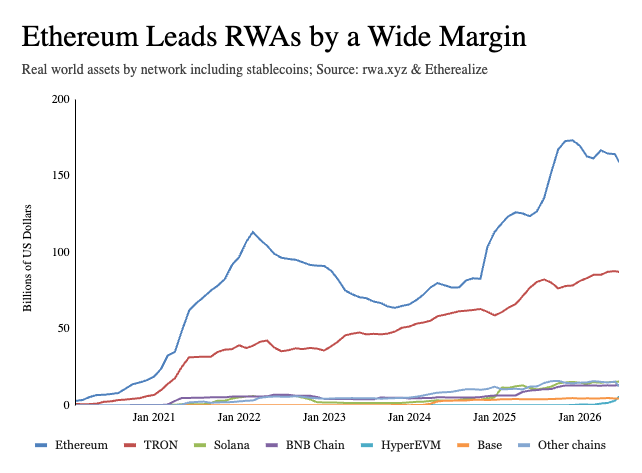
The most mature players in the field have chosen Ethereum. Coinbase and Robinhood selected Ethereum for their L2. BlackRock and JPMorgan launched their tokenized money market fund BUIDL and MONY on Ethereum. Major DeFi protocols, including Aave, Maker/Sky, Maple, and Uniswap, primarily operate on Ethereum. The largest stablecoin issuers settle on Ethereum. According to Token Terminal's Q1 2026 Ethereum report, Ethereum holds 79% of active DeFi loans, 62% of stablecoins, 73% of tokenized funds, and 84% of tokenized commodities among the top five chains.
Applications are also permissionless, further reinforcing Ethereum's advantages. For example, Uniswap's permissionless listing process allows thousands of long-tail assets to find price discovery and liquidity that no centralized exchange would provide. Aave's lending market is open and composable, allowing an entire ecosystem of specialized vaults and risk managers to emerge on top of its liquidity, expanding Aave's reach beyond what the core team could achieve alone. Closed systems require gatekeepers to anticipate every use case in advance, but open systems do not.
The strongest opposition to the notion of "permissionless wins" is not technical; rather, it is that finance may be the only place where corporate-owned networks become features rather than flaws. When payments fail or assets go where they should not, regulators want someone to be responsible. When lawyers show up, "no one is responsible" sounds less like a virtue and more like a liability. But this opposition conflates two things that exist at different layers. Accountability exists at the application layer rather than the settlement layer. For instance, token standards like ERC-3643 directly embed KYC, identity validation, and jurisdictional transfer restrictions in the smart contracts of tokens so that issuers can whitelist wallets, restrict transfers, and freeze or reclaim assets. Privacy is handled in a similar way; zero-knowledge cryptography allows institutions to settle on public chains while keeping transactional details confidential. On consortium chains, the only people who can see your data are you and your closest competitors.
In the early days, the internet was considered too insecure for real business. Then HTTPS made the open network secure enough that nearly all business migrated to it, and this issue was no longer raised. The skeptics were not wrong about the early state; they were just mistaken in thinking that open networks could not bridge the gap.
The idea of banks and fintech companies building their own chains now mirrors the thinking of AOL and Microsoft in the early internet: build something open but within your own walled garden so you can collect rents. But this never works because the wall that gives you control is the same wall that blocks innovation.
A better model is Netscape. Netscape did not try to own the network; it built the browser that brought the world onto the web. Riding the explosive growth of the open network, it became one of the most important companies of its time. Ethereum's trusted neutrality is nearly impossible to replicate; it has positioned itself as the settlement layer for global finance. The winning strategy is to build on permissionless infrastructure, rather than competing with it.
Disclosure: This analysis is published by Etherealize, an organization focused on institutional Ethereum adoption. The author and Etherealize may hold positions in ETH and other digital assets discussed. This is not investment advice.
免责声明:本文章仅代表作者个人观点,不代表本平台的立场和观点。本文章仅供信息分享,不构成对任何人的任何投资建议。用户与作者之间的任何争议,与本平台无关。如网页中刊载的文章或图片涉及侵权,请提供相关的权利证明和身份证明发送邮件到support@aicoin.com,本平台相关工作人员将会进行核查。


