After 6 years of operation and approximately 100 million dollars in loans issued, Goldfinch has ended with widespread borrower defaults and the freezing of depositor funds.
Written by: ChandlerZ, Foresight News
The decentralized credit protocol Goldfinch, which raised a total of 37.7 million dollars across two funding rounds led by Andreessen Horowitz (a16z), has officially entered the shutdown process.
The core development team, Warbler Labs, published the GIP-87 proposal on the governance forum, proposing to "approve the operational maintenance of Goldfinch and the gradual liquidation of Goldfinch Prime," orderly shutting down its product Goldfinch Prime and transitioning the protocol into a maintenance mode that retains only the collection function. The Snapshot vote will close on June 23, with 100% of votes in favor received so far (with a vote count of 1.1 million GFI, far exceeding the threshold of 250,000).
This protocol, which once promised to revolutionize credit in emerging markets through DeFi, has ended after 6 years of operation and approximately 100 million dollars in loans issued, marked by widespread borrower defaults and the freezing of depositor funds.
Depositor Dilemma: 70% Actual Loss Rate, Token Down 99.8%
On June 19, a depositor named Edward Morra posted on X that 2 out of 8 borrowers in the protocol's loan book had defaulted, and 6 others were in restructuring, making recovery of funds nearly impossible. This post garnered over 800 likes and 165 replies.
Morra stated that he first deposited money in September 2021, and then made two more deposits in 2022. After five years, he still has not retrieved the full amount (and never will), let alone the promised 10% APY. Since applying for withdrawal in August 2023, this user has only recovered 30% of the principal, and the best-case scenario is possibly recovering 10% over the next 1 to 2 years.
He estimates the actual loss rate to be around 70%, far higher than the 20% displayed on the protocol panel.
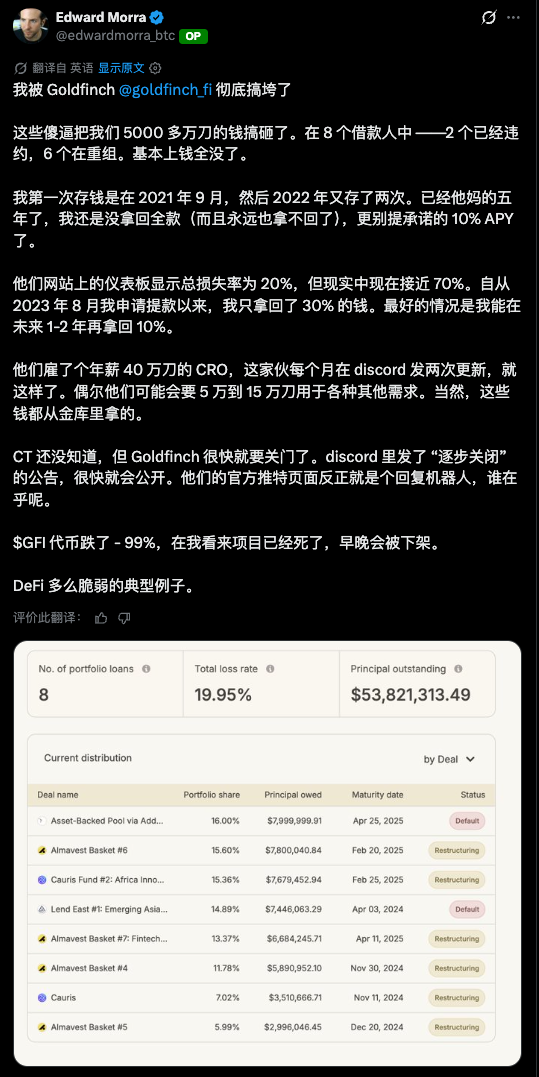
According to DefiLlama, Goldfinch currently has 56.15 million dollars in outstanding loan capital, while the TVL on Ethereum is only 1.63 million dollars, with nearly all deposit funds locked in loans and unable to be withdrawn.
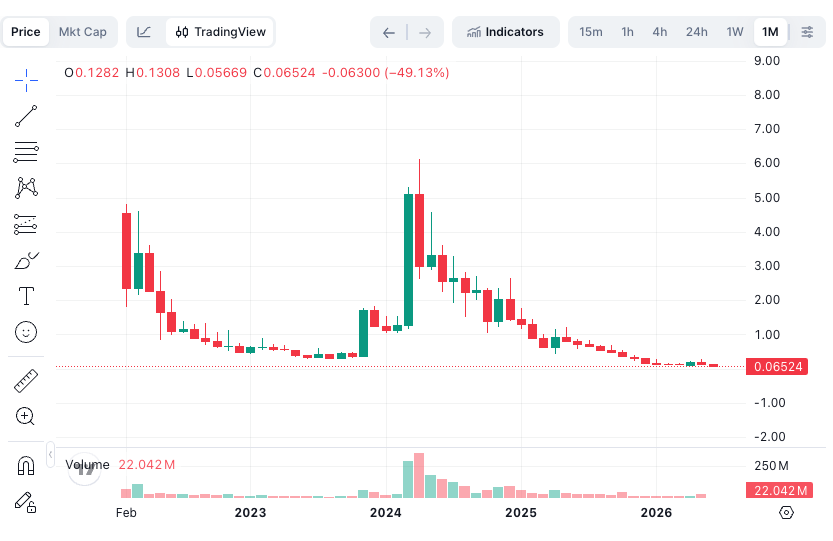
The governance token GFI has also suffered dramatically, dropping from a historical high of 32.94 dollars on January 11, 2022, to its current price of 0.06524 dollars, a decline of 99.8%. Its market cap has shrunk from over 180 million dollars in April 2024 to 5.7 million dollars.
Shutdown Plan: Establish Trust, Collect for at Least Two Years
The GIP-87 proposal is co-signed by Mike Sall and Blake West of Warbler Labs; the core arrangements of the shutdown plan include: Warbler Labs immediately ceasing all new product development, growth plans, and marketing. The protocol will establish a new U.S. trust entity, with the current Chief Restructuring Officer Ted Gavin serving as trustee, dedicated to the collection of remaining borrowers' debts. Warbler Labs will receive a 150,000 dollars closure service fee (100,000 from the DAO treasury, with 50,000 transferred from the existing operational budget). The residual applications will be maintained for at least 6 months after the last borrower repayment, to facilitate the recovery of funds for depositors. The estimated recovery period is over 2 years.
Blake West responded to community anger in a Discord post on June 14, stating that the team has spent 6 years since 2020 trying various on-chain private credit solutions, but has never found persistent demand. The latest product Goldfinch Prime shifted to tokenizing institution-level private credit funds (partners include Apollo, Ares, KKR, etc., managing over a trillion dollars in assets), launching on three chains and promoting it in collaboration with Plume and R2, but garnered little response, with no clear path to recovery within the existing funding runway.
West denied the fraud allegations, emphasizing that Warbler Labs personally paid 7 million dollars to repay depositors, returned over 1 million dollars in revenue for repayments, and sold over 2 million dollars in GFI for the same purpose. He also lost money in transactions during the V1 phase and emphasized that “ordinary crypto investors do not really want private credit products.”
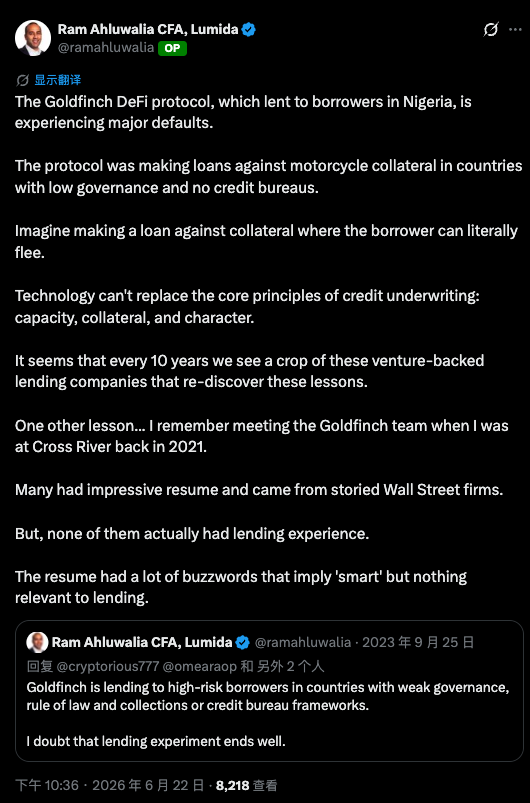
Regarding this project, former Cross River Bank employee Ramneek Ahluwalia remarked that Goldfinch essentially lent to borrowers in countries with weak governance and no credit system, against physical assets like motorcycles. The team's backgrounds were impressive but lacked actual lending experience. Technology cannot replace the core judgments of repayment capacity, collateral valuation, and borrower quality in credit underwriting. He had warned of this as early as October 2023.
Starting from Coinbase, Lending to Emerging Markets through DeFi
Goldfinch was founded by Mike Sall and Blake West in 2020, both of whom came from Coinbase. Sall was responsible for data science at Coinbase and Earn.com, while West worked on the Coinbase engineering team. The two left Coinbase at the end of 2019 and then established the development company Warbler Labs to incubate the Goldfinch protocol, which officially launched in 2021.
The core model of the protocol is to channel crypto capital (USDC) through a two-tier structure of Backers and the Senior Pool to off-chain credit companies, which then issue actual loans to small businesses and consumers in Nigeria, Kenya, Southeast Asia, and 18 other countries. Collateral is held off-chain locally by borrowers, and the protocol promises depositors approximately 10% APY returns. This narrative was highly attractive in 2021, using on-chain transparency and global liquidity to service markets that traditional banks could not reach.
In terms of financing, Goldfinch has completed three rounds of funding totaling 37.7 million dollars. In February 2021, it completed a seed funding round of undisclosed amount. In June of the same year, a16z led a 11 million dollars Series A round. In January 2022, a16z again led a 25 million dollars follow-up funding round, with participants including hedge fund manager Bill Ackman, Coinbase Ventures, BlockTower, Kingsway Capital, SV Angel, and Bain Capital. a16z general partner Arianna Simpson emphasized in the investment announcement that at that time, Goldfinch's outstanding loans had reached 38 million dollars, and the global demand for capital was enormous.
100 Million Dollars in Loans, Three Major Defaults
After its launch, the protocol issued loans totaling approximately 100 million dollars, covering over 200,000 borrowers. However, default events began to occur one after another starting in the second half of 2021.
- Tugende Kenya, a motorcycle taxi financing company in Kenya, after receiving a 5 million dollars loan from Goldfinch in October 2021, illegally transferred 1.9 million dollars of it to its struggling parent company in Uganda, constituting a breach of contract. The loan was written down, and some of it was recovered after restructuring.
- Stratos, a U.S. credit fund, obtained a 20 million dollars financing line. According to updates from the governance forum in October 2023, two of the three underlying investments held by Stratos, the real estate tech company REZI and the blockchain project POKT, are likely to be worthless, leading to approximately 7 million dollars in write-downs. Warbler Labs pledged to cover this portion of loss for senior pool investors.
- Lend East, a borrower from Singapore, was lent 10.15 million dollars. In April 2024, Lend East informed Warbler Labs that it could only repay 4.25 million dollars, with the remaining 5.9 million dollars defaulting, representing a 58% loss of principal. Sall stated on the governance forum that this gap did not match all prior communications with the borrower and exceeded expectations.
The three major defaults accumulated losses exceeding 18 million dollars.
Difficulties in the RWA Credit Field
Goldfinch's failure is not an isolated case. Between 2021 and 2022, a number of RWA lending protocols attracted large amounts of crypto capital by arguing that DeFi could scale to intermediate real-world credit.
The common weakness of this model is that while on-chain capital's transparency and programmability solve liquidity issues, the core risks of credit business are off-chain, including borrower qualification assessment, collateral valuation, and legal recovery after defaults. In emerging markets where legal systems are weak and asset recovery is difficult, these off-chain risks are further exacerbated. In similar cases, Centrifuge faced approximately 5.8 million dollars in overdue loans in 2023, primarily concentrated in a French consumer microloan fund pool, ultimately resulting in liquidation and litigation.
For RWA credit projects that are still operational, the core lesson from Goldfinch's case is that while on-chain tools can lower the costs of capital aggregation and allocation, they cannot replace professional credit underwriting, offline due diligence, and legal enforcement capabilities. When these components are missing, the technical infrastructure alone cannot prevent loans from turning into bad debts.
免责声明:本文章仅代表作者个人观点,不代表本平台的立场和观点。本文章仅供信息分享,不构成对任何人的任何投资建议。用户与作者之间的任何争议,与本平台无关。如网页中刊载的文章或图片涉及侵权,请提供相关的权利证明和身份证明发送邮件到support@aicoin.com,本平台相关工作人员将会进行核查。


