The Prime Minister's sudden resignation gives the UK crypto industry a hope for regulatory relief.
Written by: Liam 'Akiba' Wright
Translated by: Saoirse, Foresight News
Core Highlights
- Keir Starmer announced his resignation, the Labour Party has started the leadership contest, and Andy Burnham quickly became the leading candidate.
- Crypto industry executives hope Burnham will ease the Labour Party's hardline stance on digital assets, but the Financial Conduct Authority (FCA) is still advancing its entire set of regulatory guidelines scheduled for 2027.
- If Burnham takes office, he may adjust cabinet minister selections and change policy priorities, but only strong and proactive government intervention could change the overall direction of the new regulatory framework.
Keir Starmer announced his resignation as Prime Minister of the UK, and the Labour Party has thus begun the contest for his successor at 10 Downing Street. Meanwhile, a far-reaching financial regulatory framework is entering the final stages of implementation in the UK.
(Note: The UK operates a parliamentary system, and when the Labour Party is in power, the party leader also automatically serves as Prime Minister; changing the party leader results in a simultaneous change of Prime Minister.)
Starmer stated on June 22 that he would continue to serve as Prime Minister until the Labour Party elects a new leader. This term of less than two years as Prime Minister has now come to an end. He admitted that before the next general election, which must be held before 2029, the Labour Party needs a new leadership, and he himself wishes to spend more time with his family.
Andy Burnham just returned to Parliament through the by-election in the Manchester constituency and immediately became the overwhelming favorite to succeed Starmer.
His rise has offered a cautious yet optimistic hope for professionals in the crypto industry. Industry insiders believe that this former Mayor of Greater Manchester is more receptive to digital assets and blockchain technology than most senior leaders in the Labour Party.
Burnham's Solid Party Support Predicts a Smooth Transition of Power
Last week, Burnham won the by-election in the Manchester constituency, clearing the procedural obstacles to running for the Labour Party leadership. After Starmer announced his resignation, Burnham immediately confirmed his candidacy and called for the party to continue focusing on economic growth, housing, public services, and the cost of living during the power transition period.
Previously considered one of Burnham's strongest competitors, Wes Streeting announced his withdrawal from the race and publicly endorsed the former Mayor of Manchester. Streeting called for Labour Party members to unite in support of Burnham and not to waste time on minor policy differences this summer.
The Labour Party will open nominations for the leadership on July 9. If no one contests Burnham, the election process could conclude by mid-July; if multiple candidates emerge, the transition of power will be delayed until September.
Crypto prediction market Polymarket traders have long been betting on Burnham quickly taking over as Prime Minister. Data from the platform on Monday showed that the market assigns him a 97% implied probability of becoming the next Prime Minister of the UK, with total contracts betting about $12.5 million.
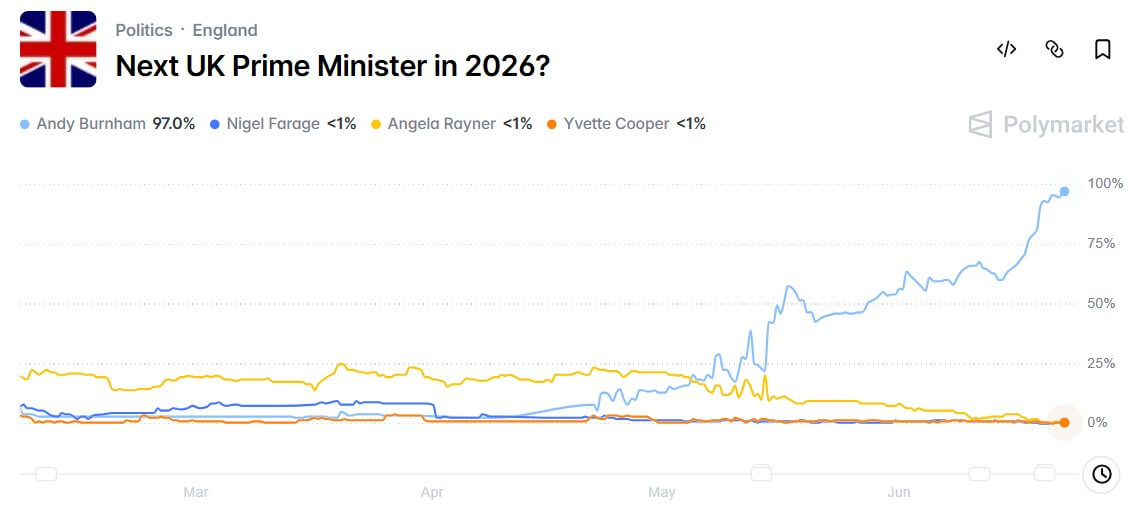
Next Prime Minister of the UK (Source: Polymarket)
This probability only represents the market judgment made by traders investing real money, rather than a rigorous polling result, but it sufficiently reflects the complete shift in market direction towards Burnham following Streeting's withdrawal.
The traditional financial market did not see significant volatility immediately: the fluctuations of the pound and UK government bonds were minimal, indicating that investors had already anticipated Starmer’s resignation. The market's long-term focus is turning to Burnham's fiscal policy stance and the new Chancellor of the Exchequer's appointment.
If Burnham takes office smoothly, he will be the seventh Prime Minister in the UK in ten years. Since the Brexit referendum in 2016, the UK has been caught in a cycle of frequent Prime Minister changes.
The Regulatory Framework for Cryptocurrency in the UK Has Been Established, Set to Take Effect in 2027
The regulatory system that the new Prime Minister will take over has long surpassed mere policy slogans.
The bill passed in February formally brings crypto-related businesses into the UK’s regular financial regulatory framework, covering all operations including crypto trading platform operations, compliant stablecoin issuance, user asset custody, and digital asset trading.
The Financial Conduct Authority (FCA) is still working on refining the supporting regulations and has publicly consulted several rounds on asset custody, stablecoins, prudent operating requirements, market fraud control, consumer protection, and corporate operating authorization processes. The regulatory authority plans for the entire new regulation to come into effect on October 25, 2027.
After the new regulations come into effect, any company engaging in the aforementioned crypto business must obtain a separate specialized operating license for crypto, even if it already holds other financial business licenses or has completed the FCA's basic registration.
Although the new Prime Minister can adjust government policy focus, change officials in the Treasury, or push for partial amendments to bills, mere leadership replacement cannot abolish existing laws or enable the FCA to restart its entire regulatory framework development work.
However, the process of regulatory implementation carries hidden risks: a cabinet reshuffle may replace a number of officials familiar with the crypto regulatory framework, while the current regulatory authorities and industry companies are concentrating on preparing for operating license applications. At the same time, government attention may also be diverted to more urgent topics such as public spending, economic growth, and the Labour Party's election prospects.
This shift in policy focus could affect the pace of implementing subordinate regulations and contentious detailed policies. However, the core structure of the regulatory system has already been shaped, and unless the new government actively intervenes strongly, the likelihood of a complete reversal in the overall regulatory direction is minimal.
This is entirely different from the previous stage of policy competition. What industry companies currently need the most are detailed regulations and clear compliance guidelines, rather than vague slogans claiming to turn the UK into a digital asset center.
The Industry Hopes New Policies Will Focus on Economic Growth
Burnham has not publicly commented much on cryptocurrencies, but past statements have already shown many industry players a glimmer of hope. Freddie New, CEO of BHODL and co-founder of the Bitcoin Policy UK, told CryptoSlate that Burnham is likely to take office, providing the industry an opportunity to reshape its public image, enabling the crypto industry to be perceived as a potential driver of economic growth in the UK, rather than a risk industry that needs to be suppressed and guarded against in previous mainstream Labour perceptions.
He pointed out that multiple Bitcoin reserve asset companies have come to London seeking to go public. The UK stock market has long struggled to attract new IPOs, while digital asset companies can bring fresh capital and global attention to London. "Emerging companies seeking to go public in London should be welcomed and supported rather than restricted, and I hope Burnham can see this."
Industry executives plan to focus on advocating for the new government: moderate capital requirements, a streamlined and feasible operating license system, and clear regulatory definitions for staking, lending, and stablecoin payment businesses; while also hoping that the FCA implements the government’s previously proposed growth-oriented regulatory mission more intuitively when formulating regulations.
Although the market has a positive outlook for Burnham, the digital asset industry still harbors concerns about certain factions within the Labour Party. Freddie New mentioned that domestic financial regulators have not fully implemented Rachel Reeves' earlier proposed growth-prioritized regulatory guidelines.
He added: "The UK financial industry has a deep foundation in computer technology and should lead the global crypto race. The earlier political and regulatory authorities truly understand and embrace this industry, the more the country will benefit from its development."
免责声明:本文章仅代表作者个人观点,不代表本平台的立场和观点。本文章仅供信息分享,不构成对任何人的任何投资建议。用户与作者之间的任何争议,与本平台无关。如网页中刊载的文章或图片涉及侵权,请提供相关的权利证明和身份证明发送邮件到support@aicoin.com,本平台相关工作人员将会进行核查。


