CFTC wants to replicate the perpetual contract mechanism from the cryptocurrency market, with the current target being crude oil.
Author: angelilu, Foresight News
Regarding the "perpetual contract" mechanism, the U.S. Commodity Futures Trading Commission (CFTC) is taking action. On June 22, 2026, the CFTC released a discussion draft, asking the public two questions: Should standard energy futures contracts be extended to allow for around-the-clock trading? Should "perpetual contracts," referencing physical commodities like crude oil, be listed on regulated exchanges? The public comment period is open for 30 days.
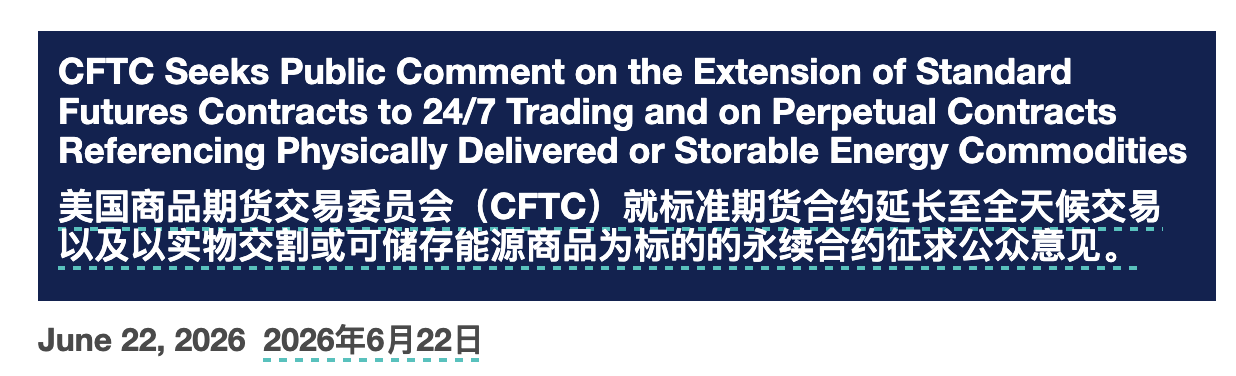
This marks the first time in CFTC's history that there has been a systematic discussion about introducing the perpetual contract mechanism for physical commodities. This mechanism has already been running in the cryptocurrency market for a full decade.
Concerning Crude Oil Pricing Power
Why is traditional finance now introducing this mechanism? It is likely due to the challenge posed by the on-chain platform Hyperliquid to traditional finance's energy pricing power.
On the night of Saturday, February 28, 2026, news began to spread about the U.S. carrying out military strikes against Iran. The crude oil futures desk at the Chicago Mercantile Exchange (CME) was closed. Meanwhile, on-chain, Hyperliquid's crude oil perpetual contracts surged over 5% within minutes. Bloomberg noted this detail: that weekend, this crypto derivatives platform became the sole operational mechanism for discovering crude oil prices globally.
As the conflict escalated, trading activity for this contract saw exponential growth in early March. By April 9, data from Hyperliquid indicated that the total trading volume for WTI crude futures ($1.68 billion) and Brent crude futures ($770 million) had first surpassed that of Bitcoin ($2.29 billion).
JPMorgan subsequently noted this in an internal report: Oil trading demand driven by the war is "continuously migrating to on-chain perpetual contracts." Fortune magazine reported on this with the title "Why Oil Traders Are flocking to This Crypto Platform."
The reason traditional finance is entering this space is not complex: traditional commodity exchanges operate five days a week and have fixed closures. Geopolitical events do not occur according to this schedule. This structural contradiction has existed for decades without anyone addressing it, until a crypto derivatives platform—almost by chance—filled this gap.
24/7 trading is one of the core reasons traditional finance has chosen to introduce perpetual contracts. In the CFTC's discussion draft, "around-the-clock trading" and "perpetual contracts" are presented as two parallel issues, which is not incidental.
A Concept Forgotten for 23 Years
The perpetual contract was not invented out of thin air by the cryptocurrency market.
In 1993, Nobel laureate Robert Shiller published a paper in the Journal of Finance proposing a derivative that does not require a fixed expiration date: by periodic cash payments between the two parties, the contract price continuously anchors near the spot price. He named this mechanism "perpetual futures," envisioning its application for illiquid assets like real estate and human capital.
Traditional finance archived this paper, and it was never mentioned again.
23 years later, on May 13, 2016, the crypto exchange BitMEX launched the XBTUSD contract: referencing the Bitcoin spot price, with no expiration date, and settling the funding rate every 8 hours. This mechanism is fundamentally the same as Shiller's concept but emerged in a cryptocurrency market that was not valued by traditional finance at that time.
The subsequent developments occurred faster than anyone expected, with major CEX and DEX in the crypto space adopting this mechanism. By 2025, leading perpetual contract exchanges had a total trading volume exceeding $91 trillion, with CEX contributing approximately $85.3 trillion and on-chain perpetual contract DEX contributing $6.38 trillion.
Three Responses from Traditional Exchanges
Before the CFTC took this step, it had already completed a "rehearsal" at the end of May: On May 29, the CFTC approved the BTCPERP contract submitted by Kalshi, the first crypto perpetual contract listed on a regulated exchange in the United States. CFTC Chairman Michael Selig referred to this as "responsible innovation."
On the day the approval news was released, the stock prices of the Chicago Mercantile Exchange Group (CME), Cboe Global Markets, and Intercontinental Exchange (ICE) all dropped simultaneously. Over the past few decades, these three institutions have formed a nearly closed derivatives ecosystem: futures contracts must be settled on an exchange, which means the exchanges not only earn trading fees but also firmly control the pricing power of global commodities and assets by controlling settlement prices and setting margin models.
However, perpetual contracts are essentially a form of "asset disintermediation," as they do not require physical delivery and achieve price anchoring through funding rates. Once this model is legalized in regulated markets, it means the "delivery pricing mechanism" that traditional exchanges rely on will completely lose its barriers; they would not only lose liquidity but also the crucial "pricing power" amid market fluctuations.
According to Bloomberg, the logic of investor concerns is clear: If perpetual contracts fully enter regulated markets, existing exchanges' derivatives businesses will face genuine competitive threats.
The three institutions offered three completely different responses to this same threat: CME Group CEO Terry Duffy announced that CME would file a lawsuit regarding the CFTC's approval of perpetual futures; Cboe discussed internally whether to directly convert its Bitcoin and Ethereum continuous futures into perpetual futures; ICE had already acted, having previously established a new entity called OKXICE in partnership with OKX.
The Regulatory Game Over Energy Perpetuals
Now, the CFTC has advanced the issue further: not just crypto assets, but crude oil.
This step is not taken lightly. Crude oil is fundamentally different from Bitcoin: the former has physical delivery properties and storage costs, while its futures price structure naturally includes the dynamic evolution of contango and backwardation. The funding rate mechanism of crypto perpetual contracts was initially designed for "digital assets with no storage costs." Directly transplanting it to crude oil requires reconstructing the arbitrage logic between futures basis and spot markets. This is the red line that the CFTC has been repeatedly examining in its discussion draft.
In fact, this demand has long been echoed in traditional finance. The closest product is the Contract for Difference (CFD): in the UK, Australia, and the EU, these products have achieved spot anchoring through overnight interest. However, CFDs have always been off-exchange over-the-counter (OTC) products and have been in the regulatory grey area in the United States for a long time, making it difficult for retail investors to access. This means that if the CFTC ultimately allows energy perpetual contracts, it will fill a financial vacuum that is older and historically more significant than "crypto regulation."
The market has already voted in advance regarding regulation. Since the beginning of this year, the proportion of perpetual contracts related to traditional financial assets in stablecoin trading volume has surged from 0.03% in December 2025 to 10% in June 2026, corresponding to a weekly funding scale of approximately $30 billion. While this figure may not be astonishing, its growth curve shows a one-way, irreversible trend.
免责声明:本文章仅代表作者个人观点,不代表本平台的立场和观点。本文章仅供信息分享,不构成对任何人的任何投资建议。用户与作者之间的任何争议,与本平台无关。如网页中刊载的文章或图片涉及侵权,请提供相关的权利证明和身份证明发送邮件到support@aicoin.com,本平台相关工作人员将会进行核查。


