Author: Claude, Deep Tide TechFlow
Deep Tide Introduction: ICE and OKX have established a 50:50 joint venture aimed at allowing OKX's 120 million users to directly trade ICE futures and NYSE tokenized stocks. But this is not just a joint venture news.
Nearly half of the tokens newly launched by Kraken this year are tokenized stocks, Robinhood has already rolled out over 200 US stock tokens in the EU, and the New York Stock Exchange is also building a 24/7 blockchain trading platform... A battle for "who will be the front-end for global retail investors to buy US stocks" has already begun.
Who will be the front-end for global retail investors to buy US stocks in the future? Brokerage apps, cryptocurrency exchanges, or the New York Stock Exchange itself?
This question has turned from hypothesis into reality over the past six months. On June 22, the parent company of the New York Stock Exchange, Intercontinental Exchange (NYSE: ICE), announced the establishment of a joint venture with cryptocurrency exchange OKX, co-led by ICE Senior Vice President Trabue Bland and former New York Governor Andrew Cuomo, aiming to connect OKX's 120 million global users to the ICE futures and NYSE tokenized stock markets. According to a BusinessWire announcement, the joint venture has a 50:50 shareholding and will operate as a US-registered brokerage and futures commission merchant upon regulatory approval.
Seen in isolation, this is a collaboration between a large exchange and a large crypto platform. In the context of the industry landscape in the first half of 2026, this is another move in the battle for tokenization access, and it is a step forward for traditional finance to claim its position.
NYSE's Direct Involvement: 24/7 Trading, Instant Settlement, Stablecoin Deposits
In January this year, NYSE announced that it is developing a blockchain-based tokenized securities trading platform, aiming to achieve 24/7 trading, instant on-chain settlement, USD-denominated orders, and stablecoin deposits.
According to a CoinDesk report on January 19, this platform will combine the NYSE's Pillar matching engine with a blockchain clearing and settlement system, supporting a multi-chain architecture, making tokenized stocks interchangeable with traditional securities, while shareholders' dividends and voting rights remain unaffected.
ICE's Vice President of Strategic Initiatives Michael Blaugrund stated at the time, "Supporting tokenized securities is a key step in ICE's strategy to operate on-chain market infrastructure in the new era of global finance."
This means that the New York Stock Exchange does not intend to hand over the distribution rights of tokenized stocks to crypto platforms; it wants to build its own trading venue. But the question is:
Where will NYSE get its users?
It excels in institutional-level infrastructure and matching engines, but is not good at customer acquisition targeting global retail users. OKX's 120 million users are one solution, with the essence of the joint venture being NYSE providing products and OKX providing traffic.
The Collective Shift of CEX: From Cryptocurrency to All-Asset Trading
OKX is not the only cryptocurrency exchange doing this. In the first half of 2026, almost all leading crypto platforms are running in the same direction.
According to CoinGecko data, among the 147 spot tokens launched by Kraken from January to April this year, 66 are tokenized stocks (xStocks) or RWA-related assets, accounting for about 45%. Kraken acquired the tokenized stock issuer Backed Finance in December 2025 and subsequently launched over 60 US stocks and ETFs for tokenized trading in the EU. According to DL News on April 2, tokenized stocks have become "the fastest growing sub-sector in the $25 billion RWA track of the crypto industry." Kraken has also launched commission-free US stock trading and crypto futures in the US, essentially becoming a multi-asset trading platform.
Robinhood has taken a different path. In June 2025, Robinhood launched over 200 tokenized US stocks and ETFs in the EU, running on the Arbitrum blockchain, and is developing its own Layer 2 (Robinhood Chain) based on the Arbitrum technology stack. According to CoinDesk on May 5, Robinhood Senior Vice President Johann Kerbrat stated that global investor demand for US stocks is on the rise, and tokenization and 24/7 trading will allow investors to "build a global portfolio instead of being limited to a single country."
Platforms like Bitget, Binance, Hyperliquid, and Bitpanda are also positioning themselves in tokenized stock perpetual contracts or spot tokens. According to CoinGecko's 2026 RWA report, by the end of the first quarter, the spot market size for tokenized stocks has reached $487 million, while the total trading volume of RWA perpetual contracts in the same period was $524.8 billion.
In other words, crypto exchanges are no longer satisfied with merely buying and selling crypto assets. They want to become the starting point for users to trade all financial assets: stocks, futures, commodities, ETFs, all through one app, one account, 24 hours a day.
Competitive Landscape
Currently, "enabling ordinary people to buy US stocks through crypto platforms" is advancing along three simultaneous routes:
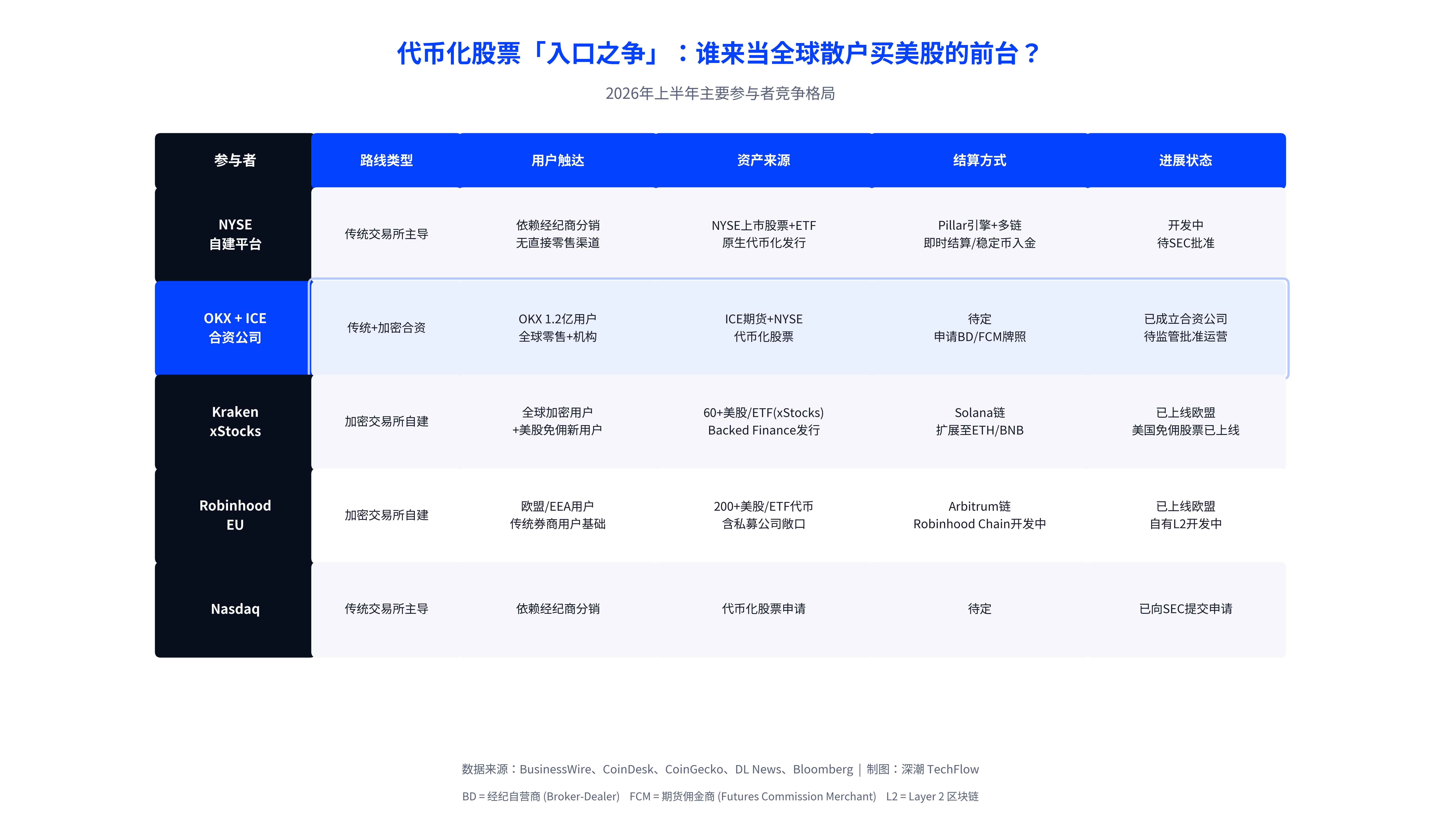
The first route is self-construction by cryptocurrency exchanges.
After acquiring Backed Finance, Kraken directly issued xStocks, Robinhood launched tokenized stocks on Arbitrum, and Bitget and Binance launched stock perpetual contracts. These platforms already have user bases and trading infrastructures but lack supply from traditional assets and regulatory compliance.
The second route is dominated by traditional exchanges.
NYSE is building its own blockchain trading platform, and Nasdaq has also applied to the SEC for trading tokenized stocks. They have assets, regulatory qualifications, and institutional trust, but lack retail distribution channels and 24/7 operational experience.
The third route is the model of the ICE and OKX joint venture. Traditional finance and crypto platforms each invest half, leveraging their strengths. ICE provides products and regulatory endorsement, while OKX supplies users and technology.
Which of the three routes will run the fastest depends on two variables: first, the actual advancement speed of US regulations (the joint venture needs brokerage and FCM licenses, and NYSE's tokenized platform also requires SEC approval), and second, the migration of user habits.
After all, for a retail investor in India or Brazil, what is the difference in experience between buying tokenized Apple stocks on OKX and buying AAPL through a local brokerage app?
One thing is certain: the second half of 2026 will be a concentrated landing period for tokenized stock products. From NYSE's 24/7 platform to the brokerage qualification application of the OKX joint venture, from Kraken's xStocks expansion to the launch of Robinhood Chain, every participant in the track is racing against the clock.
免责声明:本文章仅代表作者个人观点,不代表本平台的立场和观点。本文章仅供信息分享,不构成对任何人的任何投资建议。用户与作者之间的任何争议,与本平台无关。如网页中刊载的文章或图片涉及侵权,请提供相关的权利证明和身份证明发送邮件到support@aicoin.com,本平台相关工作人员将会进行核查。


