On June 17, the globally leading decentralized file transfer ecosystem BitTorrent announced the launch of its core AI strategic product BTTInferGrid, building a decentralized computing network aimed at AI inference scenarios.
BTTInferGrid is a heavyweight AI product strategically upgraded by BitTorrent based on its mature decentralized storage service BTFS. It embodies BitTorrent's years of accumulated technological experience in core areas such as P2P network protocol design, global distributed node governance, and large-scale resource scheduling, giving the platform an inherent advantage for scalable applications and commercial implementation right from its inception. The official launch of this product marks not only the beginning of BitTorrent's layout in the decentralized AI infrastructure race but also the formal commencement of a new chapter in empowering AI industry development through distributed computing.
Leveraging a cryptoeconomic incentive system and a distributed consensus mechanism, BTTInferGrid will seamlessly connect globally idle GPU computing resources with the diverse inference demands of AI developers, providing efficient on-demand, verifiable, and open access inference services for the next generation of AI applications, while also allowing idle GPU holders to easily monetize their resources, creating a win-win situation for both supply and demand of computing power.
From a technical perspective, BTTInferGrid reconstructs the traditional centralized computing supply system through distributed computing aggregation and intelligent scheduling mechanisms, endowing AI infrastructure with stronger resource elasticity and resilience against risks. From an industrial perspective, it pushes computing power away from scarcity and monopoly attributes to become freely circulating digital production materials, allowing every GPU holder to participate in value co-creation and revenue sharing, achieving a new industrial pattern of inclusive sharing and efficient flow of computing resources.
BitTorrent Launches BTTInferGrid to Build a Decentralized AI Inference Computing Foundation
“Computing power, algorithms, and data” are the three core elements of AI development, and the strategic value of computing power will soar to unprecedented heights by 2026. The “computing power shortage” is no longer just a long-term warning for the industry, but has transformed into the number one bottleneck hindering AI progress.
Looking at the global market, rental prices for high-end NVIDIA GPUs continue to rise, and hardware supply has been persistently tight; leading AI companies like OpenAI and Anthropic often face server downtime issues due to insufficient computing power reserves; even tech giants and elite academic institutions are struggling to secure adequate computing power. Recently listed on Nasdaq, SpaceX admitted in its IPO prospectus that the computing power demands for its AI-supported operations have far exceeded the current market supply and even considered reclaiming previously leased computing resources to Anthropic for self-preservation. Recently, Microsoft's cloud platform Azure was also reported to have urgently sought help from rival Amazon AWS to rent computing power in response to the massive computing gap caused by the surge of code submissions on GitHub during the AI era. Meanwhile, top universities like Stanford and MIT have also postponed several large model training projects due to insufficient computing power, and many graduate thesis defenses have been forced to be delayed.
It is against the backdrop of escalating global computing power supply-demand conflicts that BTTInferGrid has emerged. It aims to build a decentralized AI inference computing network (DePIN), aggregating scattered idle GPU computing resources globally in a decentralized manner, precisely matching the business needs of a vast array of AI developers, breaking down barriers and monopolies formed by traditional centralized computing service providers, maximizing global idle hardware resource utilization, and constructing a new generation of inclusive, open, and shared foundational computing infrastructure that fully unleashes the potential of global idle hardware resources, ensuring every unit of computing power can be fully utilized to maximize its value.
To ensure the efficient operation of the whole system, BTTInferGrid adopts a modular layered architecture design, establishing a three-layer collaborative system of “application layer – computing layer – settlement layer”:
- Application Layer: Serving as a service entry point for developers, the application layer provides a friendly deployment environment, supporting the rapid implementation of various AI native applications, such as AI chatbots and intelligent agents across diverse scenarios.
- Computing Layer: The core hub of the entire ecosystem, the computing layer has critical responsibilities including AI model inference computation, real-time request responses, and task scheduling.
- Settlement Layer: Responsible for the automated operation of the entire economic system, covering the entire process of computing power staking, task settlement, contribution reward distribution, and punishment for malicious nodes. This layer executes on-chain transactions in a trustless manner, ensuring that both computing power providers and consumers achieve fair and transparent value exchange without the need for intermediaries, providing a solid economic trust foundation for the entire network.
The three layers efficiently collaborate through standardized interfaces: the application layer initiates inference requests, the computing layer schedules computing resources to complete execution, and the settlement layer automatically completes incentive distribution based on execution results. The three support each other and operate in a closed loop, jointly forming a high-performance, highly trusted, and sustainable decentralized AI inference infrastructure.
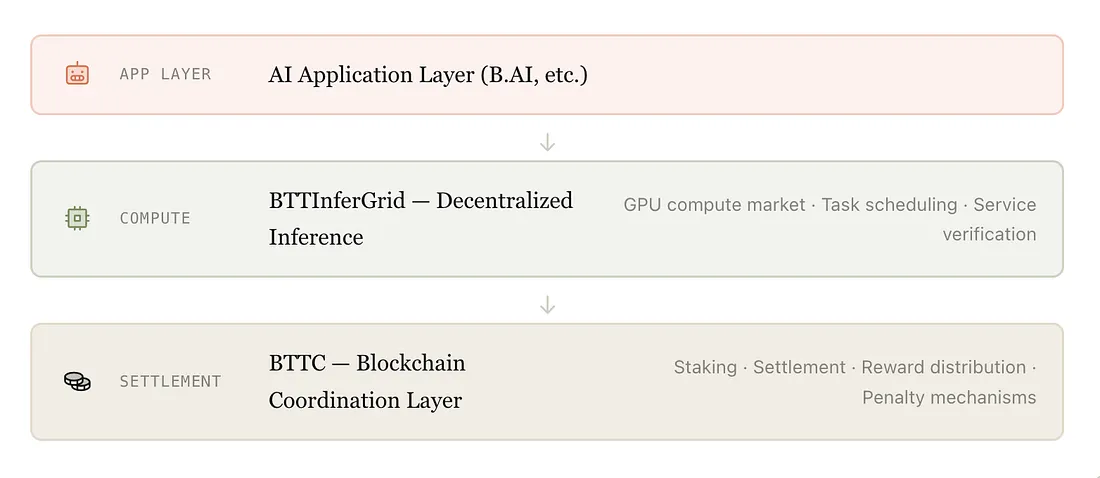
Relying on the three-layer infrastructure, BTTInferGrid has multiple advantages including autonomous distributed nodes, demand-driven permissionless access, and end-to-end trustworthy verifiability, establishing an efficient, robust, open, and unregulated distributed computing operational environment.
From the perspective of network architecture, BTTInferGrid employs a globally distributed node deployment strategy, with all nodes jointly owned and operated by the community, eliminating any single data center or operational entity's control over the network core. This inherently decentralized design thoroughly avoids common single point of failure and operational disruption risks faced by traditional centralized platforms, endowing the network with strong censorship resistance and 24/7 uninterrupted service resilience, capable of providing a highly available operational foundation for various AI inference tasks.
Regarding access to computing resources and scheduling rules, BTTInferGrid implements a permissionless open mechanism: all GPU devices that meet performance standards can freely access the network without centralized institutional approval. Moreover, the overall supply of computing power is driven entirely by real business needs, using actual computing power utilization and comprehensive service performance as the basis for incentive accounting, supplemented by a dynamic supply adjustment mechanism that flexibly allocates resource scale according to real-time network computing load. This mechanism enhances the efficiency of computing resource turnover, while ensuring that computing power providers obtain stable earnings that match their contributions over the long term.
In terms of trust mechanisms, BTTInferGrid incorporates trust logic throughout the entire business process. The entire network operates based on a comprehensive cryptoeconomic system, automatically completing operations like computing power dispatch, task allocation, and revenue settlement; every AI inference computing task can be fully traced, and computation results support on-chain cross-verification. The design of the underlying mechanisms eradicates misreporting of computing power, data tampering, and other violations from the source, ensuring the authenticity and integrity of all computing tasks, allowing demand-side users to use confidently and supply-side participants to engage reassuredly.
In conclusion, the distributed node architecture endows the computing power network with autonomy and high stability; the demand-driven permissionless access model ensures efficient turnover of computing power and long-term economic sustainability; the end-to-end verifiable trust system maintains a secure baseline for the ecosystem. The deep integration of these three core characteristics makes BTTInferGrid not only a technologically advanced distributed computing network but also a long-term stable, highly trusted, future-oriented decentralized AI infrastructure.
BTT is Expected to Become the Core Value Token of the Decentralized AI Computing Network, Ecological Application Boundaries May Be Broadly Extended
As the native value token of the BitTorrent ecosystem, with the formal implementation of BTTInferGrid and the continuous expansion of the ecosystem, BTT's strategic positioning may undergo a critical upgrade, with application scenarios likely to extend from traditional distributed transmission and storage fields to the entire industrial chain of AI computing infrastructure, continuously broadening the ecological value boundaries.
In the past, BTT was the circulating medium of the world's leading decentralized file transfer network BitTorrent; now, based on the new AI computing network BTTInferGrid, it is expected to evolve into the core token that facilitates the scheduling of the decentralized AI computing network, undertaking dual functions of value circulation and ecological governance.
Moreover, the cryptoeconomic incentive mechanism of BTTInferGrid serves as the underlying engine for network operations, connecting off-chain idle GPU computing power with the inference needs of AI developers, achieving automation in task scheduling, result verification, and profit settlement through token incentives, ensuring supply-demand matching and governance transparency.
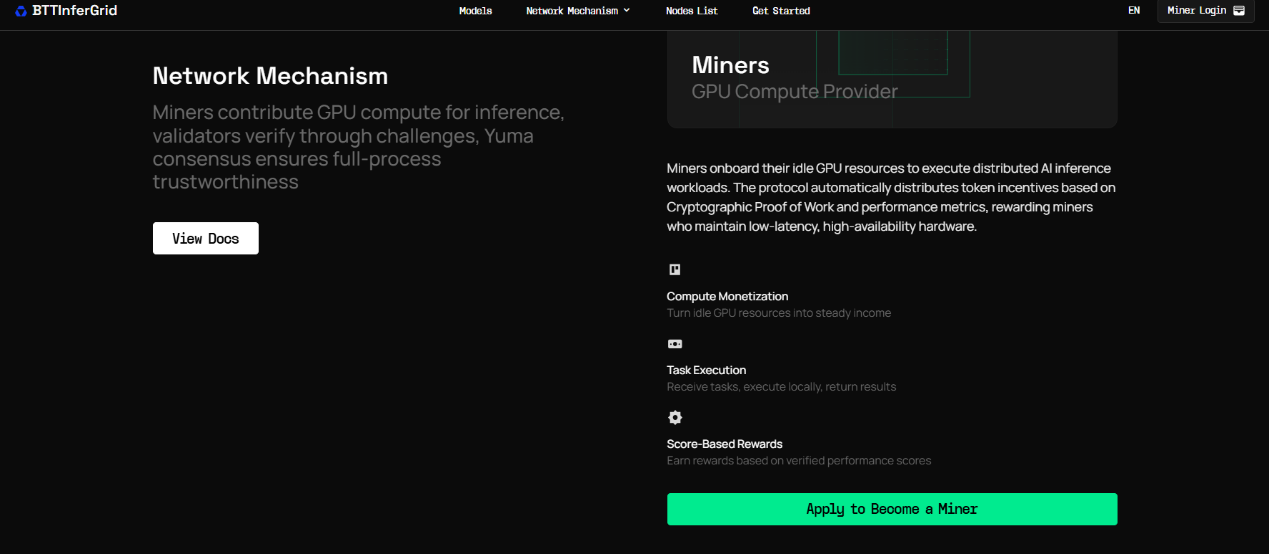
Within the BTTInferGrid system, the sustainable operation of the ecosystem relies on the collaborative participation and division of labor among three core roles: miners, users (AI developers), and validators, jointly constructing a decentralized computing network that operates autonomously:
- Miners (Computing Power Providers): Contribute idle GPU resources, undertake and complete execution of AI inference tasks, and earn corresponding rewards based on actual workload, task completion quality, and dynamic performance ratings.
- AI Developers (Computing Power Demanders): Can access a global distributed computing pool through a unified standardized API, significantly reducing computing power calling costs.
- Validators (Network Guardians): Audit the computational performance of miner nodes and conduct random challenges to identify cheating or low-quality computing power, receiving respective rewards for maintaining network security and service quality.
The three types of participants form a complete closed loop of symbiotic interests and mutual constraints based on a decentralized consensus mechanism, jointly driving the continuous evolution and healthy cycle of the BTTInferGrid ecosystem. The core bond that connects the rights of all parties and drives the healthy operation of the ecosystem is the cryptoeconomic incentive system tailored for BTTInferGrid.
This system realizes precise quantification and fair distribution of computing power value through token circulation, transforming behaviors like computing power supply, task execution, and result auditing into clearly quantifiable incentive signals: miners contribute idle GPUs and complete inference tasks with high quality to earn token rewards, validators earn profits by maintaining network security, while AI developers pay fees according to actual computing power consumption. The interests of all three achieve dynamic balance in the flow of the token economy, thus establishing a sustainable value closed loop.
Within this framework, BTT is expected to become the unified native incentive and settlement fundamental token within the BTTInferGrid ecosystem, spanning core elements throughout the computing power ecosystem, covering the entire process of using and paying for AI computing resources, contribution incentives, and dynamic distribution processes, ultimately building a closed-loop economic system in which “computing power contributors receive rewards, computing power users conveniently pay, and ecosystem participants share value.”
Specifically, BTT tokens can play multiple core roles within the BTTInferGrid network: as a payment medium, AI developers use BTT (or its equivalent tokens) to pay for inference service fees, achieving “on-demand procurement, pay-as-you-go”; as an incentive tool, miners earn token rewards based on verifiable actual computing contributions, and validators receive profits for providing auditing and challenge services, thus continuously attracting idle global resources to access the network; as a staked asset, validators must stake tokens to participate in scoring and validation, while computing nodes also need to stake a certain quantity of tokens to qualify for task acceptance, with any misconduct triggering a collateral penalty mechanism that effectively ensures the security and fairness of the network from an economic perspective.
In this view, BTT is likely to be not only a value carrier matching supply and demand of computing power in the future but also the underlying core driving force supporting the efficient, fair, and long-term operation of the entire decentralized AI computing economy. On one hand, through token incentives, it continuously attracts more idle GPU resources to access the network and expands the supply of computing power; on the other hand, with the supporting collateral penalty mechanism, it guarantees the stability and reliability of inference services. Additionally, all settlement and reward-punishment logic is automatically executed by smart contracts, effectively addressing the common issues of information opacity and high trust costs present in centralized computing platforms.
With the development and increasing prosperity of the BTTInferGrid ecosystem, BTT is expected to become a general value anchor connecting distributed computing and AI application demands, opening a new paradigm for the decentralized AI economy.
BTTInferGrid Restructures Global Computing Power Allocation Mechanism, BitTorrent Opens a New Chapter in the Decentralized AI Race
Against a backdrop of intensifying global computing power supply-demand contradictions and escalating centralized computing monopolies, BTTInferGrid restructures the computing power supply model through distributed technology: it efficiently aggregates global fragmented idle GPU resources, constructing an open and shared computing infrastructure, allowing AI developers to access elastic computing power without barriers and enabling every piece of idle computing power worldwide to unleash its inherent value. At the same time, through innovative cryptoeconomic incentives and collaborative governance mechanisms, it breaks through the closed loop of value circulation between the supply and demand sides of computing power, forming an ecological cycle that promotes mutual enhancement and healthy operation of both sides.
For miners (computing power providers), BTTInferGrid is a “value converter” that transforms idle computing power into continuous income. Any idle GPU meeting basic performance thresholds can connect to the network permissionlessly and contribute computing power to earn returns.
Unlike the traditional crude model of distributing returns based solely on “hardware computing power size,” BTTInferGrid employs a multidimensional scoring and weighted incentive model: the network comprehensively verifies nodes' actual effective workload, task response latency, service stability, result accuracy, and other core indicators to dynamically calculate and allocate corresponding rewards. This mechanism thoroughly breaks the pattern of “large computing power monopolizing earnings,” allowing small and medium miners providing high-quality, reliable services to also earn excess returns, institutionally ensuring service quality across the network. Additionally, miners who participated early in building the network will enjoy exclusive reward multipliers and other ecological inclination policies, gaining a first-mover advantage.
For AI developers, BTTInferGrid provides developers with open access, verifiable processes, and flexible on-demand payment AI inference computing power services, representing a completely different set of solutions from traditional cloud vendors that effectively address the multiple pain points faced by the industry such as “high computing costs, poor elasticity, and difficulties in trust,” significantly lowering the trial-and-error threshold for AI applications to be implemented.
Firstly, BTTInferGrid offers elastic computing power scheduling that can dynamically allocate resources based on AI inference loads, freeing developers from the need to pre-purchase hardware or sign long-term contracts, entirely avoiding resource locks imposed by centralized cloud vendors, genuinely achieving on-demand usage and flexible scaling; secondly, it employs decentralized market pricing and token-based precise billing, eliminating the exorbitant mark-ups of centralized platforms and significantly lowering inference costs, bringing computing expenses back to reasonable levels; even more critically, BTTInferGrid has built a decentralized multi-validator auditing network that, through random challenges, cross-verification, and collateral penalties, technically eliminates computing power fraud and result tampering, ensuring that every inference computation is authentic, traceable, and results verifiable. Multiple advantages complement each other, making BTTInferGrid not only a cost-effective channel for acquiring computing power but also a decentralized AI inference infrastructure trusted by developers.
Regarding product development, BTTInferGrid has established clear and actionable short-term, mid-term, and long-term development plans, steadily promoting iterative advancements and ecological expansion of the decentralized AI computing network:
Short-term Goals (2026): Focus on network startup and foundational service implementation while gradually increasing the number of online GPU nodes, completing core node launches and inference service validation, and adding support for mainstream open-source models like DeepSeek and Qwen, launching API services for developers and enterprise clients;
Mid-term Goals (2027): Focus on ecological closed-loop and capability boundary expansion, enhancing network performance and ecological richness based on stable operation of inference services, achieving upgrades from single inference services to comprehensive computing platforms (such as model fine-tuning, cross-chain resource access, etc.), and establishing a complete developer toolchain and ecological support system;
Long-term Goals (2028 and Beyond): Aim to become the native infrastructure for AI, creating a cooperative network integrating computing, storage, and smart contracts to provide foundational support for AI agents and automated applications, ultimately becoming the preferred decentralized inference layer for global open-source AI applications, providing elastic, inclusive, and trusted computing support for large-scale, high-concurrency next-generation AI application scenarios.
In terms of ecosystem construction, BTTInferGrid has now completed native adaptations for multiple industry-leading open-source large models, including Alibaba Cloud Tongyi Qianwen Qwen3.6 27B, Qwen2.5 7B Instruct, and Meta Llama 3.1 8B Instruct, covering diverse business scenarios such as general dialogue, code generation, and content creation. Developers can flexibly call it as needed through standardized API interfaces without having to deploy and debug the models themselves, further lowering the usage threshold for developers and significantly shortening the development and launch cycles of AI applications.
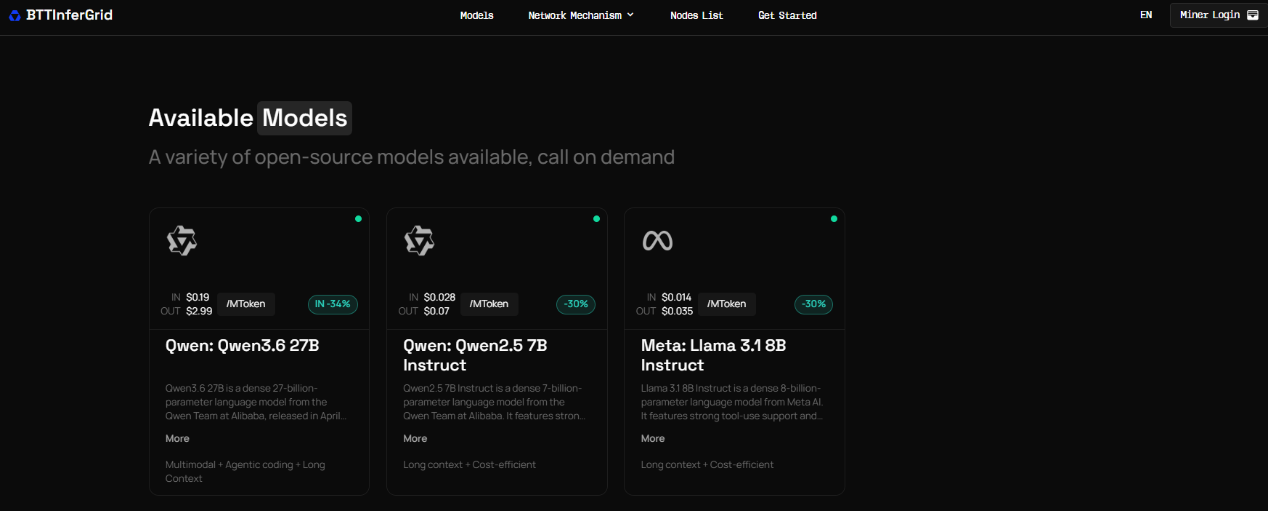
Currently, users can apply for miner access through the BTTInferGrid official website, participating early in network co-construction and sharing the dividends of ecological development.
The formal launch of BTTInferGrid is not only a strategically significant milestone arrangement for BitTorrent in the decentralized AI race but also provides a feasible new pathway for solving the computing power shortage dilemma faced by the global AI industry. It reconstructs the computing power supply system with decentralized technology, redefines the logic of production, allocation, and value exchange of computing power, and breaks the resource monopoly that centralized platforms have long established; simultaneously, it promotes the decentralized AI infrastructure from concept validation toward large-scale implementation, officially opening the door to a new phase of distributed computing empowering the next generation of artificial intelligence industries.
免责声明:本文章仅代表作者个人观点,不代表本平台的立场和观点。本文章仅供信息分享,不构成对任何人的任何投资建议。用户与作者之间的任何争议,与本平台无关。如网页中刊载的文章或图片涉及侵权,请提供相关的权利证明和身份证明发送邮件到support@aicoin.com,本平台相关工作人员将会进行核查。


