What signals are hidden in the Ethereum Foundation's new organizational structure?
Written by: KarenZ, Foresight News
The Ethereum Foundation (EF) has finally begun to draw boundaries for itself.
This restructuring of the Ethereum Foundation is noteworthy not just because it has reduced its staff by 54 people (approximately 20% of the Foundation), but it has also laid bare a long-standing unresolved issue: What should the EF still manage, and what must it set aside? The answers are already outlined in the new organizational structure: the protocol, security, privacy, and access layers have been given more prominent positions.
In an organizational chart, the most noteworthy aspect is the weighting
The new structure of the Ethereum Foundation is roughly divided into eight segments: protocol layer, access layer, user layer, community layer, institutional layer, operations layer, management layer, and management support.
According to the official organizational chart, the protocol layer is the largest, with a total of 57 people; the access layer has 34 people, the operations layer has 26 people, the community layer has 25 people; the institutional layer has 12 people, the user layer has 5 people; the management layer has 5 people, and management support has 6 people.
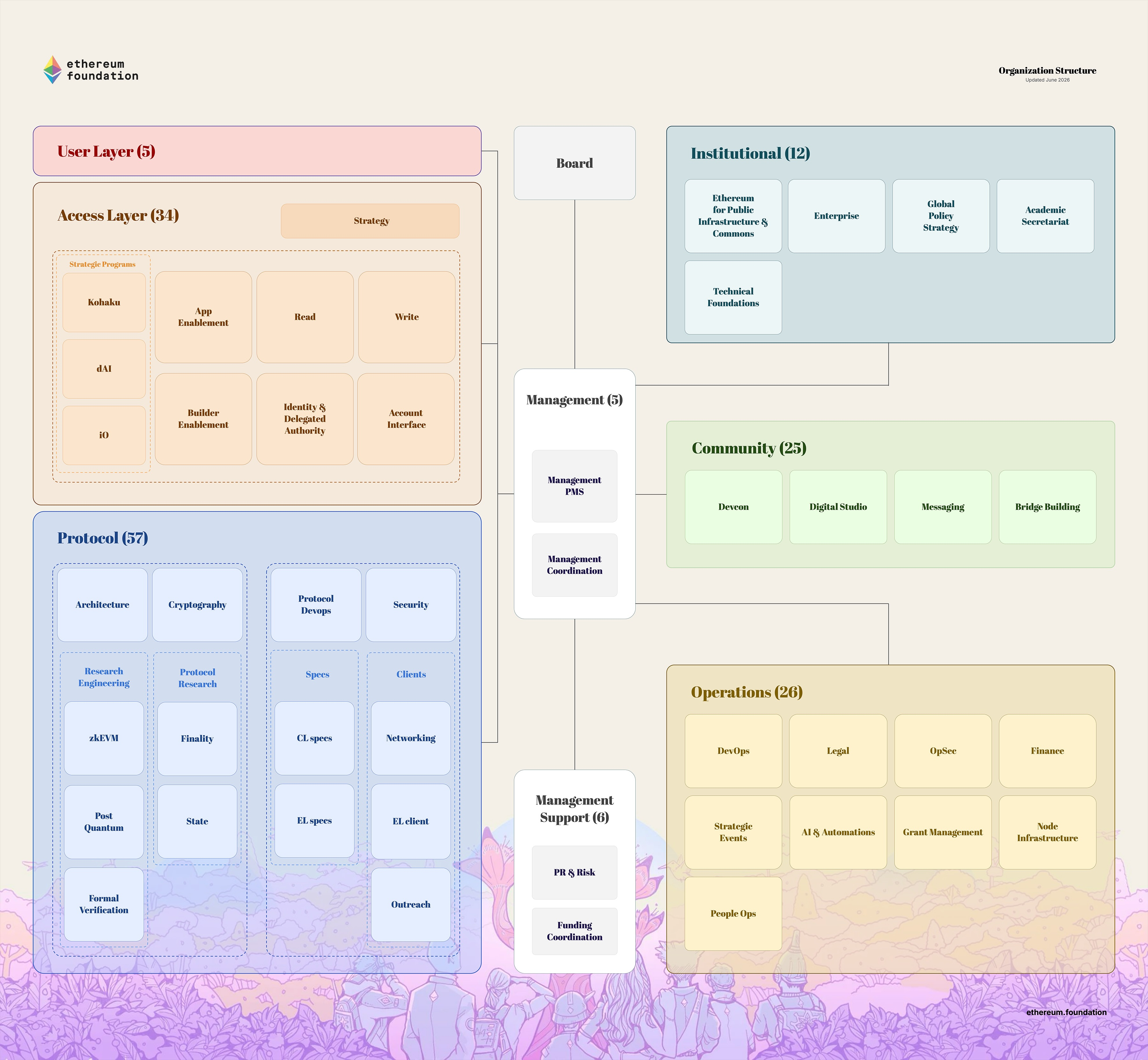
This ranking itself indicates the problem: after the contraction, EF's resources have not been diluted evenly, but have instead been refocused on the protocol and access layers. In other words, the Foundation is redirecting more energy back to the core aspects of Ethereum that are most challenging to outsource: protocol evolution, security, privacy, client interfaces, standards, and the actual entry points for users and institutions interacting with the chain.
Let's first look at the protocol layer, which is defined by the official stance as maintaining the most defensible attributes of Ethereum: censorship resistance, capture resistance, open source, privacy, and security. EF articulates plainly in its blog that the protocol team's work is not to make Ethereum easier for the market to package, nor to transform it into a financial rail controlled by intermediaries, but to ensure its reliability amid counterparty failures, platform censorship, governmental overreach, and intermediary rent-seeking.
Researcher Justin Drake provided a detailed breakdown of tasks within the protocol layer, where it is notable not every individual name but several technical lines that have been explicitly elevated in priority.
The most striking is the architecture group: led by Justin Drake, with Vitalik Buterin also included. Over the past year, Justin Drake has frequently pushed discussions on strawmap, post-quantum security, zkEVM, issuance policy, among others, while Vitalik represents one of the highest weights of Ethereum's long-term roadmap. The simultaneous appearance of both individuals in the architecture group indicates that EF is not merely compressing teams, but rather elevating the long-term evolution of the protocol to a higher priority.
Several more specific long-term technical topics are also distinctly marked out: Thomas Coratger is responsible for post-quantum security (a new team established in January 2026), Ignacio Hagopian is responsible for zkEVM, and Alex Hicks is responsible for formal verification. These names may not all be publicly active, but the directions they correspond to are critical: post-quantum security concerns whether Ethereum can complete its cryptographic migration ahead of schedule, zkEVM relates to the long-term shape of the execution layer and proof systems, while formal verification is a new tool EF hopes to use to reduce protocol complexity and client maintenance costs.
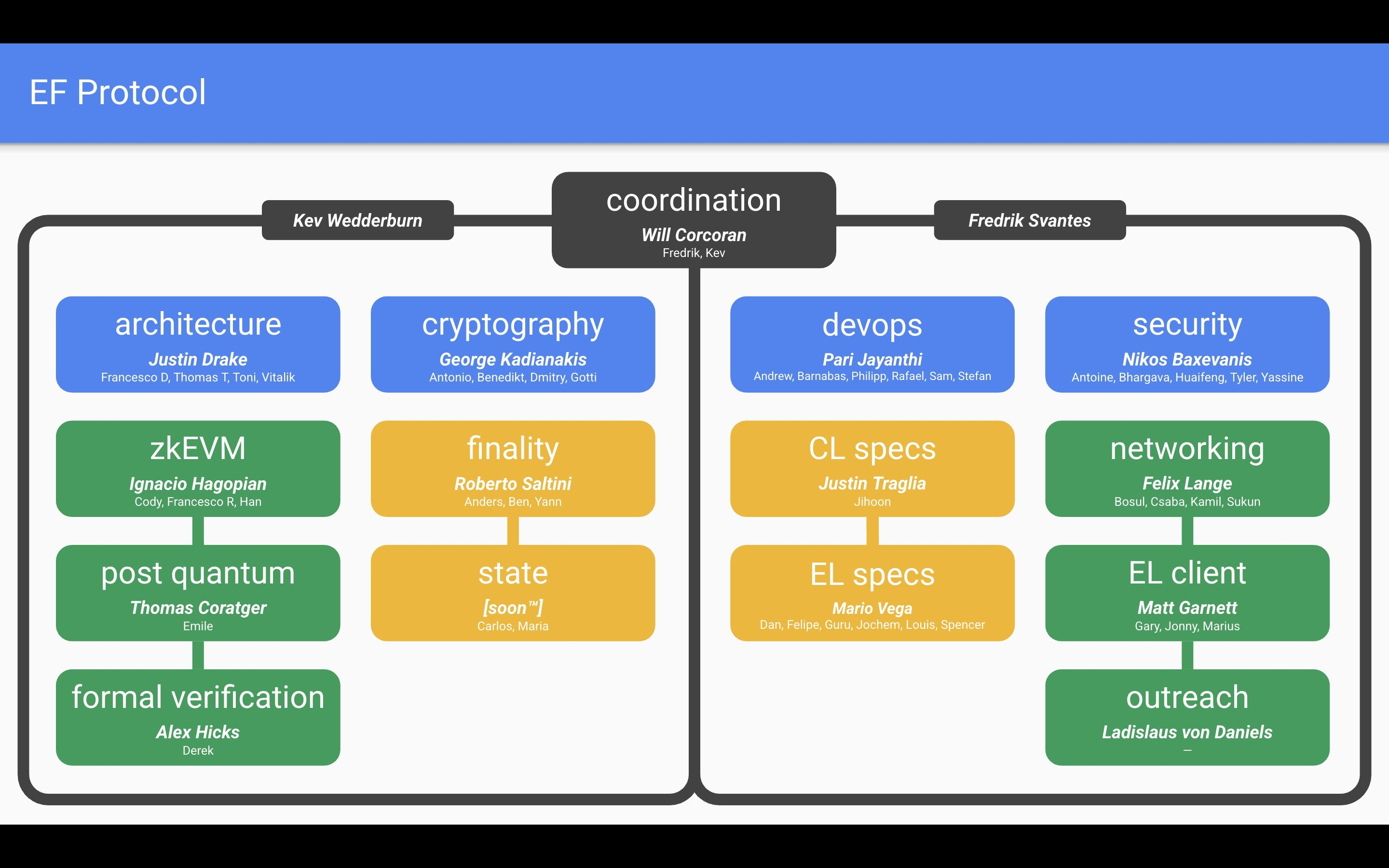
Additionally, the cryptography direction is led by George Kadianakis, who has long been involved in privacy networks and anonymous communication research, including participation in Tor's security research; the security direction is led by Nikos Baxevanis; and Protocol DevOps is managed by Pari Jayanthi.
The signals from these two charts are strong: EF has not turned the protocol layer into a vague “research department,” but has broken down post-quantum security, zkEVM, formal verification, finality, clients, standards, and security engineering into accountable subunits. The challenges facing Ethereum are not a single scaling issue, but a series of interdependent hard problems: faster L1, stronger privacy, lower complexity, less reliance on trust, and the cryptographic migration before the risks of quantum computing arrive.
Justin Drake's updates provide a more specific direction for the protocol layer. He states that the EF Protocol cluster has shrunk from around 100 people to about 60 people, EF’s subsidies for consensus and execution layer clients will end in 2027, and the annual expenditure, including grants, has dropped to about $30 million. He also mentioned that timelines for strategic upgrades like post-quantum security and zkEVM are being shortened, with AI-assisted formal verification and automated research changing the way protocols are developed.
Vitalik also noted that the Strawmap being advanced by Ethereum is a "third-phase" transformation, involving consensus, proofs, privacy, account models, state, and multiple components. He added that the multi-client model may shift from a past focus on "redundant security" to more "specialization,” with some security strategies potentially being handled by AI-assisted formal verification.
This touches on a very sensitive aspect within Ethereum's culture. In the past, the multiple clients were seen as a hallmark of Ethereum’s security philosophy: as long as no individual client surpasses a critical threshold, the chain will not stop due to a bug. But if the complexity of the protocol continues to rise, and all clients fully replicate the same capabilities, the costs will become increasingly higher. EF's new direction seems to bet on a different view of security: reducing unnecessary complexity while combining provable correctness, formal verification, AI-assisted research, and specialized clients.
This path carries risks. Formal verification is not magic, and AI cannot replace engineering responsibility. But it points to the deep water of the next round of competition for Ethereum: the future chains will not just compete on TPS but also on who can establish new secure production methods before complexity spirals out of control. If Ethereum wishes to enforce privacy, scalability, anti-MEV measures, post-quantum security, and better user access simultaneously, the bottleneck will not only be human resources, but also R&D methods, engineering collaboration, and trade-offs in the roadmap.
Cutting 20%, Budget Cut by about 40%: EF is Learning to Live Long-Term
Vitalik's explanation for this restructuring is more aligned with the underlying financial and strategic aspects. He indicated that EF's budget is expected to decline by about 40% this year, aiming to operate with an average annual spending of about 15% of remaining funds until 2026, gradually transitioning to a long-term donation fund-style organization with about 5% spend per year post-2030.
This statement is significant as it explains the true predicament of EF: a foundation operating on the ETH treasury cannot perpetually spend as imagined during a bull market. The more Ethereum strives to become "world-class infrastructure," the less the EF can function like an ever-expanding tech company. Tech companies justify expenditures with growth, while foundations constrain expenditures with mission. When these two logics intertwine, it leads to the state that has been repeatedly criticized externally over the past few years: the foundation is expected to fund public goods while also supporting applications, branding, conferences, institutional adoption, and ecological relationships, making it so every initiative can find justification, yet every initiative may dilute the main line.
Tomasz K. Stańczak, the former co-executive director of the Ethereum Foundation, provided another perspective. He agreed with the direction of reducing large events, client subsidies, institutional teams, and non-core large projects but expressed concern that the new organizational chart still appears complex.
He also mentioned that EF needs more professional and transparent treasury management and cannot miss large ETH opportunities in the staking and funding distribution processes due to insufficient financial functionality.
The Ethereum Ecosystem Needs to Grow More Nodes
Another subtle change during the restructuring process is that EF is pushing some tasks outward to the ecosystem.
The emergence of EthLabs fits perfectly within this context. This organization identifies itself as a non-profit R&D lab focused on Ethereum and ETH, aiming to make Ethereum the settlement layer of the global economy, while emphasizing its role in converting genuine needs into protocol work, standards, infrastructure, and products among users, applications, wallets, L2, infrastructure, institutions, ETH holders, core developers, and researchers.
EthLabs appears to be a sample of EF’s "multi-node future." It undertakes a portion of the work that EF can no longer suitably handle directly, yet is very important for Ethereum: closer to adoption, placing more emphasis on ETH, and nearer to product and market feedback. If EF is the constitutional layer, organizations like EthLabs act more like policy laboratories and engineering translators. Their value lies not in speaking for EF, but in allowing Ethereum to avoid placing all public goods, research, adoption, and narratives under one foundation.
Recommended Reading: 《Ethlabs Established, Treasury Company Pays for Ethereum After EF》
In a thread on June 22, EF mentioned that realizing Ethereum's potential requires a group of organizations to cooperate around a shared vision, and several organizations have emerged over the past year, enhancing the resilience and carrying capacity of the ecosystem. It explicitly mentioned EthLabs, Ethereum Apps Guild (EAG, promoting the proliferation and adoption of Ethereum-native applications), Ethereum Economic Zone (EEZ, a framework for synchronizing composable Rollups), and Argot (maintaining Solidity and the open-source compiler tools that the Ethereum ecosystem relies on), emphasizing at the end: "The privilege of safeguarding Ethereum should not be hoarded but rather carefully shared with others committed to building self-sovereign infrastructures."
Placed within the context of EF's restructuring, these organizations collectively illustrate one thing: Ethereum is no longer suited to compress all public goods, adoption, research, standards, and narratives under the central foundation. EF needs to concentrate resources on the most irreplaceable tasks such as protocol, security, privacy, and access layers; meanwhile, application adoption, developer tools, ecosystem coordination, institutional communication, ETH narrative, and product advances will require more external nodes to fill the gaps.
The true test lies here. A multi-node structure can improve resilience but may also generate new coordination costs. Whether third-party organizations can form complementary efforts rather than pursue independent routes; whether they can reduce reliance on EF without creating new central narratives; and whether they can translate funding, talent, and research outcomes into tangible products and protocol advancements will determine whether EF’s retreat is a healthy decentralization of power or just a more complicated coordination experiment.
EF's New Role: Shrinking Boundaries, Betting on Hard Problems
The signal genuinely released by this restructuring is deeper: the Ethereum Foundation is abandoning the sense of security derived from being "large and comprehensive" and is shifting towards a narrower, harder, and longer-term role.
This restructuring by EF does not point to mere contraction, but rather redefinition of the Foundation's responsibilities. Doing less does not equate to diminished ambition; it resembles a form of discipline: focusing limited funds and talent on the hardest-to-replace areas. Taking on challenges does not equal technological romanticism; it demands that EF presents executable roadmaps in areas like post-quantum security, formal verification, zkEVM, privacy, and access layers while ensuring that new nodes outside the foundation truly emerge.
Vitalik mentioned that Ethereum must deserve a place in the era of quantum computing, Mars rockets, robust biotechnology, and artificial intelligence, and be capable of responding to the challenges brought by this era.
This path will not please everyone. Developers may worry about reduced funding, institutions may fear narrowed interfaces, the market may criticize a lack of storytelling, and the community may continue to question whether EF is sufficiently transparent. Just as Tomasz expressed concern: if the organizational chart has shrunk, but decision-making remains ambiguous, the restructuring is merely an expensive reformatting.
免责声明:本文章仅代表作者个人观点,不代表本平台的立场和观点。本文章仅供信息分享,不构成对任何人的任何投资建议。用户与作者之间的任何争议,与本平台无关。如网页中刊载的文章或图片涉及侵权,请提供相关的权利证明和身份证明发送邮件到support@aicoin.com,本平台相关工作人员将会进行核查。


