Authors: Dave Mazza, Thomas DiFazio
Translation: Deep Tide TechFlow
Deep Tide Guide: The market values of the three major global memory chip manufacturers have all exceeded $1 trillion, and Morningstar immediately issued an article reminding investors not to overlook the fundamentals. Roundhill Investments (issuer of the DRAM ETF) published a piece refuting each point: AI infrastructure is reshaping the supply-demand structure of the memory industry, the manufacturing barriers of HBM prevent new players from entering the market, and the combined expected profits of the three giants will reach $704 billion by 2027. It is important to note that the authors of this article manage the DRAM ETF, and their stance is inherently bullish.
The three major global memory chip manufacturers—Samsung Electronics (005930 KS), SK Hynix (000660 KS), and Micron (MU)—have all surpassed a market value of $1 trillion, joining an extremely rare club. However, this milestone has also invited scrutiny.
Morningstar recently published a blog reminding memory ETF investors not to ignore the fundamentals, raising several sharp questions:
- Historical experience warrants caution: The memory industry has repeatedly undergone boom-bust cycles, and investors may be ignoring this history.
- Memory companies lack moats: Memory is essentially a commodity business where new capacity can always enter the market, eroding pricing power; companies lack true barriers to protect profit margins.
- Price increases may be momentum-driven rather than fundamentals-driven: The enthusiasm surrounding memory stocks reflects more excitement for AI than a calm analysis of earnings, profit margins, and supply-demand dynamics.
- Valuations have skyrocketed: Memory stocks have surged, and prices may have already outpaced the fundamentals.
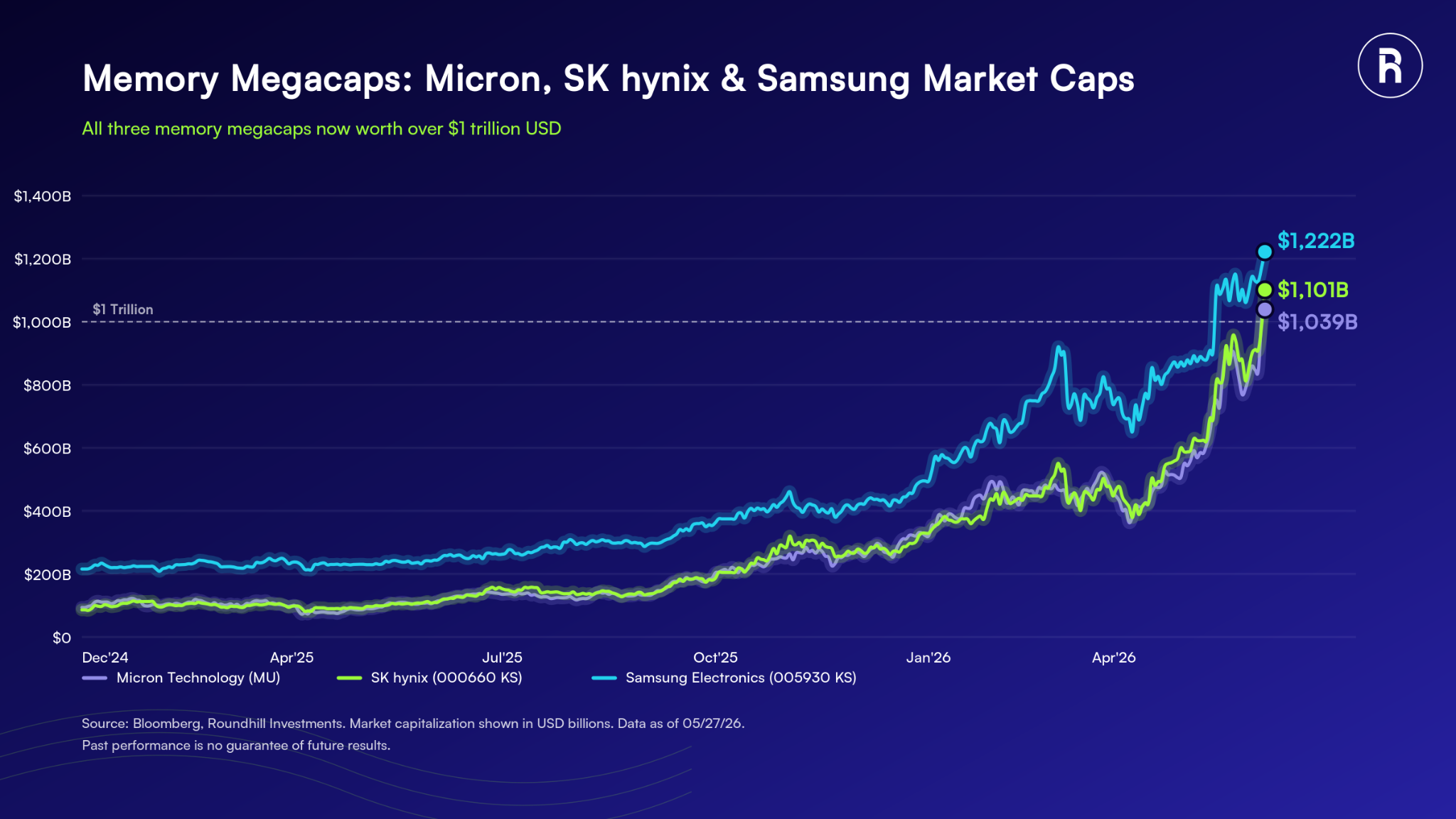
Caption: Overview of the memory chip industry
Roundhill's stance is: this time is different from the past. To understand the future of the memory industry, one must first look back at its past.
History does indeed warrant caution, but is history still applicable?
The boom-bust cycle of memory chips is a fact. The most classic round occurred in the mid-1990s. In August 1995, Microsoft released Windows 95, transforming personal computers from being enterprise-exclusive to consumer products, with each computer's DRAM capacity quadrupling from 1-2 megabits to 4-8 megabits. Manufacturers were caught off guard by sudden demand, frantically building factories and ramping up production, ultimately leading to oversupply and price collapse.
A similar story played out in the mid-2010s. When Apple released the iPhone 7, upgrading the base storage from 16GB to 32GB seemed like a minor change, but after scaling, demand surged, prompting manufacturers to invest heavily, followed again by oversupply and price drops.
These cycles share a common pattern: technological breakthrough → demand surge → manufacturers expand production → oversupply → price collapse.
The question is, does this pattern still apply today?
The memory chip industry has undergone structural changes. Memory demand is no longer tied to the replacement cycles of consumer electronics but is linked to the computational expansion of AI infrastructure. The scale of this market far exceeds that of a smartphone upgrade wave, and the growth potential is much greater.
Since January 2024, the prices of DRAM and NAND have increased over fivefold, and hyperscalers have started requesting long-term supply agreements to secure bandwidth. Historically, long-term supply agreements in the memory industry were loose frameworks that changed with market conditions. However, this model has changed. SK Hynix stated during its earnings call in January 2026 that current agreements reflect "strong reciprocal commitments" between customers and suppliers, due to the high capital intensity of cutting-edge memory manufacturing. Micron also reported similar long-term agreement conditions.
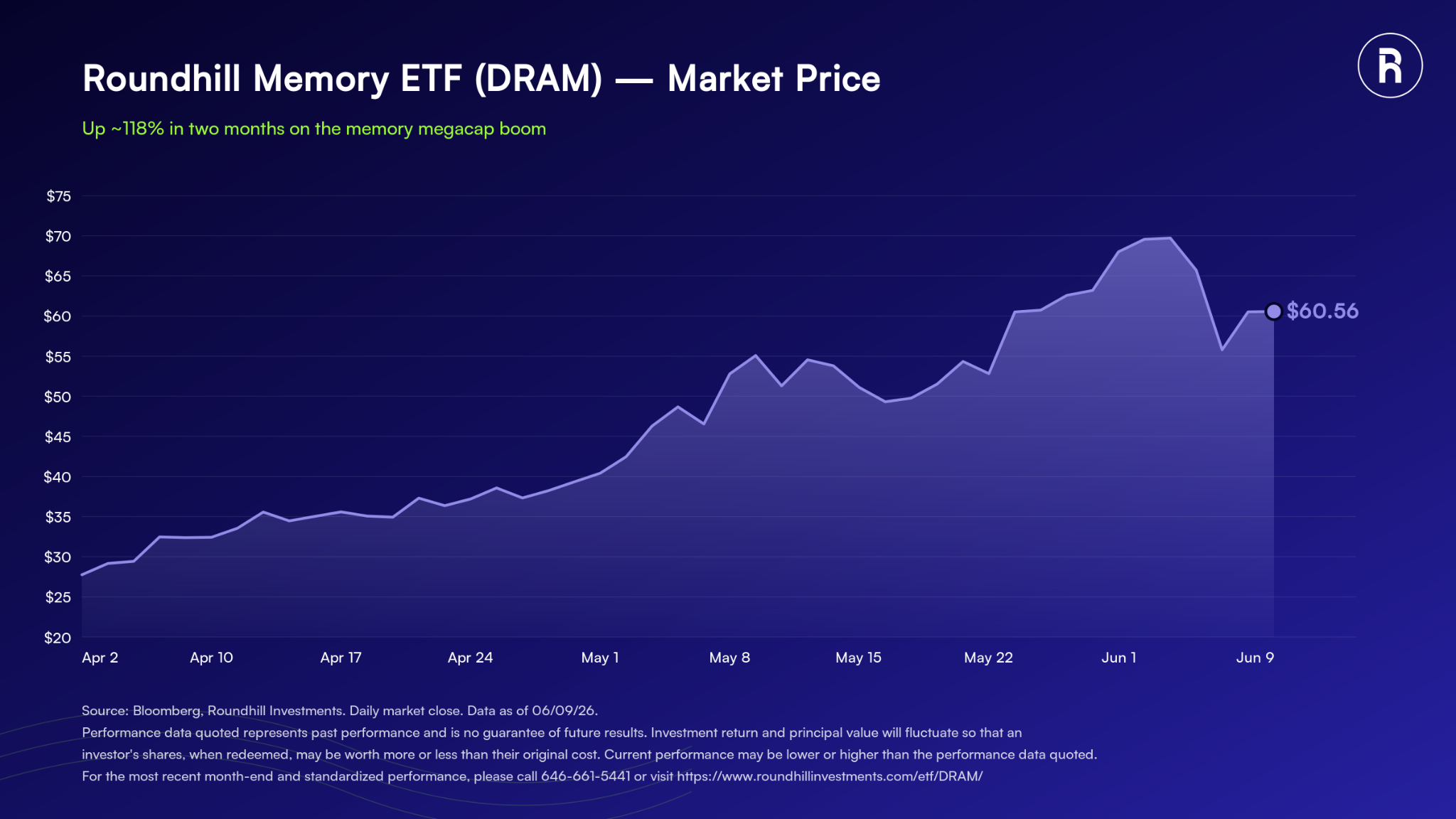
Caption: Price trends of DRAM and NAND
The moat of memory chips: manufacturing complexity
Not all memory chips are alike. The memory that drives today's AI systems is called High Bandwidth Memory (HBM), which is fundamentally different from the memory found in mobile phones and computers. HBM is specifically designed for AI workloads and has extremely strict manufacturing conditions.
Goldman Sachs reports that SK Hynix, Samsung, and Micron control nearly all global HBM supply. This industry has undergone decades of consolidation, and the accumulated manufacturing experience cannot be replicated overnight. The complexity of manufacturing itself is a moat and is precisely why these three manufacturers have reached their current position.
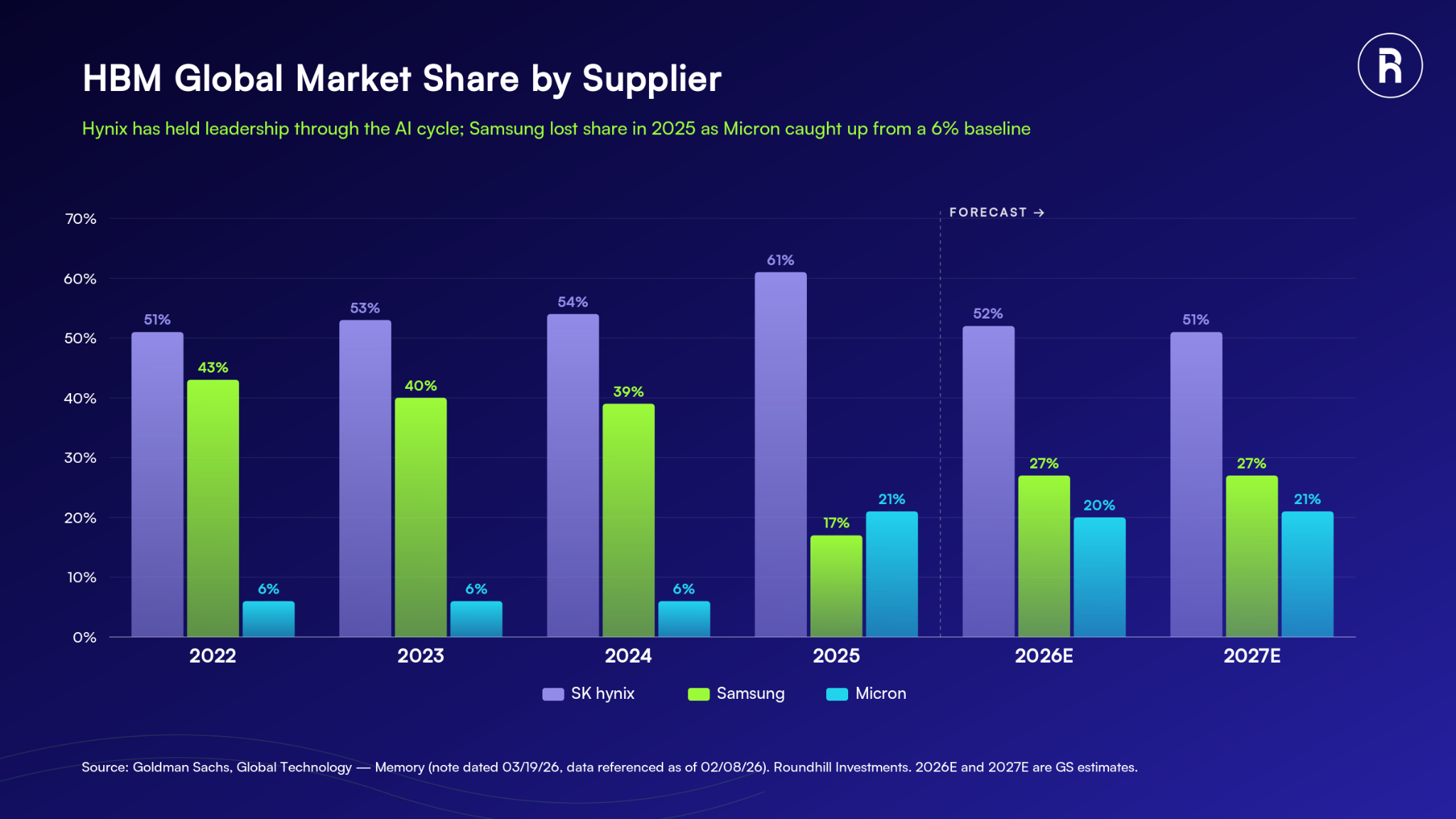
Caption: Distribution of global HBM market share
This is completely different from the logic of past cycles. In the past, demand surged → new capacity entered → prices collapsed. Today's bottleneck is not capital or willingness, but technical capability. SK Hynix currently controls about 58% of global HBM supply and announced plans on June 2 to double wafer production capacity over the next five years while warning that supply shortages would persist until 2030. Building a new factory takes at least 3 years, and if it's a completely new site, it takes over 5 years.
Additionally, ASML—the world's only manufacturer of extreme ultraviolet lithography (EUV) machines, which are essential for producing cutting-edge memory chips—has backorders amounting to up to €38.8 billion by 2026, exceeding its entire annual sales estimate, with delivery times for single EUV machines exceeding 12 months. This bottleneck cannot be resolved in the short term.
Fundamentals: Memory manufacturers are about to join the ranks of the world's most profitable companies
The earnings, revenue, and profit margin projections for Samsung, SK Hynix, and Micron reflect the secular wave of AI adoption. Bloomberg consensus estimates show that by 2027, these three companies will be among the ten most profitable companies in the world.
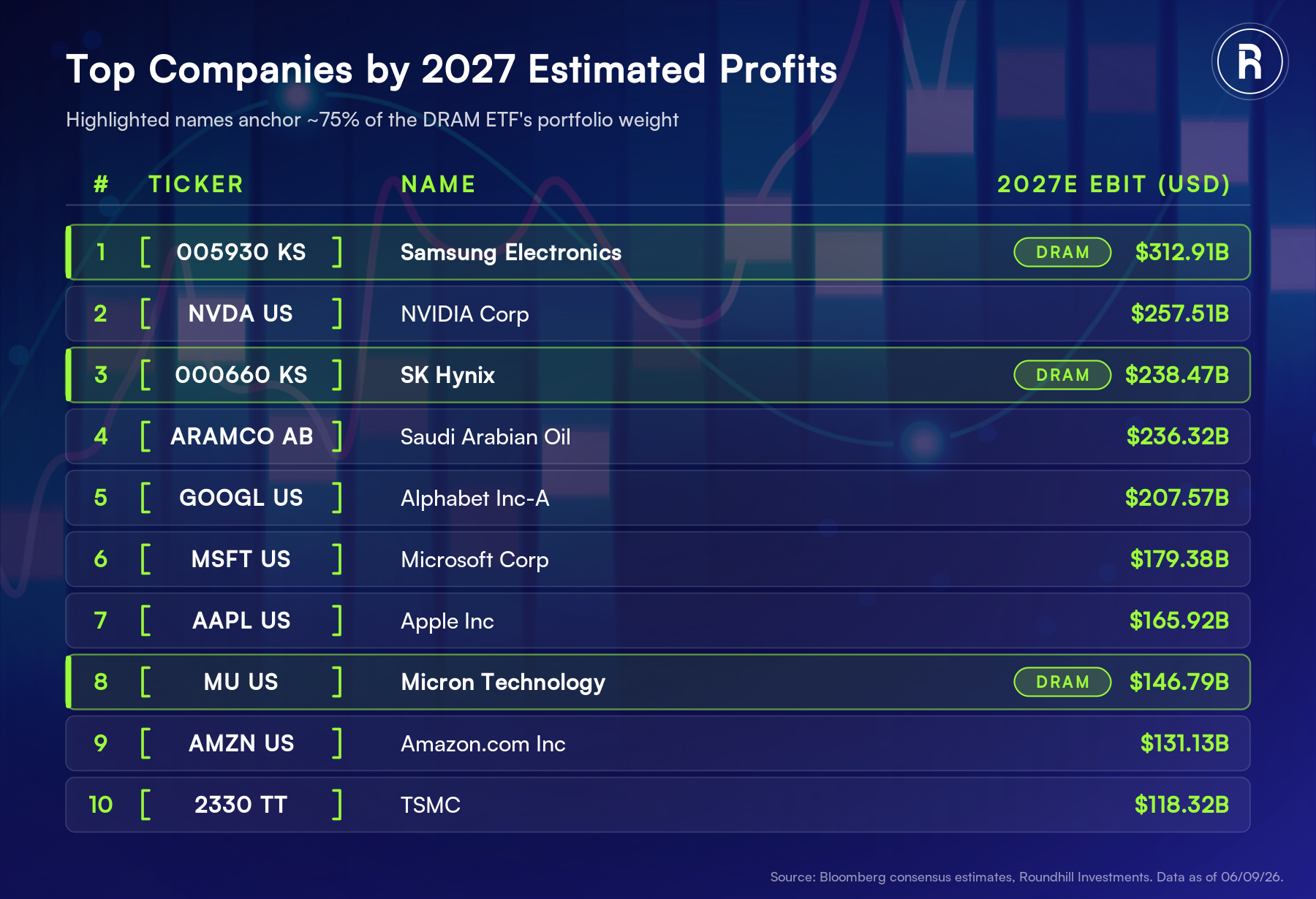
Caption: Forecast of the world's most profitable companies in 2027 (Bloomberg consensus estimates)
The combined bottom line profit of the three by the end of 2027 is expected to be $704 billion, with total revenue exceeding $1 trillion.
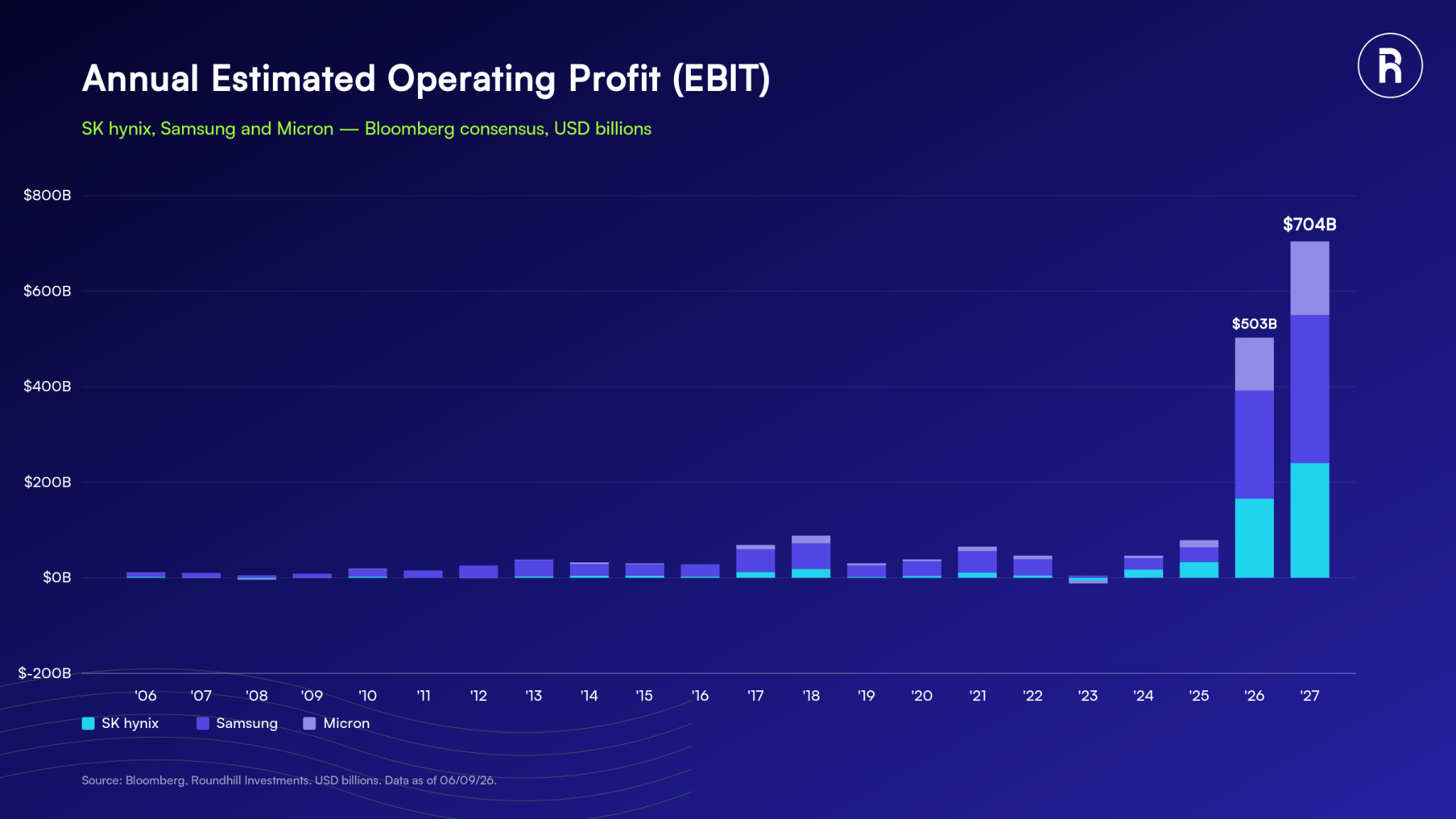
Caption: Revenue forecast for the three major memory manufacturers
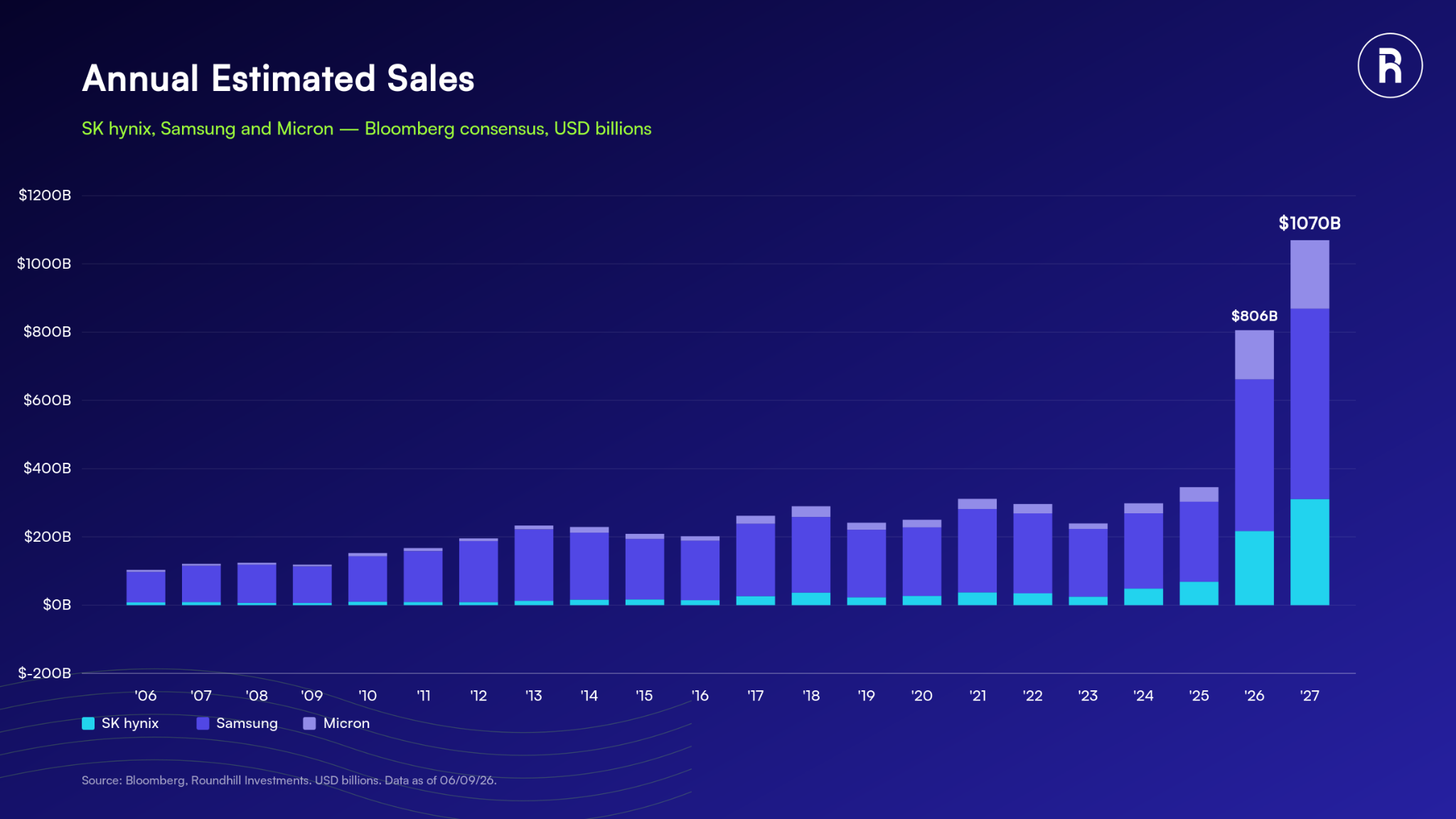
Caption: Profit forecast for the three major memory manufacturers
In terms of profit margins, Samsung, SK Hynix, and Micron's operating gross margins have reached record highs, surpassing the previous peak in 2018.
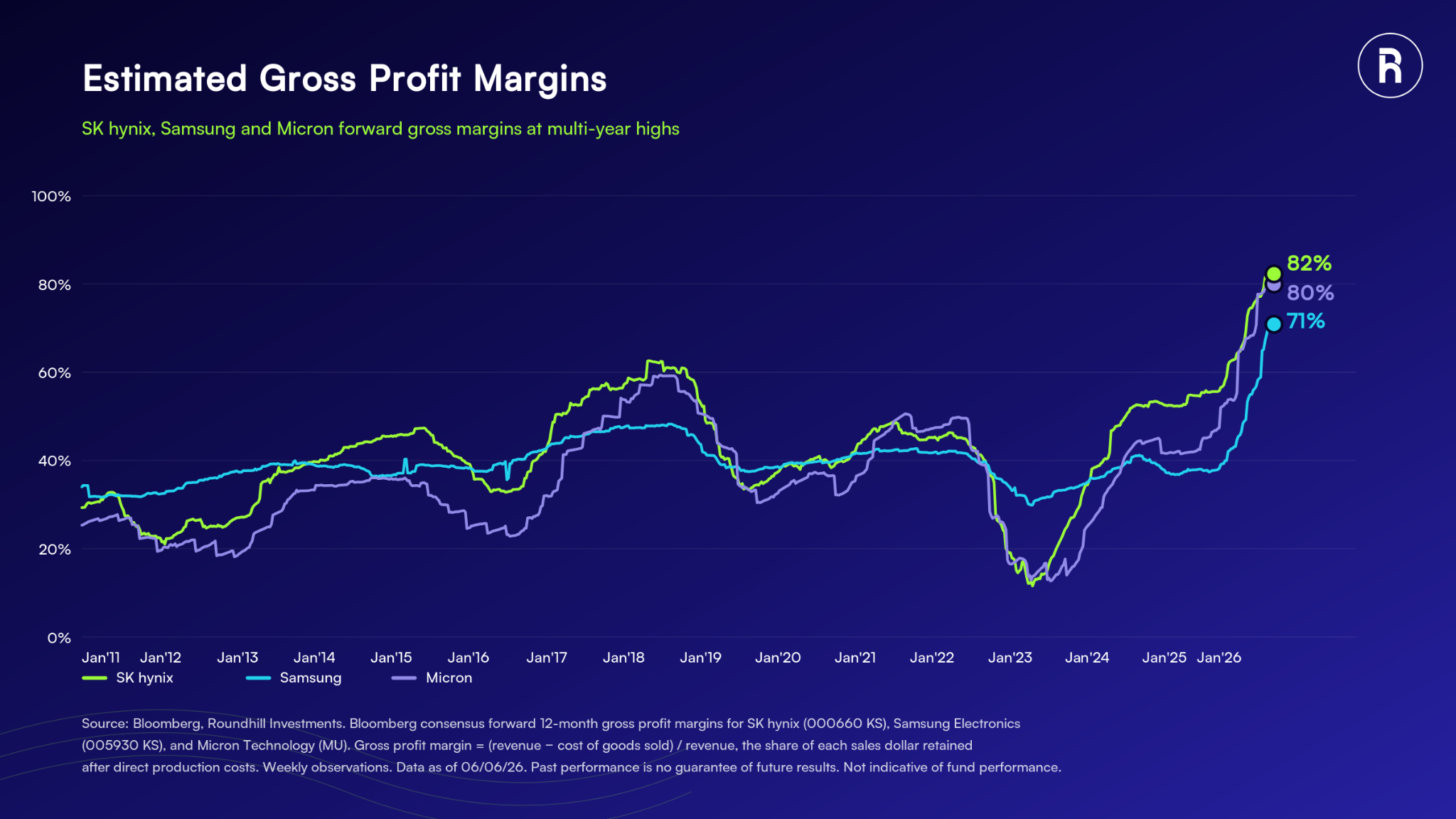
Caption: Historical trends of gross margins for the three major memory manufacturers
These figures have never been seen in the history of the memory industry. Even if growth slows down, in the context of generative AI continuing to integrate into the global economy, the memory industry is expected to rest on an unprecedented high baseline.
Valuation re-evaluation in a new era of profitability
The historic stock price performance combined with significant upward revisions of fundamentals indicates that the industry is undergoing a major re-evaluation driven by earnings growth and profit margin expansion.
SK Hynix and Samsung are two typical cases. For nearly a decade, the NTM (Next Twelve Months) price-to-book ratios of these two stocks have fluctuated within a certain range, constrained by the cyclical earnings characteristics of the memory industry. However, this ceiling may no longer apply. The expected ROE (return on equity) for both companies has soared to levels never seen in the history of the memory industry, necessitating a reevaluation of the valuation framework investors have historically used to judge these stocks.
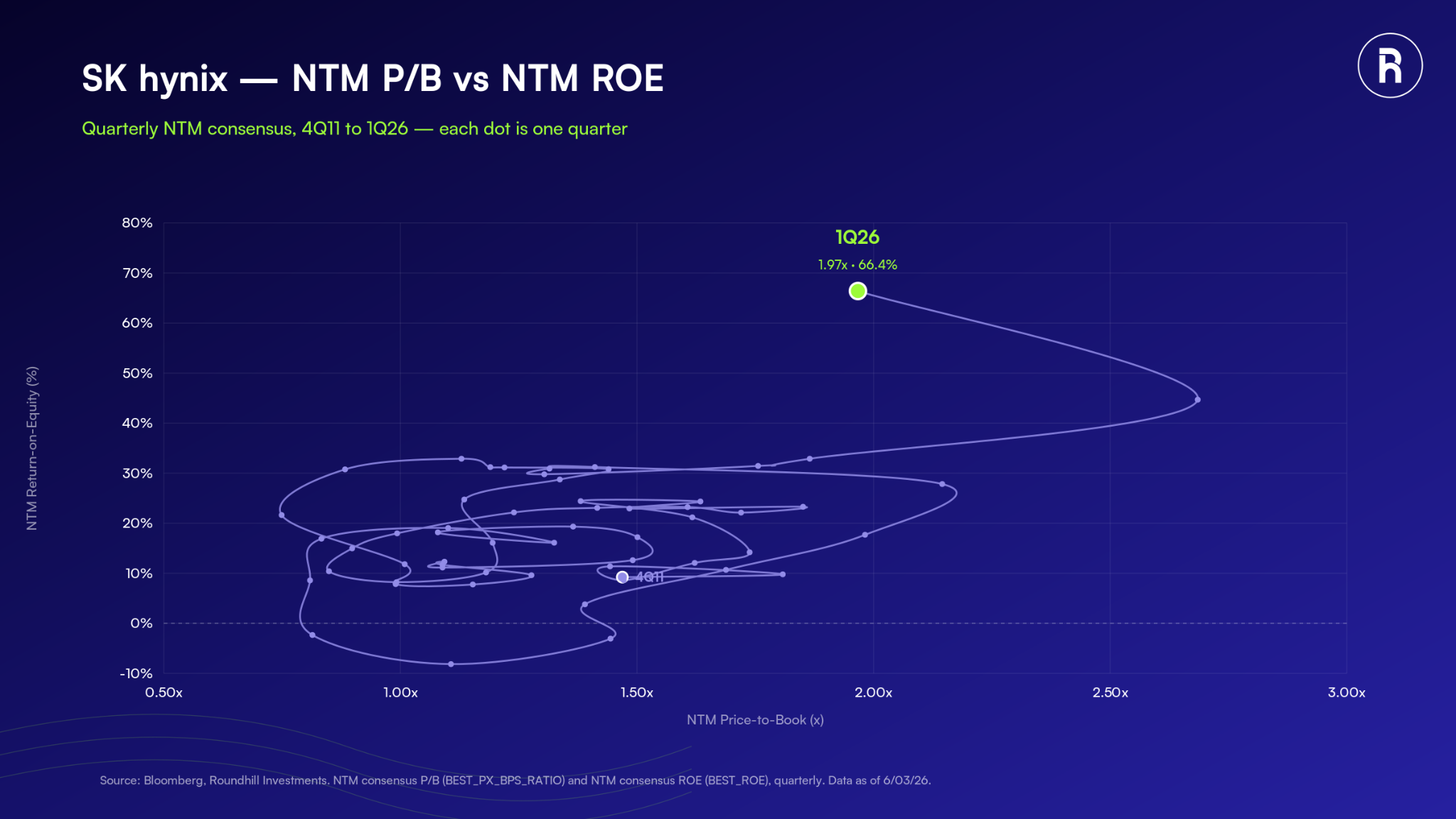
Caption: SK Hynix NTM price-to-book ratio and ROE trends
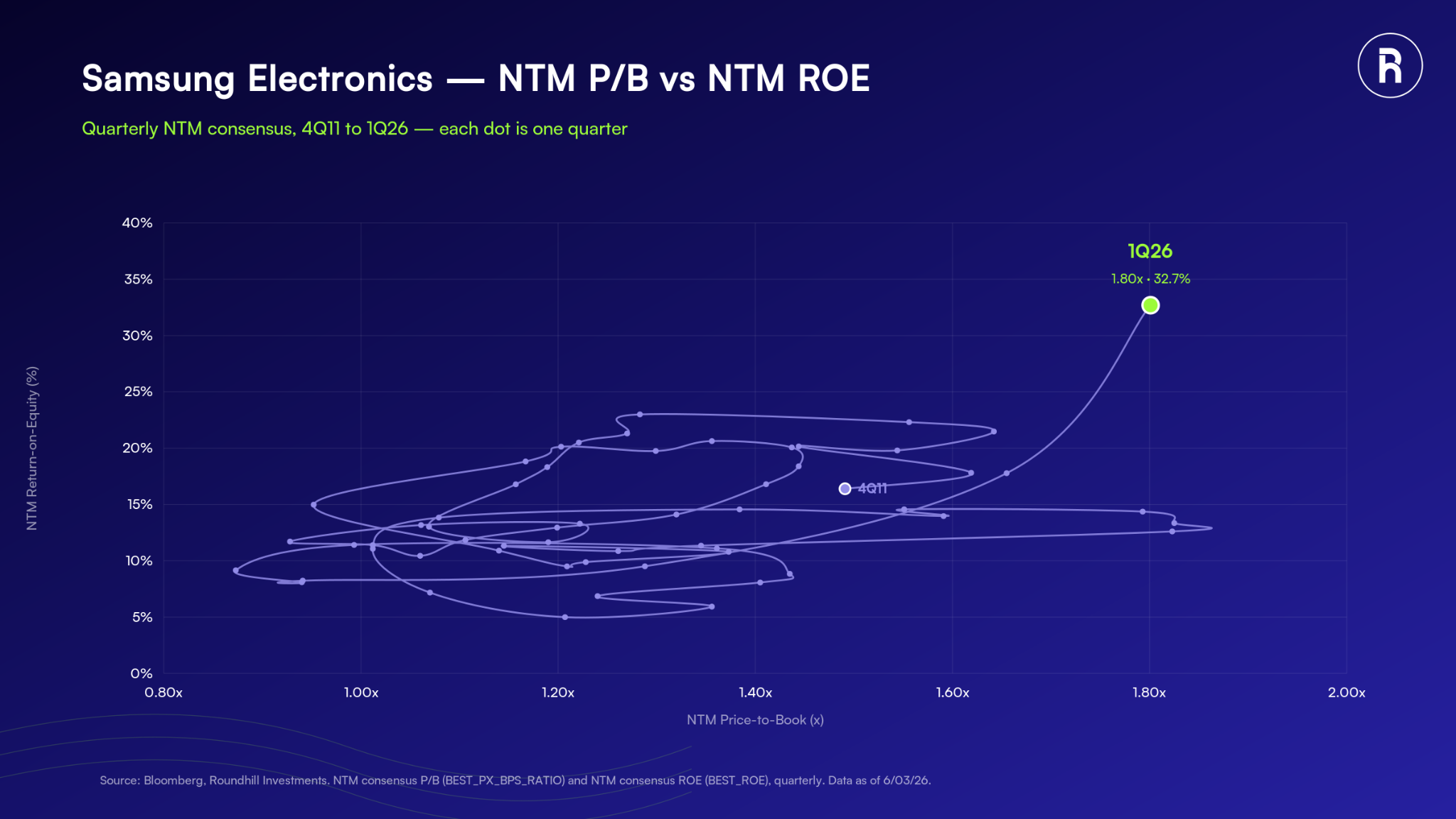
Caption: Samsung Electronics NTM price-to-book ratio and ROE trends
Despite the recent staggering increases in stock prices, the median NTM price-to-earnings ratio of the holdings in the DRAM ETF is only 8.37 times, making it attractive compared to a wider range of tech stocks. Meanwhile, the current fiscal year median EPS growth rate in the portfolio is 632%. Claiming that memory stocks are overvalued is actually using old data to fit a new industry. In Roundhill's view, the gap between historical valuation practices and current fundamental performance is where the opportunity lies.
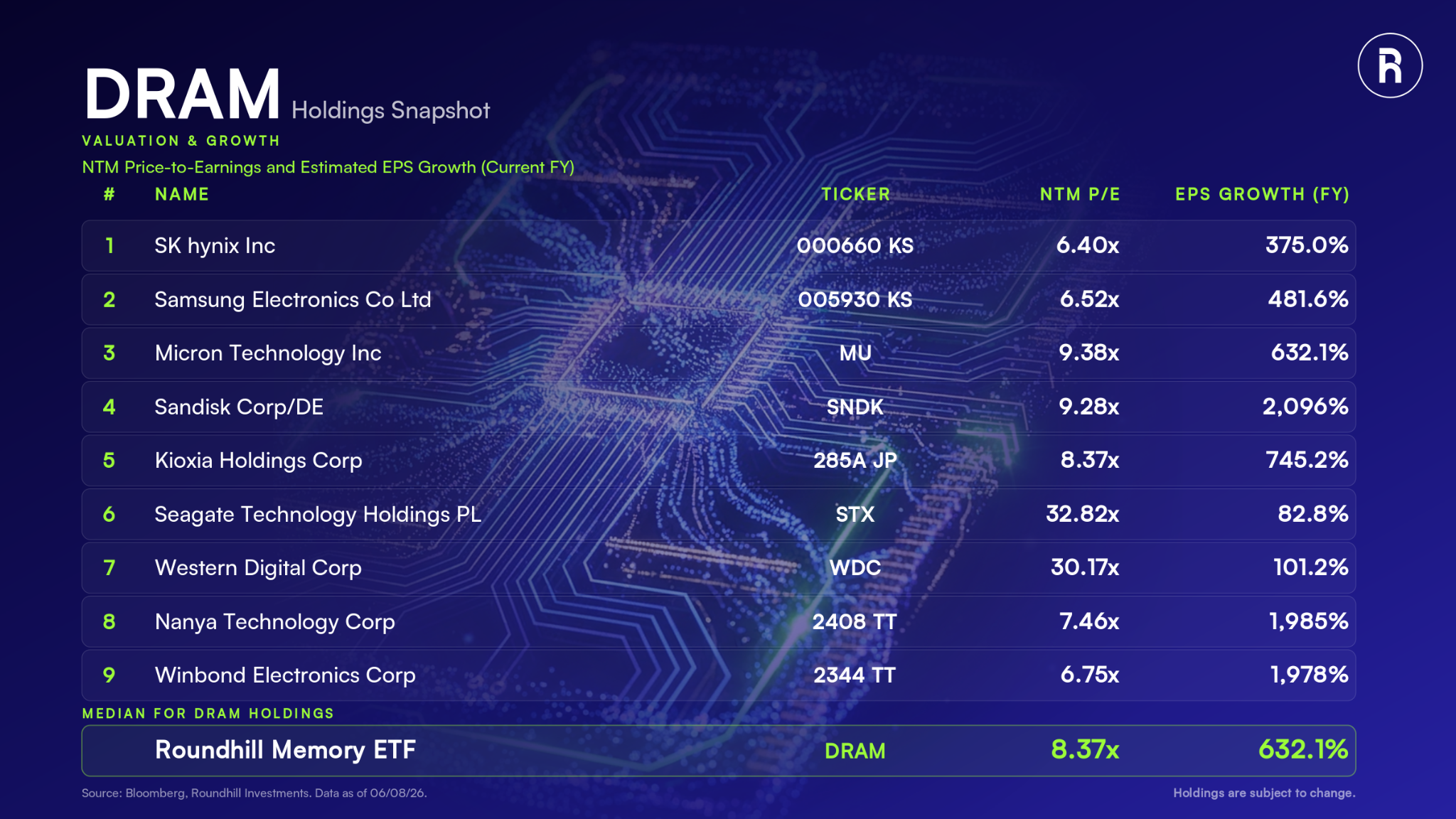
Caption: Overview of the valuation and earnings growth of DRAM ETF holdings
Conclusion: Why Roundhill is not worried
Being skeptical about soaring stock prices is reasonable; fundamentals are always important in the long term. However, in this case, the fundamentals are precisely the reason behind the rise in memory stocks.
The characteristic of old cycles was: demand surged with no upper limit, manufacturers overexpanded production, resulting in inevitable price collapse. Today's situation is structurally different: manufacturing barriers limit new entrants, industry leaders themselves say that supply shortages will persist until 2030, and the earnings cycle has only just begun to reflect the scale of AI infrastructure development.
Roundhill believes that the market is currently pricing not a bubble, but rather an industry that has struggled for decades through boom-and-bust cycles is entering a new era.
⚠️ Editor's Note: The authors of this article, Dave Mazza and Thomas DiFazio, are members of Roundhill Investments, which issues and manages the DRAM ETF (Roundhill Memory ETF). The article's stance is inherently bullish, and readers should consider third-party perspectives such as Morningstar for a comprehensive assessment. The ETF risk disclosures and legal disclaimers at the end of the original text have been omitted; for complete information, please refer to the original link.
免责声明:本文章仅代表作者个人观点,不代表本平台的立场和观点。本文章仅供信息分享,不构成对任何人的任何投资建议。用户与作者之间的任何争议,与本平台无关。如网页中刊载的文章或图片涉及侵权,请提供相关的权利证明和身份证明发送邮件到support@aicoin.com,本平台相关工作人员将会进行核查。


