Nesa shifts AI execution from centralized black boxes to a verifiable distributed network through its Layer-1 architecture, providing new options for privacy-sensitive scenarios.
Written by: Grok
Assisted by: AididiaoJP, Foresight News
On June 24, 2026, Binance Alpha will officially launch Nesa (NES). Eligible users can claim airdrops using Binance Alpha points through the Alpha activity page after trading opens. Meanwhile, Binance Wallet will also launch the Nesa Booster event, with a total reward pool of 1 million NES tokens, allowing users holding at least 2 Alpha points to participate. This arrangement marks Nesa's formal entry into a broader market vision as a representative project of privacy-first, verifiable decentralized AI execution layers.
Nesa is positioned as a lightweight Layer-1 blockchain, focusing on providing a distributed execution environment for AI inference tasks that require high privacy, security, and trust. It allows developers to operate multimodal models, such as language and vision, without trusting a single server or centralized platform, while achieving verifiable results through cryptographic methods. The project emphasizes low hardware thresholds, allowing nodes to run on ordinary household devices, breaking the traditional AI infrastructure's reliance on high-end GPUs.
Project Background and Core Mechanism
Currently, AI inference mainly relies on centralized cloud services, a model that, while stable in performance, presents issues such as data privacy risks, layered cost increases, and single points of failure. The emergence of Nesa aims to address these pain points. It builds a decentralized execution layer that allows AI computations to be completed on distributed nodes while maintaining the confidentiality of input data and the model itself.
Nesa is one of the star projects emerging from the AI+Crypto track in 2024, and has been selected for Binance Labs' Season 7 MVB Accelerator Program. This program is co-hosted by BNB Chain and Binance Labs, aimed at supporting early Web3 builders' growth. Nesa stands out with its innovations in privacy protection and verifiable AI execution, becoming a representative of the track.
The core mechanism revolves around "encrypted submission, sharded execution, and cryptographic verification." After users or dApps submit encrypted inference requests, the system splits the model into multiple shards and allocates them to different nodes in the network for execution. Each node only processes part of the computation task and cannot access the complete input or model parameters. This sharded approach combines primitives from cryptography, such as equivariant encryption and homomorphic secret sharing, to achieve end-to-end privacy protection.
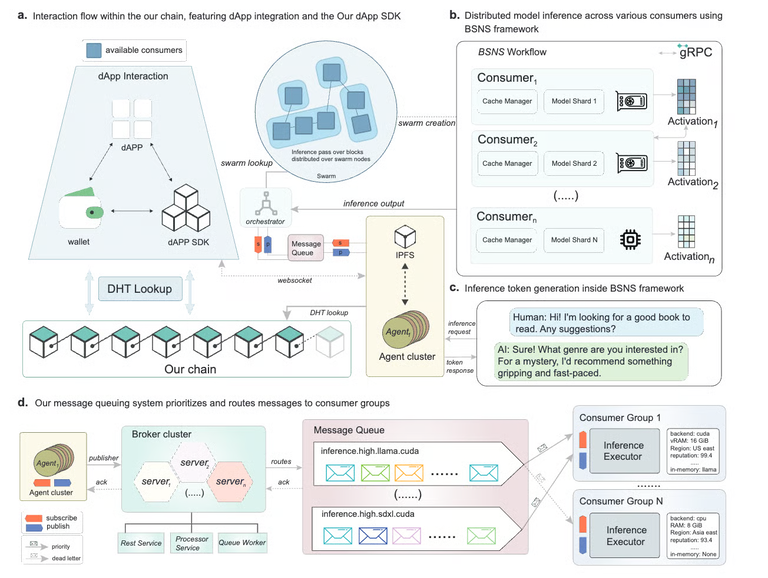
During execution, Nesa employs hardware trusted execution environments (TEE) and zero-knowledge machine learning (ZKML) technologies to ensure that the computation results can be verified cryptographically without revealing the underlying data. The network also incorporates dynamic scheduling mechanisms like MetaInf, which automatically selects the optimal execution strategy based on task types and hardware configurations, further enhancing efficiency and adaptability. The entire process is transparent for developers; users only need to submit requests via compatible interfaces to receive verifiable output results.
From the user's perspective, this is akin to transforming traditional "black box" cloud inference into auditable distributed collaboration: inputs are encrypted for protection, computations are executed in shards, and results come with a proof chain. Node operators contribute computing power by running models, earning corresponding incentives. This design reduces the trust dependence on centralized platforms while allowing ordinary hardware participants to join the network.
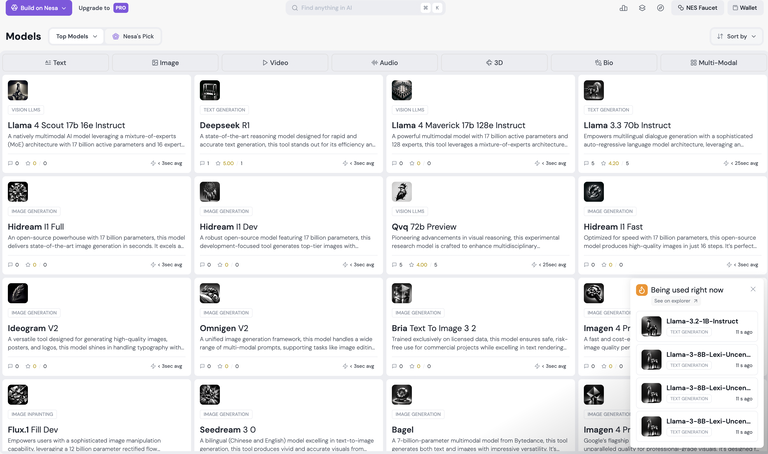
The network currently supports a wide range of open-source and proprietary models, including text classification, sentiment analysis, summarization, image generation, translation, and more. Testnet data shows that the inference request processing speed is fast, with average response times kept within a reasonable range. The project also offers model upload and Playground tools, enabling developers to deploy or test models directly without managing hosting and scaling themselves.
Practical Use Cases, Competitive Landscape, and Token Economics
The practical application scenarios of Nesa are concentrated in areas with high demands for privacy and verifiability. Decentralized AI applications can run natively on the network, achieving transparent and verifiable AI functions while establishing credibility through staking mechanisms. In enterprise scenarios, it is suitable for processing sensitive data or tasks with strict compliance requirements, such as medical-assisted diagnosis, financial risk control models, or legal document analysis, without exposing data to external service providers.
Ordinary developers can also contribute or call models through the model marketplace, earning incentives. Model owners can receive rewards through the network, while node operators benefit from providing computing power. This incentive structure shifts AI development from "centralized hosting" to "community co-construction."
In terms of competitors, decentralized computing networks like io.net focus on GPU resource aggregation, providing a more general computing power market; projects like Render Network focus on rendering and graphics computing; Akash emphasizes general-purpose cloud alternatives. Nesa's differentiation lies in its focus on the privacy and verifiability of AI inference, adopting a Layer-1 architecture to achieve on-chain coordination and verification, and reducing participation costs through model sharding and low-threshold node design. It resembles a "verifiable execution dedicated chain" in the AI field rather than a general computing power platform.
The token NES is the core economic vehicle of the network. As a gas token, it is used to pay for all on-chain transactions, including AI inference queries. Users can pay inference fees in stablecoins, and the system automatically converts them to NES for settlement. NES also serves as a staking token, supporting miners, validators, and staking for AI inference tasks. A portion of the fees will be allocated to miners, validators, and model owners, forming a closed-loop incentive.
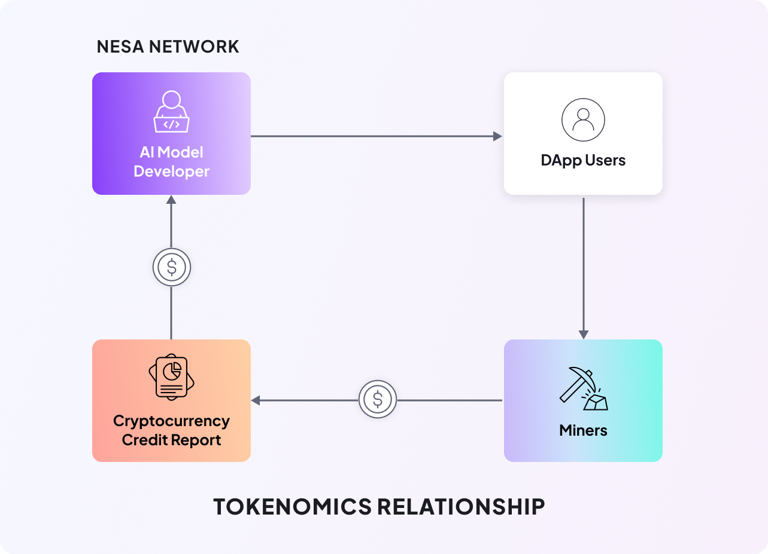
The network adopts an inflation model: the total supply for the genesis block is set at a specific large-scale figure, with an inflation rate of 80% in the first year, decreasing by 80% each subsequent year until stabilizing at a floor level of 1.8% annually after 20 years. The reward distribution mechanism ensures that genuine contributors receive NES, model developers profit from model usage, and node operators are rewarded for providing reliable computing power. This design avoids excessive early subsidies and emphasizes demand-driven actual needs.
Team Background and Risk Logic
The Nesa team boasts a strong background at the intersection of AI and blockchain. CEO Patrick Colangelo is an expert in technology scaling, a Harvard University graduate with extensive experience in software and hardware development. Co-founder Gerry Che holds a PhD in AI, having worked at Nvidia AI Research and Google Brain; Harry Yang previously worked at Facebook AI, participating in projects like Make-a-Video. The team has published over 200 papers related to AI and deep learning, covering fields like generative AI, large language models, and computer vision.
The project received recognition from platforms like Binance Labs in its early stages and established partnerships with computing power providers like io.net to rapidly expand GPU support. The team emphasizes open source and community co-construction, having launched a testnet and miner program that attracts early participants to contribute nodes and accumulate points. Harry Yang stated in an interview: "The more you invest and learn, the more you like it, because the concept of decentralized platforms aligns closely with my vision for the future of artificial intelligence." He also emphasized that decentralization enables everyone to do what they want, rather than relying solely on giants like Meta, OpenAI, or Google.
In terms of risks, Nesa is still in its early developmental stage, and network adoption, model richness, and actual inference demands remain to be verified. The decentralized AI sector is highly competitive, with rapid technological iterations, and the balance between privacy and performance requires continuous optimization. From a regulatory perspective, AI computation involves cross-border data and compliance issues, with potential uncertainties arising from future policy changes. Furthermore, node incentives depend on real transaction volumes; if demand growth falls short of expectations, early participant returns may fluctuate.
Overall, Nesa repurposes AI execution from centralized black boxes to a verifiable distributed network through its Layer-1 architecture, providing new choices for privacy-sensitive scenarios. With the launch of Binance Alpha and the gradual maturation of its ecosystem, its positioning in decentralized AI infrastructure will become clearer.
Conclusion
Nesa, as a lightweight AI Layer-1 focused on privacy and verifiability, is accelerating its deployment with platforms like Binance Alpha. It not only lowers the barrier to entry for AI inference but also provides a monetization pathway for idle computing power. In the trend of deep integration between AI and blockchain, this model offers a reference example for the industry’s execution layer. Developers, node operators, and model contributors can pay attention to its subsequent mainnet progress and ecosystem applications.
Reference Links
- Nesa official website and token page
- Nesa documentation
- Binance-related announcements and event information (Alpha launch, Booster event)
- Team and partnership public information (collaboration with io.net, etc.)
免责声明:本文章仅代表作者个人观点,不代表本平台的立场和观点。本文章仅供信息分享,不构成对任何人的任何投资建议。用户与作者之间的任何争议,与本平台无关。如网页中刊载的文章或图片涉及侵权,请提供相关的权利证明和身份证明发送邮件到support@aicoin.com,本平台相关工作人员将会进行核查。


