Original | Odaily Planet Daily (@OdailyChina)
Author|jk
Bitcoin today once again broke through the key psychological support of 60,000 USD, dropping to 59,023 USD, hitting the lowest point since October 2024, a nearly 20-month low. As of the time of writing, BTC has slightly rebounded from its low, priced around 60,600 USD, with a 24-hour decline narrowing to about 3%, and a cumulative drop of approximately 9% over the past seven days.
This drop is the third time Bitcoin has fallen below the 60,000 USD mark this year. Unlike the previous two times, this round of decline occurs against a backdrop of continuous institutional withdrawal of funds and a sharp turnaround in macro policy expectations, causing a systemic impact on market confidence.
What is the reason?
Reason One: Spot ETF Experiences the Longest Net Outflow in History
The U.S. Bitcoin spot ETF has become the core driver of this downturn. Since mid-May, the ETF has recorded net outflows for six consecutive weeks, losing about 5.94 billion USD in total over 30 days, marking the largest wave of institutional withdrawals since its launch in January 2024.
Among them, BlackRock's IBIT saw a single-day net outflow of 528 million USD on May 28, setting the record for the highest single-day outflow since its inception. The total assets of Bitcoin ETFs have dropped from about 113 billion USD at the beginning of the year to about 77.5 billion USD, evaporating more than one-third. Notably, according to data from The Block, on June 23, the ETF still recorded a net outflow of about 113.8 million USD, and the momentum of institutional withdrawals has not shown a substantial reversal. Whether the selling pressure from institutions will ease afterward will be an important observation window for the market.
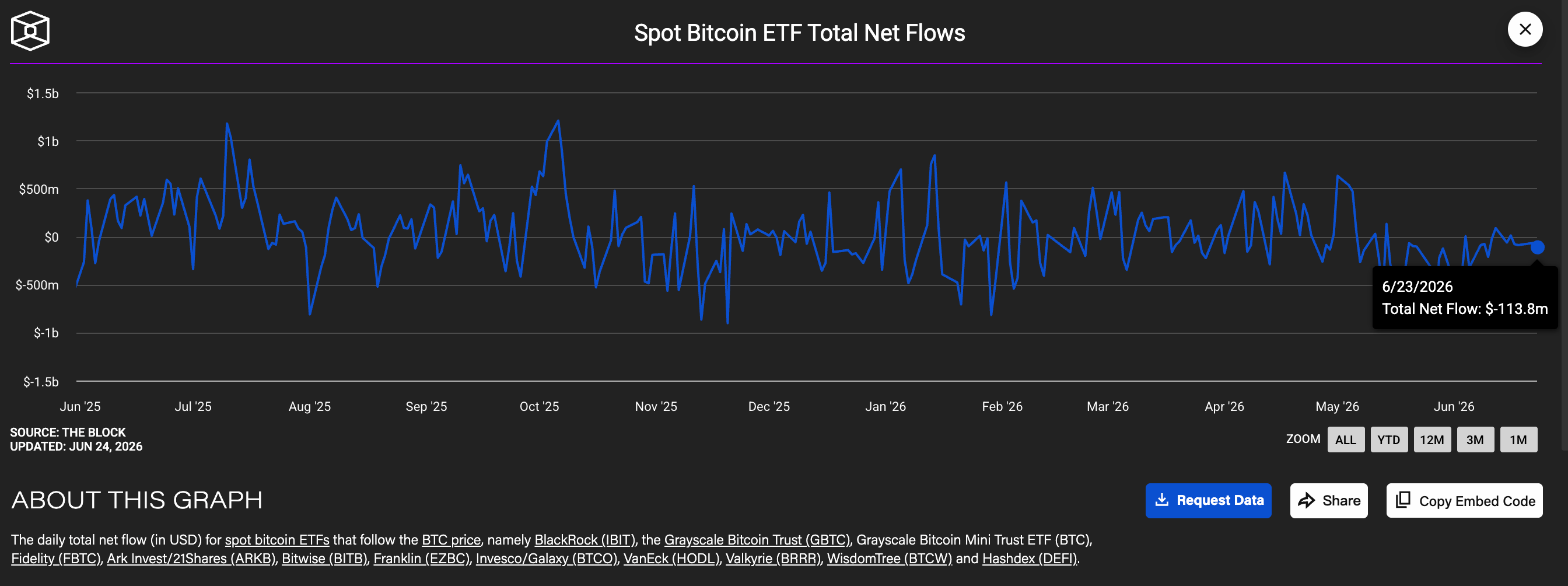
ETF net outflow, Source: The Block
The problem with the ETF is cyclical: when institutions redeem shares, authorized participants must directly sell the corresponding Bitcoin on the secondary market, creating continuous spot selling pressure. CoinShares characterizes the current situation as an "emotional shock," believing this is not a structural collapse of the crypto market's fundamentals.
Reason Two: Fed Rate Hike Expectations Resurrect, Macro Pressure Intensifies
Macroeconomically, there is also an undeniable pressure on Bitcoin. The number of job openings in the U.S. rose to 7.62 million in April, far exceeding market expectations, reaching the highest level in nearly two years, directly pushing the 10-year U.S. Treasury yield back above 4.45%.
Subsequently, Cleveland Fed Chair Beth Hammack publicly stated that if inflation remains high, the Fed may need to resume rate hikes. CME FedWatch data shows that the market's pricing probability for a rate hike before the end of the year has risen to over 50%.
Conversely, the strong bull market forecast for 2025 is built on expectations of "Fed rate cuts." Once the expectations for rate cuts reverse and actual interest rates rise, institutional funds tend to shift towards low-risk assets like bonds and cash, with Bitcoin, as a high-risk asset, being the first to bear the brunt.
What do different analysts think?
- 21Shares: In the latest "Crypto Market Status" report, 21Shares pointed out that the current downturn closely aligns with historical correction cycles following halving events. Although there were expectations at the beginning of the year that Bitcoin's four-year cycle might end, the current price movement suggests that the cycle remains intact. The institution maintains its expectation that prices will rebound to 100,000 USD before the end of the year, believing that the significant base support from cumulative net inflows of about 53 billion USD will form effective bottom support.
- Arthur Hayes: Holds a more pessimistic view of the market and expects Bitcoin to bottom out at 40,000 USD within the next six months, with the core logic being that the Fed's hawkish stance will continually suppress market liquidity. Hayes stated that while he maintains a long position, he has hedged downside risks through options.
- CryptoQuant: Citing on-chain data, it indicates that the average holding cost for current investors is about 53,000 USD, and historically, bear markets usually reach bottom after prices fall below the "realized price." Institutions believe that this bear market may continue until the end of 2026 or even early 2027, with no clear signs of sustained demand recovery yet.
In the short term, the market's focus will be on the upcoming U.S. inflation data and the Fed's next policy signals. If the CPI data is lower than expected, it may provide a breathing window for Bitcoin; if it further confirms persistent inflation, the pressure for further declines will continue to accumulate. Before extreme panic sentiment dissipates and ETF fund flows show a clear turning point, whether Bitcoin can hold the critical defense line of 60,000 USD may determine the next direction of this bear market.
免责声明:本文章仅代表作者个人观点,不代表本平台的立场和观点。本文章仅供信息分享,不构成对任何人的任何投资建议。用户与作者之间的任何争议,与本平台无关。如网页中刊载的文章或图片涉及侵权,请提供相关的权利证明和身份证明发送邮件到support@aicoin.com,本平台相关工作人员将会进行核查。