Author: CryptoSlate
Translation: Deep Tide TechFlow
Deep Tide Introduction: This is not just a simple support level breakdown. When 7,600 bitcoins flowed into Binance, the ETF experienced net redemptions, and whales closed 800 long positions, the dip-buying funds had not yet entered the market. For investors, the key is not whether $60,000 can be reclaimed, but whether the inflow to exchanges can slow down, whether the ETF can stop the bleeding, and whether the liquidation pressure can ease.
On June 24, Bitcoin dropped below $60,000, exposing the market's timing issue: sellable coins are concentrating on exchanges, ETF demand is weakening, and leveraged traders are cutting back on risks.
CryptoSlate market data shows Bitcoin is currently priced at $59,340, down 4.05% in 24 hours and down 9.03% over the past week.
This price level has caused BTC to break below one of the most prominent support areas in the market, and at this time, selling pressure is becoming easier to track.
The clearest signal comes from CryptoQuant, which marked approximately 7,600 BTC flowing into Binance, intensifying panic selling. At the current market price, this represents approximately $479 million of potential selling pressure.
"Potential" is the key qualifier. The inflow to exchanges shows that the sellable supply is moving to places that can pressure prices, while the $60,000 area is already under strain.
This is the key difference between simple price fluctuations and a breakdown in market structure. When Bitcoin falls, new supply becomes easier to access, while some traditional buyers in the market seem to weaken.
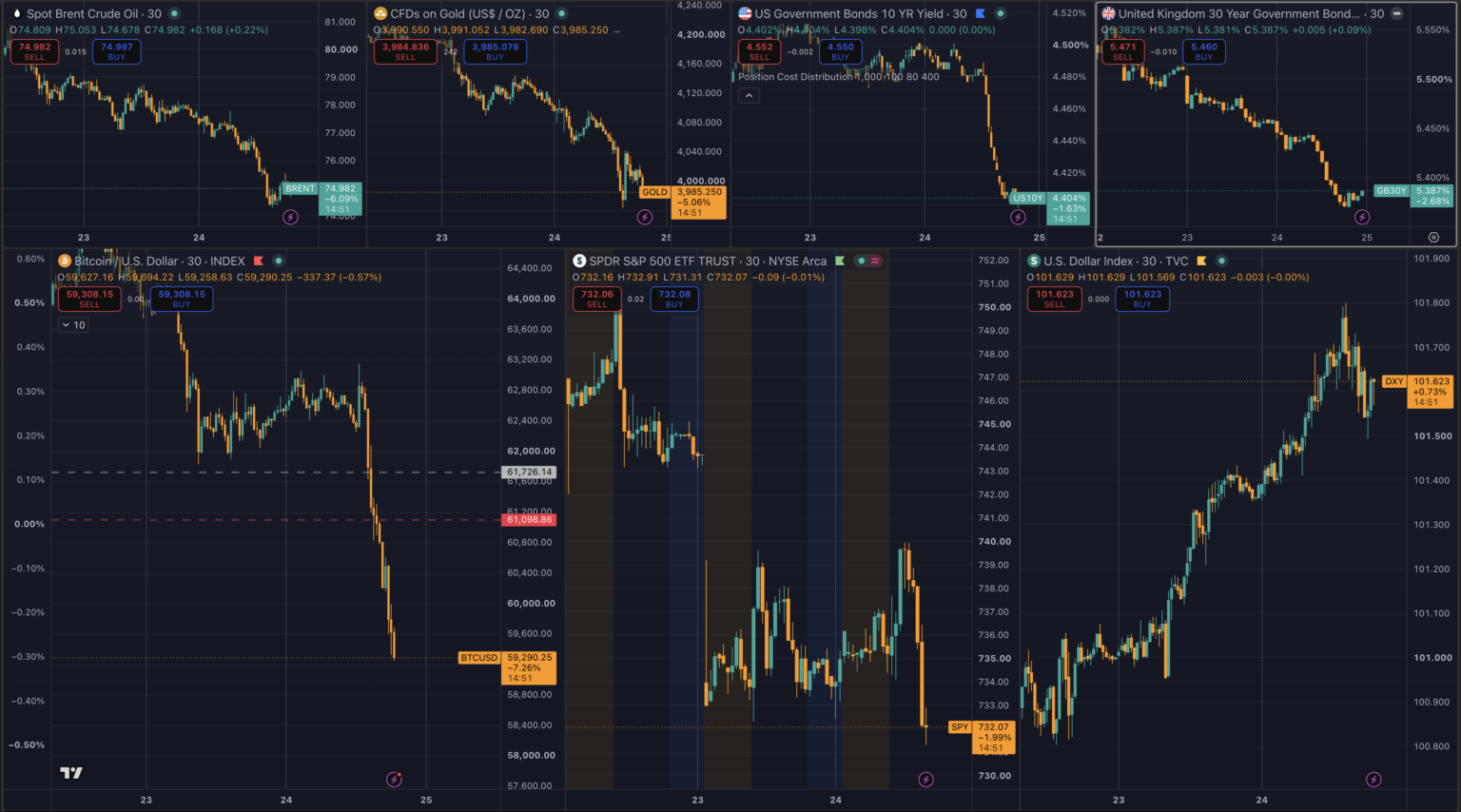
Selling pressure arrived first
When the inflow to exchanges reaches a crowded position, it becomes more significant. The force of 7,600 BTC flowing into Binance is amplified because other pressures have already accumulated around the support level.
Another report from CryptoQuant on the deteriorating market background notes that the market conditions around this trend are weakening, reinforcing the view that the breakthrough is driven by a series of stacked pressures rather than a single clear catalyst.
When Bitcoin hovers around a prominent position like $60,000, traders do not need a single event to trigger a sell-off. What they need is a reason to doubt whether buyers can continue to absorb the supply.
This doubt is clearly visible in the flow of funds. Lookonchain reports that on June 24, Bitcoin spot ETFs experienced negative net inflows, with a net outflow of 2,548 BTC in one day and a net outflow of 6,728 BTC in seven days.
However, ETF fund flows only represent one channel of demand, but it has become one of the clearest public indicators of whether institutional demand is adding support or withdrawing support.
When these fund flows are negative while inflows to exchanges rise, the market receives two signals: there may be more coins available for sale, and one of the most monitored demand channels appears weaker.
ETF outflows are part of the breakthrough, not the sole reason, but they help explain why once $60,000 is lost, the decline accelerates.
The price background exacerbated the pressure. Broader crypto market and Bitcoin data from CryptoSlate show that BTC still maintains market dominance, but the drop over the last seven days is significant.
In this environment, dip-buying has to counteract both spot supply and deteriorating confidence. The same combination also makes each new fund flow update more important, as traders observe whether there is enough buying power in the market to convert a breakthrough into a reset.
This is the direct answer to why the breakthrough accelerated: when new sellable supply emerges, the open demand channels in the market are weakening. This trend turns familiar support tests into accumulation tests, forcing traders to judge whether buyers are entering, whether support has stopped functioning, and whether leverage will increase a new round of selling below that line.
Leverage makes breakthroughs faster
The second layer is leverage. Lookonchain reports that a whale closed out 800 BTC long positions after Bitcoin fell below $61,000.
A large long position closing only shows a single case of actively reducing risk, but timing remains crucial. It occurred before the $60,000 line stabilized completely.
When it comes to leveraged positions, this dynamic changes how support loss occurs. Spot sell-offs can push the price down to a certain level.
Leverage can make the next segment of decline faster because traders expecting a rebound are forced to reduce exposure or exit when that level is lost. This is where the liquidation dashboard becomes part of the story rather than an aside.
CoinGlass data shows Bitcoin liquidation pressure, with BTC long liquidation alerts repeatedly emerging around $59,650 to $59,670 as prices trade below $60,000, consistent with the trend pattern. As prices breach support, long positions are being cleared near new lower ranges.
Therefore, this breakthrough should avoid a bearish predictive framework. Evidence allows for a rebound, but also shows that the market's ability to absorb sell-offs precisely weakened as more sellable supply and forced risk reductions became visible.
This makes the liquidation sequence a marker for pressure in the support zone, rather than an independent prediction of the next segment of the trend.
This distinction changes what traders should focus on next. If the breakthrough is mainly panic selling to stronger hands, the market should soon begin to show signs of recovery: less inflow to exchanges, calmer liquidation alerts, and ETF fund flows that cease the bleeding.
If these signals do not appear, the same evidence points to a different conclusion: $60,000 is not a redistribution of chips, but a failure of support.
This sequence also keeps the focus on market pipelines rather than just sentiment.
The next signal is buying power
If a rapid rebound exceeds $60,000 without calmer fund flows below, the rebound is incomplete. A more critical question is whether the market can absorb the supply without relying on forced buying or temporary short squeezes.
To improve the situation for chip redistribution, the inflow to Binance needs to slow down after the 7,600 BTC inflow. ETF fund flows need to stabilize after reported outflows of 1 day and 7 days.
Long liquidation pressure needs to cool down rather than shift to a lower range. If the recovery of $60,000 is accompanied by calmer position signs, it will carry more weight.
If the opposite occurs, the failure of support will be exacerbated. Continued inflow to exchanges will indicate sellers are still preparing to take advantage of deep liquidity.
More ETF redemptions will mean weaker demand from institutional investors. Further long liquidations below the $59,650 level will indicate that the market is still clearing leveraged exposure rather than rebuilding spot demand. Bitcoin is currently testing this exact area.
Strategy and MSTR anxieties also play a role in the background, as confidence among large Bitcoin holders affects market psychology. However, at the time of writing, there is no direct evidence of BTC sell-off.
The market points elsewhere: sellable coins are moving to Binance, ETF fund flows are negative, a whale closed a long position below $61,000, and liquidation pressure appeared as BTC traded below $60,000.
This makes the $60,000 breakthrough more like a test of buying power rather than just a simple support loss. If buyers step in during calmer fund flows, Bitcoin can still turn panic selling into chip redistribution.
If they fail to do so, the breakthrough has already shown where the weakness lies: new selling arrived in the market before dip-buyers exhibited enough strength to catch it.
Bitcoin has fallen 2.55% in the past 24 hours and currently ranks first by market capitalization.
The current state of the broader market
Currently, the total cryptocurrency market capitalization is $2.1 trillion, with a 24-hour trading volume of $92.3 billion. Bitcoin's dominance is 58.24%.
免责声明:本文章仅代表作者个人观点,不代表本平台的立场和观点。本文章仅供信息分享,不构成对任何人的任何投资建议。用户与作者之间的任何争议,与本平台无关。如网页中刊载的文章或图片涉及侵权,请提供相关的权利证明和身份证明发送邮件到support@aicoin.com,本平台相关工作人员将会进行核查。


