MiCA license rules are one country licensed, valid across Europe.
Written by: Ma He, Foresight News
On June 24, Binance announced the withdrawal of its license application for the "Regulation on Markets in Crypto-assets" (MiCA) submitted to the Hellenic Capital Market Commission, stating that it would turn to other EU member states to continue the licensing process. This decision comes at a critical window as the EU's MiCA regulatory transition period is set to end on July 1.
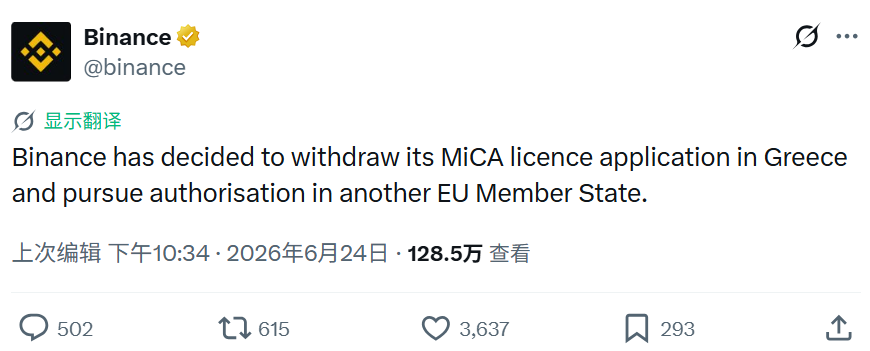
Furthermore, Binance stated that it would obtain relevant licenses in new member countries within the coming months, but specific countries will be announced "when ready." User assets remain secure and accessible at all times, though some users may be affected based on their country and account status. The company will directly inform the relevant users of subsequent steps and available options.
License Games
MiCA is an important regulation for the unified oversight of crypto assets in the EU, covering core areas such as authorization of crypto asset service providers (CASP), issuance and trading of stablecoins, and investor protection. One of its core mechanisms is "passporting," meaning a license from one country is valid across Europe without the need for duplicate applications.
To ensure a smooth transition, MiCA established an 18-month transition period, allowing unlicensed platforms to continue servicing EU users under certain conditions. This transition period will officially end on July 1, 2026, and ESMA has clearly stated that it will not be extended. After that, unlicensed platforms under MiCA that continue to service EU users will face compliance risks and potential penalties.
Binance's journey with the MiCA application began in January 2026. At that time, Binance submitted a comprehensive application to the HCMC through its Greek subsidiary. The choice of Greece was partly due to its relatively friendly business environment and potential contributions to taxes and employment, and also reflected Binance's strategic intention to achieve EU-wide coverage through authorization from a single member state.
On June 16 of this year, Reuters cited sources saying that Greek regulators were inclined to reject Binance's application, which would result in Binance losing its permission to continue servicing EU customers. The report indicated that the review by the HCMC was nearing completion, but the final outcome might not be favorable to Binance.
Binance responded that it had engaged in 18 months of constructive communication with regulators, stating that the HCMC had completed its review of the application and deemed it compliant with MiCA requirements. The application also underwent scrutiny at the ESMA level. Binance emphasized that it had invested over 1,500 compliance professionals over the past two years, establishing a comprehensive compliance system, and had obtained full licenses under other jurisdictions, such as in the UAE's ADGM, preventing nearly $7 billion in potential fraud losses.
Just a week later, Binance officially announced the withdrawal of its Greek application. As of now, Binance is not listed in ESMA's temporary register of MiCA authorized providers.
Currently, around 200 crypto asset service providers in Europe have obtained formal CASP authorization.
End of Regulatory Arbitrage?
On June 24, OKX founder Star Xu commented in a Twitter post that strict and uniform regulation is not an obstacle to industry development, but a key to strengthening long-term health—it will end the "arbitrage" model that relied on differences in rules across various jurisdictions, promoting the industry's transition to compliance and transparency. Moreover, in the MiCA era, a company's true moat comes from solid compliance capabilities, capital reserves, and technical risk control, rather than regulatory gaps or gray areas.

In January 2025, OKX Europe Limited obtained full MiCA CASP authorization from the Malta Financial Services Authority, becoming one of the first exchanges globally to initiate the passporting mechanism covering all EEA member states.
OKX's statement has been interpreted by the market as a response to unlicensed platforms like Binance: the regulatory "bonus period" has ended, and the European crypto market will accelerate its reshuffling, with licensed platforms (such as OKX, Coinbase, etc.) likely to gain more user migrations and market share.
MiCA may not only be a regulatory upgrade but also a sign of industry maturity.
Binance's current license scope and European strategy: from transitional operation to single authorization strategy
Before the full implementation of MiCA, Binance mainly served users in the EU through local registrations, VASP registration, or transition period arrangements, having operated in countries like France and Germany, but also faced varying degrees of local regulatory restrictions (such as some countries having requested the cessation of derivatives services, etc.). Binance has not obtained unified MiCA CASP authorization covering the entire EU, thus is highly reliant on transition period provisions.
In addition to attempts in Europe, Binance has established solid layouts in other jurisdictions globally: it has obtained multiple licenses under a comprehensive regulatory framework in the UAE's ADGM.
The core of Binance's European strategy has always been "single authorization, passport throughout the region"—to achieve approval through one member state and operate in 27 countries + EEA.
Binance holds a certain market share in the European crypto market, and its licensing progress directly affects market liquidity, user choices, and competitive landscape. This withdrawal, while a tactical adjustment rather than a strategic exit, highlights the real challenges faced even by industry leaders under the new regulatory framework—the balance between past enforcement records, approval timelines, and regulatory independence.
In the long run, MiCA will provide European users with stronger legal protections, more transparent products, and a fairer competitive environment.
For the industry, platforms that have obtained MiCA authorization will gain a first-mover advantage, while giants like Binance, with their resources and determination, may still manage to establish their presence in other jurisdictions.
免责声明:本文章仅代表作者个人观点,不代表本平台的立场和观点。本文章仅供信息分享,不构成对任何人的任何投资建议。用户与作者之间的任何争议,与本平台无关。如网页中刊载的文章或图片涉及侵权,请提供相关的权利证明和身份证明发送邮件到support@aicoin.com,本平台相关工作人员将会进行核查。


