Original Author: Rita
Introduction
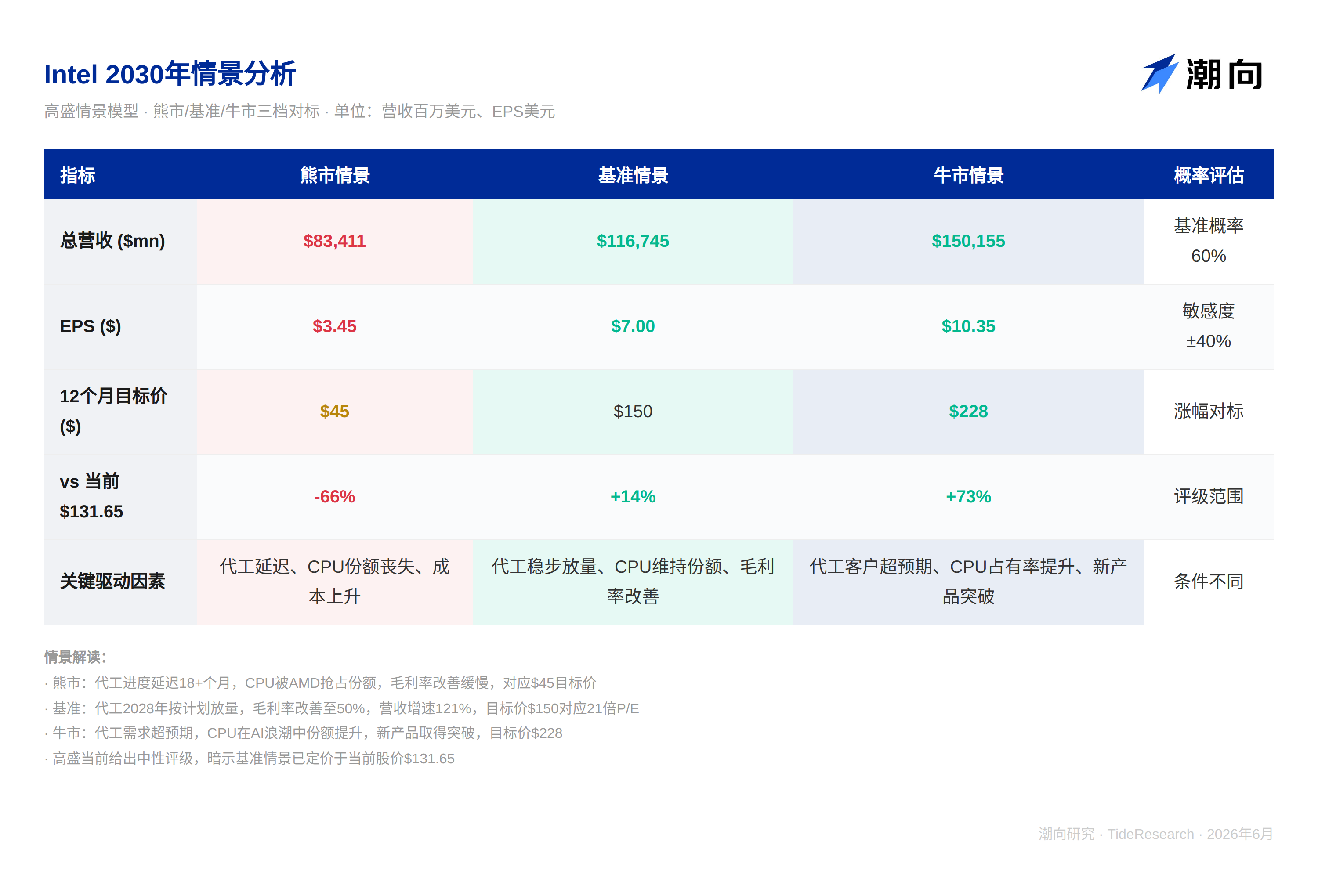
Goldman Sachs has released its first coverage report on Intel, giving it a neutral rating and a 12-month target price of $150 (an increase of 13.9% from the benchmark stock price of $131.65). Behind this seemingly contradictory judgment is a clear investment logic: the foundry and server CPUs are indeed growth highlights, but these opportunities have long been priced in by the market. In contrast, AMD, Nvidia, and Broadcom offer better options in terms of visibility and valuation.
A "Neutral" Rating with Contradictions
The decision to give a neutral rather than a buy rating is itself interesting. Goldman Sachs has not stated that Intel is failing, but has instead pointed out two genuine positives.
The first is the foundry business. Intel is advancing its external wafer business in advanced packaging (especially EMIB technology), and Goldman Sachs expects this revenue could reach $11 billion by 2030 (base case), growing from zero to the billion-dollar level. This growth is based on confirmed customer orders, not a fictitious growth story.
The second is server CPUs. Driven by Agentic AI, demand for server computing power from enterprises will continue to grow. With its x86 architecture’s stickiness in the enterprise market and sunk costs, Intel is expected to maintain a 28% compound annual growth rate through 2030. This means Intel’s revenue expectations for server CPUs are on an upward trend, rather than being squeezed.
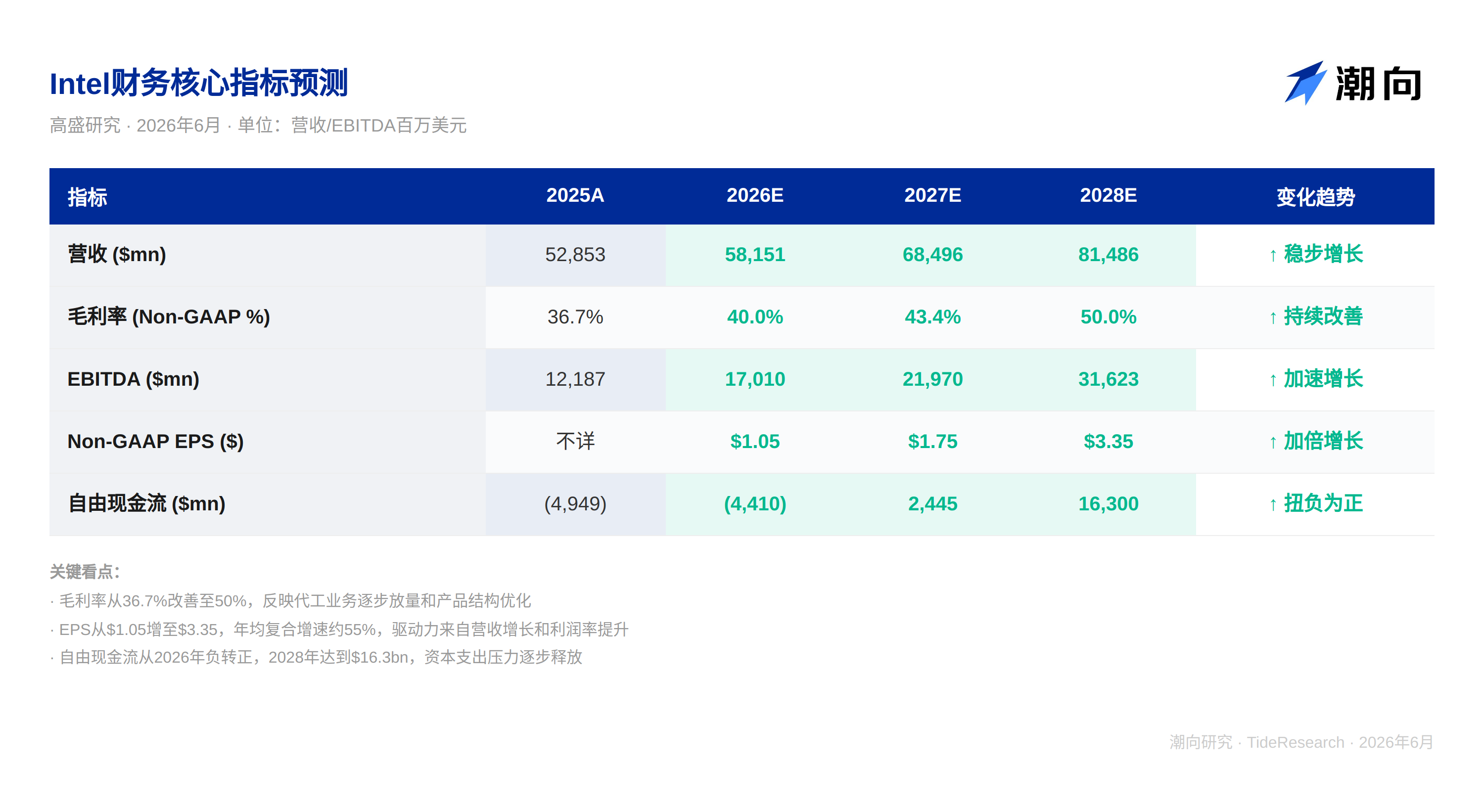
However, because both of these stories are true, they have already been priced into the market. Intel's current stock price reflects these expectations. Based on 2030's profitability, a target price of $150, given a valuation multiple of 21 times earnings, suggests Goldman Sachs believes there is not much upside from current buying levels. Additionally, AMD, Nvidia, and Broadcom have performed better in terms of supply chain certainty and valuation appeal. This is the core reason why Goldman Sachs provided a neutral rating rather than a buy.
The Foundry Business is a Billion-dollar Gamble
Intel's foundry story is clear, but the focus is not solely on scale, but on costs and competitiveness.
Advanced packaging costs are far lower than wafer foundry. EMIB (Embedded Multi-die Interconnect Bridge) technology allows Intel to perform chip integration for customers without building new wafer fabs. This is good news for customers (lower costs, faster cycles), and also good news for Intel (lower capital expenditures, higher gross margins). Goldman Sachs estimates that the gross margin for this business could be over 50%, far exceeding the 20-30% of traditional wafer foundries.
The time window for external wafer business will open around 2028. Although Intel's 7-nanometer and below processes are lagging behind TSMC, many customers are willing to pay more to diversify supply chain risks given the geopolitical context in Europe and America. Goldman Sachs predicts that revenue from this business could reach $11 billion by 2030, meaning Intel's gross margin contribution from this segment could significantly enhance overall profitability.
But this story comes with time costs. Profit growth in 2027 and 2028 will mainly come from its core business (CPU and GPU). The foundry business will not see a significant ramp-up until after 2028. Therefore, if you expect Intel to perform remarkably over the next 12 months, the foundry story won't help you. This is also why Goldman Sachs is not optimistic about Intel's current stock price.
Server CPU Growth at 28%, but Peers are Faster
Server CPUs are Intel's traditional stronghold, and the rise of Agentic AI has rejuvenated this business segment.
The difference between Agentic AI and traditional large language model inference lies in its need for frequent multi-turn interactions and real-time responses, requiring higher CPU and memory performance. This means enterprises cannot just pile up GPUs; they also need efficient CPUs. Intel has two advantages here: one is the completeness of the x86 architecture ecosystem, and the other is the purchasing habits and supply chain dependence of enterprise customers on Intel.
Goldman Sachs predicts that Intel's server CPU will see a compound annual growth rate of 28% by 2030. This sounds good, but is actually quite average in the AI chip cycle. Nvidia's data center segment is growing at a rate far above this (with a year-on-year growth close to 200% in 2024), and Broadcom and AMD are also generally growing faster in specific segments.
The key issue is that Intel's growth starts from an already large base. The CPU business is now Intel’s primary source of revenue, with growth potential limited by the overall expansion rate of the server market. Meanwhile, the growth ceilings for GPUs and other AI-related chips are much higher. Therefore, from a relative return perspective, investing in GPU and network chip manufacturers may offer higher returns.
Why Peers are More Favored by Goldman Sachs
Among other tech chip companies covered by Goldman Sachs, AMD, Nvidia, and Broadcom have all received buy ratings. Why is Intel excluded?
The core lies in visibility and valuation alignment. Nvidia’s data center demand has almost no decline risk, and there is significant growth potential through 2030. AMD has more aggressive product roadmaps for both CPUs and GPUs than Intel. Broadcom is positioned as a major growth driver in the network chip space for large data centers. These companies have higher growth expectations and lower risks.
At the same time, while Intel's foundry story is appealing, the commercialization verification period is longer. Visible orders will start from 2027, with tangible contributions to scale only realized by 2030. Meanwhile, the demand curve for GPU chip manufacturers has already been validated, and the discussion is merely about the magnitude of growth.
From a valuation perspective, Intel’s expected P/E ratio in 2028 is 21 times, while Nvidia and Broadcom have higher multiples but also higher growth rates. For investors seeking high certainty in growth, higher growth with higher multiples may actually be more cost-effective than lower growth with lower multiples.
The Judgment Behind Goldman Sachs's Neutral Rating
Goldman Sachs's neutral rating actually suggests a judgment: Intel will neither fall nor soar. In the medium term, Intel will be constrained by strong performance in consumer chips and the appeal of the AI chip cycle. However, in the long term (3-5 years), the profit contributions from foundry and server CPUs will gradually become evident, and the target price of $150 will be verified.
The upside risk for this judgment lies in the unexpected attractiveness of foundry business clients, or better-than-expected protection of server CPU market share during the Agentic AI wave. The downside risk lies in delays in mass production of advanced foundry processes, or Intel losing CPU market share to AMD more quickly.
Catalysts include: confirmation of foundry orders each quarter, the market performance of the next generation Xeon, and the realization of improved gross margins. However, these catalysts are not immediate. Therefore, for investors needing quick returns, Intel may not be the optimal choice.
Conclusion
Goldman Sachs's logic is clear: Intel has a story, and that story is valid, but the value of the story has already been priced in. In an era where peers offer higher growth and better certainty, Intel, which seeks stable growth, has naturally been pushed to the watchlist rather than the buy list.
免责声明:本文章仅代表作者个人观点,不代表本平台的立场和观点。本文章仅供信息分享,不构成对任何人的任何投资建议。用户与作者之间的任何争议,与本平台无关。如网页中刊载的文章或图片涉及侵权,请提供相关的权利证明和身份证明发送邮件到support@aicoin.com,本平台相关工作人员将会进行核查。


