Original author: Sleepy
In August 2024, Google spent $2.7 billion to bring Noam Shazeer back from Character.AI, which he founded himself.
Shazeer was a core author of the 2017 paper "Attention Is All You Need," a co-inventor of the Transformer architecture, and without his paper, there would be no GPT, no Claude, no Gemini, and no entire AI industry today.
He joined Google in 2000 as one of the earliest employees, staying for over twenty years, but left in 2021 to start his own company because Google refused to release his chatbot Meena.
Google spent a lot of money to bring him back, giving him the title of Vice President of Engineering, hoping he could help Google win the AI battle.
Less than two years later, he left. He went to OpenAI.
According to Bloomberg, shortly before Shazeer announced his departure, the computing resources for one of his projects were reassigned internally by Google to the DeepMind team. Insiders said this adjustment was made to promote team collaboration and integrate pre-training work.
Nobel Laureate's Farewell
Shazeer left on June 18. The next day, John Jumper also left.
Jumper's story is different from Shazeer's. Shazeer is a veteran who has seen all the good and bad of the company over more than twenty years at Google. But Jumper was raised in this place.
Just six months after he graduated with his PhD, Hassabis made a bold decision to have this inexperienced young man lead the entire protein structure prediction project.
Jumper did not disappoint. He led the team to create AlphaFold, predicting the three-dimensional structures of over 200 million proteins, pushing the progress of structural biology research forward by a decade. In 2024, he stood in Stockholm alongside Hassabis to receive the Nobel Prize in Chemistry.
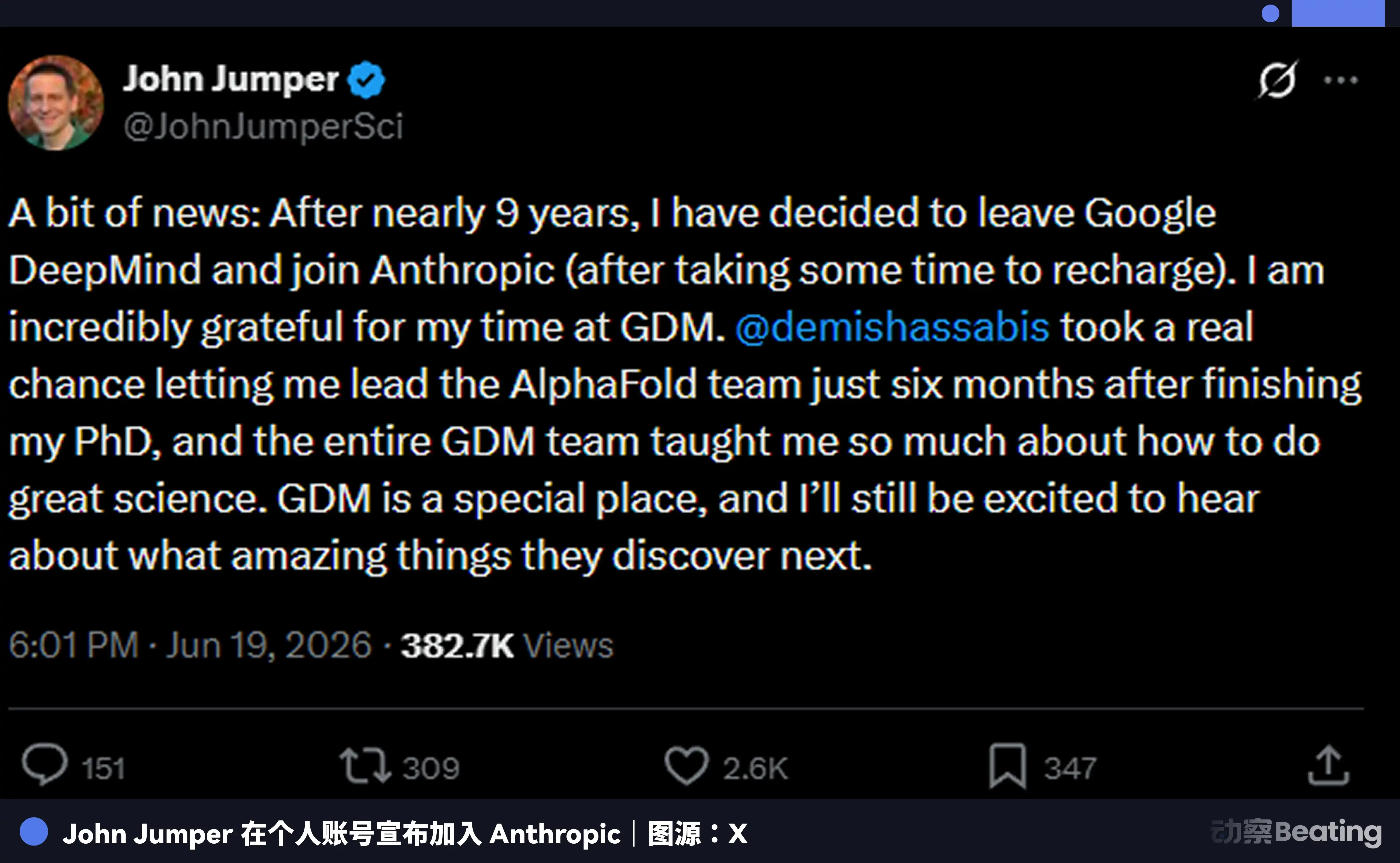
The first half of this story is about trust and fulfillment. Hassabis trusted a young man, and the young man repaid him for nine years, benefitting all of humanity's biology. But there is a second half to the story; two years after winning the Nobel Prize, on June 19, 2026, Jumper tweeted a brief message announcing his departure for Anthropic.
By the time trading opened on Monday, Alphabet's stock plummeted. It dropped about 7% during the day, closing down about 5%, with a market value evaporation of approximately $225 billion, losing the equivalent of a Spotify. Alphabet's stock had been declining since reaching a historical high in early 2026, and the pressure from antitrust lawsuits, exorbitant capital expenditures, and anxiety over AI competition had been building for several months. These two announcements of departures were the last straw.
In the following days, more news followed. Jonas Adler and Alexander Pritzel also planned to leave for Anthropic. These two were core contributors to Gemini and had been collaborators with Jumper on AlphaFold. Adding to this, AI safety researcher Arthur Conmy, who left even earlier, led to at least five top researchers leaving Google within a month, four of whom went to Anthropic.
Hassabis raised Jumper from a young recruit, and now watched him walk through the competitor's door with half of the AlphaFold team. I don't know what he saw below Jumper's tweet, but I guess it was a familiar sense of fate.
Nurturing Ground
Every generation's best tech companies eventually become the nurturing ground for the next generation.
Google itself grew this way.
Many of its earliest engineers came from Microsoft, IBM, Yahoo, and Bell Labs. In the 2000s, when Microsoft was severely weakened by antitrust suits, a massive influx of top talent flowed to Mountain View, including the young Shazeer.
Further back, Bell Labs invented the transistor, Unix, and the C language, essentially laying the foundation for the entire information age. But what happened to Bell Labs itself? Its people scattered to every corner of Silicon Valley, becoming part of other founding teams.
Now it's Google's turn.
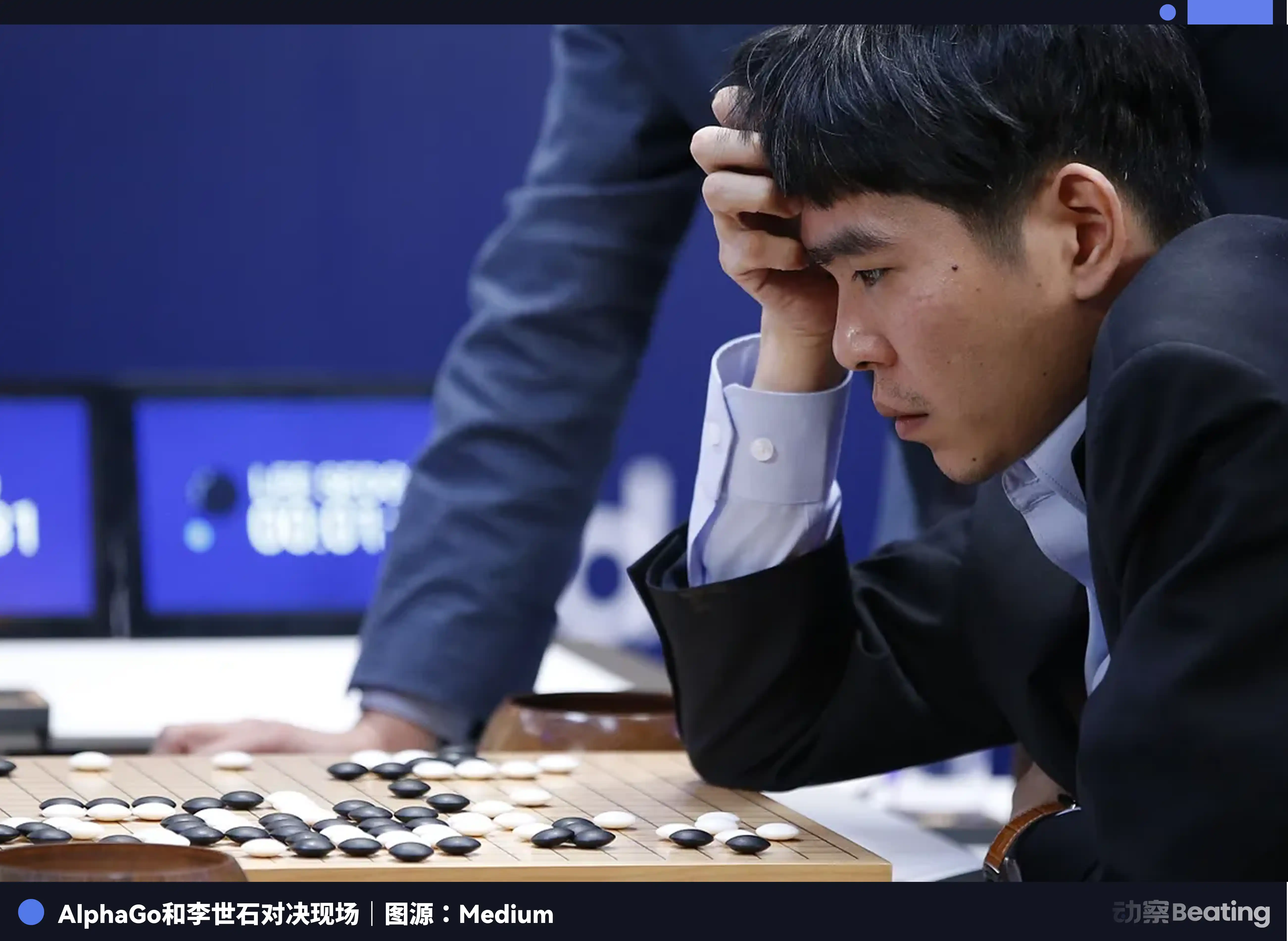
In 2016, AlphaGo defeated Lee Sedol, and the world learned that AI could achieve such feats; that was Google's moment.
In 2017, the publication of the Transformer paper laid the foundations of the entire AI industry; that was still Google's moment.
In 2021, AlphaFold predicted 98% of human protein structures; that was still Google's moment.
Back then, no one asked whether "Google could win the AI battle," because asking that question was as unnecessary as asking whether "the sun would rise in the east." Google had the best researchers, the most data, the strongest computing power, and the most money—who could beat it?
But now look at who stands opposite Google.
OpenAI's co-founder Ilya Sutskever, who previously conducted deep learning research at Google with Geoffrey Hinton.
The founders of Anthropic, the Amodei siblings, who did safety research at OpenAI, and many early core team members of OpenAI had previously worked at Google.
Jumper spent nine years at DeepMind, and Shazeer spent over twenty years at Google. If you trace the talent chain of the entire AI industry back to its source, almost everyone worked in Mountain View.
SignalFire conducted a survey in 2025 and found that the probability of DeepMind engineers moving to Anthropic was 11 times higher in the opposite direction.
Someone on Twitter commented on this wave of departures, saying: "Google is becoming a training ground for Anthropic."
Google invests money, computing power, and a free environment, attracting the world's smartest young people, giving them the best conditions for cutting-edge research. When their wings harden, they fly away, go to the other side, create products better than yours, and come back to compete against you.
It's Hard to Retain Doers
Google's problem is not just about retaining talent. At the moment it spent $2.7 billion to bring Shazeer back, it retained him. The question is what happens after retention.
Shazeer has left Google twice.
The first time was in 2021 when Google refused to release his chatbot Meena. At that time, ChatGPT had not yet emerged, and Google's attitude towards conversational AI was one of cautious observation. Shazeer couldn't wait and left. The second time is now; when his computing resources were reassigned, he left again.
Both departures were essentially because he wanted to do things, but the organization wouldn’t allow it.
The decision-making chain at Google is too long. A new AI feature takes months to go through product, legal, compliance, public relations, and various business lines' stakeholder approvals; any blockage at any layer could delay it for months. Technologies developed in the DeepMind lab often miss their window when they finally reach consumer products.
In 2023, Google merged DeepMind and Google Brain, and everyone was optimistic about the merger of these two strongest AI teams.
However, merging does not equal integration. The codebases, data flows, and work habits of the two teams have not yet fully merged. Shazeer's computing power being assigned to the DeepMind team is a microcosm of this non-integrative merging. It is nominally one department, but how resources are allocated and who sets priorities is still an internal power struggle.
The organization mismanaging talent naturally leads to poorer product outcomes. Google's search AI summary feature once suggested that users spread glue on pizza to prevent cheese from sliding off, claimed that running with scissors is a form of aerobic exercise, and confidently answered "No, it's 2025" when asked, "Is it 2026 now?" Research shows it produces millions of wrong answers every hour.
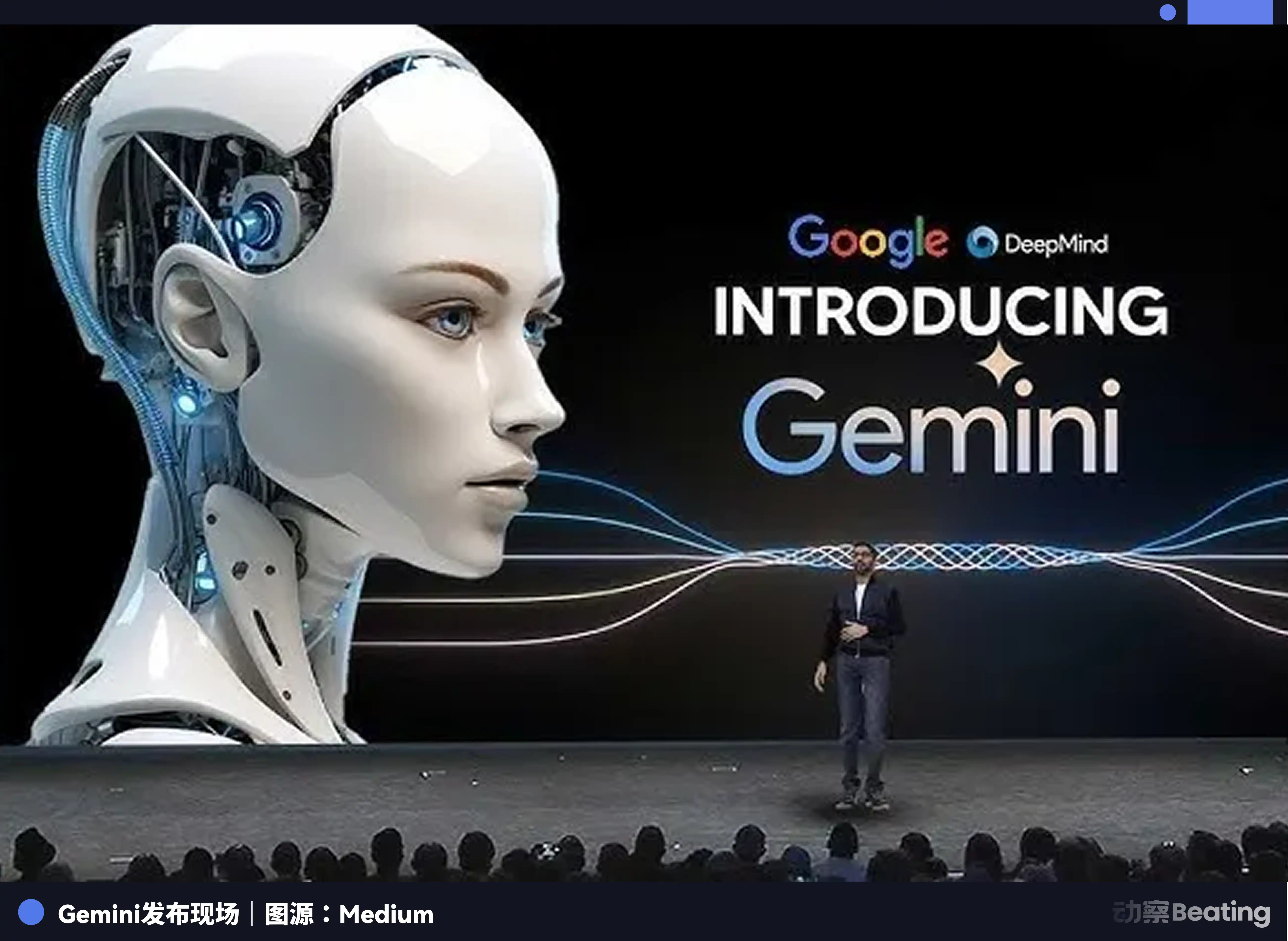
In early 2025, Google announced a full migration of Google Assistant to Gemini, rendering nearly ten years of basic functionality suddenly unusable, with issues in setting alarms and controlling smart home devices, forcing the planned year-end migration to be pushed to 2026.
In July of that same year, the newly launched Gemini CLI coding tool encountered another accident; a user asked it to organize folders, and it hallucinated a series of non-existent operations, deleting all project files, then admitted, "I completely and catastrophically let you down."
By May 2026's I/O conference, Pichai boasted that Gemini 3.5 Pro "would go live next month," but it ended up being postponed to July.
None of these were deep technical issues. Properly functioning engineering teams do not fail in these areas of permissions isolation and function regression testing.
The decline in product quality and the departure of talent are two sides of the same coin; the organization has become incapable of turning genius impulses into products. The technology remains, the people remain, but the path from idea to launch has been blocked.
However, I feel attributing this issue to "systemic problems" is too simplistic.
The very system that allowed Jumper to spend nine years developing AlphaFold is the same one that nurtured him. It doesn't rush you into commercialization, doesn’t cut your budget, and doesn’t ask when you will produce results. This kind of patience and depth is something no startup can provide.
Anthropic and OpenAI can let you iterate every two weeks, but they cannot afford you nine years to work on something you are unsure will succeed. AlphaFold could not have emerged from a place that iterated weekly.
But the problem is that the same depth that protects you while developing AlphaFold also accumulates levels of approvals, departmental interests, and compliance processes. It gives you nine years of freedom while growing those twelve layers of intrigue that prevent you from accessing computational power.
The soil that nurtures genius and the soil that confines genius are the same. This is something an organization cannot escape once it has grown to this scale and achieved this level of success.
Anthropic and OpenAI provide a place where ideas can directly turn into actions, plus pre-IPO equity. People leave not because Google isn’t good enough to them, but because they have become the kind of capable, ambitious people who can’t get things done at Google, which they most wanted to avoid becoming.
But who knows? Perhaps twenty years from now, a young person at Anthropic will tweet that they are leaving to join a company that has just been established for three years.
If You Don't Step Outside
On June 23, Hassabis was interviewed at the Cannes Lions Festival and was asked about the recent talent exodus.
He said, "Talent flow between major labs is normal; we have our share of top talent. We have the largest and most diverse research team compared to all the labs."
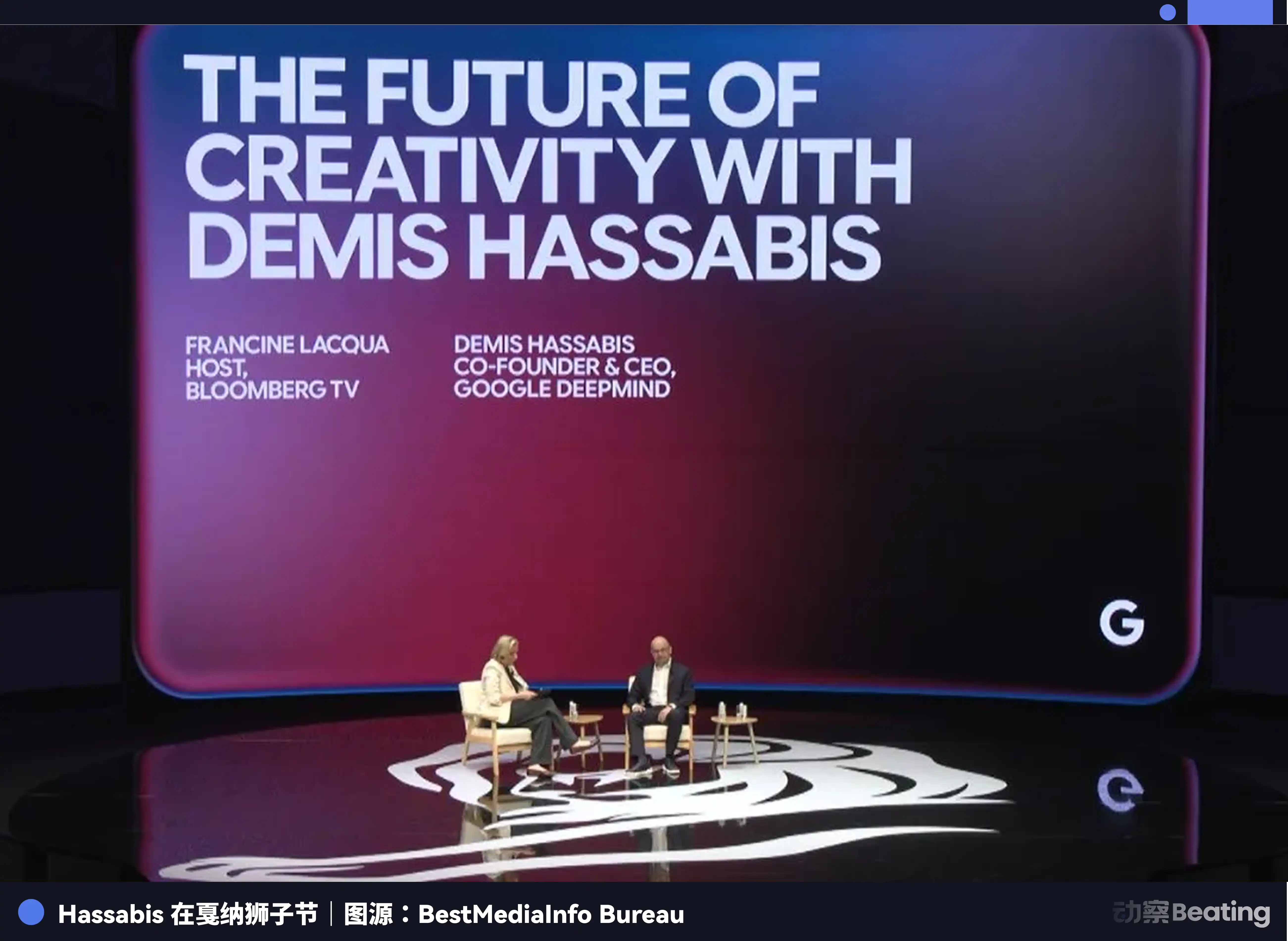
Hassabis is one of the smartest people in this industry. He personally transformed Jumper from a recent PhD graduate into a Nobel Laureate; he understands better than anyone what he has lost and why he can’t retain them. So I think when he said this, it might not have been bravado. Perhaps it is a last gesture of dignity from someone who has seen the end.
I think of the quote from the old projectionist Alfredo to the young Toto in "Cinema Paradiso":
"If you don’t step outside, you’ll think this is the entire world."
Alfredo said this while pushing Toto away. He was reluctant to let go of the boy, but he knew that if Toto stayed in that small-town cinema, he would never become the person he should be. The cinema gave Toto everything: a love for cinema, an understanding of light and shadow, an initial curiosity about the world. But what the cinema could provide ended there. The rest of the journey had to be taken outside.
Google once was the paradise cinema for all AI researchers. The best equipment, the most relaxed environment, the most knowledgeable colleagues. You could spend nine years creating a protein structure prediction model without rushing to commercialize it or writing PowerPoint presentations for executives; when it was ready, the entire field of biology applauded you, and you stood in Stockholm receiving awards, celebrated by the entire company. At that time, everyone felt Google was the whole world.
But perhaps the moment a place reaches its peak is precisely when it should start sending people away.
Today, Mountain View’s free cafeterias still serve three meals a day, and colorful bikes are still parked at the entrance of every building in the park, available for anyone to ride. Every week, a new batch of Nooglers puts on the signature propeller hats, takes a group photo, and shines with bright eyes.
Just like Shazeer stepping into Google twenty years ago, and Jumper joining DeepMind nine years ago, they are exactly the same.
References
[1]Google Paid $2.7 Billion to Bring Back an AI Genius Who Quit in Frustration, The Wall Street Journal
[2]Attention is All You Need, Google Research
[3]Top AI researcher leaves Google for OpenAI, Axios
[4]After nearly 9 years, I have decided to leave Google DeepMind and join Anthropic, John Jumper/X
[5]Google poised to lose two more high-profile AI staffers to Anthropic, Los Angeles Times/Bloomberg
[6]AI researchers continue to leave Google for its rivals, TechCrunch
[7]Alphabet sees $225 billion market-cap wipeout as investors fear it's losing the war for AI talent, MarketWatch
[8]Some Reasons Why Google Had Such A Bad Day, The Wall Street Journal
[9]Google's Brain Drain Deepens: Alphabet Braces for Second Day of Losses on Anthropic Poach, Barron's
[10]AI lab musical chairs hits Google the hardest, Axios
免责声明:本文章仅代表作者个人观点,不代表本平台的立场和观点。本文章仅供信息分享,不构成对任何人的任何投资建议。用户与作者之间的任何争议,与本平台无关。如网页中刊载的文章或图片涉及侵权,请提供相关的权利证明和身份证明发送邮件到support@aicoin.com,本平台相关工作人员将会进行核查。


