The background of this discussion in Space is actually quite clear: the World Cup is entering the final stage of the group matches, and the odds are beginning to converge rapidly, with much of the previously scattered information gradually being focused into pricing; at the same time, the global macro environment has transitioned from an earlier stage of shocks to a rebalancing process, with the market reassessing liquidity and the positioning of risk assets; coupled with a marginal easing of geopolitical situations, overall risk appetite has shown some recovery, but the structure remains unstable.
Viewed together, the current market state resembles a situation where: events are decreasing, but prices are accelerating in adjustment. The direction has not yet fully emerged, but the volatility has already reflected some expectations in advance.
围
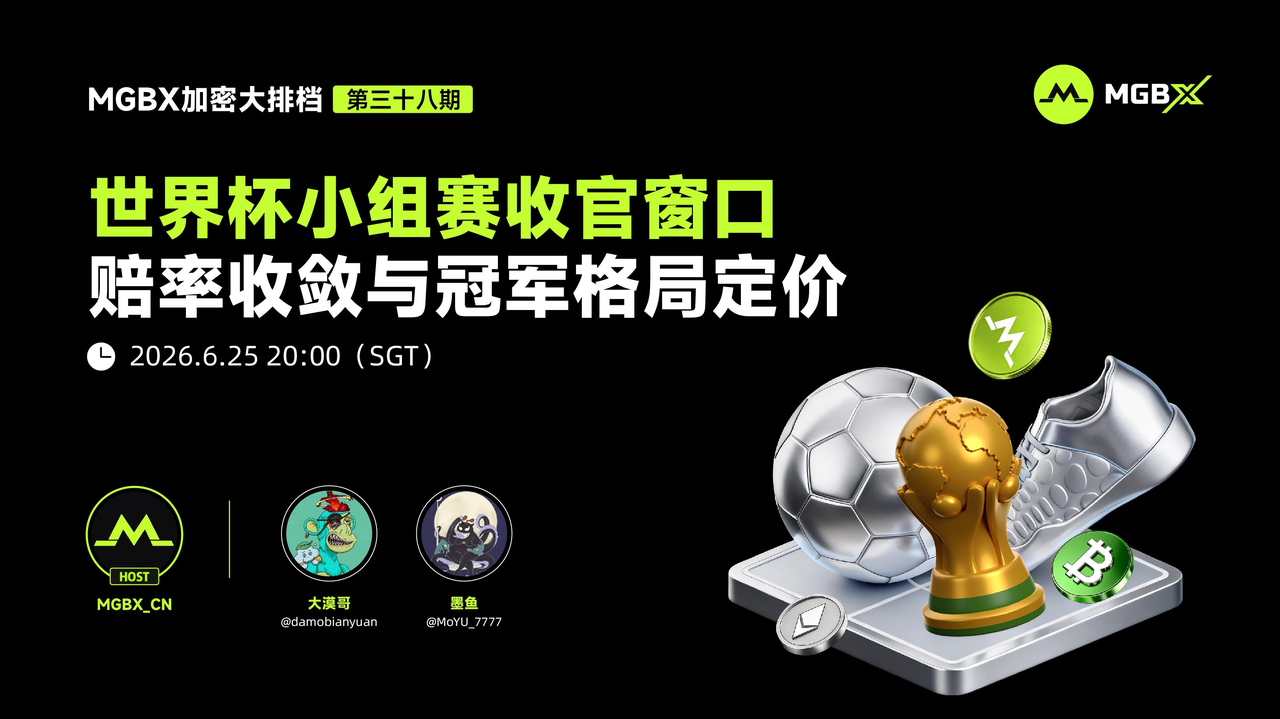
In light of this background, the first discussion focused on trading rhythm and position management.
Teacher Damo ( @damobianyuan) takes a straightforward approach, believing that in this phase of rising volatility, the most important thing is not to increase aggressiveness, but to first pull back risk. Because once volatility increases, market noise will significantly rise, and if one maintains a high leverage state, it can easily be repeatedly impacted in a short time.
Therefore, his approach is to first lower the overall position, reduce leverage, lighten the core positions, and bring the account structure back to a relatively safe position. However, he also emphasizes that this does not mean completely exiting the market, as this environment is often accompanied by event-driven rapid fluctuations, such as changes in sentiment or short-term data shocks, which still present trading opportunities. Thus, the overall stance is more like “defensive first, but retain flexible positions.”
The second question turned to the current phase of BTC and ETH.
Teacher Mo ( @MoYU_7777) judges that it currently resembles a phase of price oscillation rather than an early trend initiation. Although external risks are decreasing and market sentiment is recovering, the key issue is that liquidity has not entered a clear expansion cycle, which limits the formation of trends.
In this structure, BTC is more about consensus correction within a range, with some funds trading on future recovery expectations, while another part is still defending against macro risks; ETH is more sensitive to sentiment, but similarly lacks a sufficiently supportive volume structure for a trend.
Therefore, the overall state resembles: direction is brewing but has not been confirmed.
The third question discusses the nature of betting markets and odds changes.
Teacher Zhen Nai ( @nice11018) believes that the changes in odds at this stage cannot be simply understood as "information pricing" or "emotional bias," but rather as a combination of both.
As the matches enter the concluding phase, information does indeed converge, resulting in increasingly concentrated odds. Meanwhile, market consensus is also forming, which causes prices to approach "consensus probabilities," but not necessarily equal the real probabilities themselves.
Consequently, the market exhibits a typical structural differentiation: popular outcomes become increasingly stable, but the profit margin continues to compress; while obscure outcomes have large spaces, but the risks are also significantly higher.
In this structure, trading essentially turns into a multiple-choice question, no longer about judging right or wrong, but about choosing between more certainty or more odds space.
The fourth question discusses, from a broader perspective, whether the activity levels of sports betting and prediction markets affect global asset volatility.
Teacher Damo ( @damobianyuan) believes that such phenomena do have an impact, but mainly manifest at the emotional level rather than the trend level. High-attention events like the World Cup will temporarily boost market participation, increase risk appetite, and thus amplify volatility and trading activity.
However, it will not change the long-term direction of the market, only alter the rhythm. In other words, it is more like an "emotional thermometer," capable of reflecting market heat but unable to determine market direction.
The overall discussion finally returns to a common question: during the overlapping phase of the World Cup emotional cycle, macro repricing, and risk appetite recovery, is the market driven by fundamentals or reshaped by events and emotions?
From the perspectives of these guests, whether it is odds convergence, BTC/ETH oscillation, or structural changes in prediction markets, all essentially point to one state: the market is still being continuously repriced by information, but this pricing process is dynamic and not one-dimensional.
In this phase of high volatility and high event density, price itself is the most direct expression of the market, and the difficulty in trading lies not in directional judgment, but in understanding rhythm and structure.
Exactly for this reason, such windows often will not be the most "smooth" market condition, but will be one of the phases that can clearly reveal market structure.
👉 Download MGBX from the official website: https://mgbx.com/
Company: MGBX
Official Business: @MGBXVIP
Risk Warning: Digital assets and leveraged trading carry high risks, and market volatility may lead to capital loss. Please make rational judgments and prudent decisions.
免责声明:本文章仅代表作者个人观点,不代表本平台的立场和观点。本文章仅供信息分享,不构成对任何人的任何投资建议。用户与作者之间的任何争议,与本平台无关。如网页中刊载的文章或图片涉及侵权,请提供相关的权利证明和身份证明发送邮件到support@aicoin.com,本平台相关工作人员将会进行核查。