Author: Rita
Guided Reading
Guo Xin Securities released a deep report on electronic specialty gases and electronic bulk gases on June 26. The report points out that the demand for AI computing power is driving electronic gases into a stage of exponential growth. Due to China's export controls on high-purity tungsten, the supply of tungsten hexafluoride in Japan has faced shortages, creating a replacement window for Chinese companies with simultaneous expansion in demand and market share, leading to historical opportunities for leading electronic gas companies with simultaneous growth in both volume and price.
Electronic Gases: The Basic Materials for Semiconductors
Electronic gases are the second-largest material in semiconductor manufacturing after silicon wafers, accounting for about 13% of the wafer manufacturing materials market. According to the application field, electronic gases can be divided into electronic bulk gases (high-purity nitrogen, oxygen, argon, etc.) and electronic specialty gases (used for etching, deposition, cleaning, doping, etc.).
According to TECHCET data, the global market size for electronic gases used in semiconductors is approximately $6.34 billion in 2025, and is expected to exceed $7 billion by 2028. The growth rate of China's electronic gas market is even faster, with the scale of the electronic specialty gas market in China increasing from 10.5 billion yuan in 2017 to 19.5 billion yuan in 2024, and expected to reach 25.6 billion yuan by 2028. This growth is driven by both the expansion of downstream wafer factories and the iteration of manufacturing processes.
The "Multiplier Effect" of AI Computing Power Igniting Demand
Global AI infrastructure construction has entered an upward cycle. According to TrendForce, the global wafer foundry output value is expected to increase by 24.8% to $21.88 billion in 2026, with the combined capital expenditures of the eight major CSPs expected to grow by approximately 61% year-on-year. The global shipment growth rate of AI servers is expected to exceed 28%.
The pull from AI for electronic gases comes not only from the expansion of wafer production but more critically from the increase in gas consumption per wafer. The etching steps for advanced processes have increased from about 20 times at 65nm to about 140 times at 7nm, leading to a multiplicative increase in the gas used for etching, deposition, and cleaning. For HBM, the TSV deep silicon etching process requires sulfur hexafluoride and octafluorocyclobutane. The increase in the number of stacked layers in 3D NAND directly drives up the usage of etching gases.
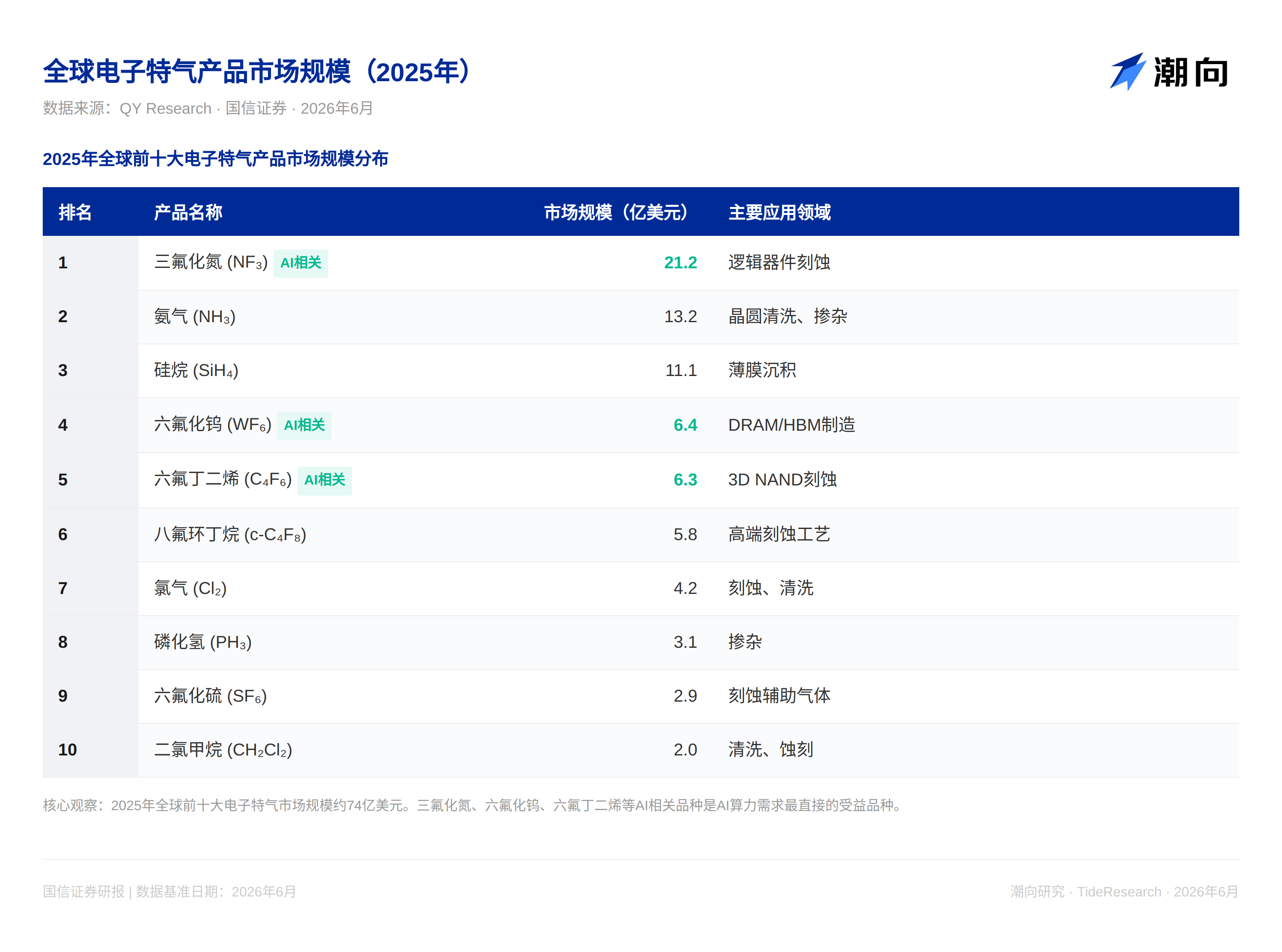
Changes in demand structure are reshaping the market space for electronic specialty gases. According to QY Research, the global market size of the top ten electronic specialty gas products is approximately $7.4 billion in 2025, with nitrogen trifluoride, ammonia, and silane ranking the top three. Nitrogen trifluoride, tungsten hexafluoride, and hexafluorobutadiene are mainly used in the manufacturing of integrated circuit logic devices, DRAM/HBM, and 3D NAND, making them the varieties that benefit most directly from the demand for AI computing power.
Domestic Replacement Window: The Supply Gap of Tungsten Hexafluoride
The global electronic gas market has long been dominated by four international giants: Linde, Air Liquide, Air Products, and Japan's Taiyo Nippon Sanso, collectively accounting for over 70% of the market share. Although domestic electronic specialty gas companies have made breakthroughs in some products, their overall market share remains low, with a localization rate of about 25% in the integrated circuit field.
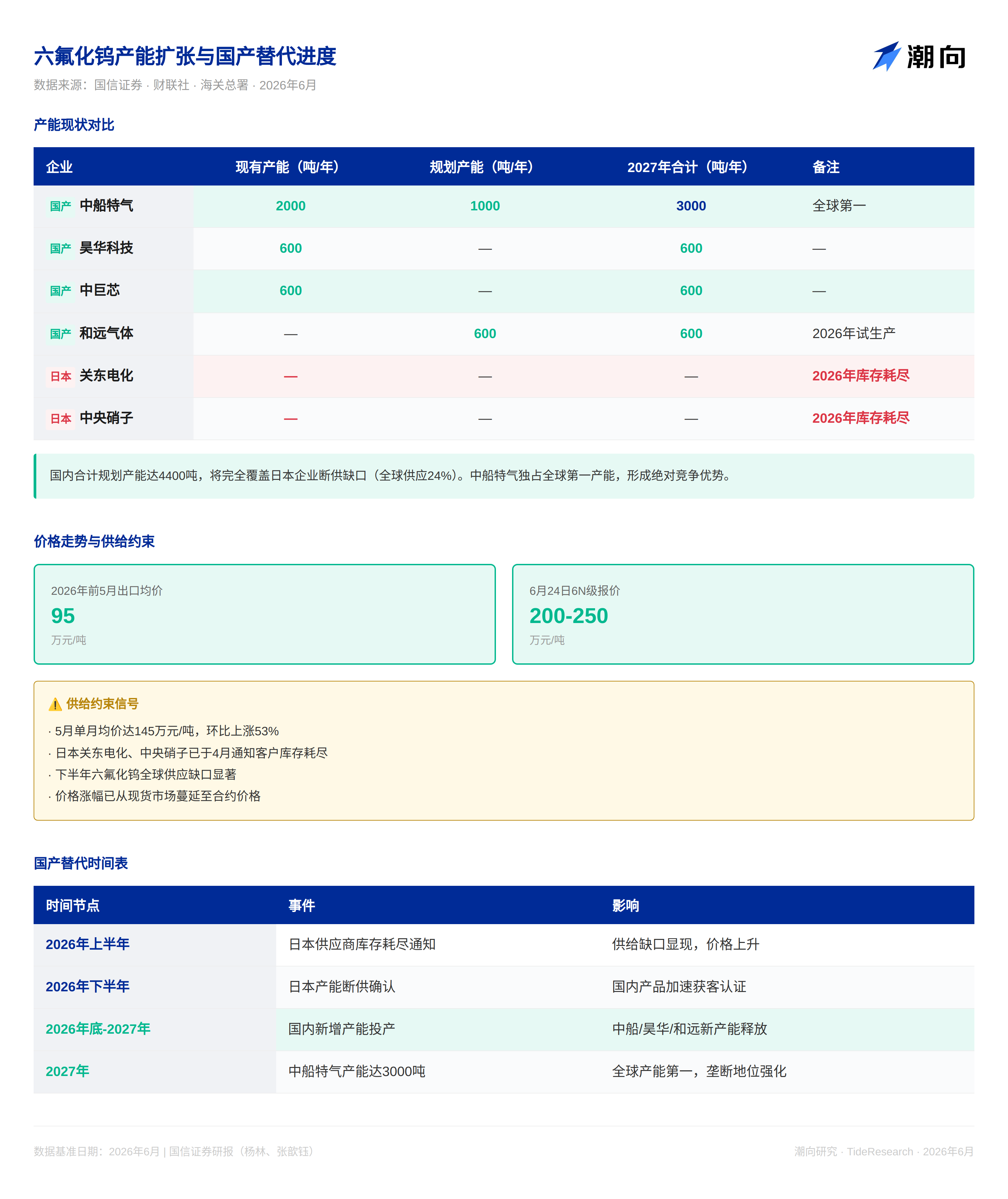
However, the supply landscape is changing. According to reports from the Caixin company, due to China's export controls on high-purity tungsten, Kanto Denka and Chuo Glass in Japan notified South Korean customers in April 2026 that their inventories were depleted, and the supply of tungsten hexafluoride may not be guaranteed in the second half of the year. Japanese gas companies account for about 24% of the global supply of tungsten hexafluoride, thus creating a significant supply gap after the suspension.
At the same time, domestic companies are rapidly expanding their production capacity. Zhongchuan Teqi has achieved a tungsten hexafluoride production capacity of 2,000 tons and plans for an additional 1,000 tons, with total capacity expected to reach 3,000 tons by 2027, ranking first in the world; Haohua Technology and Zhongjuxin each have a capacity of 600 tons; Heyuan Gas aims for trial production with a capacity of 600 tons by 2026. The price of tungsten hexafluoride has rapidly increased; according to the General Administration of Customs, the average export price for the first five months of 2026 has risen to about 950,000 yuan per ton; as of June 24, the price of 6N grade is quoted at 2,000,000 to 2,500,000 yuan per ton.
Electronic Bulk Gases: Overlooked Long-term Cash Flow
While electronic bulk gases are not as market-attended as specialty gases, their business model holds unique value. Due to the extremely high demand for gas supply stability from semiconductor customers, electronic bulk gases are mostly supplied using on-site generation, with contract periods typically lasting 15 years or even longer, locking in long-term cash flow with a "pay without negotiation" model.
Currently, the domestic electronic bulk gas market is still dominated by foreign capital, but Guanggang Gas, since breaking the foreign monopoly in 2018, has captured a 25.4% share in new projects in the domestic electronic semiconductor field, ranking first. By the end of 2025, Guanggang Gas has received recognition from ten 12-inch wafer factories. In 2024, China's electronic bulk gas market size is about 9.7 billion yuan, and Guanggang Gas's electronic bulk business revenue is 1.487 billion yuan, with a market share of about 15%, which still has room for improvement in the future.
Multidimensional Growth Opportunities for Domestic Companies
In this logical chain, the growth dimensions for domestic companies are not just one. AI-related specialty gas varieties such as nitrogen trifluoride, tungsten hexafluoride, and hexafluorobutadiene have the greatest demand elasticity, offering the most direct opportunity for simultaneous growth in both volume and price. Meanwhile, electronic-grade dichlorodihydrosilane and trichlorosilane, which contain silicon and are used for silicon epitaxial wafers and advanced deposition processes, currently rely mostly on imports, indicating a vast potential for domestic replacement. Sanfu Co., Heyuan Gas, and Jinhong Gas are actively promoting capacity construction and customer certification.
Electronic bulk gases provide stable cash flow through long-term contracts, highly binding downstream customers, making the marginal benefits from capacity expansion significant. This explains why analysts are optimistic about both the simultaneous increase in volume and price of specialty gases as well as the steady growth of bulk gases.
For investors willing to hold for 3-5 years, the growth certainty of the electronic gas industry is relatively high. Short-term risks include macroeconomic fluctuations, increased competition in the industry, and rising raw material prices, but the logic of supply constraints and rising prices still supports the industry fundamentals.
Disclaimer
This article is an organization and interpretation of third-party brokerage research reports by Tide Research. The viewpoints and related judgments quoted in this article are solely those of the analysts at Guo Xin Securities and represent the position of their institution, not that of Tide Research, and do not constitute any investment advice.
When reading, please pay attention to three points: 1. The value of research reports lies in the main logic and its premise assumptions, rather than a specific market size forecast. 2. Sell-side research reports are naturally biased toward optimism, and some covered companies may have investment banking relationships with the broker. 3. The market has risks; decisions must be made independently.
The market has risks; decisions must be made independently. This article should not be a basis for buying or selling any securities.
Data Source: Guo Xin Securities Research Report (Yang Lin, Zhang Xinyu, June 26, 2026)·TECHCET·TrendForce·QY Research·Caixin·General Administration of Customs
Tide Research · TideResearch · June 2026
免责声明:本文章仅代表作者个人观点,不代表本平台的立场和观点。本文章仅供信息分享,不构成对任何人的任何投资建议。用户与作者之间的任何争议,与本平台无关。如网页中刊载的文章或图片涉及侵权,请提供相关的权利证明和身份证明发送邮件到support@aicoin.com,本平台相关工作人员将会进行核查。


