The new hawkish Federal Reserve Chairman Waller is completely flipping the narrative on the dollar in Wall Street. The dollar index rose 2.1% in June, as traders bet on a rate hike as early as July, with hedge funds holding a massive $29.4 billion long position. JPMorgan bluntly stated that the Fed has "activated" a bullish outlook, with inflows into AI capital and the divergence of US and European policies further fueling the dollar. The strong dollar era may have quietly restarted.
Written by: Zhao Ying
Source: Wall Street Journal
The hawkish appearance of the new Federal Reserve Chairman Waller is reshaping Wall Street's overall judgment on the dollar.
In his first monetary policy meeting since taking office, Waller emphasized the central bank's mission against inflation, with such firm wording causing the market to quickly reprice. The dollar index has accumulated a 2.1% increase in June so far, making it one of the best monthly performances in nearly a year, as traders began to bet on a potential Fed rate hike as early as July, with large-scale bullish bets on the dollar also appearing in the options market.
Major Wall Street institutions, including JPMorgan, Bank of America, and Goldman Sachs, have successively expressed renewed confidence in the dollar's outlook.
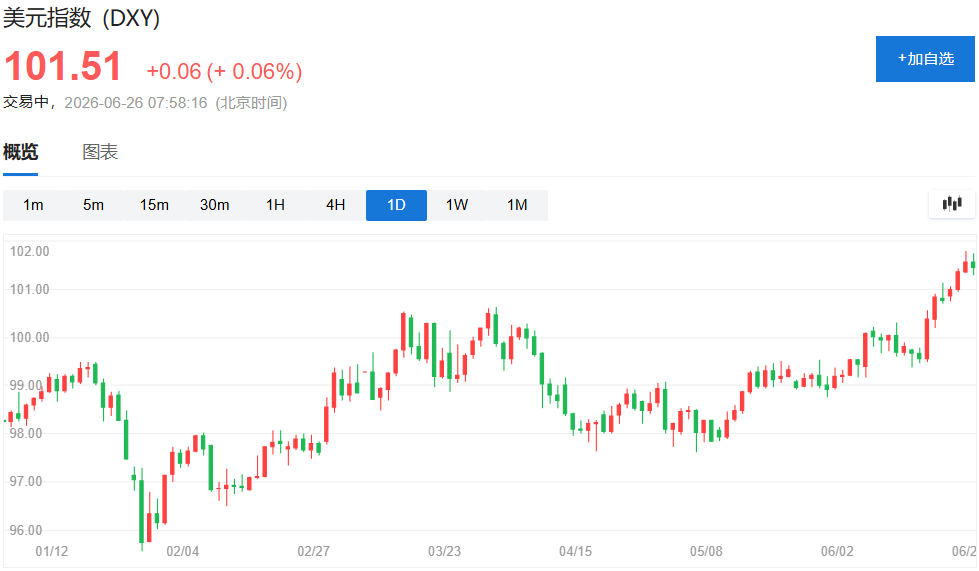
This shift is significant. Just over a year ago, "hedging against US risks," de-dollarization, and currency devaluation trades were mainstream narratives in the market; now, these voices have fully receded. MUFG Bank strategist Lee Hardman indicated that the Fed's hawkish policy update "is threatening to trigger a bullish breakout for the dollar," and its effects have surpassed the dampening influence of the US-Iran negotiation agreement on the dollar.
Fed "activates" dollar bulls
Meera Chandan, co-head of global FX strategy at JPMorgan, directly stated that the Fed has "activated" a bullish outlook on the dollar. "Other central banks don't seem to be catching up, and the interest rate differential for the dollar won't narrow," she said in an interview.
At Waller's first press conference after taking office, his strong statements on price stability significantly shifted market expectations for the rate hike path. Jayati Bharadwaj, head of foreign exchange strategy at TD Securities, summarized this change: "US data is resilient, economic activity is strong, the new chairman has a hawkish stance, and is discussing policy credibility and price stability. The threshold for a Fed rate hike is now lower; this is a shift in market perception."
The Bloomberg dollar spot index is currently trading at its highest level since November, having risen 1.7% so far this year. June's increase is almost comparable to the spike driven by oil prices in March. Chandan stated, "The baton that truly drives the market has now passed from energy to the Fed's policy response."
Treasury endorsement, new gathering of bullish and bearish forces
The hawkish Federal Reserve is not the only support for a stronger dollar. Treasury Secretary Yellen has recently more clearly stated her support for a strong dollar policy and publicly endorsed Waller. However, Yellen emphasized that it is the US policy framework, rather than the exchange rate itself, that drives the dollar's dominance in the global economy.
At the institutional level, capital is accelerating towards long positions in the dollar. According to data from the Commodity Futures Trading Commission (CFTC), as of June 16, hedge funds, asset management firms, and other speculators held a cumulative $29.4 billion in bullish dollar positions. Hedge fund Man Group expects the dollar to rise another 5% by the end of the year, while TD Securities predicts a moderate increase of about 2% in the third quarter.
Bank of America currency strategist Alex Cohen believes the dollar "still has room to rise." The bank downgraded its year-end forecast for euro to dollar from 1.20 to 1.15 on Thursday, expecting the Fed to raise rates three times this year. European Central Bank President Christine Lagarde lowered rate hike expectations earlier this week due to weak signals from the Eurozone economy, leading to the euro dropping to a one-year low, further highlighting the divergence in monetary policy between the US and Europe.
AI trading provides additional momentum
In addition to monetary policy factors, the wave of artificial intelligence is becoming another logical mainstream driving the dollar's strength. Goldman Sachs chief currency and emerging markets strategist Kamakshya Trivedi stated: "The reality is that AI trading is boosting US economic growth expectations and stock market returns, making it an attractive destination for capital."
StanChart G-10 currency research global head Steven Englander also believes that productivity gains related to AI support the dollar's positive outlook, and capital inflows along with improved corporate earnings will continue to support the dollar. Deutsche Bank head of currency strategy George Saravelos positions the dollar as "the main beneficiary of future AI revenue streams."
Trivedi pointed out that the path for the dollar's strength is not one-size-fits-all: the dollar will exert stronger pressure on low-yield currencies, especially those sensitive to oil prices, but it may perform relatively poorly against high-yield currencies and trade-sensitive currencies—such as the Mexican peso, Brazilian real, and Australian dollar. Goldman expects the Thai baht and Philippine peso to weaken against the dollar in the next three months.
Uptrend may not be smooth sailing
Despite high bullish sentiment, some institutions are cautious about the sustainability of the upcoming upward trend. Barclays strategists warn that "the dollar's upward path may not be linear," due to the fact that rate hike expectations have been priced in by the market, market sentiment is quite bullish, and oil prices along with US economic data may be approaching cyclical peaks.
TD Securities' Bharadwaj also noted that for more significant dollar appreciation to be seen, the Fed needs to deliver rate hikes that exceed current market pricing—currently, the market anticipates only about one to two 25 basis point hikes before early next year.
Additionally, from the perspective of options market signals, the premiums for betting on dollar appreciation relative to depreciation in the next 12 months are nearing the highest level in over a year, approaching the five-year average, but still below the peak levels seen during the last round of "American exceptionalism" dominating the market, indicating that there is still space for bulls, but caution is warranted regarding the risk of overly concentrated expectations.
免责声明:本文章仅代表作者个人观点,不代表本平台的立场和观点。本文章仅供信息分享,不构成对任何人的任何投资建议。用户与作者之间的任何争议,与本平台无关。如网页中刊载的文章或图片涉及侵权,请提供相关的权利证明和身份证明发送邮件到support@aicoin.com,本平台相关工作人员将会进行核查。


