Original link:CZ on the Future of Crypto
Original translation by: CryptoLeo (@LeoAndCrypto)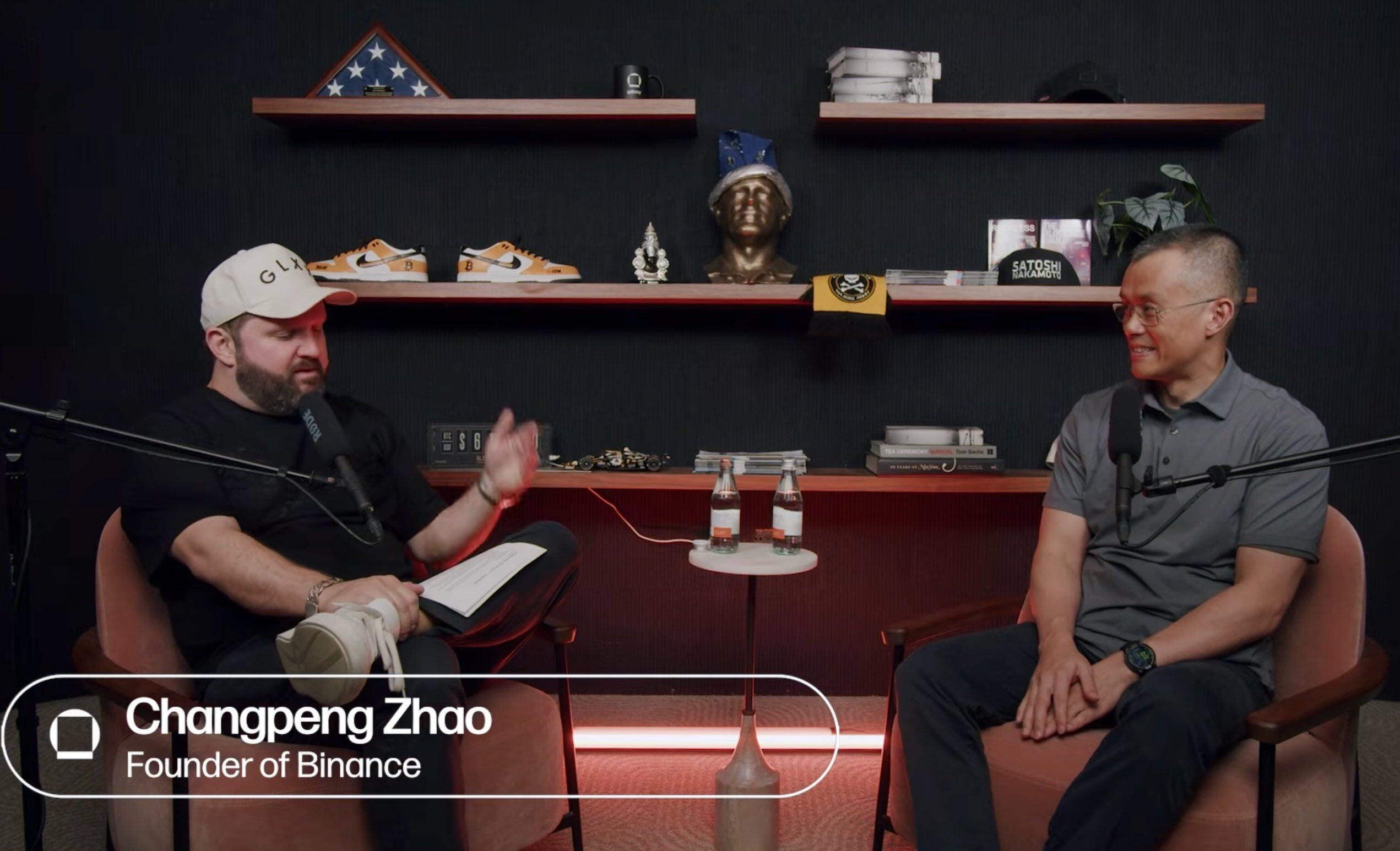
Editor's note: It has been a long time since I have seen discussions about coins in cryptocurrency circles (the chat is filled with Micron, SpaceX), Odaily revisits the content of CZ's interview on Galaxy to recharge everyone's faith — the interview is titled "CZ on the Future of Crypto," and the two discuss the current market cycle, the integration of traditional and crypto, market predictions, AI development, investment philosophy, etc. This may inspire those who still hold hope for coins during the bear market; the following is an excerpt of the full content translated:
Q: Regarding the four-year cycle of crypto, I have done some calculations and found it to be quite accurate, almost to the day. What do you think?
CZ: I think the idea of a four-year cycle in cryptocurrency is very accurate. This is a normal cycle. Now the coin price has retraced about 50%. In previous cycles, we even saw an 80% retracement. For instance, after the collapse of Luna in 2022, there was the FTX explosion, when cryptocurrency fell to a low of Bitcoin at 16,000 dollars. Now the coin price is 4 to 5 times what it was at that time, and each cycle is going higher.
Compared to before, now there are countries supporting Bitcoin, many countries accepting cryptocurrency, and cryptocurrency regulation and discussion are becoming nationalized. There are also institutions adopting it (like BlackRock), including the listing of the BNB ETF. We are really seeing more real development activity, with more developers returning to the U.S., and some countries are issuing more stablecoins. There’s also RWA, for example, you can buy SPCX/preIPO tokens on Binance or other trading platforms.
Although we are talking about cycles, the cycle does not end at the same point. Each cycle starts much higher than the previous one, it is a continuously rising cycle loop.
I cannot say where the bottom of this cycle is or how long it will last. I don't really like to make predictions, but previous highs are usually the support levels for the future. For example, 60,000 dollars is the historical high from 4 or 5 years ago, in technical analysis, the previous high always becomes the support for the next low. There are many theories behind this, and I don't know if the theories are correct. I am not a great technical analyst, but the facts seem to be that way.
Q: In the cryptocurrency cycle, there is always a major collapse that causes the crypto market to plummet from its peak to its low. In this cycle, is there anything close to a collapse?
CZ: This is a very interesting question, and I have been curious about it, probably for 6 months now. But in the past 6 months, no institutions have disclosed they are close to bankruptcy; the entire industry is doing better at controlling leverage. Perhaps there are indeed some internal shocks within the industry, but no one has gone bankrupt.
My knowledge is limited, I have not seen a lot of high-leverage products, although there are some stablecoins offering high yields, similar to circular lending. But overall, the scale of these products is relatively small compared to the current size of the industry, which is a good thing.
Q: Traditional finance is building its own chains, and cryptocurrency is introducing tokenized securities and RWA. In terms of the integration of traditional finance and crypto, where do you think the boundary lies between centralized and decentralized? Will TradFi make cryptocurrencies more centralized, or will cryptocurrencies make TradFi more decentralized?
CZ: I think both will happen because we have already seen this integration. Moreover, theoretically, cryptocurrency is not an independent industry; it is just a new technology and tool that enables financial transactions to be realized in a high-speed, low-cost, and more transparent manner. Just as there are no purely internet companies today, but there are internet infrastructure companies like Cisco.
Traditional financial companies can use blockchain; the technology is open to anyone. They can also develop their own chains with various different technologies, most of which are open source. As for cryptocurrency companies, they can offer services that are very similar to traditional financial services. Now they can provide lending, savings, stock trading, etc. Transfers, payments, all these cryptocurrency companies can do, and this is not limited to cryptocurrencies; besides stablecoins, there are fiat channels, and crypto companies also deal with business similar to fiat.
Cryptocurrency and traditional finance should not be divided; it is a fintech industry, so this integration will certainly happen. Regarding centralization and decentralization, I believe that, essentially, any platform or company in the industry is a part of centralization, even any team or project, as long as there are multiple people involved, it is part of centralization.
Human beings have network effects; we like teamwork. Few people can work with AI alone. But technology continues to evolve, becoming more and more decentralized. So I think both the decentralized aspects and the centralized aspects will happen. The binary opposition between centralization and decentralization can actually be understood as: in a decentralized world, anyone can work together. A decentralized world should be able to accommodate centralized participants.
If centralized participants can provide truly quality and secure services at a low cost, then they will attract more and more users; that is the network effect.
Of course, this can lead to small-scale centralization or even monopoly. There are pros and cons; companies that abuse monopolistic power will generally lose their market monopoly position over time. They just provide opportunities for new market participants. So, to some extent, centralization and decentralization will always coexist, but I am a strong supporter of decentralization; technology will continue to drive decentralized development, and more and more tools will become increasingly decentralized.
Q: Banks and credit card giants are also building their own chains or crypto businesses. For instance, Mastercard announced the establishment of a testing platform MTN. Why don’t they develop their businesses on BNB, Ethereum, or Solana?
CZ: That is the spirit of decentralization; you can build your own blockchain at will, without needing to trade on ETH or BNB. The greater the differences between blockchains, the better; to some extent, this is also good for users. The more choices we have, the better. Over time, users will become clearer about which blockchains have utility. It is not yet clear whether most people care only about centralization or decentralization.
I think most people care about fundamental aspects like low cost, safety, and ease of use. If those large traditional financial participants want to develop their own proprietary blockchain and they manage to get people to use it, then it deserves praise. But I think more and more people will demand more freedom, a truly decentralized crypto world, with greater freedom, lower costs, etc. Which chain to use depends on consumer choice.
Moreover, many countries do not fully adapt to purely open blockchains; they all hope to have their own national blockchains. I have discussed with leaders from many different countries, and they all wish to have their own national blockchains, but they need time to convince themselves: “Should we give up control over currency, or should we give up control over national financial sectors?”
This could be a transitional phase. Over time, for a large country like the United States, if all the giants on Wall Street use one or two private blockchains, and trillions of dollars are flowing through these networks, retail investors might be excluded just like in corporate internet, where there are enough activities happening that are meaningful; that would be okay.
Decentralization does not equate to everyone having to use a single open-source blockchain. If we force everyone to use Bitcoin, that is not true decentralization.
Q: Binance offers perpetual contracts, BitMEX was one of the first exchanges to provide perpetual contracts, which is a very important and efficient financial tool. Now it seems that after the legalization of crypto, more platforms like CME will emerge to trade cryptocurrencies. What impact will these have on crypto exchanges? And how will crypto trading stocks, etc., affect traditional exchanges?
CZ: First of all, contracts are not invented in the cryptocurrency field; they exist in traditional finance. Perpetual futures first appeared in crypto in 2014, introduced by BitMEX. Binance was a bit late, only starting to offer them in 2019. During those five years, other exchanges offered different types of futures, but they weren’t perpetual futures; they were delivery-based futures. You had to settle on Friday each week and roll over the delivery.
Binance offers these products because it has the largest user base, so liquidity, trading volume, prices, slippage, etc., are all top-notch. Now traditional giants like CME are also starting to roll out futures products, which I think is great because they serve a market that Binance has never served. Binance has never served those institutions in the U.S.
If CME or any other institution in the U.S. can promote institutional trading of cryptocurrency futures, then there will be more liquidity. This will fill the liquidity gap, and the liquidity of crypto trading will increase, which I think is really good.
I am not too concerned about who becomes stronger. The more people who can access crypto and trade, the better the liquidity. And the better the liquidity, the actually best protection for consumers. When liquidity is good, you will see fewer crashes and similar situations.
I predict that in the future, forex trading will also shift to blockchain.
But on the other hand, Binance's user base is very diversified. For example, most people abroad find it difficult to buy American stocks, but what country wouldn't want stocks to be purchasable by everyone in the world? For instance, if you go public with SpaceX, why wouldn't you want everyone in the world to be able to buy its stocks? Which company, which stock exchange, which country wouldn’t want people worldwide to buy their government bonds?
Going deeper, if a country buys a large amount of your government bonds, there actually won’t be a conflict between you. So you must negotiate in trade rather than attack each other, hence, the world is becoming smaller. Even though geopolitical tensions and various issues exist, cryptocurrency exchanges provide a way for those not in that country to purchase your shares, which does not undermine the existing exchanges in that country, and actually helps to increase liquidity, demand, etc. This is my viewpoint.
Q: Hyperliquid is a large and continuously growing platform. I think it is more decentralized than Binance, but not as decentralized as Uniswap, falling somewhere in between. Have you met Jeff? What are your thoughts on Hyperliquid?
CZ: We find Hyperliquid very interesting, especially regarding Jeff, whom I have never personally met. But he was actually involved in one of the earliest projects incubated by Yzi Labs, so I guess he is a very smart young person and quite capable.
Hyperliquid proves a new market segment that didn’t exist before. This was not achieved by previous others. Their team is small, but they occupy a niche market in which Binance cannot compete. They do not have KYC, and they claim to be decentralized (I will not comment on another project). Based on the technology we see, they have a lot of control over Hyperliquid, using smart contracts for deposits and withdrawals, claiming this is decentralized. In short, Hyperliquid has some technological innovations that are quite nice.
Q: What are your thoughts on prediction markets? Many jurisdictions in the U.S. are angry about prediction markets (sports betting), but they seem to have considerable utility, especially in cases where you need to trade on the derived products of events rather than the events themselves. From both regulatory and product concept angles, what is your current perspective on prediction markets?
CZ: I also think it is a great invention. Prediction markets have existed for a while, like event futures prediction markets. Different regions have different regulations on prediction markets. But the CFTC Chair is supportive of prediction markets in tone, and many important figures in the U.S. government have expressed support for Polymarket. That’s good, allowing people to provide prices and liquidity.
I founded an exchange, so I like to see any tools that can provide price discovery and liquidity. I believe Polymarket and Kalshi have licenses in the U.S., so I am not sure about some states which may not like it. I keep my distance from any form of jurisdictional disputes. But I think it is good for consumers and for the global cryptocurrency industry, just like any new technology or platform; as long as they function well, they will be great. Of course, there will always be poorly executed ways. But I think the top prediction market projects today are indeed doing well. And in the future, there will be many emerging prediction markets.
There may be as many prediction market projects in the cryptocurrency space as there are, probably around 100 to 1000. So I hope all these projects can execute responsibly.
Q: What should we pay attention to on the BNB chain right now?
CZ: I am no longer in charge of exchange operations and have more time to communicate with developers in the community. I am really excited about some of the new features they are developing on the BNB chain. One suggestion I gave to developers is, don’t do major upgrades during a bull market, but rather do them during a bear market when the market is calmer. Of course, I advise every blockchain project to do this, not just the developers of the BNB chain.
They are now developing the next version, which is faster, costs less, and provides users with more privacy control options. The feature list for the next version is quite long. I am not driving these features, but when I see the list of all the features they are developing, I think it is fantastic.
Q: Now the Ethereum hub and spoke model has become somewhat urgent because L1 is highly decentralized. They have introduced L2, but the current L2 is mainly OP’s single sequencer rollup, which is not genuinely decentralized. I don't think they have reached what I consider the second stage of true decentralization. What are your thoughts on this argument? I know Vitalik seems to suggest more focus on L1.
CZ: Yes, I do sense a shift in Vitalik's attitude, and I remember several years ago, the Ethereum community was focused on L2 technology. In the past few years, they seem to have taken a step back and stopped moving forward. I think the main reason is that L2 contributes to L1 coins.
We have done calculations and found that BASE pays more in licensing fees for choosing the OP technology than they actually pay in L1 fees.
Vitalik seems to realize that L2 doesn't help L1, and then Ethereum experienced a decline, and Vitalik had to deal with the pressure brought by the price drop. All these factors combined made him realize that he still needs to work harder on L1. So now he has slightly shifted his focus, which is normal.
Currently, there are still some strong L2 solutions, but I think the future still belongs to L1. For instance, the speed of L1 will increase, but then the demand will rise, and L1 cannot scale quickly, and in the future, there might be other types of L2 solutions that emerge, resembling a L1-L2 rotational cycle.
Q: Yzi Labs was previously known as Binance Labs. It is your core investment tool. What kinds of projects are you focused on now?
CZ: I have a rough guiding principle for Yzi's investment projects: about 70% cryptocurrency, 20% artificial intelligence, and 10% biotechnology. I think these three areas are large-scale industries that will continue to grow rapidly, and there are many new innovations in these three areas waiting to be discovered, implemented, and built, and these innovations are likely to positively impact our civilization.
Our philosophy is that we hope Yzi invests in impact rather than just investment returns. For example, suppose we invest one billion dollars in a drug research company that treats common diseases such as cancer, and the treatment is very cheap. The company may not make any money, but it could cure one million, ten million, or one hundred million people. I would prefer to lose that one billion or even tens of billions of investment. That would make me very happy because we gained impact.
Many early projects have a bit of craziness, and we expect a very high failure rate. Of course, we also invest in some very good projects. There are many cryptocurrency companies in there, which I do not want to discuss because many of these companies have tokens and would be seen as promotional.
Apart from crypto companies, we invested in a company that creates artificial wombs, allowing you to give birth in a machine, freeing women from the pregnancy process. Tests have been conducted on mice during pregnancy, and it may take 5 to 10 years to reach human pregnancy.
Recently, there is a technology for knee cartilage regeneration, which promotes the growth of knee cartilage by placing a 3D-printed scaffold into your knee cartilage. Many elderly people have knee problems.
This project is also quite early. I forgot what stage they are at; perhaps they are just starting the next phase of human clinical trials. We are also investing in many AI robotic technologies, but what excites me the most is the biotechnology company.
Q: Speaking of AI, what is your personal favorite model right now? What mobile application’s AI features are you particularly interested in? And how do you view the future of AI?
CZ: I have almost installed all the mobile AIs, and I use different AIs for different things. OpenAI was the first I installed; Anthropic and Claude are better for programming and providing decent responses. I travel often and find that different AIs are sometimes inaccessible in different countries; when you open the application, it will say, "Sorry, I cannot serve in this country."
For example, when I want to travel to Hong Kong, the American AI companies won’t work, so I have to use Deepseek, Kimi.
Overall, I think that America’s large language models are more accurate; China’s are also quite good, but sometimes not comprehensive enough.
I am not an expert in the AI field. But I believe that in the future, there will also be an AI race between countries. China is definitely developing its own chips and building its own data centers, while the U.S. is also trying to build. Competition can be healthy and promote growth. But I think we must be cautious about the growth rate in the field of artificial intelligence, as AI is incredibly powerful and may bring dangers.
Many people are focusing on cryptocurrency regulation now, but few are discussing AI regulation. What can you do, and what can’t you do? Cryptocurrency regulation is much simpler; it’s like dealing with money matters, not many other things like KYC and AML; it is all about money.
But AI is different; the things AI can do are vast. It can hack into your computer. It can devise how to make a nuclear bomb. The applications of artificial intelligence are extremely broad, but I think no one has really deeply and comprehensively thought about how to regulate AI.
Of course, regulation is not about stifling; regulating this industry means you want to promote its use. However, regulating AI is really difficult. Many people have not deeply considered or discussed this issue. When you think about this issue, you realize how crucial they are to our civilization.
No matter how cryptocurrency develops, it lacks the ability to destroy our civilization; it helps global trade and promotes our economic development, etc. But if we are careless in using artificial intelligence, it may indeed destroy our civilization (a little rant).
Q: Is there a belief that you have held since founding Binance in 2017 that remains unchanged or even stronger?
CZ: Cryptocurrency will not perish; crypto will become a vast industry. This belief has not changed from the beginning, and it is even stronger than ever.
A lot of hot money has now flowed into the AI sector; they are chasing AI-related stocks. But now people are trading AI stocks with cryptocurrency, and AI is actually contributing to the trading volume of cryptocurrency.
Imagine if there is an agent that can help you buy tickets, trade, or do anything you can do, integrating payment systems by country, or enabling cryptocurrency because the current payment system does not support AI; AI cannot swipe your credit card; many payment methods require 2FA, such as KYC requiring a passport, which AI cannot perform. But the blockchain is API-driven, making it much easier for AI.
We need to update the current financial system; when we have AI, blockchain, and the internet, they will work together to build a better financial system. Many people ask me if I am worried that all the money will flow to AI. I reply:
Some money has flowed over, but that’s okay; there is enough money around, and what we are facing is the entire financial system. Even the money that flows there will eventually circulate on the blockchain.
免责声明:本文章仅代表作者个人观点,不代表本平台的立场和观点。本文章仅供信息分享,不构成对任何人的任何投资建议。用户与作者之间的任何争议,与本平台无关。如网页中刊载的文章或图片涉及侵权,请提供相关的权利证明和身份证明发送邮件到support@aicoin.com,本平台相关工作人员将会进行核查。