Original author: Zhao Ying
Original source: Wall Street View
The hawkish stance of Federal Reserve Chairman Kevin Warsh may just be a carefully designed smokescreen.
Academy Securities analyst Peter Tchir raised in his latest report that although the market currently prices in a 75% probability of a rate hike in September and expects a cumulative rate increase of 1.25 times by the end of the year, he believes the market is missing a real path to a rate cut in September—one that Warsh himself might quietly be paving.
Tchir pointed out that the signals being sent by Warsh are already quite clear: using hawkish statements to suppress long-term interest rate tail risks (the yield on 10-year U.S. Treasuries has fallen from 4.46% to 4.37% this week), while also leaving room for future data narratives to shift. In his view, the end game of this series of operations could be a rate cut in September and another in October, coincidentally landing right before the midterm elections.
This judgment is still a personal opinion, and Tchir himself acknowledges the uncertainty involved. But his argument logic is tightly connected, covering the redefinition of inflation data, the struggle for the discourse on neutral interest rates, and the core premise that the White House's policy goals have never changed.
Is hawkishness just a performance? Political logic points to rate cuts
The starting point of Tchir's argument is a political economy interpretation of Warsh's motives.
He believes that the Trump administration's policy goals have not fundamentally changed. The President himself has repeatedly stated his deep understanding of real estate and the importance of low interest rates to the real estate market. In this context, it is hard to imagine that Trump would be satisfied with the continued hawkishness of the Fed chair he nominated—unless this was itself a negotiated strategy.
Tchir outlined a hypothetical scenario: Warsh persuades Trump that releasing dovish signals right now would be disastrous. By appearing hawkish, he can suppress long-term yields and maintain the appearance of Fed independence while also shifting Wall Street analysts and media towards expecting rate hikes. Then, as the data gradually "cooperates," he can pivot to rate cuts under the banner of "data-driven," blaming the inflation issue on the previous Fed for "using wrong data and acting too late."
He added that Warsh's father-in-law is a major donor to Trump, a background that may not be insignificant.
Taking aim at inflation data: PCE is not the measure for this Fed
The most substantive part of Tchir's argument is a systematic questioning of the current inflation measurement system.
He explicitly states that PCE is not the preferred inflation indicator for Warsh's Fed. He believes that PCE is more of a preference from the Bernanke era, and Warsh would not be tossing and turning over PCE data in the middle of the night.
In measuring housing inflation, his criticism is especially sharp. The "owner's equivalent rent" (OER) in the CPI did not peak until mid-2023, with a peak of around 8%; while Zillow's rent data had already reached nearly 16% at the beginning of 2022. He noted that the Cleveland Fed has developed the "New Tenant Repeat Rent Index" (NTRR), which aligns closely with Zillow's data, yet this more reality-based indicator has received almost no attention.
His conclusion is: the Fed can completely switch to using the indicators developed by the Cleveland Fed without introducing external data, thereby providing a justification for rate cuts on a data level.
Truflation and "2-point-something is enough"
Beyond PCE, Tchir also referenced real-time inflation data from Truflation. According to him, Truflation constructs a daily inflation index based on a vast real-time data set, with its core inflation rate currently around 1.45%, consistently below 1.8% since February of this year.
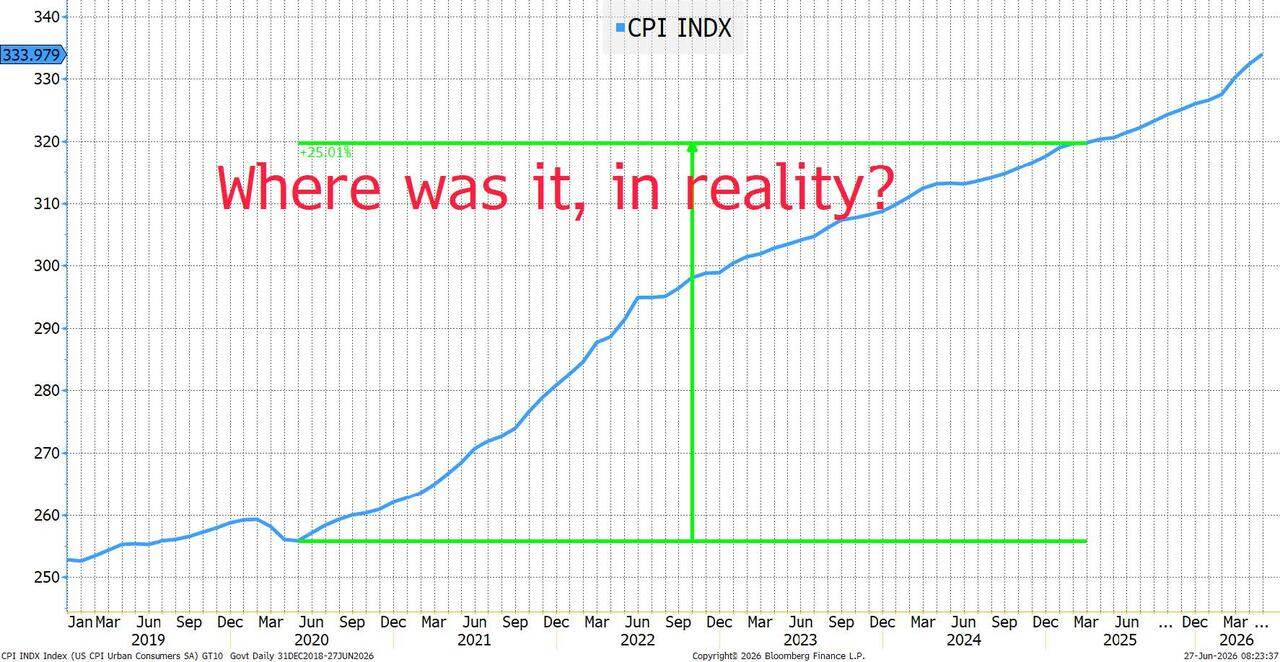
He also noted that Warsh's recent statements hinted that the "big digits" of inflation numbers (i.e., the integer part) are more important than precise values. Tchir infers that the market may be gradually being "conditioned"—accepting that "2-point-something" equates to the cognitive framework close to the 2% target. In charts, he marked the inflation target line at 2.9%, rather than the conventional 2%.
He believes that once the narrative around data switches, the technical barriers to rate cuts will be significantly lowered.
Tchir also mentioned the work of former Fed insider Miran on the neutral interest rate issue. He believes that although no one in the market is currently discussing the neutral rate, this topic will resurface at the appropriate time.
His logic is: neutral rates are inherently difficult to measure accurately, with a considerable estimation range. If the new Fed leadership can argue that the previous judgment of neutral rates was too high, then based on just this point, they can provide a theoretical basis for a rate cut of 50 to 100 basis points while attributing the blame to the "errors of the old Fed."
Apple price increases and AI inflation: Rate hikes missed the target
In response to market concerns about AI-driven inflation, Tchir offered a reverse interpretation.
He pointed out that after Apple (AAPL) recently announced price increases, its stock price fell, indicating that the market's reaction precisely shows that consumers' capacity to bear price increases is under question. If a top consumer goods company like Apple struggles to have its price increase absorbed by the market, the ability of ordinary consumer goods companies to transfer costs will only be weaker—this contradicts the narrative of continually rising inflation.
He also cited feedback from a chip company: memory prices have not risen significantly due to AI demand, with some products even cheaper than five years ago. He believes that while AI and data center construction expenditures are inflationary, this is a completely different dimension from the affordability issues faced by ordinary consumers.
More critically, he believes that rate hikes have almost no suppressive effect on AI/data center expenditures—those tech companies trading at 100 times valuation are hardly sensitive to a 50 basis point change in interest rates. The ones truly harmed by rate hikes are ordinary borrowers who have no connection to AI inflation.
Based on the above judgments, he believes that the market will start to reprice expectations for rate cuts, with the most definite opportunity being in the short end of the yield curve—betting on short-term Treasuries and expecting front-end yields to decline. For the long end, he maintains a neutral to slightly bullish stance, believing that Treasury Secretary Bascent hopes to see the 10-year yield return to the "3's," while Warsh has eliminated long-term tail risks through hawkish statements.
In the equity space, he suggests significantly overweighting the energy sector, particularly global nuclear power assets; in the defense and security (ProSec) theme, overweight biotechnology/pharmaceuticals and underweight chips. He holds a cautious view on the valuations of AI and data centers and warns that potential dilution pressure from large tech companies may weigh on stock prices.
免责声明:本文章仅代表作者个人观点,不代表本平台的立场和观点。本文章仅供信息分享,不构成对任何人的任何投资建议。用户与作者之间的任何争议,与本平台无关。如网页中刊载的文章或图片涉及侵权,请提供相关的权利证明和身份证明发送邮件到support@aicoin.com,本平台相关工作人员将会进行核查。


