Original | Odaily Planet Daily (@OdailyChina)
Author | jk
On July 1, 2026, the European Union's Markets in Crypto-Assets Regulation (MiCA) transition grace period officially ends.
From this day forward, all entities providing crypto asset services to users within the EU must hold a formal MiCA license without exception. Unlicensed operators are prohibited from accepting new deposits and conducting new business, with the French regulatory authority AMF clearly warning that violations may face up to two years of imprisonment and a fine of 30,000 euros. Regulatory authorities also reserve the power to publicly blacklist, apply for website seizures.
As of May 2026, approximately 194 crypto enterprises had obtained formal MiCA authorization within the EU, while crypto service providers registered or operating under the systems of various European countries are estimated to exceed 1,100 to 3,000. Legal firm Hogan Lovells estimates that about 75% of the older platforms will lose their legal operating qualifications after the grace period ends. Unlicensed exchanges include Binance, MEXC, etc.
What kind of regulatory challenge will this be for the exchanges? What details does MiCA contain? Which exchanges will no longer be able to operate? What actions do users need to take? Odaily Planet Daily will provide an in-depth interpretation.
What is MiCA?
MiCA is the first comprehensive regulatory framework for the crypto asset market in European Union history, officially coming into effect in 2023, covering all 27 member states of the EU plus Norway, Iceland, and Liechtenstein.
Before MiCA was implemented, regulation of crypto enterprises across European countries was highly fragmented. The same exchange needed to register with the financial regulatory authority in Germany, obtain a PSAN license in France, and faced varying thresholds of requirements and enforcement across different countries. The goal of MiCA is to replace this fragmented scenario with a single set of unified rules. This is also the EU's longstanding approach to policy-making.
MiCA, as a large and comprehensive regulatory framework, covers a wide range of services. Any entity providing crypto asset-related services to customers within the EU is collectively referred to as a "Crypto Asset Service Provider" (CASP) and must apply for authorization from national regulatory agencies, clearly specifying the types of services provided.
MiCA subdivides CASP's service types into ten categories, including: operating trading platforms for buying and selling matching, crypto asset custody, crypto asset exchange, executing orders on behalf of clients, portfolio management, consulting services, etc. A MiCA license only covers the categories specified at the time of application; if an exchange wants to conduct matching, custody, and transfers simultaneously, it needs to apply for authorization covering multiple services.
MiCA also establishes a dedicated sub-framework for stablecoins. Stablecoins pegged to fiat currency and those pegged to a basket of assets must meet issuance authorization and reserve requirements respectively, with stricter regulatory constraints on those issued in amounts exceeding certain thresholds.
At the same time, MiCA introduces a "Passporting" mechanism: just as a person holding an EU passport can reside, work, and live in any member state, an enterprise that obtains a MiCA license in any EU member state can expand its services to other member states through a notification process without needing to apply individually in each country.
Different transition periods?
The rules for stablecoins under MiCA will come into effect in June 2024, while provisions related to CASP will take effect officially at the end of December 2024. To accommodate crypto enterprises that are already registered or operating in various countries, MiCA has set up a transition grace period, allowing each member state to determine the length of its grace period, with a maximum of 18 months, meaning by the latest July 1, 2026.
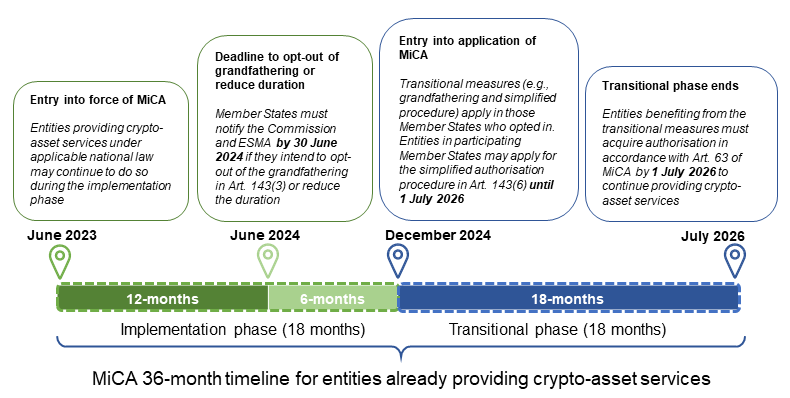
The core logic of the grace period is to give platforms that are already operating under national systems some time to complete the MiCA application and approval process while continuing to operate during that time.
Countries have had different approaches to the grace period. The Netherlands was the first to terminate the grace period on July 1, 2025, forcing a number of local exchanges to complete their licensing ahead of time. Germany shortened its grace period to the end of December 2025, using this as leverage to pressure applicants and speed up the approval process. When Lithuania's transition period ended, over 240 registered crypto enterprises there closed down. By June 2026, 20 of the 27 EU countries had ended their respective national transition periods before the July 1 final deadline.
On April 17, 2026, the European Securities and Markets Authority (ESMA) issued a formal statement confirming that July 1 is the final deadline, with no further extensions. For CASPs that have not been authorized before the deadline, ESMA requires the implementation of an "orderly shutdown": stopping the acceptance of new deposits, ceasing new business activities, transferring existing user assets to licensed platforms, or assisting users in migrating to self-custody wallets.
According to a report cited by Crypto News, as of May 2026, only about 194 crypto enterprises had obtained formal MiCA authorization within the EU, while the number of crypto service providers registered or operating under the various European countries' systems is estimated to exceed 1,100 to 3,000. Legal firm Hogan Lovells estimates that about 75% of the platforms operating under the old registration systems will lose their legal operating qualifications after the grace period ends.
How will leading exchanges respond?
Platforms that completed licensing early
- Coinbase x Luxembourg: In June 2025, the Luxembourg Financial Supervisory Authority (CSSF) granted MiCA licensing to Coinbase's European subsidiary, consolidating multiple local licenses previously scattered in Ireland, Germany, France, Italy, the Netherlands, and Spain, establishing Luxembourg as the single licensed hub for the EU, serving the entire EU through the passporting mechanism.
- Kraken x Ireland: Kraken obtained CASP authorization from the Central Bank of Ireland while also holding Luxembourg entities and MiFID-derived brand licenses.
- OKX x Malta: OKX is the world's first major exchange to obtain MiCA authorization, granted by the Malta Financial Services Authority (MFSA), using Malta as its base for EU-wide operations.
- Bybit x Austria: On May 28, 2025, Bybit obtained authorization from the Austrian Financial Market Authority (FMA), with its EU headquarters located in Vienna, covering services across 29 EEA member states.
- Crypto.com obtained a full license in Malta on January 27, 2025; Gemini landed in Malta in August of the same year. Bitstamp also chose Luxembourg and completed CSSF authorization in May 2025 (it is currently under Robinhood). eToro holds a CySEC license in Cyprus, while Robinhood completed registration in Lithuania.
Platforms with pending applications that have not yet landed
Bitget is a current high-profile case. As of June 17, 2026, Bitget's application submitted to the Austrian FMA is still under review, with its EU headquarters in Vienna, led by Oliver Stauber, who previously worked at KuCoin and Bitpanda. Until approval is granted, Bitget has suspended services to EEA users.
KuCoin's situation is more complex. It obtained authorization from the Austrian FMA in November 2025, but then due to key vacancies in anti-money laundering and compliance positions, the FMA prohibited it from officially undertaking business, and KuCoin has appealed this, currently unable to accept new users from the EU.
Stablecoins, mixed fortunes
If the reshuffling in exchanges is still underway, the reshuffling in the stablecoin sector has already been completed. Tether's USDT is the largest stablecoin globally but has never obtained MiCA authorization. CEO Paolo Ardoino publicly stated that MiCA's requirement to store most of EMT reserves in EU-regulated bank accounts is incompatible with Tether's existing reserve model. The result: Coinbase delisted USDT in December 2024; Crypto.com followed suit on January 31, 2025; Binance and Kraken delisted it in March 2025, and USDT completely exited major compliant platforms in the EU.
Circle's USDC and EURC passed EMT authorization, with USDC's market capitalization at approximately $75 billion in June 2026, becoming a mainstream stablecoin option within compliant scenarios in the EU. The Asset Reference Token (ART) framework is the highest threshold under MiCA, with no issuers having obtained authorization to date.
Several platforms most affected
Binance
Binance is the most scrutinized name in this reshuffling. In terms of scale, Binance has over 300 million registered users globally and, as the undisputed leader in the exchange domain, should qualify to apply for MiCA.
In January 2026, Binance submitted its MiCA application through the Hellenic Capital Markets Commission (HCMC), positioning Greece as the core base for Binance's European expansion. However, on June 16, Reuters cited two informed sources reporting that HCMC was planning to reject Binance's application, with regulatory authorities in Greece, Ireland, and Latvia jointly examining the application due to concerns over Binance's past legal handling and corporate governance structure.
On June 24, Binance officially announced the withdrawal of its application, stating it would resubmit in another EU member state, expecting approval "in the coming months," without disclosing the target country. Before obtaining a license, we may see Binance temporarily exit the European market, and its market share may be slightly eroded.
Binance stated in its official announcement: "Regarding user impact, Binance indicates that some users may be affected, with specifics varying by country and account status. The company is directly sending account-specific notifications to all EU users. Related notifications will indicate whether users need to take any action, available options, relevant timelines, and support channels."
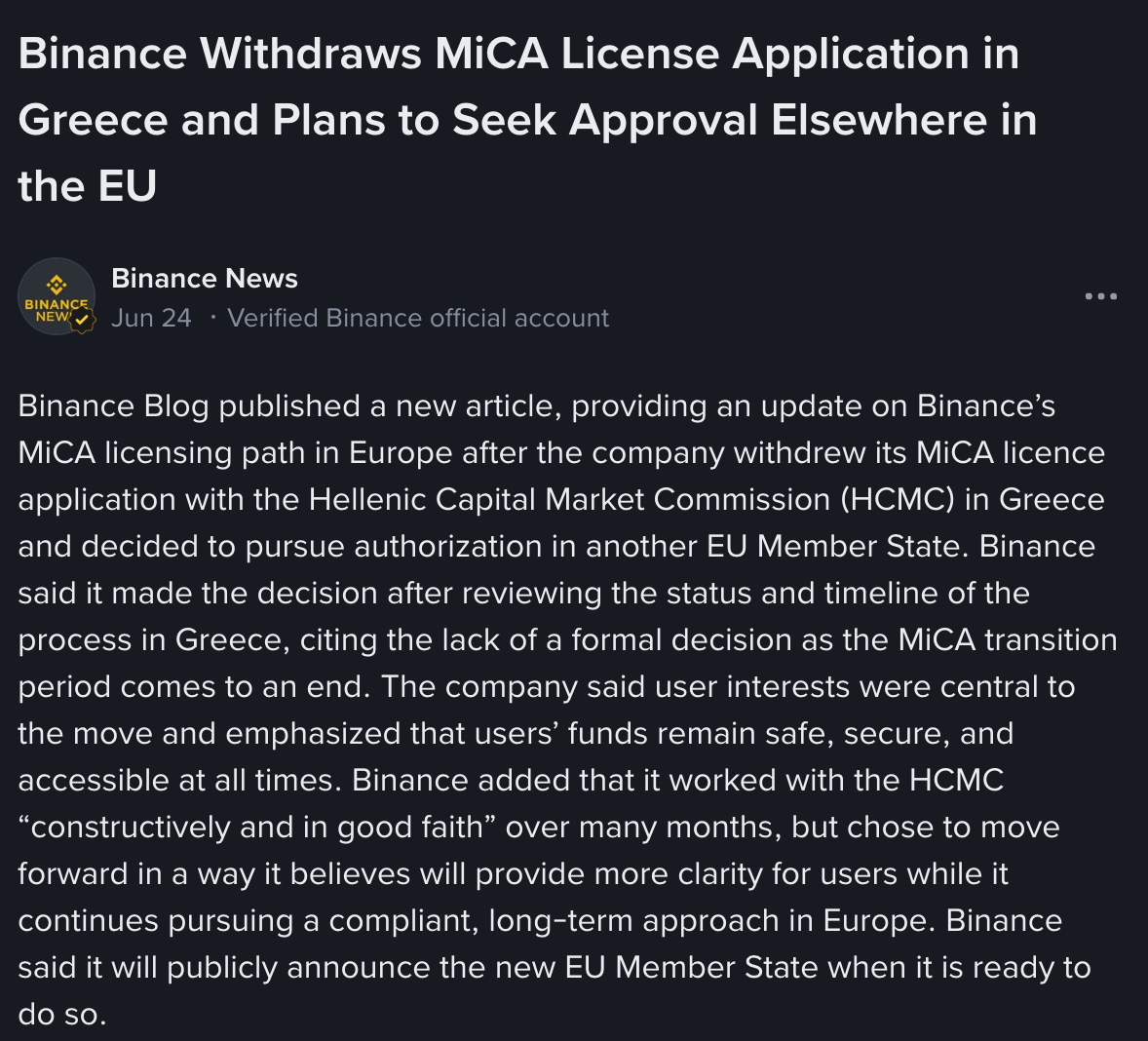
Binance's official statement, source: Binance Square
MEXC and HTX
Compared to the high visibility of the Binance incident, MEXC and HTX (formerly Huobi) have remained more subdued. Neither platform holds a MiCA license nor has any publicly available application records.
What should users do?
For EU users, after July 1, using unlicensed platforms means facing several practical risks: the platform may stop accepting new deposits, users may be required to complete withdrawals within a specified timeframe, and the platform may impose account operation restrictions without prior notice. OKX Europe analyzed that between May 2025 and May 2026, approximately 41% of total downloads of European crypto applications came from exchanges that have not obtained MiCA authorization, estimating that about 60% of European crypto users are currently using unlicensed platforms.
If the utilized platform has notified users for account migration, such as Bybit, Bitvavo, Kraken, Coinbase, and some EU users of Crypto.com, this typically means re-completing KYC identity verification and accepting updated terms of service, which is the normal procedure under MiCA's anti-money laundering requirements.
Next steps for industry regulation
MiCA is not the end. On May 20, 2026, the European Commission launched the formal review and consultation process for the MiCA regulation, with comments due by August 31, and the final report to be submitted to the European Parliament by June 30, 2027. This round of consultation covers 86 questions, including the competitiveness of stablecoins (especially the weak positioning of euro stablecoins compared to dollar stablecoins), DeFi, staking lending, RWA tokenization, and whether ESMA should gain direct regulatory power over major CASPs.
France, along with Austria and Italy, clearly supports the proposal for ESMA to directly regulate leading CASPs to narrow the standard gaps between member states. Meanwhile, the Qivalis alliance, initiated by 37 banks including BNP Paribas, ING, and UniCredit of Italy, is developing a compliant stablecoin pegged to the euro, hoping to carve out a place for euro digital currency in a market dominated by dollar stablecoins.
The reshuffling in the industry is still ongoing. Odaily Planet Daily will continue to track and report.
免责声明:本文章仅代表作者个人观点,不代表本平台的立场和观点。本文章仅供信息分享,不构成对任何人的任何投资建议。用户与作者之间的任何争议,与本平台无关。如网页中刊载的文章或图片涉及侵权,请提供相关的权利证明和身份证明发送邮件到support@aicoin.com,本平台相关工作人员将会进行核查。


