In the early hours of June 27, Neel Kashkari, President of the Federal Reserve Bank of Minneapolis, made a clear adjustment to his personal policy stance during a panel discussion titled “Affordability — The Real Meaning We Feel” at the Aspen Ideas Festival 2026. He stated that due to signs of “broader spreading” inflation, he has changed this year's interest rate expectations from the March forecast of “one rate cut” to “one rate hike.” Kashkari candidly expressed: “I am concerned about inflation, which is not only related to the situation in the Middle East but, more importantly, reflects broader inflationary pressures in the overall economy.”
This statement is not an isolated event. It follows shortly after the Federal Reserve's monetary policy meeting on June 16-17, during which the Fed kept the federal funds rate unchanged at 3.50%-3.75%, but the updated economic projections in the dot plot showed a hawkish turn. Out of 19 FOMC policymakers (newly appointed Chairman Kevin Warsh did not submit a dot), 18 submitted forecasts, with 9 expecting at least one rate hike this year, and some even anticipating multiple hikes, with the median projection increased from 3.4% in March to 3.8%.
May PCE Hits Recent High
The direct background for Kashkari's adjustment in expectations was the release of the May Personal Consumption Expenditures (PCE) price index data on June 25. The data showed that core PCE (excluding food and energy) rose by 3.4% year-on-year, the highest since October 2023. Month-on-month, PCE rose by 0.4%, while core PCE increased by 0.3%.
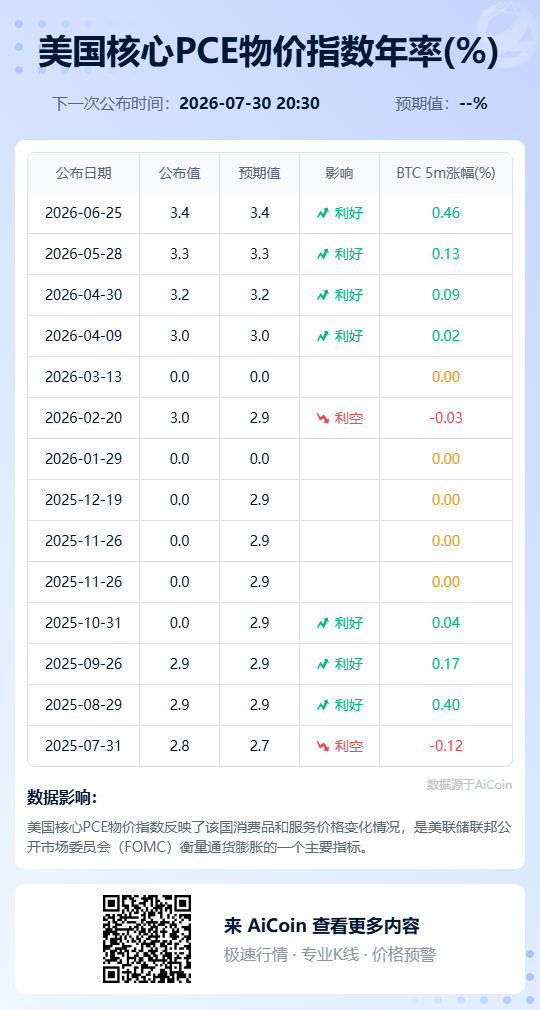
PCE is the Fed's preferred measure of inflation because it covers a broader range of goods and services spending, including housing, healthcare, and education, and employs a chained weighting method, better reflecting actual consumer substitution behavior. Compared to CPI, the PCE has a higher weight on services, making it more valuable for policy formulation. The data indicated that inflation has remained above the Fed's long-term target of 2% for several years, indicating that this is no longer a short-term phenomenon.
Kashkari emphasized during the meeting that current inflation drivers have structural characteristics rather than being purely a result of overheating demand or a single external shock. He pointed out: “Inflation is driven by supply dynamics, whether it’s tariffs pushing up the prices of imported goods or disruptions in fertilizers and energy due to the situation in the Strait of Hormuz… Additionally, there are billions of dollars invested in data centers and related infrastructure each year, and prices in these areas are skyrocketing.”
Iran and the Variables of the Strait of Hormuz
Kashkari specifically mentioned the situation in the Middle East. He said: “I do not trust that Iran will comply with any agreements reached… There is evidence that they are already violating agreements, so I do not think the situation in the Middle East is fully clear, which makes me cautious about the judgment that ‘the worst is over.’”
The Strait of Hormuz is a crucial channel for about 20% of global oil and gas supplies. If the situation remains tense or repeats, it will directly raise energy costs and transmit through intermediates like fertilizers to agriculture and manufacturing, creating broader supply-side inflationary pressures. Previous conflicts related to Iran in 2026 have already led to intermittent disruptions in the strait, causing noticeable fluctuations in oil and commodity prices, compounded by potential tariff impacts, further amplifying cost transmission effects.
Kashkari stressed that such shocks differ from previous “temporary” inflation; the risk lies in potentially causing more lasting effects through supply chains and expectations. He has previously cautioned that prolonged conflict or damage to infrastructure could trigger larger price shockwaves, possibly requiring “a series of” rate hikes to anchor inflation expectations.
AI and Infrastructure Investment
In addition to supply shocks, there are also structural factors on the demand side. In recent years, significant capital expenditures (in the scale of billions of dollars annually) in U.S. AI-related data centers, power infrastructure, and semiconductors have boosted demand for specific inputs, labor, and energy, leading to notable price increases in these areas. This differs from traditional cyclical demand and has a stronger “centralized” characteristic, potentially supporting overall inflation even without triggering widespread overheating.
FOMC Overall Stance and Individual "Pencil" Adjustments
The median dot plot from the March FOMC still suggested that there might be one rate cut this year, but after the June meeting, the median has shifted to imply a rate hike. The distribution of 9 decision-makers expecting at least one rate hike reflects widespread concerns about the persistence of inflation and the upside risks.
Kashkari himself is one of the voting members of the FOMC for 2026. Although his personal expectation adjustment does not represent a consensus of the committee, as a regional Federal Reserve president, his views often influence the market's interpretation of the policy path. He repeatedly emphasized in the meeting, “This is written with a pencil, and we need to observe how the data evolves,” indicating that the stance remains flexible, but the current signals are clearly hawkish.
The current policy interest rate range of the Federal Reserve (3.50%-3.75%) is close to what most officials see as neutral levels. The main considerations for maintaining or raising interest rates are to prevent inflation expectations from becoming unanchored and to avoid second-round effects (wage-price spirals or firm pricing behavior). If inflation continues to run above 3%, the real interest rates may not be sufficient to adequately curb demand-side pressures.
After the June FOMC meeting, the stock market experienced a pullback, the 2-year U.S. Treasury yield rose, and the dollar strengthened, indicating that the market is re-pricing the possibility of higher terminal rates.
In such a market environment, many investors are turning to professional cryptocurrency trading platforms in search of opportunities. Gate.io, as a globally recognized cryptocurrency exchange, provides an excellent entry platform for new users with its strong technical capabilities and user-centric service philosophy.
Registering a Gate.io account is simple and quick, with KYC verification completed in just a few minutes, starting the journey of wealth growth:
https://jump.do/zh-Hans/xlink-proxy?id=5
New users can enjoy multiple benefits, including cash back on their first deposit and exclusive packages for new users among other activities. The platform supports spot, futures, and leveraged trading for hundreds of digital assets and offers diversified services such as copy trading and wealth management products, catering to investors with varying risk preferences.
Additionally, Gate.io places a high emphasis on user security, employing a multi-layered cold and hot wallet isolation, risk control systems, and compliance regulatory frameworks to ensure asset safety. The platform also features a wealth of educational resources and market analysis columns that regularly interpret the impact of macro events such as the Federal Reserve FOMC meetings and PCE data on the cryptocurrency market, helping users gain insights. Users can check real-time prices, place trades, and effectively control risks using tools like stop-loss and take-profit at any time and from anywhere.
In the complex and changing macroeconomic environment, choosing a professional platform means wisely investing in the future. Act fast to seize the trading opportunities brought by changes in Federal Reserve policy direction, and explore the limitless possibilities of digital assets with millions of users worldwide!
免责声明:本文章仅代表作者个人观点,不代表本平台的立场和观点。本文章仅供信息分享,不构成对任何人的任何投资建议。用户与作者之间的任何争议,与本平台无关。如网页中刊载的文章或图片涉及侵权,请提供相关的权利证明和身份证明发送邮件到support@aicoin.com,本平台相关工作人员将会进行核查。