Original author: Jia Liu, Zhangsheng Beatz
The post "Byte employees made 30 million from stock trading" has gone viral.
The protagonist is rumored to be the leader of an early internal U.S. stock investment group at Byte.
It's said that he achieved financial freedom through investments and left two sentences on his last day: working can only maintain the current lifestyle, only investing can lead to a better life; the probability of achieving financial freedom through investments is far greater than making it to level 4-1 at Byte.
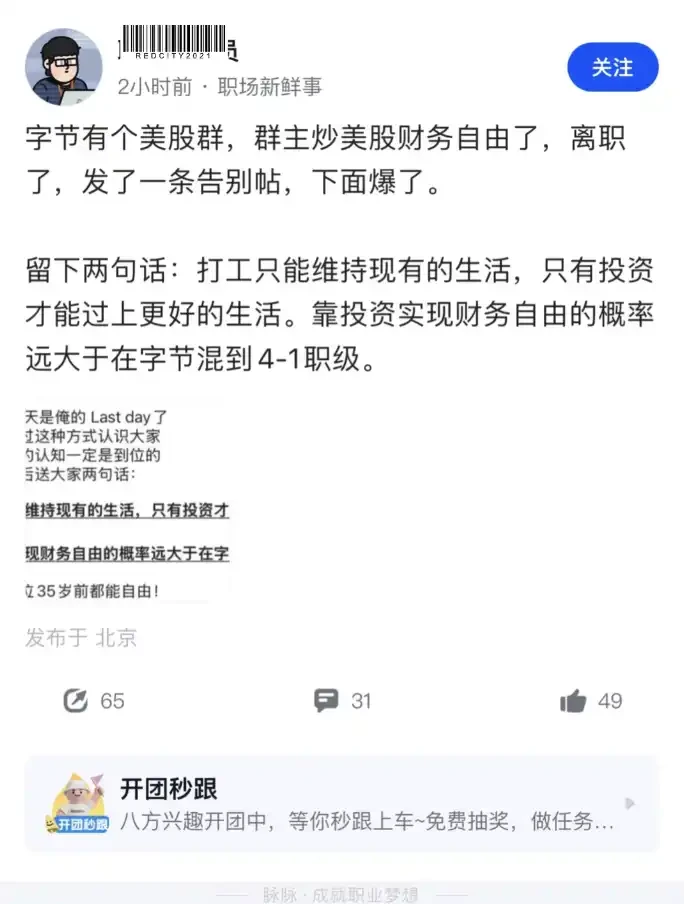
The story of financial freedom is always so inspiring.
It is said that friends at Byte couldn't take it anymore and took out loans on the spot to go all in on stocks.

The narrative of large companies in the past was quite simple. Join a high-growth company, receive high cash income, wait for options to appreciate, and rely on promotions and the company going public to achieve a wealth leap. Byte itself is one of the most successful examples of this narrative. Business Insider reported last year that Byte's employee buyback valued itself at about $330 billion, with Fidelity giving an even higher valuation; subsequently, secondary trading pushed Byte's implied valuation to about $480 billion. In other words, Byte employees from the start are exposed not just to "work," but to valuation, options, buybacks, liquidity, and asset re-evaluation.
So the stock trading guy didn't even want Byte's options. He looked down on them.
This is not the first urban legend about Byte.
Last year, there was a "Beijing speculator" ID also coming from Byte, known in the community as "Beijing God." The common narrative about him in stock market communities and various financial articles is that he entered the market in 2007, experienced the typical trial and error of ordinary retail investors early on, and later turned an 80,000 investment into a scale in the tens of millions. An article reposted by NetEase summarized his path as "80,000 turned into 50 million."
The current stock market is truly historic. Not just U.S. stocks, but globally. The daily trading volume of A-shares on the Shanghai and Shenzhen exchanges exceeding 3 trillion yuan has become the norm, something unimaginable in the last bull market. Korean stocks are even more explosive, with Koreans withdrawing their pensions and insurance money to go all in on Haili.
At the end of November 2022, ChatGPT was launched. From that moment, Wall Street has been waiting for the AI bubble to burst.
But three and a half years later, this round of the market has not only not ended but has instead accelerated in its expansion. Nvidia's market value rose from $500 billion at the beginning of 2023 to over $5 trillion, experiencing impacts from DeepSeek, U.S.-Iran conflicts, and inflation rebounds; after each dip, it was pushed to new heights by stronger earnings reports and larger capital expenditures. By 2025, AI-related stocks contributed about 80% of the annual gain of the S&P 500.
In the first half of 2026, the global stock market is still in a phase of fervent growth.
After all, the sentiment of this generation is: work is increasingly like a side job, while stock trading and investing are the main business.
免责声明:本文章仅代表作者个人观点,不代表本平台的立场和观点。本文章仅供信息分享,不构成对任何人的任何投资建议。用户与作者之间的任何争议,与本平台无关。如网页中刊载的文章或图片涉及侵权,请提供相关的权利证明和身份证明发送邮件到support@aicoin.com,本平台相关工作人员将会进行核查。


